Recipe: Gujarati Dal

IMG_5632[2]Dal or pulses is the staple of any Indian meal, more so, if its a vegetarian meal as this is the one which supplies the protein to the meal. So every community in India will have their own versions of dal. We also make some sort of dal almost every day, and one of my favourites is this sweet and sour dal from the state of Gujarat. This dal is quite simple to make and uses ingredients found in the pantry. For non-Indians reading this blog, the dal I used can be brought from any Indian store or any supermarket which sells grains.
IMG_5633[1]

Gujarati Dal

Ingredients:

  • 1 cup yellow moong dal, washed and soaked in water for 10 minutes
  • 2 tbsps raw peanuts, soaked in hot water for 10 minutes
  • 1 tomato
  • 1 green chilli, chopped finely
  • 1 inch piece of ginger, grated
  • 1 tsp grated jaggery (sugar or brown sugar can be a substitute)
  • 1-2 tsps lemon juice
  • 1/4 tsp turmeric powder
  • 1 tsp red chilli powder
  • Salt to taste
  • Water as required
  • Coriander leaves to garnish

To temper

  • 1 tbsp ghee
  • 1 tsp mustard seeds
  • 1 tsp cumin seeds
  • 1/4 tsp fenugreek (methi) seeds
  • 2 inch piece cinnamon stick
  • 3-4 cloves
  • 2-3 dried red chillies
  • A pinch of asafoetoda

Method:

  • In a pressure cooker, add the dal, tomato chopped into 4 large pieces and the turmeric powder and cook till it becomes mushy. This should take 3-4 whistles, but you can cook it on a stovetop also.
  • Once cool, open the cooker, remove the skin of the tomato and mash the dal well and add it to a large pan along with enough water to make it into a thin consistency. To this add the red chilli powder, chopped chilli and ginger and the peanuts (remove from the water first).
  • Add salt to taste and let it come to a nice rolling boil. Let it boil for around 10 minutes and then prepare the tempering.
  • In a small pan, heat the ghee and when warm add the tempering ingredients in the following order: mustard seeds, cumin seeds, fenugreek seeds, dried red chillies, cinnamon stick and cloves, stirring for a couple of seconds each time before adding the next ingredient.
  • Once the spice mixture has sizzled, add it to the dal.
  • Switch off the gas and add the lemon juice and check for salt. Garnish with coriander leaves and serve with rice and a vegetable of your choice.

Delicious Gujarati dal is ready!


IMG_5634[1]

Recipe: Mango Milkshake

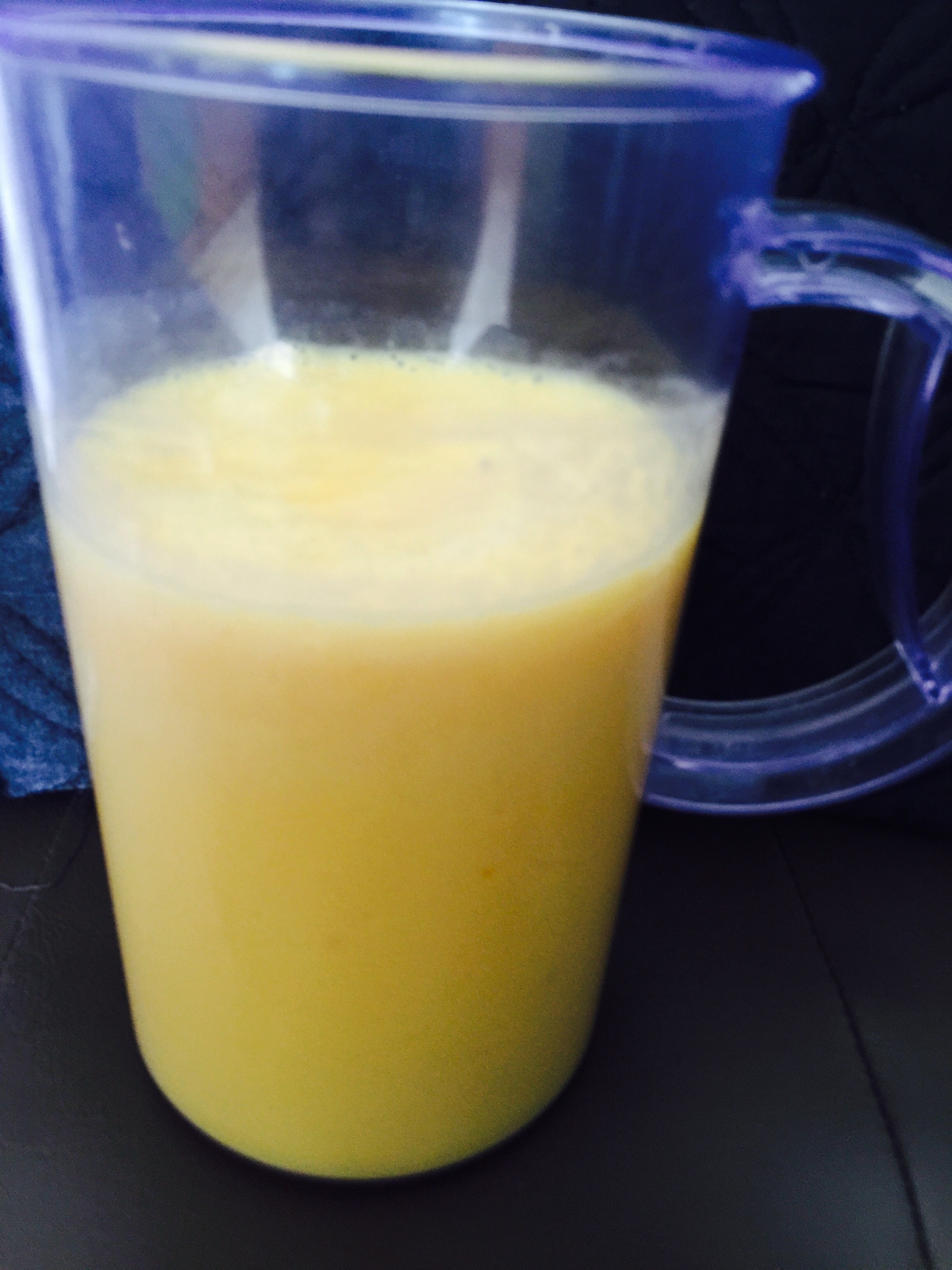
Summer, to me, is mango season! In Mumbai, right from around end April, you see, hear and smell the king of fruits – the Alphonso Mango. While I am not a big mango lover, everyone else in my family is and my childhood summer memories are filled with this fruit.

My paternal grandmother was a huge fan of the alphonso mango or hapus as it is called in Marathi (the state language of Mumbai, where I grew up). My paternal grandparents moved to Bangalore when I was quite young, initially to help out my uncle (my dad’s brother) who had moved there for work. Then, after he married, they stayed on, because they loved the gentler pace of life that Bangalore had then as well as the cooler climate. But my ammama (my grandma) missed some parts of Mumbai, a city she came as a young bride and had stayed for more than 30 years before moving to Bangalore.

So every summer, during our holidays, we’d make our annual trip to Bangalore. Along with clothes and other assorted items, we’d take a huge ass carton of the best alphonso mangoes we could get. We even had our own mango seller, who, every summer would bring us a nicely packed carton of mangoes, all chosen to ripen at exactly the right time, which would be just after we reach ed Bangalore. And once we reached our home there, my grandma would gorge on this delicacy.

Mangoes are heaty, and so the rule in my home was to drink a glass of milk after each mango session. Some mangoes used to be made into pulp to be drank with milk, especially if the mangoes were ripening and would go bad. Last week at the baby naming ceremony we were given a couple of mangoes and so I decided to make them into milkshakes for BB & GG for them to drink as their after school drink. The mangoes we got were not top quality ones (not alphonso), hence not as sweet and so I had to use sugar, but if you have sweet mangoes, please omit sugar completely. This is perfect for summer, especially if you refrigerate it before serving.

Mango Milkshake

Ingredients:

  • 2 mangoes, peeled and chopped
  • Sugar, as required
  • 5-6 pieces of cashewnuts
  • A pinch of saffron
  • 2.5 cups skim milk

Method:

  • In a small bowl, heat up a couple of tablespoons of milk till warm and add the cashewnuts and saffron to it and keep aside for 10 minutes.
  • In a blender or mixer, add the chopped mangoes, sugar (if using), milk and the cashewnut-saffron mixture and blend until it forms a smooth paste. Add the skim milk to help it form the paste.
  • Add the rest of the milk and chill in the fridge for a while before serving.
  • Enjoy delicious, chilled mango milkshake!

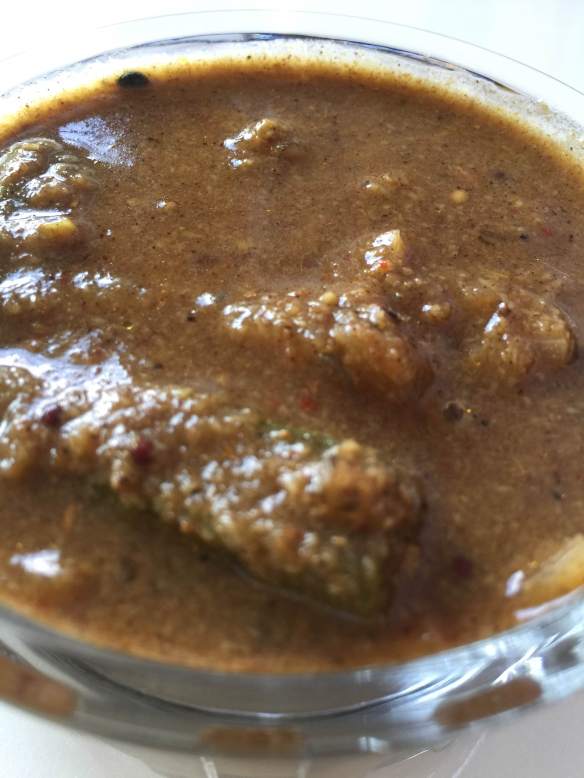
Recipe: Vendakkai Puli Kozambu aka Okra Tamarind Stew

IMG_5617

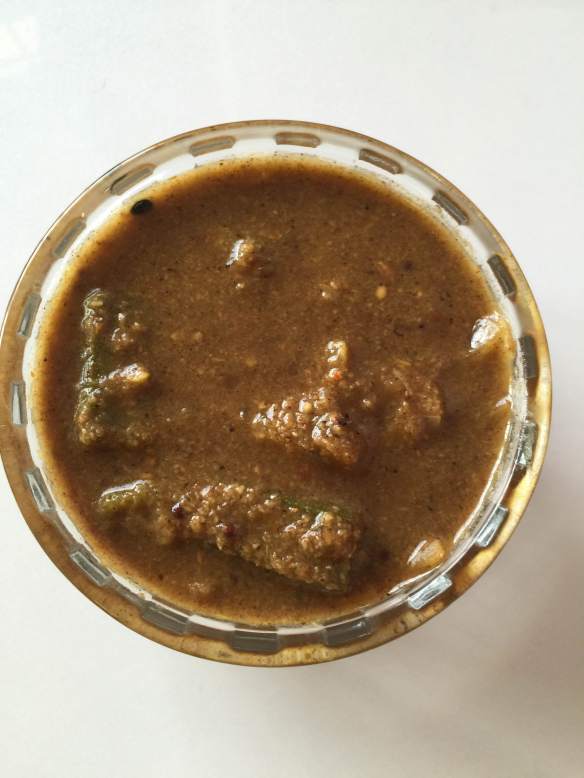
A typical recipe from the Tamil heartlands, this is a hearty, though slightly spicy and sour stew which goes very well with rice. This is not a typical tambram recipe. It’s quite funny that while I love garlic and love it in most north Indian sabzis, for some reason, probably due to my tambram genes, I can’t stand it in typical south Indian food. While the original recipe calls for whole garlic pods in the kozambu or stew, I ground it along with the other spices. I served it with brown rice and a stir fried vegetable and loved it. Here’s the recipe which I tweaked!

Vendakkai Puli Kozambu aka Okra Tamarind Stew

IMG_5615

Ingredients:

  • 1 lime-sized ball of tamarind, soaked in warm water for 15-20 minutes, then squeezed to get the water, which will be used. Alternatively, use 1-2 tsp of tamarind paste which can be brought in any Indian store.
  • 1 cup ladies finger or okra, cut into 1 inch circles
  • 1 onion, chopped
  • 2 tbsps gingelly oil
  • 1 tsp mustard seeds
  • Salt to taste

To be ground into a paste:

  • 8-10 garlic cloves
  • 1 onion, chopped
  • 1 tomato, chopped
  • 2 tsp coriander seeds
  • 1 tsp fennel seeds
  • 1/2 tsp fenugreek seeds
  • 5-6 dried red chillies
  • 1/4 cup coconut
  • 2 tsps oil

Method:

  • In a pan, take the oil (not the gingelly oil) and fry in the following order the spices: coriander seeds, fennel seeds, fenugreek seeds and dried chilli. Stir each spice for a few seconds before adding the next spice.
  • Next add the garlic and let it become slightly golden, then the onions and let it become translucent and last the tomatoes.
  • Add a tsp of salt to help the tomatoes to lose water and become slight mushy. In the end, add the coconut and let it cook a while. Once it has cooked around five minutes, switch off the gas and let it cool completely. Once cool, blend it to a fine paste.
  • In another pan, add the gingelly oil and fry the ladies finger/okra until it cooks and becomes crisp. Remove from the gas and keep aside.
  • In the same pan, with the balance oil, add the mustard seeds and then chopped onions.
  • When the onions become translucent, put in the blended paste and stir for a few seconds. Now add the tamarind juice and let it come to a boil.
  • Add the crisp ladies finger/okra and salt to taste and let the stew boil  for 10 minutes.
  • The stew is done when the oil floats to the top.
  • Enjoy with rice and a vegetable of your choice!

IMG_5616


Recipe: Aloo Matar Paneer aka Potatoes, Peas and Paneer

IMG_5612

BB loves Paneer and will ask for it to be added to any and all vegetables at any given chance. On Saturday, when we had to go to to the hospital so GG & BB could meet their new cousin, I wanted to make dinner at home before we left, so that once we’re back, we can eat. The most obvious choice would be roti and a sabzi. I made a traditional Punjabi dish, but with a twist that R suggested which really took it up a notch. Try it, especially with the addition of this totally unexpected ingredient!

Aloo Matar Paneer

IMG_5611

Ingredients:

  • 2 potatoes, peeled and diced into small pieces
  • 1 cup frozen peas
  • 1 cup frozen paneer, thawed in hot water for 10-15 minutes

For the gravy

  • 2 onions, roughly chopped
  • 2 tomatoes, roughly chopped
  • 1 inch piece of ginger
  • 5-6 cloves of garlic
  • 1 tsp cumin seeds
  • 1 tsp coriander seeds
  • 1 tsp fennel seeds
  • 1/2 tsp carom seeds (ajwain)
  • 4-5 dried red chillies (or fresh if you have them)
  • 1/4 tsp turmeric powder
  • Salt to taste
  • 1 tsp Garam masala powder
  • 1-2 tsps Kasuri Methi
  • A handful  of chopped spinach leaves, washed well to remove any residue dirt
  • 2 tbsps oil

Method:

  •  Chop the potatoes, and put the paneer in a bowl of hot water to thaw and soften.
  • Once the paneer is soft, cut them into smaller pieces.
  • In a pan, heat up 1 tbsp oil and once the oil is warmed, add the cumin seeds, coriander seeds, fennel seeds and carom seeds in that order. Let each pop for a few seconds before adding the next one in.
  • Then add in the garlic and ginger, stirring a few minutes each time.
  • Once the garlic is slightly brown, add the onions and stir, letting it become translucent.
  • Next add the washed spinach and let it wilt.
  • Add the tomatoes next and a pinch of salt to help cook. The tomatoes need to break down completely and become mushy. At this point switch off the gas, let this cool and once cool, blend it to a smooth paste.
  • In the same pan, add the balance oil and once warm, put the potatoes in to cook. Add the turmeric powder here and let it coat the potatoes. Cover and add a few drops of water to help it cook. When it is halfway cooked, add the peas and let it cook.
  • When the potatoes and peas are three quarters cooked, add the blended paste and some water to bring it to the consistency you like.
  • Once the whole mixture is bubbling away, add the paneer pieces to this.
  • Check for salt and add the garam masala and if you want, add a tsp or two of ghee, this really makes the dish look as if you’ve cooked the whole thing in ghee!
  • Once the gravy has attained the consistency you want, switch off the gas and enjoy hot and tasty Aloo Matar Paneer.

IMG_5610

Recipes: Roasted Vegetables, Indian Style

IMG_5583

Usually, Sundays, which is R’s weekly off is the one day in the week when I can cook what I want. Usually the Sunday lunch is some variation of an Indian meal – a rice or roti dish with a gravy dish and some salad or raita to accompany it.

This weekend, I was bored of cooking the same old food, week after week and so decided to do something different. I decided to pair a soup with some roasted vegetables and then to kick it up a notch, I decided to make it with an Indian twist. So here’s some roasted vegetables, cooked in Indian style and with Indian spices!

Roasted Vegetables, Indian Style

IMG_5584

Ingredients:

  • 1 head cauliflower, cut into florets
  • 1 capsicum (any colour) chopped into large pieces
  • 20 baby potatoes, chopped into half or quarters (depending on size)
  • 2 large sweet potatoes, chopped into large pieces
  • 2-3 carrots, chopped into large pieces
  • 2 onions, chopped into large pieces
  • 2-3 tbsps Oil

Spice Mixture

  • 1 tsp red chilli powder
  • ¼ tsp turmeric powder
  • 2 tsps cumin seed powder
  • 1 tsp coriander seed powder
  • 2 tsps dried methi (kasoori methi)
  • 2 tsps dried mint powder
  • 2 tsp chats chat masala
  • Salt to taste

Method:

  • Preheat the oven to 200 degrees Celcius (392 degree Farenheit)
  • Mix the spices into a powder and keep aside.
  • Chop all the vegetables into bite-sized pieces, wash, dry and put into a large utensil which should be large enough to mix well.
  • Pour enough of the spice mixture and oil and mix the spices into the chopped vegetables, ensuring that every piece is coated with the spice and oil mixture.
  • Line a large baking tray with aluminium foil and pour the coated vegetables into it. Make sure the vegetables are even in the tray.
  • When the oven is heated, bake the vegetables for approximately between 40 – 60 minutes, depending on how crisp you want it or how much the quantity is. I found a full shallow tray of root vegetables needed 60 minutes while other vegetables were done in less than 40 minutes.
  • Let it cool and enjoy!

IMG_5585

I paired this with my carrot, coriander and pumpkin soup and it was a hit! We had this for both meals and nobody missed having rice or rotis with this meal!