Recipe: White Pumpkin Rasavangi

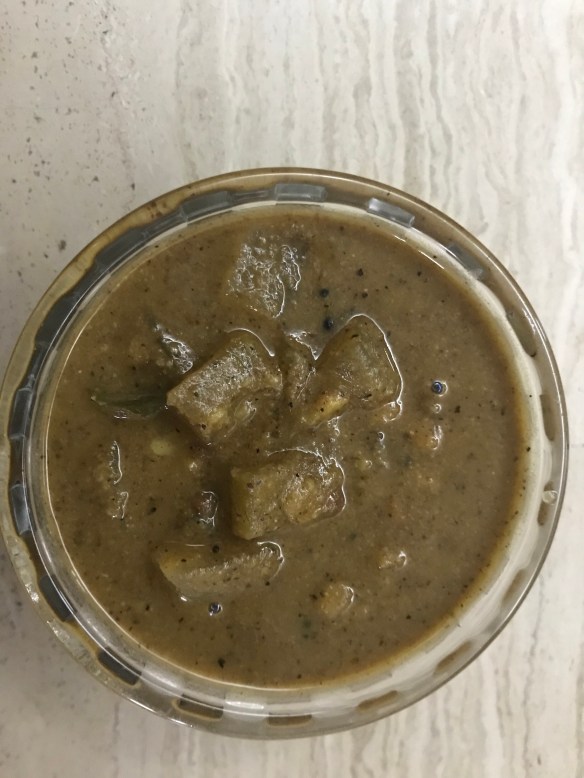
The word Rasavangi is very evocative and exotic, isn’t it? In Marathi (or rather the Bambaiya Hindi which is spoken in Mumbai), Vangi means Brinjal or Aubergine. And Rasa in most Indian languages brings to mind a gravy. So I always thought Rasavangi is brinjal cooked in gravy. It was only recently I learnt that it is, in fact, a South Indian term and most probably used by the Brahmins. All this time, I used to call this dish a Pumpkin Sambhar. Anyway, here’s the Rasavangi I made recently.
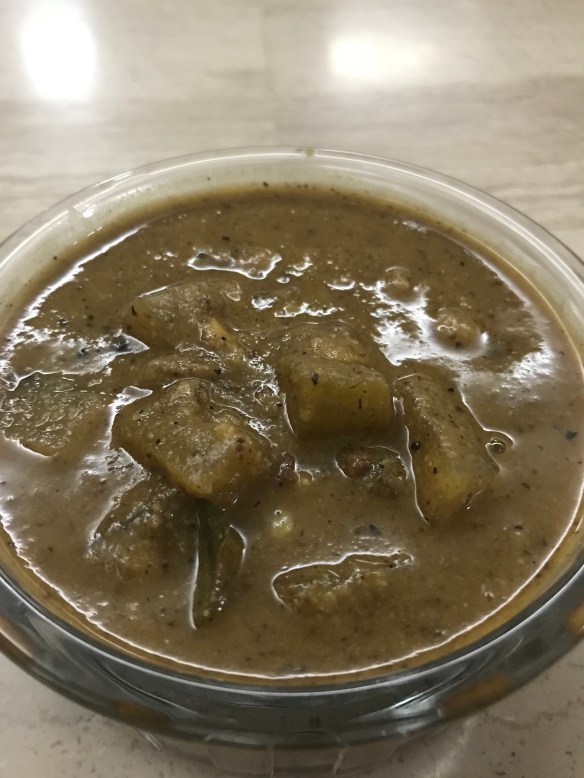
White Pumpkin Rasavangi

Ingredients:

  • 1 large white pumpkin, peeled and chopped into small pieces after discarding the seeds and fibre
  • 1 lemons sized ball of tamarind, soaked in hot water for 20-30 minutes, then squeezed so the fibres are removed and the tamarind water separated
  • 1 tsp turmeric powder
  • 1/2 cup toor dal
  • 2-3 tbsp chana dal

To be ground into a paste:

  • 1/2 cup grated coconut
  • 6-8 dried red chillies
  • 2 tbsp coriander seeds
  • 1 tbsp chana dal
  • 2 tbsp oil

To Temper:

  • 1 tbsp oil
  • 1 tsp mustard seeds
  • 1 tsp broken urad dal
  • 5-6 curry leaves

Method:

  • Cook the toor and chana dal until they lose their shape. Whisk them well till it becomes a homogeneous mixture. Keep aside
  • In a pan, take 2 tbsp oil and when the oil warms, add the dried red chillies, coriander seeds and chana dal and stir until they start becoming red. Then add the coconut and keep stirring till the coconut becomes reddish brown and loses all moisture and becomes completely dry. Keep aside to cool.
  • When cool, blend to a fine powder. If your blender can’t do this, you can also add water and blend it to a fine paste.
  • In the same pan, put the chopped pumpkin and turmeric powder with just enough water to cover the bottom of the pan and ensure it does not burn. You can also add a bit of salt here so the pumpkin is not bland.
  • Cook the pumpkin till it becomes tender. At this point add the tamarind water and boil until the raw smell of the tamarind goes away.
  • Now add the cooked dals and the ground paste and check for seasoning. When the Rasavangi starts to boil again, remove from the flame.
  • Take a smaller skillet and pour in the remaining 1 tbsp oil. When the oil heats up, add the mustard seeds and let it splutter. Then add the urad dal and let it brown slightly. Add the curry leaves and switch off the flame. Pour this seasoning over the Rasavangi.
  • Serve hot as a gravy with rice or even as an accompaniment to a traditional South Indian meal. If serving as an accompaniment, make it thicker than usual. This can also be eaten with Indian flatbreads.

 

Recipe: Sindhi Kadhi

sindhi-kadhi-2

Growing up in Mumbai, my closest neighbours were people who had fled Sindh in Pakistan after the partition and came to India as refugees. They were a joint family of four brothers and their families and the children in that family and me and my sister grew up together. Our front doors faced each other and growing up, the doors were only closed in the afternoons and at night. We were in and out of each other’s homes all the time and so food became one of the things we shared. Avial, sambhar, Idli, Dosai etc were favourites from our home to theirs and Samosas, Koki (a type of parathas), Sai Bhaji etc were our favourites from their home. I learnt to make many dishes from the aunties in that home and my mum learnt to make Sindhi Kadhi, which is a gravy dish from them too.

Over the Chinese New Year weekend, when I was wondering what to make for a sudden lunch invite to S’ uncle and aunt, I decided to make this version of Sindhi Kadhi. I didn’t exactly remember how my mum made it, so I turned online to source for a recipe. I used this recipe from Sanjeev Kapoor as my guide but played with it a bit. The main ingredient, as I remember used to be okra or ladies finger, but since I didn’t have that, I omitted it and added other vegetables.

sindhi-kadhi-1

Sindhi Kadhi

Ingredients:

  • 4 tsp gram flour or besan
  • 1 drumstick
  • 2 potatoes
  • 2 carrots
  • 7-8 beans
  • 1/2 tsp asafoetida
  • 1/2 tsp fenugreek seeds or methi
  • 1/2 tsp cumin seeds
  • 6-8 curry leaves
  • 3 tbsps oil
  • 2 tomatoes
  • 1/4 tsp turmeric
  • 1/2 tsp red chilli powder
  • 1 lemon sized ball of tamarind or 2 tbsp tamarind pulp
  • Salt to taste

Method:

  • In a large bowl, add the tamarind and pour hot water into it. Leave it for 20-30 mins and when cool to touch, squeeze the pulp and remove it. Strain the tamarind water and keep aside.
  • Chop all the vegetables into largish cubes and cut the drumstick into around 1.5-inch sticks.
  • Heat 2 tsp oil in a pan and stir fry the vegetables for a few minutes and aside.
  • In the same pan, heat the remaining oil and add the asafoetida, mustard seeds, fenugreek seeds, cumin seeds and curry leaves to the pan and sauté until fragrant.
  • Then add the gram flour and sauté until fragrant. Do not allow the gram flour to burn. When you smell a nice aroma from the gram flour, add around 1.5 cups of water and whisk well until the mixture is very smooth.
  • The mixture will thicken very quickly so you can add another cup of water to thin it. Add the sautéed vegetables.
  • In a hand food processor, crush the tomatoes or grate or chop them into very fine bits. Add this to the gravy which should be bubbling away by now. Add turmeric powder, red chilli powder and salt and mix well.
  • When the vegetables are almost cooked, add the tamarind juice or pulp and let them blend well. If the gravy is too thick, you can thin it with some water.
  • Check for seasoning and add what is missing and serve hot with rice.
  • I served this with my Caramelised Onion Pulao and a raita

sindhi-kadhi-1


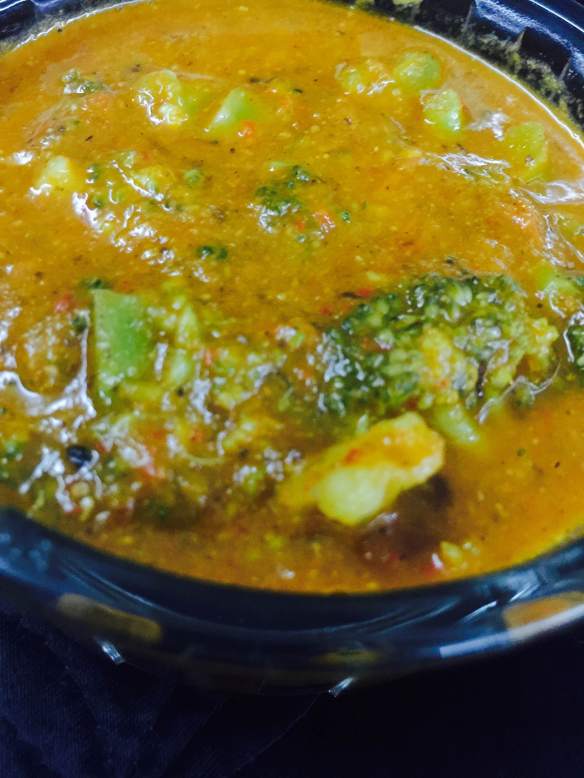
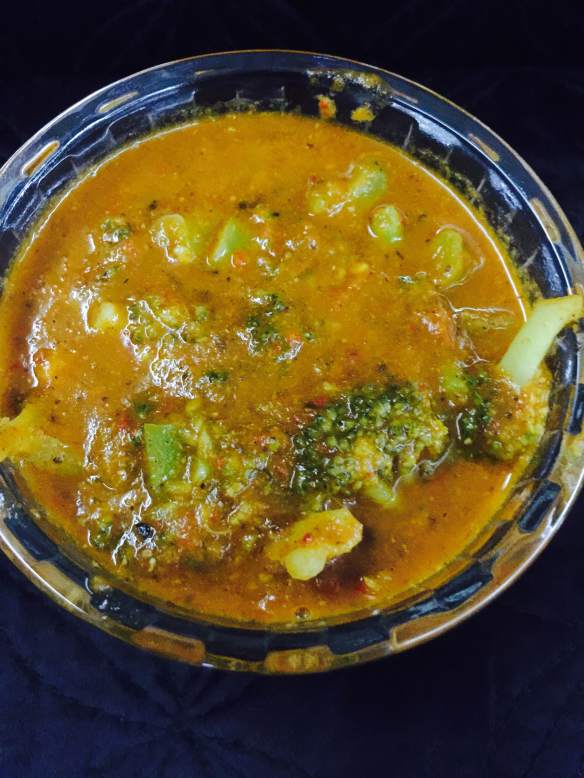
Recipe: No Onion, No Garlic Broccoli in Red Pepper Gravy

img_6138

During the 10/11 days of Navratri, I do not eat food which has onions and/or garlic added to it. So this means, we’re usually cooking traditional south Indian Brahmin food, which does not incorporate these two vegetables. After a few days of cooking traditional dishes, I was bored and so decided to make something north Indian, but to make these gravy-based vegetables without onions and garlic is a challenge. I also had two heads of broccoli which were going to spoil soon so I experimented with this dish which tried to replace garlic and onions with asafoetida and cashew nuts and sesame seeds. It was a hit and even though I made enough for the whole day, we only ate for a single meal and I had to make something else for dinner!

img_6139

No Onion, No Garlic Broccoli in Red Capsicum Gravy

Ingredients:

  • 2 heads broccoli, cut into florets, washed and kept aside
  • 2 tsp cumin seeds
  • 1 tsp coriander seeds
  • 1 tsp fennel seeds
  • 1 tsp carom seeds/ajwain
  • 4-5 cashew nuts
  • 1 tsp white sesame seeds
  • 2 tsp red chilli powder
  • ½ tsp turmeric powder
  • ¼ tsp asafoetida
  • 1 tsp garam masala powder or sabzi masala powder
  • Salt to taste
  • 4 tomatoes, chopped roughly
  • 1 red bell pepper, chopped
  • 2 tbsps oil
  • Coriander leaves to garnish

Method:

  • Heat 1 tbsp oil in a pan and add 1 tsp cumin seeds.
  • When it splutters, add the coriander seeds, fennel seeds, carom seeds and cashew nuts.
  • Let the cashew nuts brown and then add the red bell peppers and the tomatoes.
  • When the tomatoes start to dissolve, switch off the gas and add the sesame seeds.
  • Let it cool completely and when cool, blend it into a fine paste.
  • In another clean pan, heat the remaining oil and add the balance cumin seeds.
  • When it splutters, add the asafoetida and turmeric and stir for a couple of seconds.
  • Now add the washed broccoli heads and stir-fry for a few minutes till the broccoli gets coated with the spices.
  • When the broccoli is half cooked, add the blended paste and season it with salt, red chilli powder and garam masala powder or sabzi masala.
  • Add water if the gravy is very thick and dry and bring it to the consistency you want.
  • Cook this gravy and the broccoli for a few minutes. Do not overcook the broccoli and keep it slightly al-dente.
  • Garnish with coriander leaves and serve hot with any rice or flat bread.

img_6140

Arachavitta Sambhar

This is a very traditional South Indian recipe. Archavitta literally means with ground spices. This sambhar is different from the usual one we make on a regular basis in that there is no sambhar powder used.

I have wanted to make this for a few weeks now. The last time I tried making it, I found I didn’t have coconut at home and so had to postpone making it. I finally made it with the basic recipe from my bible of tam bram cooking – Cook and See by S. Meenakshi Ammal. I used the recipe from Book 1 of Cook and See and tweaked it a bit using advice given to me by my mother and mother-in-law.

Arachivitta Sambhar

Ingredients:

  • ½ cup red gram dal (toor dal)
  • 1 small lime sized ball of tamarind, soaked in water and the pulp squeezed out
  • 1 cup shallots
  • 1-2 carrots, peeled and cut into big pieces
  • ½ a yellow pumpkin, peeled and cut into big cubes
  • 4-5 potatoes, cut into largish cubes
  • 2-3 tsps oil
  • 1 tsp mustard seeds
  • Salt to taste
  • Coriander leaves to garnish

To be ground into a paste:

  • 6-8 dried red chillies
  • 2 tsps coriander seeds
  • 1 tsp Bengal gram seeds (chana dal)
  • 1 tsp fenugreek seeds
  • 4-5 shallots
  • ½ cup fresh, grated coconut

Method:

In a small pressure cooker, pressure cook the toor dal with a pinch of turmeric powder till it is soft and the dal has broken down. This usually will take around 3 whistles in the cooker.

Heat 1 tsp of oil in a pan and one by one add the ingredients to be gound into a paste and roast them till the coconut is golden and the water in it evaporates. Transfer to a mixer and when cool, grind it to a fine paste using a bit of water. Keep aside.

In the same pan, heat the remaining oil and add the mustard seeds. When they pop, put in the shallot and stir for a few minutes. Then add the potatoes, carrots and pumpkin and fry for a few minutes.

Now add the gound paste and stir into the vegetables. Once it is all mixed in, pour in the tamarind water and add salt to taste.

Let this boil for around ten minutes. Check to see if the vegetables are cooked. When the vegetables and shallots reached the almost cooked stage, add the cooked dal.

Let it boil well, check for seasoning and switch off the gas. Garnish with coriander leaves and serve hot with white rice.

Chow Chow (aka Chayote) Kootu

A kootu is another traditional South Indian food item. Kootus are generally vegetables mixed with a lentil or dal (usually moong, but can be others also) with a coconut/chilli gravy all mixed together. This is another example of Indian meals being complete meals as this kootu will have proteins from the lentils, plus fibre from the vegetables. This is usually eaten with a carbohydrate like rice or roti and you have all the important parts of a meal together.

Today’s recipe is Chayote or Chow Chow Kootu

Chayote is an edible plant belonging to the gourd family, being roughly pear-shaped and light green in colour. The skin is not used in Indian cooking and the flesh has a bland taste. This means it takes on any flavouring that is added to it. The seeds are generally not used in cooking.

Chow Chow Kootu

Ingredients:

  • 3 Chayotes (peeled, seeds removed and diced)
  • ½ cup Moong Dal
  • 3 tbsps Channa Dal
  • ½ tsp turmeric powder
  • salt to taste
  • ½ cup freshly grated cocounut (you can use frozen coconut if you don’t have access to fresh coconut. I have used frozen coconut in this recipe)
  • 4-5 fresh green chillies (this is what I used, but please adjust according to the intensity of the chillies and your spice tolerance level)
  • ½ tsp cumin seeds
  • ¼ tsp mustard seeds
  • 1 tsp oil
  • ¼ tsp urad dal
  • A small sprig of curry leaves
  • A pinch of asafetida

Method:

In a pressure cooker, cook the moong dal and 2 tbsps of the chana dal with ¼ tsp of turmeric powder. While the dals are cooking, peel the chow chow, remove the seeds and chop into small, bite-sized cubes. Cook the chow chow in a pan with very little water, ¼ tsp of turmeric powder and some salt.

In a mixer, add the coconut, cumin seeds and chillies and grind it to a fine paste without adding too much water. Some people prefer to add yoghurt here, but I don’t, preferiing to add water to provide the moisture to grind it.

Once the Chayote is cooked but firm, add the dal to it along with the coconut mixture. Adjust the salt and let it boil for a while, around 5-7 minutes. Then turn off the gas and start the tempering to finish the dish.

In a smaller skillet, pour 1 tsp oil oil and wait for it to heat up. Once heated up, put the mustard seeds and wait for it to pop. Once it pops, add the urad dal, curry leaves and asafetida and lightly stir. When the urad dal starts to brown remove from flame and add it to the kootu. Mix well and serve with rice or rotis.