Festivals of India – Jallikattu

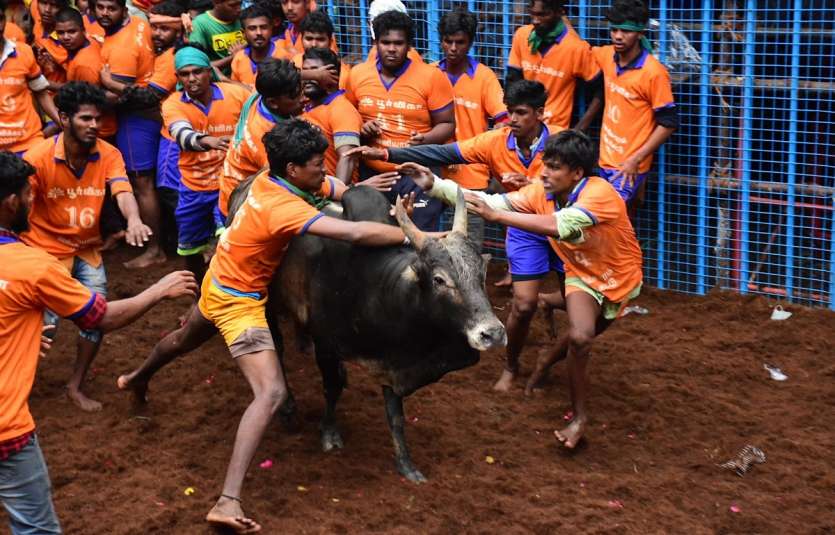
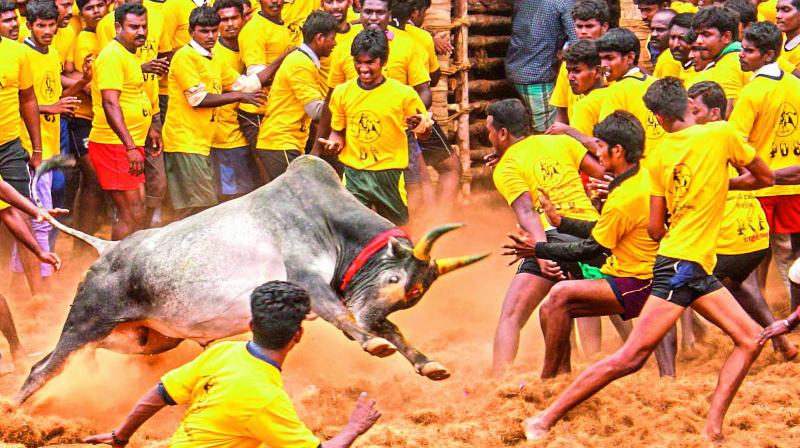
Jallikattu, also known as Eru Thazhuvuthal and Mañcuvirattu, is a traditional event during the Pongal festival in which a bull, of the Pulikulam or Kangayam breeds, is released into a crowd of people, and multiple human participants attempt to grab the large hump on the bull’s back with both arms and hang on to it while the bull attempts to escape. Participants hold the hump for as long as possible, attempting to bring the bull to a stop. In some cases, participants must ride long enough to remove flags on the bull’s horns. Jallikattu is typically practised in the Indian state of Tamil Nadu as a part of Pongal celebrations on Mattu Pongal day, which occurs annually in January. The most popular Jallikattu is the one celebrated at Alanganallur near Madurai.

Ancient Tamil Sangams described the practice as yeru thazhuvuthal or bull embracing. The modern term jallikattu or sallikattu is derived from salli or coins and kattu or package, which refers to a prize of coins that are tied to the bull’s horns and that participants attempt to retrieve. Mancu virattu means bull chasing.
Jallikattu has been known to be practised during the Tamil classical period between 400 and 100 BC. It was common among the Ayar people who lived in the Mullai geographical division of the ancient Tamizh Nadu. Later, it became a platform for the display of bravery, and the prize money was introduced for participation encouragement. A seal from the Indus Valley civilization depicting the practice is preserved in the National Museum in New Delhi. A cave painting in white kaolin discovered near Madurai depicting a lone man trying to control a bull is estimated to be about 1,500 years old.

The popular myth revolving around this festival is about how Lord Shiva asked Basava, his bull, to convey two messages. This bull twisted the words of the messages and expressed them in another way. It is said that the bull was asked to tell the human beings on earth to take an oil bath every day and that food must be consumed only once a month for six months. Instead of this message, the bull conveyed that food must be consumed daily and oil baths must be taken only once a month. This debacle made Lord Shiva angry and he cursed the bull to aid humans in cultivating their land for all eternity.

Some variants of Jallikattu include the Vadi Manjuviratttu, the most common category of Jallikattu. Here, the bull is released from a closed space or Vadi vasal and the contestants attempt to wrap their arms or hands around the hump of the bull and hold on to it to win the award. Only one person is allowed to attempt at a time. This variant is most common in the districts of Madurai, Theni, Thanjavur, and Salem. In Veli Virattu, the approach is slightly different as the bull is directly released into open ground. The rules are the same as that of Vadi Majuvirattu and this is a popular variant in the districts of Sivagangai and Madurai. In the Vatam Manjuvirattu, the bull is tied with a 15 m rope where a vatam means a circle in Tamil. There are no other physical restrictions for the bull and hence it can move freely anywhere. The maximum time given is 30 minutes and a team of seven to nine members can attempt to untie the gift token that is tied to the bull’s horn.

Bulls enter the competition area through a gate called the vadi vasal. Typically, participants must only hold onto the bull’s hump. In some variations, they are disqualified if they hold onto the bull’s neck, horns or tail. There may be several goals to the game depending on the region. In some versions, contestants must either hold the bull’s hump for 30 seconds or 15 m. If the contestant is thrown by the bull or falls, they lose. Some variations only allow for one contestant. If two people grab the hump, then neither person wins. Bulls for Jallikatu are bred specifically and bulls that participate successfully in jallikattu are used as studs for breeding and also fetch higher prices in the markets.

With the introduction of the Regulation of Jallikattu Act, 2009, by the Tamil Nadu legislature, before the event, a written permission is obtained from the respective collectors, thirty days before the event along with the notification of the event location. The arena and the way through which the bulls pass are double-barricaded, to avoid injuries to spectators and bystanders who may be permitted to remain within the barricades. The gallery areas are built up along the double barricades and necessary permissions are obtained from the collector for the participants and the bulls fifteen days prior. Final preparations before the event includes complete testing by the authorities of the Animal Husbandry Department, to ensure that performance-enhancement drugs, liquor or other irritants are not used on the bulls.
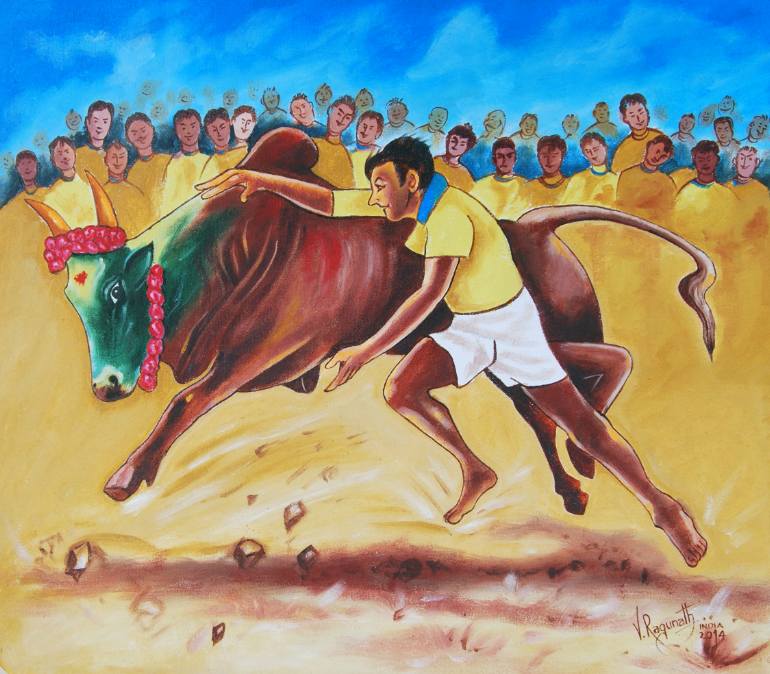
Incidents of injury and death associated with the sport, both to participants and animals forced into it, animal rights organisations have called for a ban on the sport, resulting in the court banning it several times over the past years. However, with protests from the people against the ban, a new ordinance was made in 2017 to continue the sport.

Between 2008 and 2020, more than 70 people died and about 10 4 bulls were killed in Jallikattu events. Animal welfare concerns are related to the handling of the bulls before they are released and also during competitors’ attempts to subdue the bull. Practices, before the bull is released, include prodding the bull with sharp sticks or scythes, extreme bending of the tail which can fracture the vertebrae, and biting the bull’s tail. There are also reports of the bulls being forced to drink alcohol to disorient them, or chilli peppers being rubbed in their eyes to aggravate the bull. During attempts to subdue the bull, they are stabbed by various implements such as knives or sticks, punched, jumped on and dragged to the ground. In variants in which the bull is not enclosed, they may run into traffic or other dangerous places, sometimes resulting in broken bones or death. Protestors claim that Jallikattu is promoted as bull taming, however, others suggest it exploits the bull’s natural nervousness by deliberately placing them in a terrifying situation in which they are forced to run away from the competitors which they perceive as predators and the practice effectively involves catching a terrified animal. Along with human injuries and fatalities, bulls themselves sometimes sustain injuries or die, which people may interpret as a bad omen for the village.
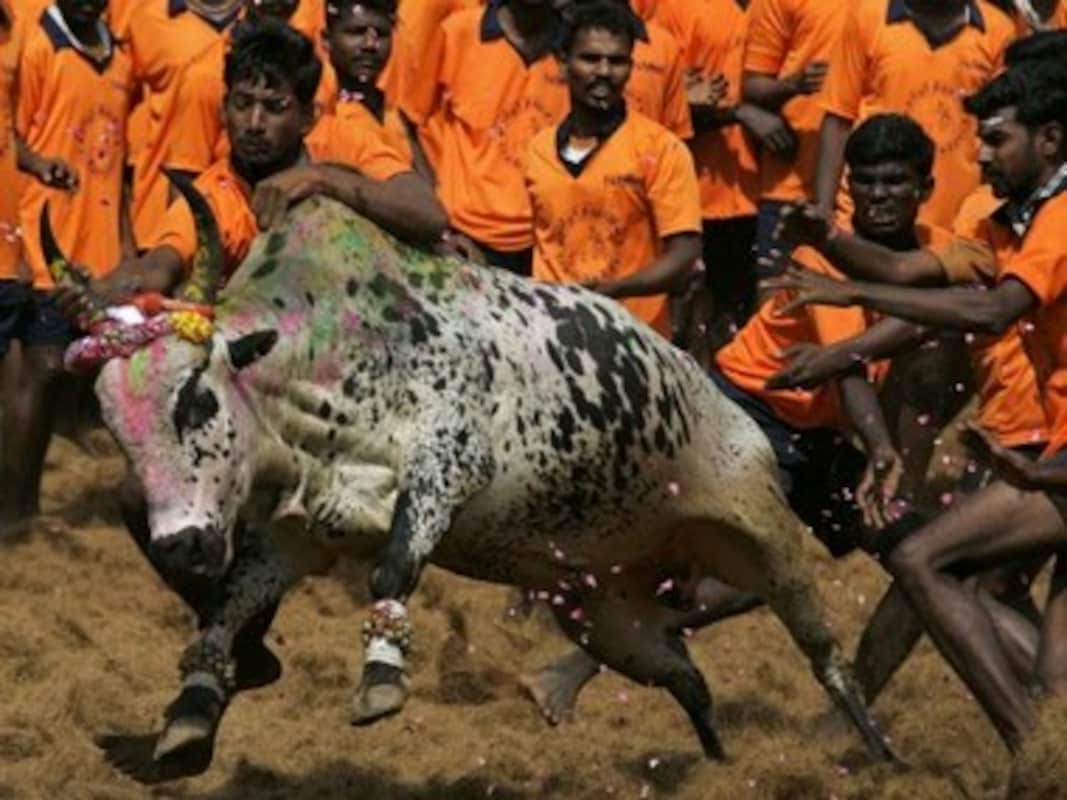
Animal welfare organisations such as the Federation of Indian Animal Protection Organisations or FIAPO and PETA India have protested against the practice. The former Indian Minister of Women and Child Development, Maneka Gandhi denied the claim by Jallikattu aficionados that the sport is only to demonstrate the Tamil love for the bull, citing that the Tirukkural does not sanction cruelty to animals.

The Jallikattu Premier League is a professional league in Tamil Nadu for Jallikattu. The league was announced on 24 February 2018, to be organised in Chennai by the Tamil Nadu Jallikattu Peravai and the Chennai Jallikattu Amaippu. Kabaddi is usually played as a warm-up sport before the players enter the arena for Jallikattu.
Festivals of India: Makar Sankranti

A harvest festival celebrated across India and the subcontinent, Makar Sankranti, Uttarayan, Maghi, or just Sankranti, which is celebrated today is also known as Poush Sankranti in Bangladesh or Tirmoori in Pakistan, is a harvest festival day, dedicated to the Sun God Lord Surya. It is observed each year the day the Sun enters the zodiac sign Capricorn, which corresponds to January as per the Gregorian calendar and marks the first day of the sun’s transit into the Makara Rashi or Capricorn.

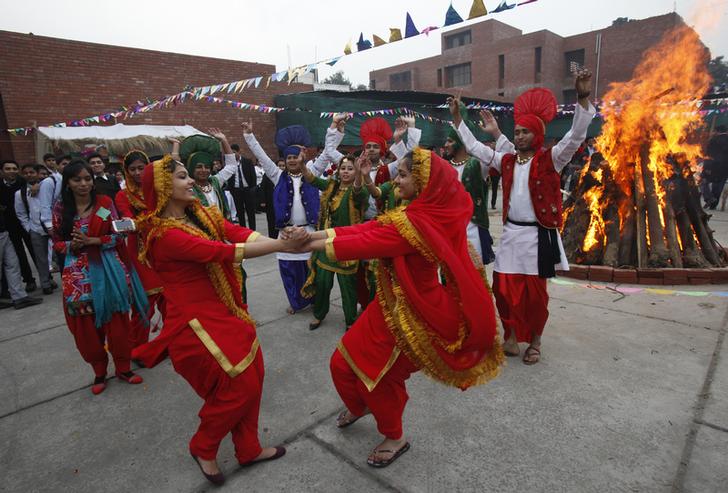
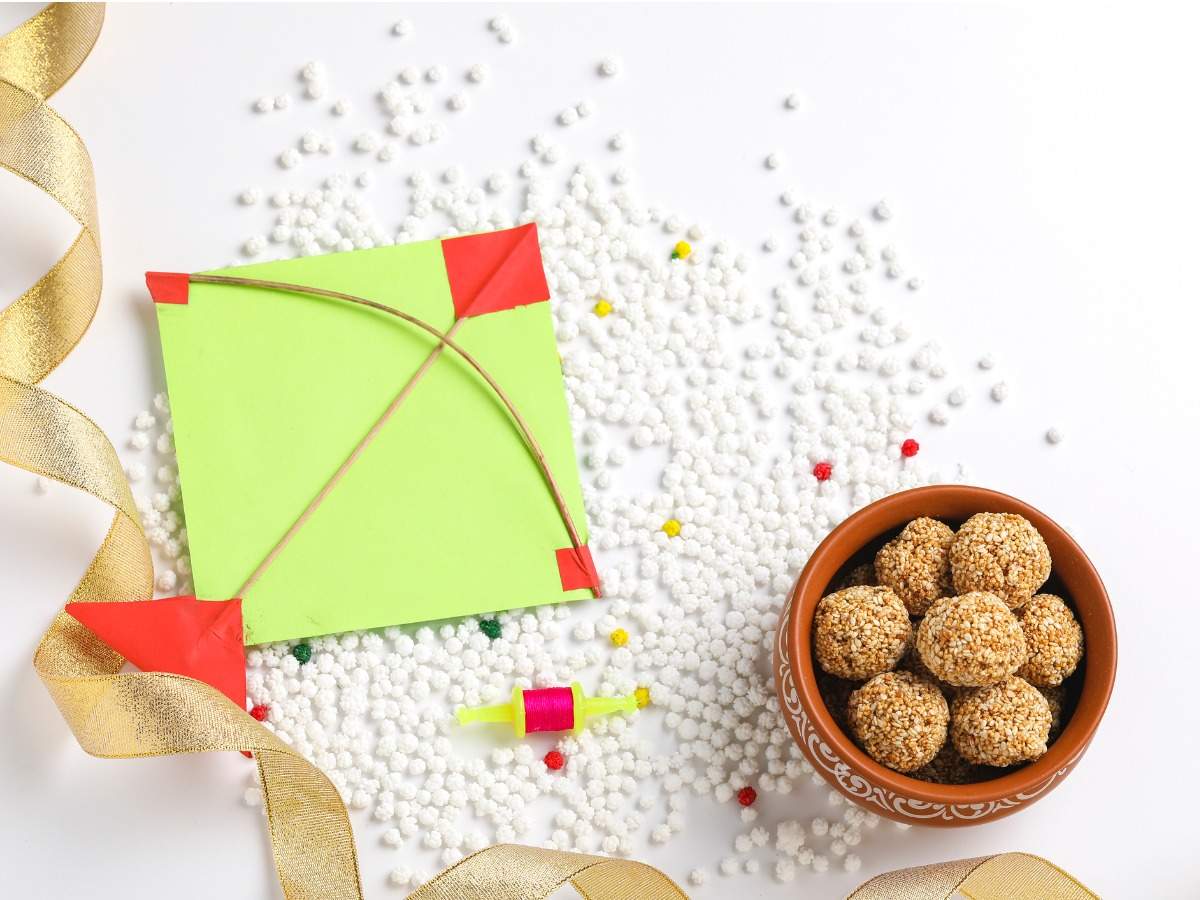
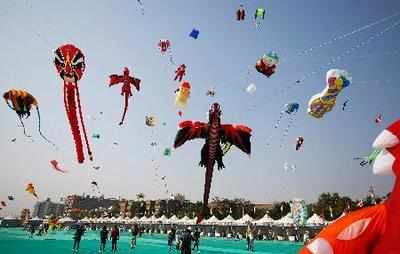
It is celebrated on either 14 or 15 January due to the addition of the extra day in leap years. The festival, which is a harvest festival is celebrated with colourful decorations, children singing and asking for treats, fairs, dances, kite flying, bonfires and feasts. Some go to sacred rivers and lakes and bathe in a ceremony of thanks to the sun and every twelve years, the Kumbh Mela, the largest mass pilgrimage festivity is observed in conjunction with Makar Sankranti. Here, devotees pray to the Sun God and bathe at the confluence of the Rivers Ganga and Yamuna, known as the Triveni Sangam in Prayagraj, Uttar Pradesh, a tradition attributed to Adi Shankaracharya.

Makar Sankranti is known by various names across the country. It is known as Magh Bihu in Assam, Maghi, in Punjab, Haryana, and Himachal Pradesh, Sukarat in central India, Pongal in Tamil Nadu, Uttarayan in Gujarat, Uttarakhand and Uttar Pradesh, Ghughuti in Uttarakhand, Makara Sankranti in Odisha, Karnataka, Maharashtra, Goa, West Bengal where it is also known as Poush Sankranti, and as Sankranthi in Andhra Pradesh and Telangana. Outside of India, it is known as Maghe Sankranti in Nepal and Tirmoori in Pakistan.

Makar Sankranti is set by the solar cycle and corresponds to the exact time when the sun enters the sign of Capricorn and usually falls on 14 January or 15 January during a leap year according to the Gregorian calendar.

Makar Sankranti is dedicated to the Sun God, Surya whose significance is traceable to the Vedic texts, particularly the Gayatri Mantra, a sacred hymn found in the Rigveda. It marks the termination of the winter season and the beginning of a new harvest season. From this day, the sun begins its northward journey or Uttarayan or the northern hemisphere and so the festival is also known as Uttarayan.

As per legend, Sankranti killed a devil named Sankarasur and so the day after Makar Sankrant is called Karidin or Kinkrant. On this day, she slew the devil Kinkarasur. As per another legend, the Sun God, Lord Surya forgave his son Shani who visited him on Sankranti. And that’s why people distribute sweets and urge everyone to let go of any negative or angry feelings. On this day people take a holy dip in rivers, especially the Ganga, Yamuna, Godavari, Krishna, and Kaveri because bathing in the rivers on this day is believed to result in merit or absolution of past sins. The Sun God is also prayed to and thanked for successes and prosperity. For most parts of India, this period is a part of the early stages of the Rabi crop and agricultural cycle, where crops have been sown and the hard work in the fields is mostly over. The time thus signifies a period of socialising and families enjoying each other’s company, taking care of the cattle, and celebrating around bonfires. On Makar Sankranti, people wear black which is otherwise a huge no-no on other festival days. As Sakranti falls in the winter months, wearing black adds to body warmth which is the reason for the colour.

In Assam, Makar Sankranti is known as Magh Bihu and the festival is marked by feasts and bonfires. Young people erect makeshift huts, known as Meji and Bhelaghar, from bamboo, leaves, and thatch, and in Bhelaghar they eat the food prepared for the feast and then burn the huts the next morning. celebrations also feature traditional Assamese games such as tekeli bhonga or pot-breaking and buffalo fighting. In Goa, people distribute sweets in the form of granules of sugar-coated sesame seeds among family members and friends and newly married women offer five sunghat or small clay pots filled with newly harvested grains, betel leaves areca nuts and tied with black beaded threads tied around them, to the deity. Uttarayan, as Makar Sankranti is called in Gujarati, is a major festival that lasts for two days. Kites made of special light-weight paper are flown and the festival is eagerly awaited.

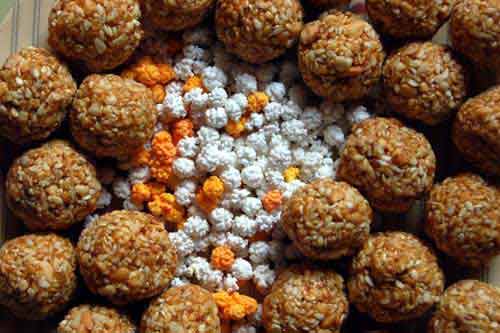
In Haryana and Delhi, the festival is celebrated similarly to Western UP and the border areas of Rajasthan and Punjab. This includes ritual purification by taking a holy dip in rivers with sweets like kheer, churma, halwa and distributing a sesame and jaggery sweet called til-gud. Brothers of a married woman visit her home with a gift pack, called Sindhara or Sidha with gifts of clothing for her and her family. In Jammu, it is celebrated as Uttrain and is celebrated a day before Lohri by the Dogra community to commemorate the end of the Poh or Pausha month. Among the Dogras, there is a tradition of Mansana or charity of Khichdi of Maah Dal and that is why this day is also referred to as Khichdi wala Parva. There is also a tradition of sending Khichdi & other food items to house of married daughters and fairs are organised in holy places and pilgrimages are taken. In Karnataka, it is celebrated as Suggi and on this day, girls wear new clothes to visit near and dear ones with the Sankranti offering on a plate and exchange the same with other families in a ritual called Ellu Birodhu. The festival signifies the harvest of the season since sugarcane is predominant in these parts. Gifts are exchanged by women and newly married women give away bananas for five years to married women from the first year of their marriage. Kite flying, drawing rangolis, giving away red berries known as Yalchi kai are some of the intrinsic parts of the festival. In rural Karnataka, a display of decorated cows and bulls and their procession is done and they are also made to cross a flame and this custom is known as Kichchu Haayisuvudu. In Maharashtra, on Makar Sankranti day people exchange multicolored halwa and sweetmeats made from sesame seeds and jaggery known as til-gul laadoo. Married women invite friends and family and celebrate with guests given til-gul and some small gift, as a part of the ritual and women make it a point to wear black clothes on this day.

In Odisha, on the day of the festival, people prepare makara chaula and along with uncooked newly harvested rice, banana, coconut, jaggery, sesame, rasagola, Khai/Liaa and chhena puddings offer It to the Gods and Godesses. The Sun God at the Konark Sun Temple is worshipped with many starting the day with a ritual bath while fasting. In Puri special rituals are carried out at the temple of Lord Jagannath. In Punjab, Makar Sankranti is celebrated as Maghi which is a religious and cultural festival. Bathing in a river in the early hours on Maghi is important with Hindus light lamps with sesame oil as this is supposed to give prosperity and drive away all sins. A major fair is held at the Sri Muktsar Sahib on Maghi which commemorates a historical event in Sikh history. In Rajasthan and Western Madhya Pradesh, the day is celebrated with special Rajasthani delicacies and sweets. Women in this region observe a ritual in which they give a gift to 13 married women. The first Sankranti experienced by a married woman is of significance as she is invited by her parents and brothers to their houses with her husband for a big feast. Kite flying is traditionally observed as a part of this festival.

In Tamil Nadu, Makar Sankranti is celebrated as the four-day festival of Pongal with day one celebrated as Bhogi Pongal, day two as Thai Pongal, day three as Maattu Pongal and day four as Kaanum Pongal. On Maattu Pongal, many villages in the state will have a Jallikattu, or taming the bull, contest, which is an ancient Pongal tradition. In Uttar Pradesh, the festival is known as Kicheri and involves ritual bathing. Over two million people gather at their respective sacred places for this holy bathing such as Allahabad and Varanasi in Uttar Pradesh. In Uttarakhand, Makar Sankranti is known by various names in the different parts of the state. In the Kumaon region the festival is known as Ghughuti, Ghughuti Tyar, Ghughutia, Kale Kauva or Uttarayani with the famous Uttarayani fair held in Bageshwar town. During the fair, people bathe before daybreak at the confluence of the Saryu and Gomati rivers, followed by an offering of water to Lord Shiva inside the Bagnath Temple. Those who are more religiously disposed of, continue this practice for three days in succession, which is known as Trimaghi. On this day, people also give khichdi, a dish made by mixing pulses and rice in charity, take ceremonial dips in holy rivers, participate in Uttarayani fairs and offer deep-fried sweetmeats consisting of flour and jaggery to crows and other birds as a way to pay homage to the departed souls of their ancestors. In West Bengal, Sankranti is also known as Poush Sankranti. The freshly harvested paddy and the date palm syrup in the form of Khejurer Gur is used in the preparation of a variety of traditional Bengali sweets made with rice flour, coconut, milk and khejurer gur or date palm jaggery and known as Pitha. Goddess Lakshmi is usually worshipped on the day of Sankranti. In Darjeeling, the festival is as known as Magey Sakrati and is associated with the worship of Lord Shiva.

The Hindu Sindhi community in western regions of India and southeastern parts of Pakistan, celebrate Makar Sankranti as Tirmoori. On this day, parents send sweet dishes and ladoos and chiki or Laaee made of sesame seeds to their married daughters. In Bangladesh, Makar Sankranti is known as Shakrain and is observed with the flying of kites. In Nepal, Maghe Sankranti as it is known in the country, is celebrated as the new year and is a major festival of the Magar community. Observant Hindus take ritual baths during this festival and the oldest female in each household wishes good health to all family members.

So here’s wishing you a very Happy Makar Sankranti with a greeting from my home state of Maharastra which goes like this: “Til gud ghya, god god bola” which means eat the sweet made from sesame and jaggery, say good and positive thoughts and words and leave all the bitterness and negativity of the past behind.

Instagram Interludes

After Chinatown, we decided to go to Little India aka Serangoon Road for dinner and a surprise awaited us. We didn’t know that the street was also lighted up for the Pongal festival. So we got another light-up as a bonus!

littleindia1

One of the side streets all lighted up


littleindia2

Serangoon Road as seen from its entrance


littleindia3

The facade of the Indian Heritage Centre, all beautifully lighted up


littleindia4

Another view of the lights in Serangoon Road