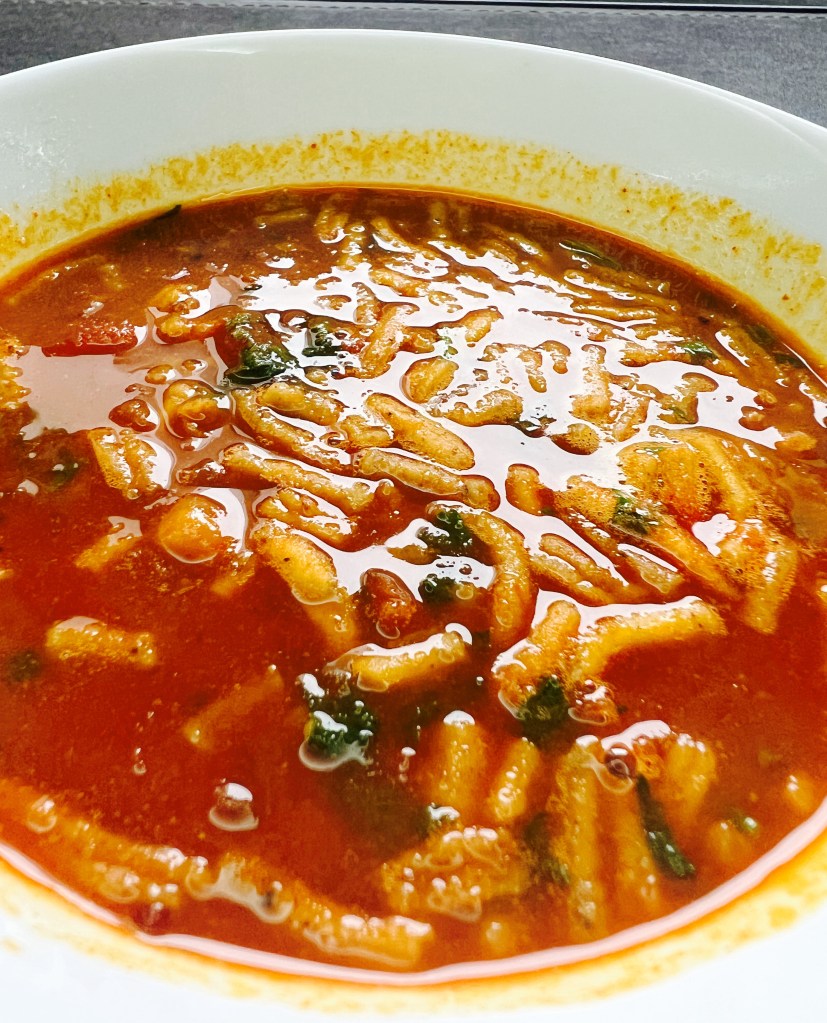
Recipes: Sev Tamatar ki Sabzi or Sev Tameta nu Shaak

For viewers of Tarak Mehta ka Ulta Chashmah, this recipe will be a familiar one. I ate this a long time ago when I was in school and then used to hear about it in shows and online. I was chatting with a friend the other day and she mentioned she had recently made the dish and I had cravings to make it. This is a fairly easy dish to make and from start to end, will not take more than 20-30 minutes, depending on the quantity you are making.

From the heartlands of Gujarat, this sabzi blends the sweetness and tartness of tomatoes with the crunch of savoury sev. Legend has it that the recipe originated in the kitchen of a Gujarati household, where the homemaker sought to create a delightful dish using the bounty of tomatoes from her garden. Faced with an abundant harvest, she combined tomatoes, spices, and a handful of sev to fashion a dish that was an instant hit with her family and the recipe soon spread like wildfire across the state. Today, this dish is a staple in Gujarati households, for its taste and ease of making from ingredients commonly found in an Indian kitchen. And because this does not use onions or garlic, this can be made even on festive days when you won’t use these ingredients. So let’s start making this yummy dish.

Sev Tameta nu Shaak or Sev Tamatar ki Sabzi

Ingredients:

  • 3 large ripe tomatoes, finely chopped
  • 1 cup sev or fried gram flour vermicelli
  • 2 tbsp oil
  • 1 tsp mustard seeds
  • 1 tsp cumin seeds
  • ¼ tsp asafoetida
  • 1 tbsp ginger and green chilli paste
  • ½ tsp turmeric powder
  • 1 tsp red chilli powder (adjust to taste)
  • 1 tsp coriander powder
  • 1 tsp cumin powder
  • Salt to taste
  • 2 tbsp jaggery or sugar
  • 1 cup water
  • Fresh coriander leaves to garnish

Method:

  • Heat oil in a pan over medium heat. Add mustard seeds, cumin seeds and asafoetida, letting them sizzle for a few seconds.
  • Then add the ginger and chilli paste and let it cook for a few seconds.
  • Add the finely chopped tomatoes to the pan and cook until they turn soft and mushy, stirring occasionally.
  • Reduce the heat to low and add turmeric powder, red chilli powder, coriander powder, cumin powder, and salt. Mix well and cook for 2-3 minutes.
  • Pour in the water and add jaggery or sugar. Stir until the jaggery dissolves completely.
  • Allow the curry to simmer on low heat for 5-7 minutes, allowing the flavours to meld together.
  • Add half the sev to the tomatoes and gently mix to coat the sev with the sauce.
  • Turn off the heat and garnish with fresh coriander leaves.
  • Just before serving, add the balance sev, so that there is still a crunch to the dish and serve hot with roti.

Notes: Don’t use the nylon sev used for bhelpuri and other chaat, instead use the thicker ones. This will mean that the sev does not dissolve in the sabzi and there is a bite. I also like to keep some sev separate so that as you dish it up, you add it as a garnish.

World Vegetarian Day

Anyone with a cursory glance at my blog will know that I am a vegetarian. I was raised as one and continue to remain one. My children are also raised as vegetarians and though I would not comment if they ate meat outside the house and in their own homes, when they have one, I will put my foot down about consuming meat in my home and will not allow anyone to cook or eat non-vegetarian food in my kitchen and home. This is, in large part, due to my religious beliefs and is something I will not budge from. I have no issues with people around me eating any kind of food and have on many occasions, in school, at work or even in social situations been with friends and colleagues who have eaten meat at the same table as me. All I ask of them is not to use their spoons to dig into my dish and if they want to taste what I am eating, to use the serving spoon in my dish to take some into their plates and eat, so my food does not get contaminated. And in any case, this is a healthy sharing practice, I believe.

What we eat impacts the well being of ourselves, animals and the planet. Vegetarianism was frequently referred to as a Pythagorean Diet, named after the ancient Greek philosopher and mathematician Pythagoras who was an early advocate for the diet before the popularisation of the term vegetarian in the mid-1800s. Vegetarianism has been present in India since the 5th century BC, though the concept is also clearly present in Buddhism, which originated between the fifth and sixth centuries, in plant-based staples such as tofu which have been consumed in China for more than 2,000 years, in Indonesian, Japanese and Thai cuisines and also on the African continent before European colonisation. It became more mainstream in the US and UK in the 1960s and gathered additional momentum in the 1970s which led the North American Vegetarian Society to establish October 1 as World Vegetarian Day in 1977 to promote the joy, compassion and life-enhancing possibilities of vegetarianism.

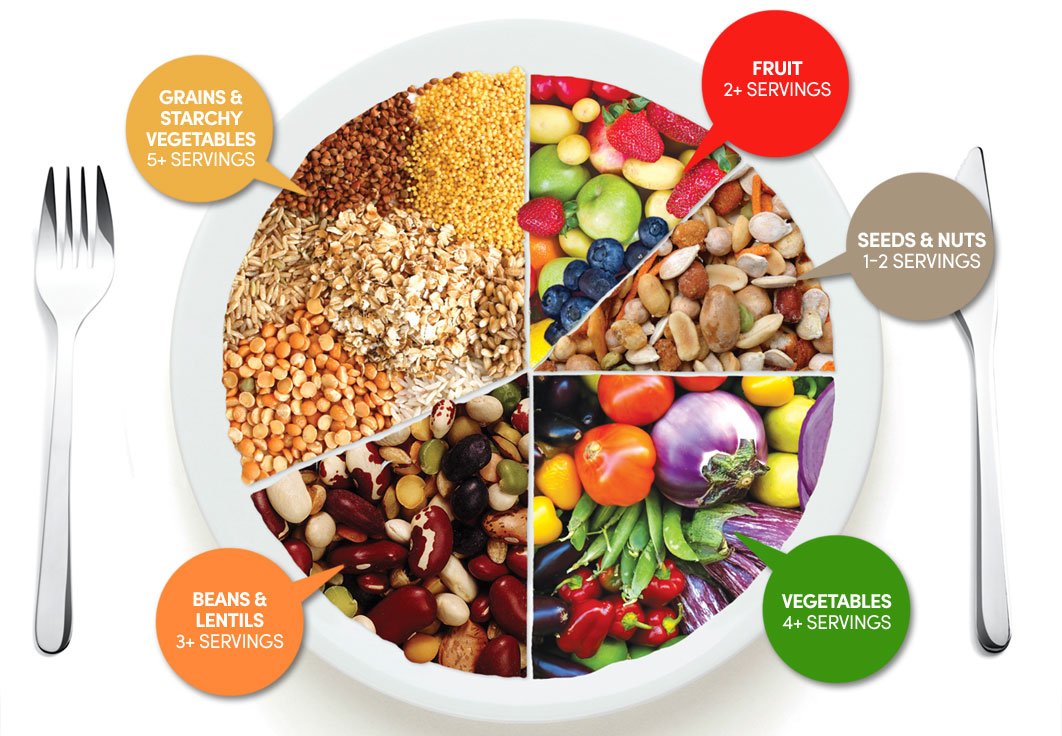
A vegetarian diet focuses on vegetables, seeds, legumes, fruits, nuts and grains and also includes animal products such as eggs, dairy and honey, that are obtained without involving the death of an animal or the consumption of its meat. There are many variations of the vegetarian diet: an ovo-lacto vegetarian diet includes both eggs and dairy products, an ovo-vegetarian diet includes eggs but not dairy products, and a lacto-vegetarian diet includes dairy products but not eggs. As the strictest of vegetarian diets, a vegan diet excludes all animal products, including eggs and dairy and even extends to abstain the use of any animal-derived products.

Maintenance of a vegetarian diet can be challenging. While avoidance of animal products may support health and ethical concerns, dietary supplements may be needed to prevent nutritional deficiency if all such products are shunned, particularly for vitamin B12. Packaged and processed foods may contain minor quantities of animal ingredients. While some vegetarians scrutinise product labels for such ingredients, others do not object to consuming them or are unaware of their presence. Labelling is however mandatory in India to distinguish vegetarian products (green) from non-vegetarian products with vegetarian products having a green dot in them and non-vegetarian products having a brown dot which must be visible.

Vegetarianism may be adopted for various reasons. Many people object to eating meat out of respect for sentient animal life. Such ethical motivations have been codified under various religious beliefs as well as animal rights advocacy. Other motivations for vegetarianism are health-related, political, environmental, cultural, aesthetic, economic, taste-related, or relate to other personal preferences.

The American Dietetic Association has stated that at all stages of life, a properly planned vegetarian diet can be healthful, nutritionally adequate, and may be beneficial in the prevention and treatment of certain diseases. Vegetarian diets offer lower levels of saturated fat, cholesterol and animal protein, and higher levels of carbohydrates, fibre, magnesium, potassium, folate, vitamins C and E, and phytochemicals. Studies have shown that a vegetarian diet may increase the risk of calcium deficiency and low bone mineral density. A 2021 review found no differences in growth between vegetarian and meat-eating children. Vegetarian diets are under preliminary research for their potential to help people with type 2 diabetes. A study presented at the European Congress on Obesity found that vegetarians appear to have a healthier biomarker profile than meat-eaters.

Vegetarianism reduces the risk of major killers such as heart disease, stroke and cancer while cutting exposure to foodborne pathogens, provides a viable answer to feeding the world’s hungry through more efficient use of grains and other crops, saves animals from suffering in factory-farm conditions and from the pain and terror of slaughter, conserves vital but limited freshwater, fertile topsoil and other precious resources and preserves irreplaceable ecosystems such as rainforests and other wildlife habitats, decreases greenhouse gases that are accelerating global warming and mitigates the ever-expanding environmental pollution of animal agriculture.

Established by the North American Vegetarian Society in 1977 and endorsed by the International Vegetarian Union in 1978, World Vegetarian Day is observed annually around the globe on October 1 to emphasise environmental considerations, animal welfare and rights issues and personal health benefits to encourage people into ditching animal products. It taps into the studies which highlight the proven health benefits of a vegetarian diet. The day is also marked to raise awareness about saving animals‚ lives and helping to preserve the Earth. World Vegetarian Day also initiates the month of October as Vegetarian Awareness Month, which ends on November 1, and is celebrated as World Vegan Day, at the end of that month of celebration. Vegetarian Awareness Month has been known variously as the Reverence for Life month, the Month of Vegetarian Food, and more.

Hinduism does not require a vegetarian diet, but some Hindus avoid eating meat because it minimises hurting other life forms. Vegetarianism is considered satvic, which is purifying the body and mind lifestyle in some Hindu texts. Lacto-vegetarianism is favoured by many Hindus, which includes milk-based foods and all other non-animal derived foods, but it excludes meat and eggs. There are three main reasons for this – the principle of nonviolence or ahimsa applied to animals, the intention to offer only vegetarian food to their preferred deity and then to receive it back as prasad or offerings, and the conviction that non-vegetarian food is detrimental to the mind and for spiritual development. Many Hindus point to scriptural bases, such as the Mahabharata with its maxim that nonviolence is the highest duty and the highest teaching, as advocating a vegetarian diet.

A typical modern urban Hindu Lacto-vegetarian meal is based on a combination of grains such as rice and wheat, legumes, green vegetables, and dairy products. Depending on the geographical region the staples may include millet-based flatbreads and fat derived from slaughtered animals is avoided. Many Hindus, particularly those following the Vaishnav tradition, refrain from eating onions and garlic either totally or during the Chaturmas period which is roughly between July and November in the Gregorian calendar. In Maharashtra, many Hindu families also do not eat any eggplant preparations during this period.

If you are not a vegetarian or are contemplating a change to a more plant-based diet, this is a good opportunity to dip your toes into this diet. Try and see, you may decide you like it after all.

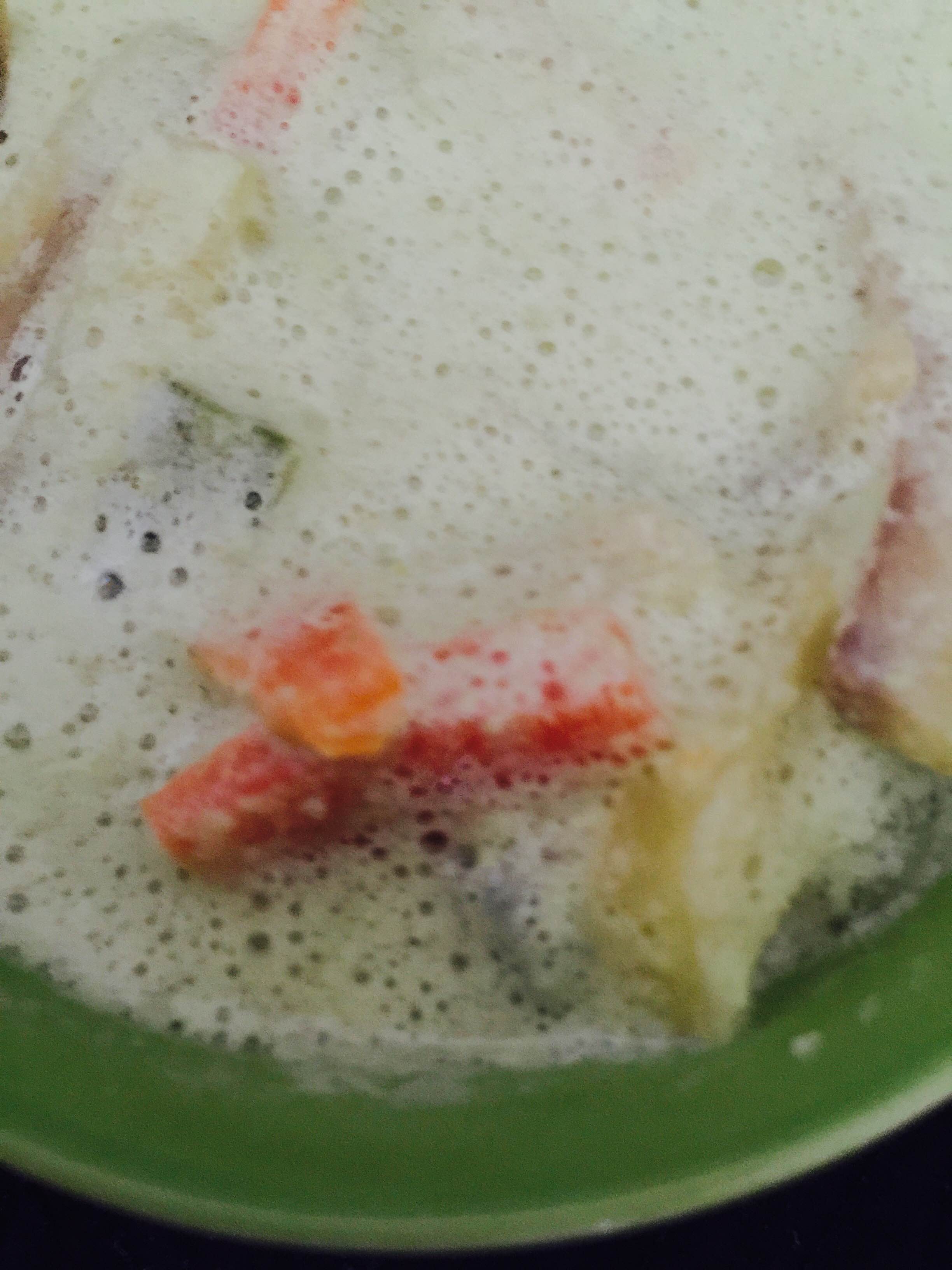
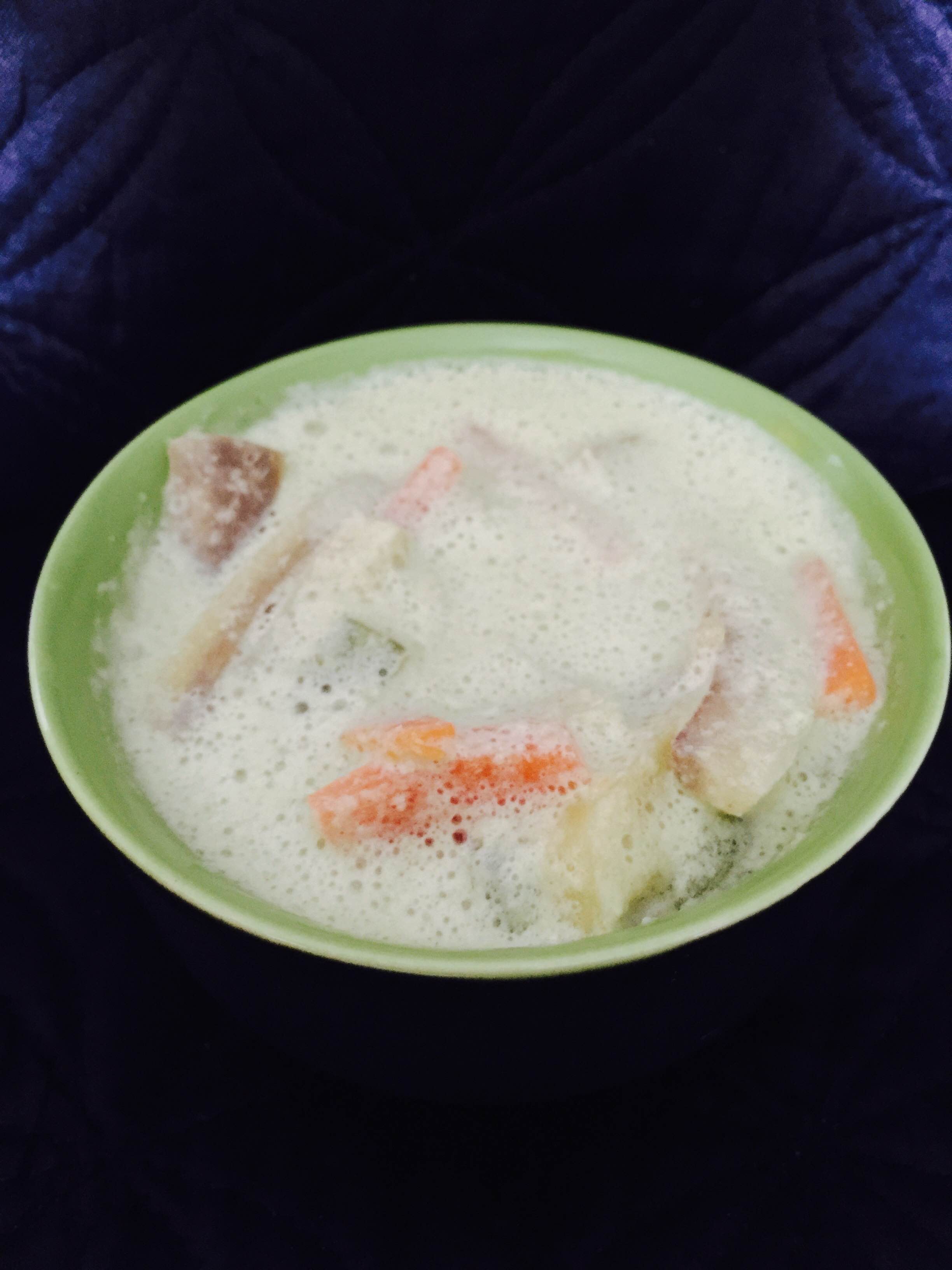
Recipe: Avial

img_6065

One of the eponymous dishes which are common across South India, Avial is one of my favourite dishes. I remember when my mum used to make this dish, I would eat it the whole day, so much that what was supposed to be enough for both meals, would finish by the time we had lunch!

Both GG & BB love it as much as I do, S is quite indifferent to it. When S started working with us, she also started to love it and if we go a couple of months without making it, she will remind me to make it soon.

This dish is quite ancient and is said to be invented by Bhima, the second Pandava brother during their year in exile. Most vegetables used to make Avial are what we call local (Indian) vegetables. Some ‘English’ vegetables like potato, carrots, beans and peas are also used. Other vegetables like Yellow/Orange pumpkin, white pumpkin, drumstick, snake gourd, yam, raw banana are also used. You can use all of these or some, depending on what you have at home. The dish can also be made thick or thin – thick if you are not planning to eat it mixed with rice (like a gravy) or thin if this will be mixed with rice. In my home, if we make Avial, we don’t usually make anything else since it has all vegetables in it, we eat it with rice and some crisps.

img_6067

Avial

Ingredients:

  • 2 carrots, chopped lengthwise in 2 inch sticks
  • 2 potatoes, chopped lengthwise in 2 inch sticks
  • 2 raw bananas, chopped lengthwise in 2 inch sticks
  • 1/4 piece of yellow pumpkin, chopped lengthwise in 2 inch sticks
  • 7-8 beans, chopped 2 inch
  • 2 drumsticks, chopped in 2 inch sticks
  • 1 snake gourd, chopped lengthwise in 2 inch sticks
  • 1 cup yoghurt, beaten
  • 1/4 tsp turmeric powder
  • salt to taste
  • 3-4 curry leaves (optional)
  • 1 tsp coconut oil (optional)

To be ground into a paste

  • 2 tsps cumin seeds
  • 6-8 green chillies
  • 1 cup grated coconut
  • 1/2 cup yoghurt

Method:

  • In a deep bottomed pan, add all the chopped vegetables and cook them with very little water and the turmeric powder and 1 tsp salt. Cook till the vegetables are al-dente, they should be still firm to touch.
  • While the vegetables are cooking, grind the coconut, chillies and cumin seeds, using the yoghurt as moisture. Grind the coconut till it is very fine.
  • Once the vegetables are cooked, add the coconut mixture to the vegetables. Stir well and add salt to taste.
  • From the remaining yoghurt, add as much yoghurt as you need to make it as thick as you need. If you need to make the avial thick, add very little yoghurt and more if you want to make the gravy watery.
  • When the avial comes to a nice rolling boil, add the coconut oil and curry leaves (if using) and switch off the gas. Cover the dish with a plate or cover to keep the fragrance of the curry leaves and oil.
  • Serve hot with rice and some crisps or papad.

Enjoy…..

img_6068img_6066


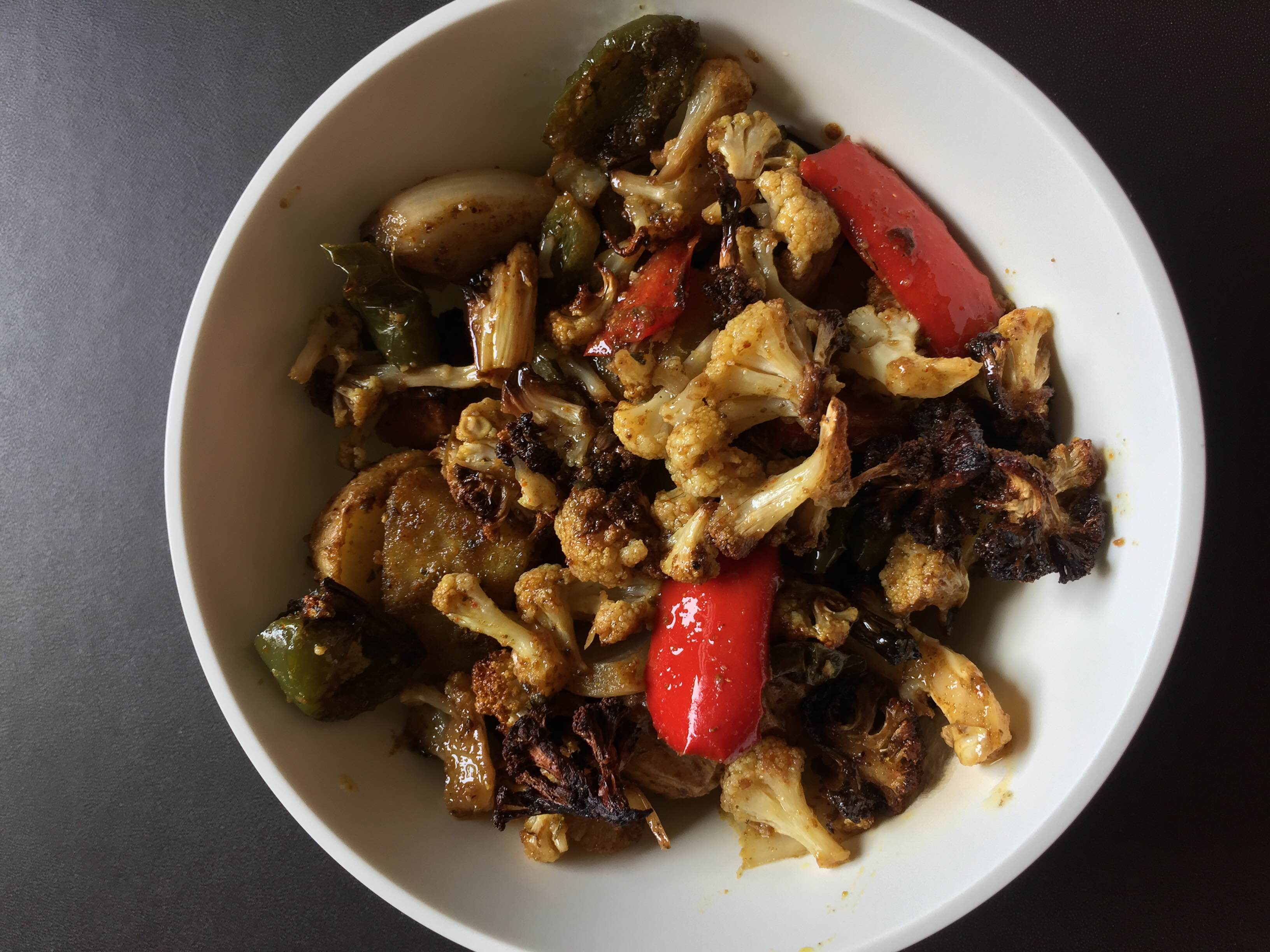
Recipes: Roasted Vegetables, Indian Style

IMG_5583

Usually, Sundays, which is R’s weekly off is the one day in the week when I can cook what I want. Usually the Sunday lunch is some variation of an Indian meal – a rice or roti dish with a gravy dish and some salad or raita to accompany it.

This weekend, I was bored of cooking the same old food, week after week and so decided to do something different. I decided to pair a soup with some roasted vegetables and then to kick it up a notch, I decided to make it with an Indian twist. So here’s some roasted vegetables, cooked in Indian style and with Indian spices!

Roasted Vegetables, Indian Style

IMG_5584

Ingredients:

  • 1 head cauliflower, cut into florets
  • 1 capsicum (any colour) chopped into large pieces
  • 20 baby potatoes, chopped into half or quarters (depending on size)
  • 2 large sweet potatoes, chopped into large pieces
  • 2-3 carrots, chopped into large pieces
  • 2 onions, chopped into large pieces
  • 2-3 tbsps Oil

Spice Mixture

  • 1 tsp red chilli powder
  • ¼ tsp turmeric powder
  • 2 tsps cumin seed powder
  • 1 tsp coriander seed powder
  • 2 tsps dried methi (kasoori methi)
  • 2 tsps dried mint powder
  • 2 tsp chats chat masala
  • Salt to taste

Method:

  • Preheat the oven to 200 degrees Celcius (392 degree Farenheit)
  • Mix the spices into a powder and keep aside.
  • Chop all the vegetables into bite-sized pieces, wash, dry and put into a large utensil which should be large enough to mix well.
  • Pour enough of the spice mixture and oil and mix the spices into the chopped vegetables, ensuring that every piece is coated with the spice and oil mixture.
  • Line a large baking tray with aluminium foil and pour the coated vegetables into it. Make sure the vegetables are even in the tray.
  • When the oven is heated, bake the vegetables for approximately between 40 – 60 minutes, depending on how crisp you want it or how much the quantity is. I found a full shallow tray of root vegetables needed 60 minutes while other vegetables were done in less than 40 minutes.
  • Let it cool and enjoy!

IMG_5585

I paired this with my carrot, coriander and pumpkin soup and it was a hit! We had this for both meals and nobody missed having rice or rotis with this meal!

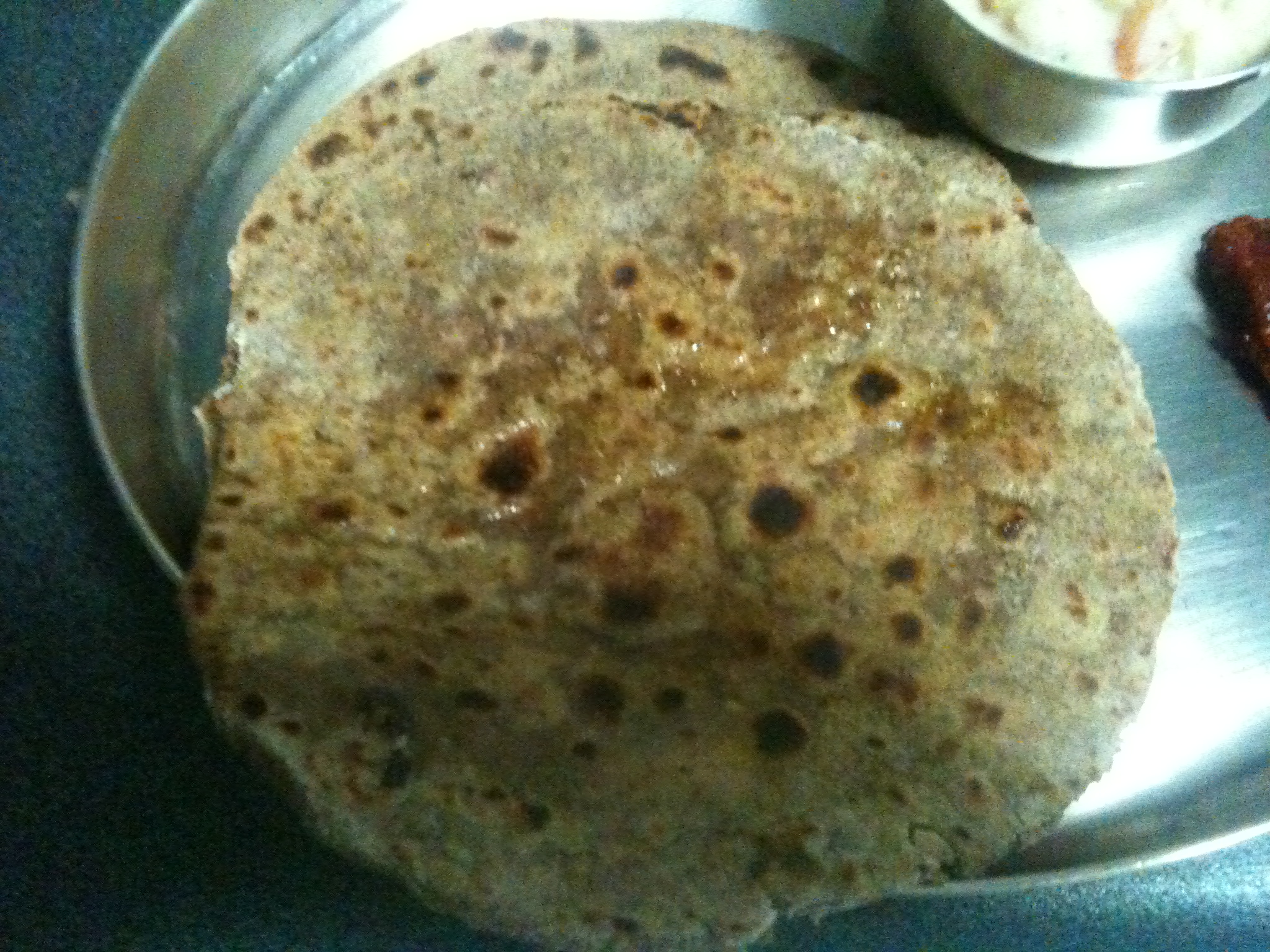
Rajma Paratha – Indian Red Kidneybean Flatbread

I had made Rajma over the weekend and as usual made too much for all of us to eat. We had leftovers and I didn’t know what to do with them. I love Rajma, so thought I will eat them with rotis when I chanced upon this recipe by The Steaming Pot. I tweaked it a bit and voila – spicy, tasty rajma parathas which we had with a dash of ginger pickle and a quick raita of baby cucumbers, tomatoes and onions.

Rajma Parathas

Ingredients:

  • 1.5 cup pre-made rajma masala, blended and pureed well to make it a smooth paste
  • 3 cups whole wheat flour
  • Some warm water to kneed the dough
  • 1 tsp oil for the dough
  • ghee/oil for the parathas (optional)

Method:

In a large dish mix the pureed rajma and the wheat flour and if needed, use the warm water to make it a smooth dough. Use 1 tap oil at the very end and mix into the dough to avoid stickiness.

Roll out into slightly thicker than usual parathas. In a non-stick tava, put the parathas in medium high heat and once the first side is done, flip and put a few drops of ghee in the first side. Repeat for the second side and remove and eat hot!

3 cups of wholewheat flour gave me around 12 parathas.