
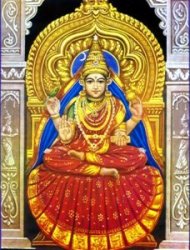
Sharadamba, the reigning deity in Sringeri
Since today is Vijaya Dashami or Dushera, I thought it was appropriate to post this long overdue post today.
My family (both paternal and maternal) have long been followers of the Sharadha Peetham which is based in Sringeri, in the southern state of Karnataka.

The main Sharada temple in Sringeri
Before I say more about this Peetham, let me backtrack about its existence. This Peetham was established by the founder of what we know as Hinduism or what we call the Santana Dharma (or a code of ethics, a way of living through which one may achieve moksha which is enlightenment or liberation) Jagadguru Sri Adi Shankara Bhagavatpada. The Sringeri Peetham is the first of the four Amnaya Peethams established at Sringeri more than twelve centuries ago, around 800 AD to foster the sacred tradition of Sanatana Dharma. The other peethams are located in Dwaraka (Gujarat), Govardhana (Odisha) and Jyotirmath (Uttarakhand).
Tradition has it that after the Acharya had dispersed all the non-Vedic creeds prevailing in the country, He was on the look-out for a convenient and holy place where he could establish an institution to spread the truths of Advaita Vedanta. When the Acharya came to Sringeri, he saw an unusual sight on the banks of the Tunga. A cobra was seen spreading out its hood over a frog in labour pains, to give it a shadow from the scorching mid-day sun. Struck with the sanctity of the place, which could infuse love between natural adversaries, the Acharya chose this very location to establish His first Math.

The unbroken guru parampara with the current and next Shankaracharyas
The Acharya came across many virtuous people at Sringeri and taught them the doctrine of Advaita. He then invoked the Divinity of Knowledge, Goddess Sharada and consecrated an icon of the Goddess. Thus the Peetham He founded at Sringeri in South India for fostering the Vedas and the sacred tradition of Sanatana Dharma came to be known as the Dakshinamnaya Sri Sharada Peetham.
The Acharya appointed his prime disciple, Sri Sureshwaracharya as the first Acharya of the Peetham. Since then, the Peetham has been blessed with an unbroken Guru Parampara, a garland of spiritual masters and Jivanmuktas representing Sri Adi Shankaracharya. The succeeding Acharyas have led a life of such austere penance that it has led disciples to adore in them the radiance of Sri Adi Shankara Himself.
Besides being a centre of spiritual power, Sringeri also came to be known as a great place of traditional learning owing to the presence of Goddess Sharada and the erudition of the Acharyas of the Peetham. The Acharyas were instrumental in bringing forth commentaries on the Vedas and in further expounding the Bhashyas of Sri Adi Shankaracharya. The Acharyas also wrote a number of independent works related to Advaita besides producing a number of hymns underlining their ardent devotion to the non-dual Supreme worshipped in multifarious forms. The Peetham thus came to be regarded as the Vyakhyana Simhasana, The Throne of Transcendental Wisdom. Many regard Goddess Sharada Herself to be moving in the form of the presiding Acharya of the Peetham.
In the 14th century, royal patronage to the Peetham began with the founding of the famous Vijayanagar empire under the divine guidance of the 12th Acharya, Jagadguru Sri Vidyaranya. The austerity of the Acharya influenced the rulers to such an extent that they began ruling in the name of the Acharya and granted the Peetham the rights over the secular administration of the land. At the rulers’ request, the Acharya began conducting a Durbar during the Navaratri festival – an occasion deemed by the rulers to honour their Guru. This durbar is conducted even today and many members of my extended maternal family still visit Sringeri to take part in the Durbar.
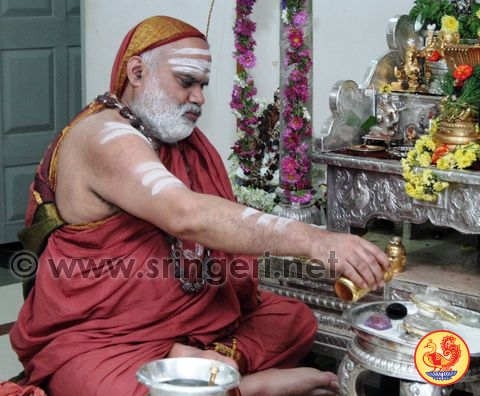
The current pontiff Jagadguru Sri Sri Bharati Tirtha Mahaswamiji worshipping Lord Chandramoulishwara
Subsequently, the Acharya came to be known as the Karnataka Simhasana Prathisthapanacharya and the Peetham became a mighty institution – a Samsthanam and is known to this day as the Jagadguru Shankaracharya Mahasamsthanam, Dakshinamnaya Sri Sharada Peetham at Sringeri. Over the succeeding centuries, a number of empires and rulers including the Mysore Maharajahs Hyder Ali and Tipu Sultan, the Nizam of Hyderabad, the Peshwas and the Keladi rulers and Travancore Rajas were drawn towards the Peetham and respected the Acharya as their Guru.
In the recent past, the Sharada Peetham has shone through the lives of the Acharyas – Jagadguru Sri Sacchidananda Shivabhinava Nrisimha Bharati Mahaswamigal, the re-discoverer of Sri Adi Shankara’s birthplace at Kalady and the founder of the famous Pathashala at Sringeri; followed by the renowned Jivanmukta, Jagadguru Sri Chandrasekhara Bharati Mahaswamigal; succeeded by the crest jewel of Yogis, Jagadguru Sri Abhinava Vidyatirtha Mahaswamigal. They have all left indelible impressions in the hearts of the disciples.
With such a rich history associated with Sri Adi Shankaracharya’s first and foremost Peetham, many wonder at the aptness of the Acharya’s choice of locating the Peetham at Sringeri, a spot replete with a hoary past, and bountiful with natural splendour and serenity.
Today, the Sringeri Sharada Peetham bedecked with an unbroken chain of Acharyas continues to uphold the principles of Sanatana Dharma with the 36th Acharya Jagadguru Shankaracharya Sri Sri Bharati Tirtha Mahaswamiji acting as a treasure of spiritual wisdom and peace for all seekers.
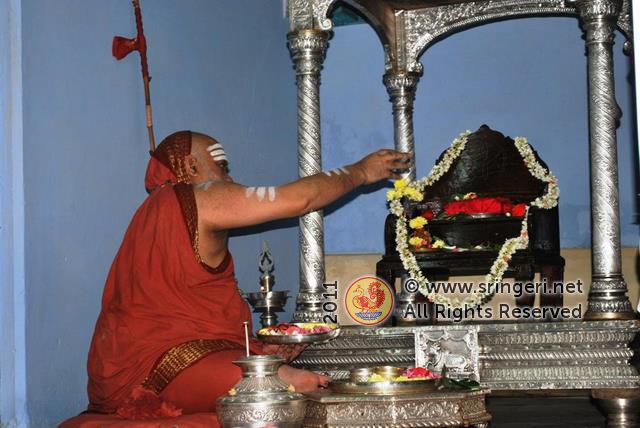
The current pontiff Jagadguru Sri Sri Bharati Tirtha Mahaswamiji worshipping
The Sringeri Sharada Peetham site includes two major temples, one dedicated to Shiva (Vidyashankara Linga, tenth Shankara memorial) and the other to Saraswati (Sharada Amba). The Vidyashankara temple was built during the Vijayanagara Empire era (1338 CE) on a square plan set inside circles in the Tuluvas and Hoysala apsidal style. It includes shrines and relief carving in reverence of major Hindu gods and goddesses such as Brahma, Vishnu (all Dasavatara, with Buddha), Shiva, Saraswati, Parvati, Lakshmi, Ganesha, Shanmukha (Kartikeya, Murugan), Durga, Kali and others. The stone reliefs also include a large variety of Hindu legends from the epics and the Puranas.
The Sringeri Peetham is one of the major Hindu monastic institutions that has historically coordinated Smarta tradition and monastic activities through satellite institutions in South India, preserved Sanskrit literature and pursued Advaita studies. The Sringeri Peetham has been a library and a source of historic Sanskrit manuscripts. Along with other Hindu monasteries such as the Kanchi Kamakoti Peetham, the contemporary Sringeri matha has been active in preserving the Vedas, sponsoring students and recitals, Sanskrit scholarship, and celebrating annual Adishankaracharya Jayanti (gurupurnima).

The sacred fish in the banks of the Tunga river at Sringeri
I have been to Sringeri twice so far, once for a cousin’s sacred thread ceremony and the second time in 2000, with my parents and grandfather just before he passed away. I want to make a trip there once more, this time with S, BB & GG as well as my parents so that before they get too old to make the trip, we can do this as a family trip together. Sringeri is a beautiful place and unfortunately, I don’t have the photos I took during my last trip there (pre-digital camera days).
If you ever get a chance to make a trip there, please do go there and enjoy the sereneness that is Sringeri along with getting immersed into the essence and core of the Sanathana Dharma.
 Memories and Such
Pingback: Festivals of India: Adi Shankaracharya Jayanti | Memories and Such
Pingback: Travel Bucket List – India: Karnataka Part 6 | Memories and Such