

Today is Friday the 13th – a date shrouded in mystery and fear, often associated with bad luck, curses, and eerie happenings. For centuries, this particular day has sparked a multitude of myths and superstitions, captivating the minds of people across various cultures.
In Norse mythology, the day was named after Frigg, the goddess of love and fertility, which led to it being called Frigg’s Day eventually evolving into Friday. Frigg’s counterpart in Roman mythology was Venus, the goddess of love, beauty, and fertility, further cementing the association of Friday with a divine feminine presence. In medieval Christian Europe, it gained an unfortunate reputation due to its connection to events considered ill-fated. For instance, some Christians believed that Eve tempted Adam with the forbidden fruit on a Friday, and it was also considered the day on which Cain murdered his brother Abel.

The superstition surrounding the number 13 is known as triskaidekaphobia and the fear of Friday the 13th is known as friggatriskaidekaphobia or paraskevidekatriaphobia. Friggatriskaidekaphobia comes from Frigg, the Norse goddess of wisdom after whom Friday is named, and the Greek words triskaideka, meaning 13, and phobia, meaning fear. Paraskevidekatriaphobia is also derived from Greek, where paraskeví translates as Friday, and dekatria is another way of saying 13. Experts say that friggatriskaidekaphobia affects millions of people and estimate that businesses, especially airlines, suffer from severe losses on Friday the 13th. Triskaidekaphobia, or the fear of the number 13, is even more widespread. So much so that many high-rise buildings, hotels, and hospitals skip the 13th floor, and many airports do not have gates numbered 13. In many parts of the world, having 13 people at the dinner table is considered bad luck.
Its roots can be traced back to various historical and cultural sources. One widely held belief links it to the Last Supper, where there were 13 individuals present, including Jesus and his twelve disciples. Judas Iscariot, the apostle who later betrayed Jesus, is often associated with the number 13, adding to the ominous reputation of this numeral.
Western culture perceives the number 12 as a symbol of completeness and harmony with 12 months in a year, 12 zodiac signs, 12 days of Christmas, 12 labours of Hercules, and 12 tribes of Israel, among others. In contrast, the number 13 was considered irregular and unbalanced, evoking feelings of discomfort and unease and a long history as a sign of bad luck.
The fusion of Friday and the number 13 to create Friday the 13th is a relatively recent phenomenon, believed to have gained prominence in the 19th century. Despite its rather recent concoction, the fear and superstitions surrounding this date have become deeply ingrained in popular culture worldwide. Over time, numerous myths and legends have emerged, further fueling the aura of Friday the 13th.

One of the most enduring legends associated with Friday the 13th is the curse of the Knights Templar. The Knights Templar, a medieval Christian military order, faced persecution and were eventually disbanded by King Philip IV of France on Friday, October 13, 1307. According to the legend, the Grand Master of the Templars, Jacques de Molay, placed a curse upon those responsible for their destruction, vowing that they would face misfortune. This curse is said to be the reason behind the superstitions surrounding Friday the 13th. Another popular belief related to Friday the 13th is its association with the full moon. While both Friday and the number 13 have their respective superstitions, the combination of the two is believed to intensify the perceived malevolence of this day, leading to heightened supernatural occurrences and erratic behaviour.
In the late-19th century, a New Yorker named Captain William Fowler (1827-1897) sought to remove the enduring stigma surrounding the number 13 — and particularly the unwritten rule about not having 13 guests at a dinner table — by founding an exclusive society called the Thirteen Club. The group dined regularly on the 13th day of the month in room 13 of the Knickerbocker Cottage, a popular watering hole Fowler owned from 1863 to 1883. Before sitting down for a 13-course dinner, members would pass beneath a ladder and a banner reading “Morituri te Salutamus,” Latin for “Those of us who are about to die salute you.”
In more recent times, several traumatic events have occurred on Friday the 13th, including the German bombing of Buckingham Palace in September 1940; the murder of Kitty Genovese in Queens, New York in March 1964; a cyclone that killed more than 300,000 people in Bangladesh in November 1970; the disappearance of a Chilean Air Force plane in the Andes in October 1972; the death of rapper Tupac Shakur in September 1996 and the crash of the Costa Concordia cruise ship off the coast of Italy, which killed 30 people in January 2012.
In some cultures, Friday the 13th is considered an inauspicious day for travel. It is believed that embarking on a journey on this date may lead to unfortunate incidents or accidents during the trip. Many individuals tend to avoid making important decisions or initiating new endeavours on Friday the 13th. The fear of potential bad luck or negative outcomes often prompts people to postpone crucial life choices until the day has passed.
So why are people scared of Friday the 13th? The fear of Friday the 13th, known as paraskevidekatriaphobia, is surprisingly widespread, impacting millions of people worldwide. But why does this particular date invoke such dread and trepidation? Several factors contribute to this phenomenon.
Cultural conditioning plays a significant role in shaping our beliefs and perceptions. From an early age, many of us are exposed to stories, movies, and media that depict Friday the 13th as a day of ill fortune. As these beliefs become deeply ingrained, they can manifest as genuine fear in adulthood. Confirmation bias refers to our tendency to interpret events in a way that confirms our preexisting beliefs. On Friday the 13th, people might be more vigilant and pay extra attention to any negative or unfortunate incidents, reinforcing the belief that the day is indeed cursed. The collective belief in the unluckiness of Friday the 13th can create a self-fulfilling prophecy. When so many people are apprehensive about a specific date, their shared energy and anxiety can influence their experiences and interactions, potentially leading to a heightened sense of negativity on that day. Superstitions can evoke genuine fear and anxiety in individuals. When people genuinely believe that something is unlucky or cursed, it can trigger physiological responses, such as increased heart rate, sweating, and feelings of unease. These reactions can reinforce the perception that the day is genuinely dangerous.
Friday the 13th remains an enigma that has captivated the human imagination for centuries. Its origins in the amalgamation of a day associated with the divine feminine and a number steeped in superstition have given rise to a host of myths and legends. As people continue to fear this date, it’s essential to recognise the power of collective beliefs and the impact of cultural conditioning on our perception of luck.
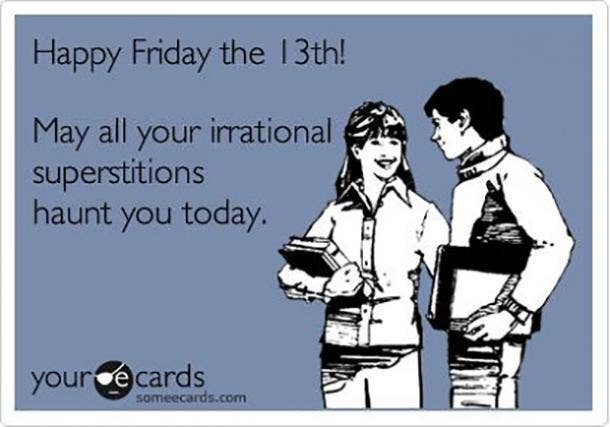
So, take a moment today to reflect on the fascinating history and myths surrounding it. Perhaps this day is not as foreboding as it seems, and the fear can be put to rest, allowing us to embrace the beauty of the unknown without the weight of superstition.
 Memories and Such
Pingback: Common Everyday Superstitions | Memories and Such