
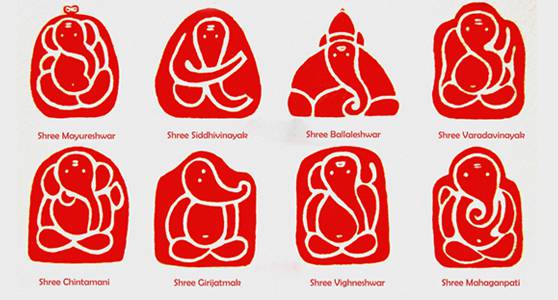
Regular readers of this blog will know that Lord Ganesha is my ishtadev, the one whom I connect to and the first I think of in joy and sadness. He is the first whom I think of when I wake up and the last I call upon before I sleep. It’s only fitting, then, that my next instalment in this series on Hindu temples is the Ashtavinayaka temples. So let’s learn more about this form of the elephant god and this temple circuit.
Among the many sacred circuits that devotees undertake, the Ashtavinayaka pilgrimage in Maharashtra holds a unique place. The term Ashtavinayaka translates to “eight Ganeshas,” referring to the eight temples dedicated to Lord Ganesha, the remover of obstacles and the harbinger of wisdom. The Ashtavinayaka Yatra is centred around the city of Pune. The eight temples house eight distinct idols of Ganesha, the Hindu deity of unity, prosperity, learning, and the removal of obstacles. Each of these temples has its legend and history, as distinct from each other as the idols in each temple. The form of each murti of Ganesha and his trunk are distinct from one another. To complete the Ashtavinayaka Yatra, one must revisit the first temple after visiting all eight temples.
Unlike other temple circuits, the Ashtavinayaka pilgrimage is distinctive because each of these eight temples enshrines a self-manifested or Swayambhu idol of Lord Ganesha, believed to have emerged naturally rather than being sculpted by human hands. The Ashtavinayaka temples are located in different parts of Maharashtra, primarily in and around Pune, in the Pune and Raigad districts, and visiting them in a specific sequence is considered highly auspicious.

Out of these eight temples, five are in Pune, two are in Raigad, and one is in Ahmednagar or Ahilyanagar District. The pilgrimage takes 3 days to complete and as per scriptures, must be in this specific prescribed order: Mayureshwar Temple, Morgaon, where Lord Ganesha is astride on a peacock and the starting and ending point of the pilgrimage, Siddhivinayak Temple, Siddhatek, a tranquil temple where Lord Vishnu is said to have meditated, Ballaleshwar Temple, Pali, the only Ganesha temple named after a devotee, Ballal, Varadvinayak Temple, Mahad, known for granting boons or varada, Chintamani Temple, Theur, associated with the return of the mythical Chintamani gem, Girijatmaj Temple, Lenyadri, carved into a mountain, and linked to Goddess Parvati, Vighnahar Temple, Ozar, dedicated to the vanquisher of obstacles, and worshipped by Lord Indra, and the Mahaganapati Temple, Ranjangaon, also known as the Great Ganesha, and connected to Shiva’s victory over the demon Tripurasura. The pilgrimage concludes by returning to Morgaon, completing the sacred loop.
It is believed that to complete the pilgrimage, a devotee must visit all eight temples in the prescribed order and then return to the first temple to complete the spiritual circuit. This act symbolises the cycle of life and the divine presence of Lord Ganesha in all stages of human existence.
Each of these temples is associated with a unique form of Ganesha and carries its legend that adds to the richness of the pilgrimage. However, what ties them together is their collective significance as sites of divine energy and devotion.
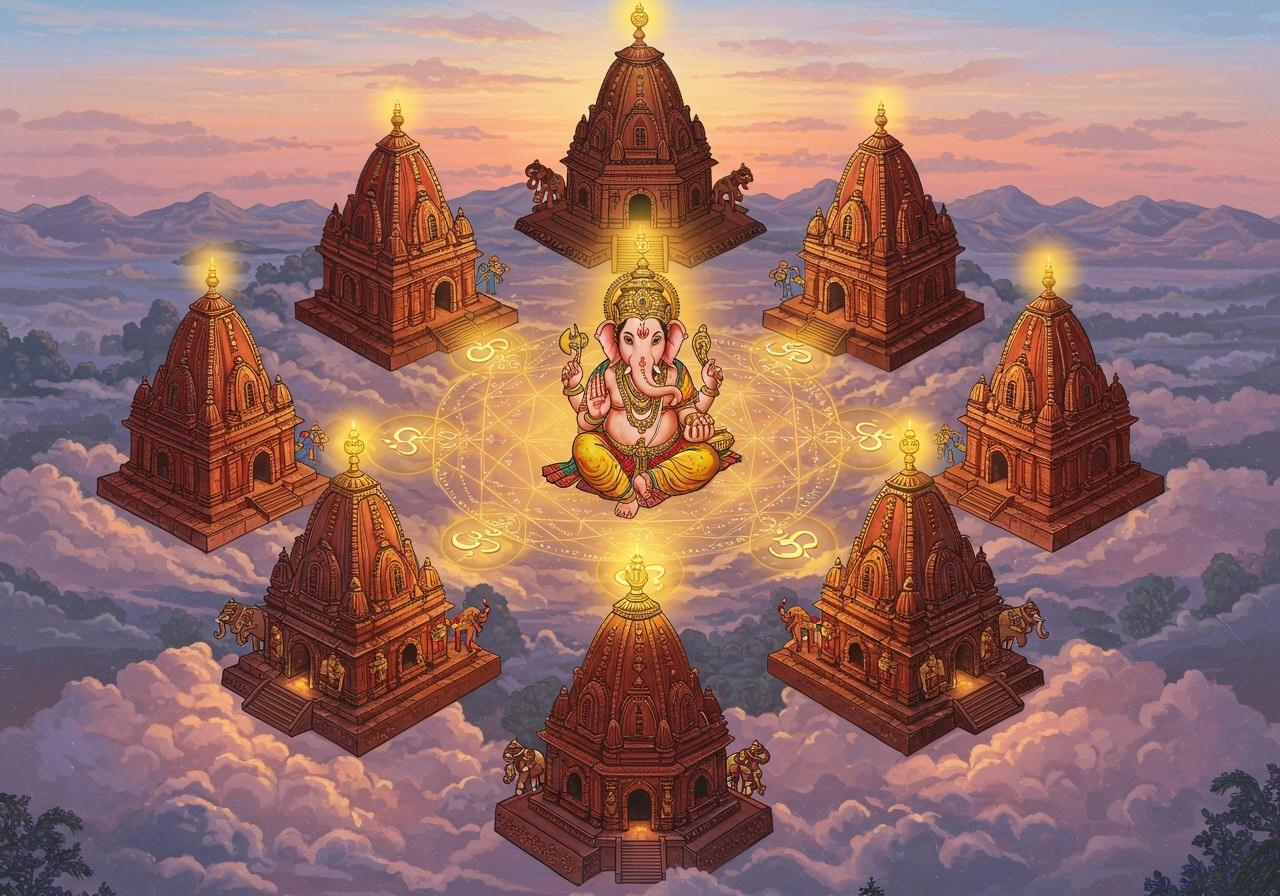
Several fascinating legends connect the Ashtavinayaka temples, making this pilgrimage more than just a visit to eight separate shrines. Some of the overarching myths associated with the circuit include
The Legend of Sage Gritsamada and Mayureshwar: According to Hindu mythology, Sage Gritsamada was blessed with a divine son, Ganapati, due to his intense devotion. However, a misunderstanding led to the formation of the Ganapatya sect, which exclusively worshipped Lord Ganesha. This sect played a vital role in the establishment of the Ashtavinayaka temples.
Lord Ganesha’s Battle with the Demon Sindhu: A prevalent myth speaks of the demon Sindhu, who had received a boon that he could only be defeated by an incarnation of Shiva and Parvati’s son. To destroy this menace, Ganesha took the form of Mayureshwar and, riding a peacock, vanquished the demon. This legend explains why the Mayureshwar Temple in Morgaon is considered the most important of the eight temples.
The Story of Ballal and the Self-Manifested Idol: At Ballaleshwar Temple in Pali, the legend of a young devotee named Ballal is widely told. A dedicated worshiper of Ganesha, Ballal was punished by his father for excessive devotion. However, moved by his faith, Ganesha himself appeared before Ballal, blessed him, and took residence in Pali, leading to the establishment of the temple.
Ganesha as the Conqueror of Obstacles: The story behind Vighnahar Temple in Ozar speaks of how Ganesha defeated the demon Vighnasura, who caused disruptions in religious practices. Ganesha subdued him but, on the demon’s plea, allowed him to stay, thus earning the title “Vighnahar” (Remover of Obstacles).
The Connection to the Pandavas: The Girijatmaj Temple at Lenyadri, located in a cave, is believed to be where Goddess Parvati meditated to be blessed with a son. It is also said that the Pandavas from the Mahabharata worshipped at this temple during their exile.

The Ashtavinayaka Yatra is not just a spiritual journey but a process of self-discovery and renewal. The circuit follows a clockwise route, believed to harness cosmic energy. Devotees often complete it within 1–2 days, symbolising detachment from worldly distractions. Devotees follow specific rituals and guidelines while undertaking this pilgrimage. Modak, Lord Ganesha’s favourite sweet, is offered at all temples, along with dhurva grass, red hibiscus flowers, and coconut. Devotees continuously chant prayers and the Ganapati Mantra to invoke his blessings. Pilgrims walk around each temple’s inner sanctum, often 3.5 times, echoing the cyclical nature of time. Tying a red thread at Morgaon and removing it at the final temple symbolises the shedding of sins. Many devotees observe fasts or perform special pujas during the pilgrimage and also listen to stories about Ganesha and his leelas, or divine acts, as part of the experience. Pilgrims observe fasting, avoid non-vegetarian food, and practice celibacy during the yatra to purify the mind and body.
The Ashtavinayaka circuit transcends mere temple-hopping; it is a metaphysical journey through Maharashtra’s heartland, blending devotion, mythology, and nature. Each temple’s unique narrative and the collective ritualistic voyage underscore the Hindu ethos of unity in diversity. For centuries, this pilgrimage has drawn kings, saints, and commoners alike, offering solace and strength. As you embark on this article series, each of the eight temples will reveal its distinct history, myths, and grandeur. Together, they form a mosaic of divine grace, making the Ashtavinayaka pilgrimage a truly transformative experience.
 Memories and Such