

One of Maharashtra’s celebrated Ashtavinayak temples, the Chintamani Temple is located on the banks of the Mula-Mutha River, just 25 km from Pune, in Theur. Revered as the abode of Chintamani Ganesha, the wish-fulfilling form of the elephant-headed deity, this temple is a magnet for pilgrims seeking peace of mind, the removal of worries, and the fulfilment of heartfelt desires.
Theur is a serene village located at the confluence of the Mula, Mutha, and Bhima rivers, a site long regarded as spiritually potent. Its name is said to derive from the Sanskrit “Sthavar,” meaning “stable,” a reflection of the temple’s legendary power to bring stability to restless minds. The temple’s peaceful setting, surrounded by lush fields and the gentle flow of water, provides an ideal environment for devotion and meditation, attracting hundreds of thousands of devotees each year.
The Chintamani Temple is steeped in legends that illuminate the compassionate and wish-fulfilling nature of Lord Ganesha. According to the Mudgala Purana, King Abhijeet and Queen Gunavati, after years of penance, were blessed with a son named Gana, also called Guna or Ganasura. Gana grew into a powerful but arrogant and greedy prince. On a royal visit to the hermitage of Sage Kapila, Gana was served a magical feast, conjured by the sage’s wish-fulfilling jewel, the Chintamani.

Overcome by desire, Gana demanded the jewel, but Kapila refused. In a fit of rage, Gana seized the gem by force and left. The heartbroken sage prayed to Lord Ganesha for help. Responding to his devotee’s plea, Ganesha appeared, some accounts say in a dream, others in person, and, with the help of his power, Siddhi, created the thousand-armed warrior Laksha to defeat Gana’s army. Ganesha himself beheaded the arrogant prince and returned the jewel to Kapila.
Yet, the sage, now enlightened, realised that the presence of the Lord was more precious than any jewel. He requested Ganesha to stay at Theur, and the deity agreed, taking the name Chintamani, “the remover of worries” and “the wish-fulfiller”.
Another legend tells of Lord Brahma, the creator, who was plagued by anxiety and an unsettled mind. Seeking peace, Brahma meditated on Ganesha at Theur and found his worries dispelled. The name “Theur” thus signifies a place of stability, where even gods find solace.
A lesser-known myth recounts that Lord Indra prayed to Ganesha under a Kadamba tree at Theur to be freed from the curse of Sage Gautama. This gave rise to the name Kadambanagari for the region, further highlighting its spiritual significance.
While the exact date of the temple’s founding is lost to history, Theur has been a Ganapatya, or Ganesha-worshipping centre, since antiquity. The present structure was restored in the 16th–17th centuries by Cintāmaṇī Maharaja Deva and his descendants and later enhanced by the Maratha Peshwas, especially Madhavrao I, in the 18th century.

The temple is closely associated with the Ganapatya saint Morya Gosavi, who frequently visited Theur on his journeys between Chinchwad and Morgaon. According to tradition, Morya Gosavi performed a 42-day penance at Theur, fasting and meditating, until Ganesha appeared to him in the form of a tiger and granted him spiritual powers, or siddhi. His descendants continued to serve as the temple’s custodians, and the Chinchwad Devasthan Trust now manages the site.
The Chintamani Temple became a spiritual hub for the Peshwa rulers of the Maratha Empire, who considered Ganesha their family deity, their kuladaivat. Madhavrao I, in particular, was a devoted patron; he renovated the temple, built the wooden sabha-mandapa, or assembly hall, and installed a large European bell captured from the Portuguese at Vasai Fort. Madhavrao spent his final days at the temple, performing a continuous abhisheka, or ritual bathing of milk, in hopes of regaining his health. His wife, Ramabai, also a devout follower, performed sati after his death, and their memory is honoured annually at the temple.
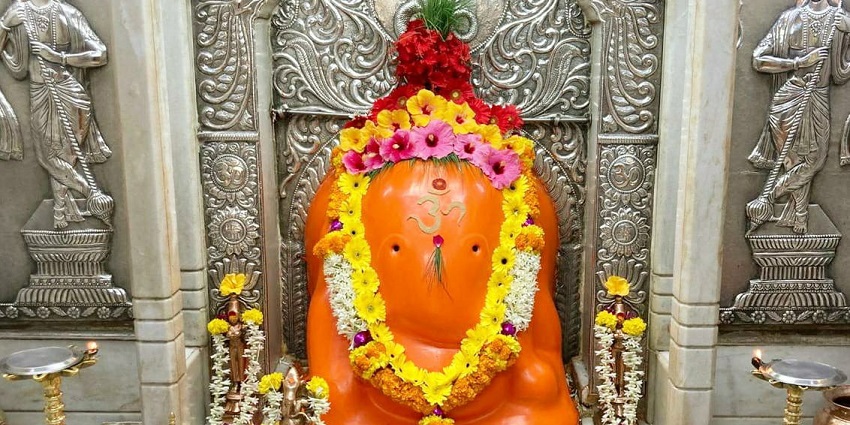
The Chintamani Temple is one of the largest Ashtavinayak shrines, showcasing a harmonious blend of architectural styles. Facing north, the main entrance opens into a spacious courtyard. The Sabha Mandapam, a wooden assembly hall constructed by Madhavrao I, features intricately carved pillars and a black stone water fountain. The Garbhagriha, the sanctum sanctorum, houses the swayambhu, or self-manifested idol, of Chintamani Ganesha, oriented eastward. The idol is cross-legged, coated in sindur, vermilion, with jewel-studded eyes and a trunk turned to the left. The temple complex is home to a sacred Kadamba tree, under which Ganesha is believed to have defeated Gana. Behind the temple stands the Peshwa Wada, once the residence of Madhavrao I, now serving as the administrative hub. The complex includes smaller shrines dedicated to Lord Shiva, Lord Vishnu, and Lord Hanuman. A European bell, a war trophy from the Portuguese, still hangs in the temple, a symbol of Maratha valour and piety.

The Chintamani Temple maintains a vibrant schedule of daily worship. The temple opens at 6 am, with devotees flocking for early morning darshan. Ritual bathing of the idol, or abhisheka, with milk, water, and flowers is performed, especially on auspicious days. Morning and evening aartis are conducted with great devotion, accompanied by the ringing of bells and the chanting of hymns. Naivedya, in the form of offerings of modaks, sweet dumplings, and other delicacies, are made to the deity and later distributed as prasad to devotees.
The temple is renowned as a centre for meditation, with devotees seeking relief from mental worries and anxieties. Pilgrims perform pradakshina, or circumambulation of the temple, often while reciting Ganesha mantras. Devotees offer prayers and tie threads around the sacred Kadamba tree, seeking the removal of obstacles and the fulfilment of wishes.
Ganesh Chaturthi, in August or September, is the most celebrated festival at Theur. Over ten days, the temple is adorned with decorations, and thousands of devotees gather for special rituals, processions, and communal feasting. The air is filled with devotional music and the sound of drums, creating an atmosphere of joy and spiritual fervour.
Maghi Chaturthi, celebrated in January or February, is another major festival. The festivities begin on the fourth day, or Chaturthi, and continue until the eighth day or Ashtami, featuring special abhishekas, aartis, and processions.
Unique to Theur is the Rama-Madhav Punyotsav, held on the eighth day of the Kartik month, so in October or November, commemorating the death anniversaries of Madhavrao I and his wife Ramabai. Devotees gather to honour their memory with prayers and rituals, reflecting the temple’s deep historical ties to the Maratha dynasty.
Theur is traditionally the fifth stop on the Ashtavinayak circuit, though many pilgrims visit it second due to its proximity to Pune and Morgaon. Its association with wish-fulfilment and peace of mind makes it a particularly popular destination for those seeking relief from life’s anxieties.
The Chintamani Temple is not only a place of worship but also a centre of community life. Festivals, daily rituals, and charitable activities bring together people from all walks of life, fostering a spirit of unity and shared devotion. In the tranquil embrace of Theur, amidst the echoes of ancient myths and the blessings of the wish-fulfilling Lord, devotees discover that true chintamani, the real jewel, is the serenity and stability that faith brings to the restless heart.
 Memories and Such