

Rising from the fertile plains of the Pune district, the Mahaganapati Temple at Ranjangaon stands as the culminating jewel of Maharashtra’s Ashtavinayak pilgrimage. Revered as the seat of Mahaganapati, the “Great Ganesha”, this temple is steeped in legend, history, and architectural grandeur. Here, Lord Ganesha is worshipped in his most potent form, invoked even by Lord Shiva himself in the cosmic battle against the demon Tripurasura. For centuries, devotees and warriors alike have sought Mahaganapati’s blessings, making Ranjangaon not just a spiritual destination but a living testament to the enduring power of faith and myth.
Ranjangaon is a tranquil village located about 50 km from Pune, along the Pune-Ahmednagar highway. The temple’s strategic location made it a favoured stop for Maratha chieftains and pilgrims journeying through the Deccan. Today, it is the eighth and final stop for those completing the revered Ashtavinayak Yatra, a circuit of eight self-manifested Ganesha temples across Maharashtra.
Historical records and the temple’s stone pillars suggest that the Mahaganapati Temple was originally constructed in the 9th or 10th century, with significant enhancements during the Peshwa era. Shrimant Madhavrao I, the Peshwa ruler, was a devout worshipper who regularly visited the temple before heading to battle. He built a stone sanctum around the idol and created a special cellar to safeguard the deity during times of turmoil. The temple’s hall and surrounding apartments, or owaris, were commissioned by Sardar Kibe, Sardar Pawar, and Sardar Shinde, prominent nobles of the time. In modern times, the temple’s Nagarkhana, or drum house, above the entrance, was inaugurated by Chief Minister Manohar Joshi in 1997, reflecting ongoing reverence and restoration.
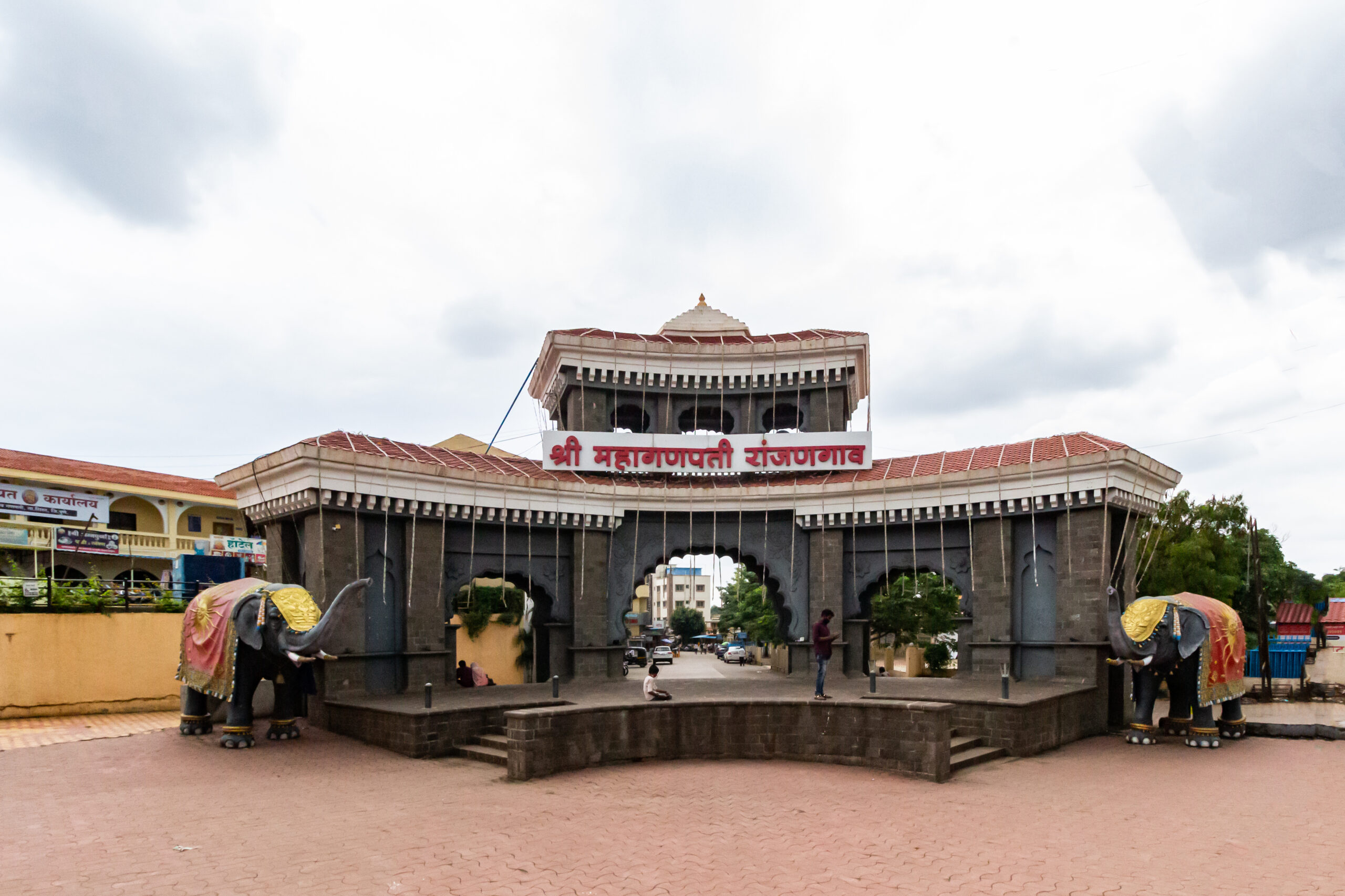
The temple boasts a massive and ornate entrance gate, flanked by two imposing dwarapalas, or gatekeepers, visible from the main road. The temple is ingeniously constructed so that during Dakshinayana, the sun’s southern movement, the rays of the rising sun fall directly on the main idol in the sanctum, a marvel of ancient engineering. The drum house above the entrance is used during festivals and processions, adding to the temple’s festive aura. The sanctum houses the swayambhu, or self-manifested idol, of Mahaganapati, seated on a lotus and accompanied by his consorts, Riddhi and Siddhi. Local tradition holds that the original idol, known as “Mahotkat,” is hidden in a basement and is said to have ten trunks and twenty arms, though the visible idol is more conventional in form.
The temple’s enduring myth centres on the cosmic battle between good and evil, with Mahaganapati as the divine catalyst. According to legend, the esteemed sage Grutsamad once sneezed, and from this act, a boy named Tripurasura was born. Tripurasura, raised with spiritual wisdom, learned the Ganesh mantra from his father and performed severe penance to Lord Ganesha. Pleased, Ganesha granted him a boon: Tripurasura would become the most powerful being in the universe and could only be defeated by Lord Shiva, after which he would attain liberation.
Empowered by this boon, Tripurasura’s pride grew unchecked. He conquered the underworld, the heavens, and even threatened the gods themselves. Lord Brahma hid in a lotus, and Lord Vishnu retreated to the cosmic ocean, unable to withstand Tripurasura’s might. Desperate, the gods turned to sage Narada, who advised them to worship Lord Ganesha. Ganesha, taking the form of a Brahmin, approached Tripurasura and offered to create three flying chariots that could only be destroyed by Shiva. In exchange, he asked for the Chintamani jewel from Kailash. When Tripurasura demanded the jewel, Lord Shiva refused, leading to a fierce battle.
Despite his power, Shiva could not defeat Tripurasura. Realising his mistake in not honouring Ganesha first, Shiva paused and recited the Shadaakshar Mantra to invoke Ganesha. Blessed with a special beejmantra, or seed mantra, Shiva was finally able to destroy Tripurasura with a single arrow]. This victory was possible only after seeking Ganesha’s grace, emphasising the deity’s role as the remover of all obstacles, even for the gods!
The site where Shiva invoked Ganesha and achieved victory became Ranjangaon, and the form of Ganesha worshipped here is known as Mahaganapati or Tripurarivade Mahaganapati, the destroyer of Tripurasura.
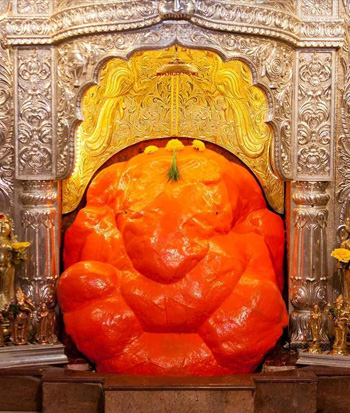
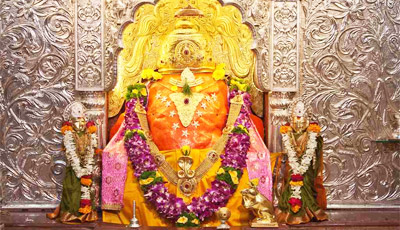
The idol at Ranjangaon is revered as one of the most powerful forms of Ganesha. Mahaganapati is depicted seated on a lotus, flanked by his consorts Riddhi, or prosperity, and Siddhi, or spiritual power. The idol is Swayambhu, believed to have emerged naturally from the earth. In some traditions, the idol is described as “Mahotkat,” possessing ten trunks and twenty arms, though it is more commonly seen with eight, ten, or twelve arms.. The idol’s serene yet commanding presence embodies both the gentle and formidable aspects of the deity.
Each day, the idol is ritually bathed with water, milk, and fragrant substances, accompanied by the chanting of Vedic mantras. Morning and evening aartis are performed with lamps, bells, and devotional songs, filling the temple with a vibrant spiritual energy. Offerings of modaks, coconut, and flowers are made to the deity, and prasad is distributed to devotees as a blessing.
Sahastravartan is an elaborate ritual that involves the recitation of Ganesha’s names or mantras a thousand times, seeking his blessings for the removal of obstacles and the fulfilment of wishes. The Satyavinayak Pooja is a special worship performed for significant life events or to fulfil vows. During the Bhadrapada festival, devotees perform “Lotangan”, which means rolling their bodies in prostration along the path to the temple as an act of surrender and devotion.

Unlike many other villages, the people of Ranjangaon do not bring Ganesha idols into their homes during Ganesh Chaturthi. Instead, the entire community gathers at the Mahaganapati Temple for collective worship, reinforcing the temple’s role as the spiritual heart of the region.
Ganesh Chaturthi is celebrated with immense fervour at Ranjangaon. The temple is adorned with flowers and lights, and special rituals, abhisheks, and aartis are performed. On the fifth day of the festival, a grand feast called a mahabhog is offered to the deity, and the idol is taken in a flower-bedecked palkhi, or palanquin procession, around the temple grounds. Wrestling matches and cultural events are also organised, drawing large crowds from nearby villages.
A unique sixth-day celebration during Bhadrapada sees devotees flocking to the temple, performing special rituals, and participating in communal festivities. The atmosphere is one of joy, devotion, and unity.
The Mahaganapati Temple is more than a place of worship; it is a symbol of the triumph of wisdom and humility over pride and chaos. The legend of Tripurasura underscores the importance of invoking Ganesha before any new undertaking, a tradition now embedded in Hindu practice. The temple’s sun-aligned architecture, powerful idol, and living rituals all reinforce the message that with faith, even the greatest obstacles can be overcome.
Ranjangaon is the eighth and final stop in the Ashtavinayak circuit, making it the spiritual culmination of the pilgrimage. Pilgrims often report a sense of completion and fulfilment upon receiving Mahaganapati’s blessings, believing that their prayers and efforts throughout the yatra have been acknowledged and rewarded.
After Ranjangaon, pilgrims go back to the Moreshwar Temple to complete the Ashtavinayak circuit. And with that visit, they complete the pilgrimage. This circuit is something I have wanted to do for a while, given that the circuit is in my home state, and it is a pilgrimage for my ishtadev! I will do this sooner rather than later; that’s my promise to myself.
 Memories and Such