

Every spring, as the searing Tamil sun mellows into the gold of April, something extraordinary happens in a quiet little village called Koovagam. For most of the year, this village in Tamil Nadu’s Kallakurichi district (formerly Villupuram) is unremarkable: dusty lanes, small fields, temple bells. But for eighteen days each year, it transforms into one of the most unusual and moving festivals in India: the Koovagam Festival.
This is no ordinary temple celebration. Here, thousands of transgender women and members of the third gender gather to take part in a centuries-old ritual, one that celebrates love, sacrifice, and identity. It is a festival rooted in the myth of Aravan from the Mahabharata, a story that intertwines devotion with a profound act of self-recognition.
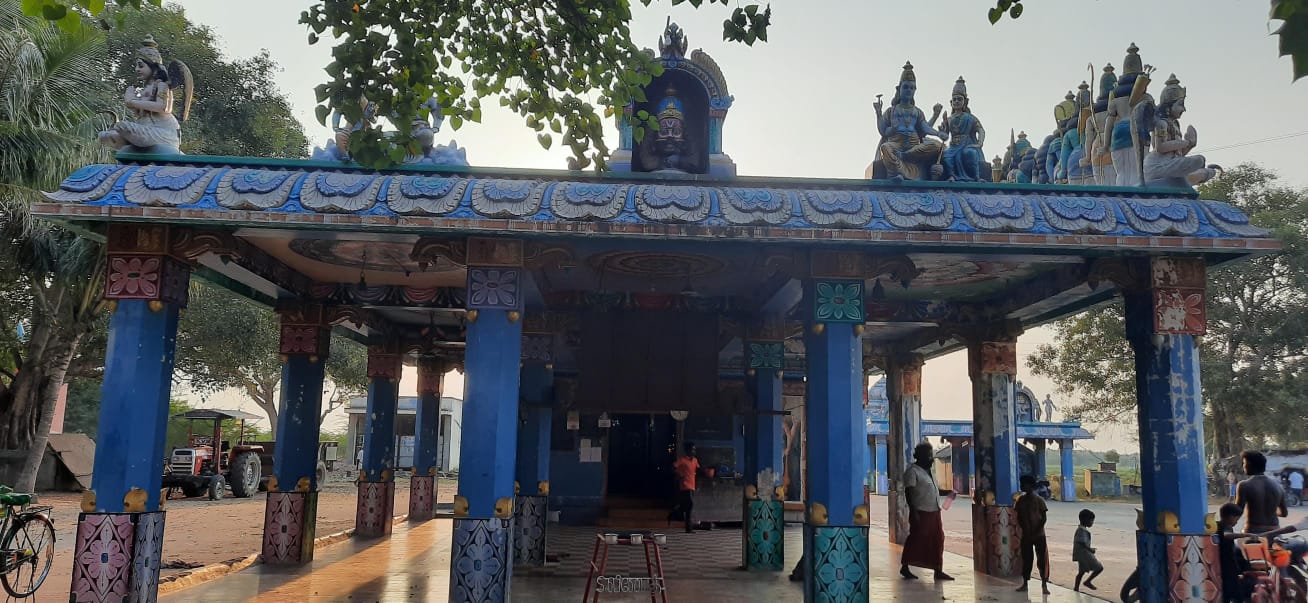
Koovagam lies about 25 km from Villupuram, reachable by road from Chennai, Puducherry or Ulundurpettai. At its heart stands the Koothandavar Temple, dedicated to Aravan, known locally as Koothandavar, the heroic son of Arjuna and the Naga princess Ulupi.
For most of the year, the temple sees a trickle of local devotees. But during the Tamil month of Chithirai (mid-April to mid-May), the quiet lanes overflow with colour and sound. Transgender devotees, called aravanis, arrive from every corner of India, from Chennai to Mumbai, from Hyderabad to Kolkata. Some even travel from Singapore and Malaysia. They come not merely as visitors but as brides, ready to marry the god who once sought love before his death.
At the heart of Koovagam lies a myth that dates back thousands of years. In the Mahabharata, Aravan (or Iravan in Sanskrit) is the son of Arjuna and Ulupi, born of a union between the human and the divine serpent race. When the Pandavas were preparing for war against the Kauravas, the goddess Kali demanded a human sacrifice to ensure victory. Aravan volunteered.
But before his death, he asked for three boons: The first that he should die a heroic death on the battlefield. The second was that he should witness the war even after his death, and the third and most poignantly, that he should be married before he died, so that he could taste the joys of love and companionship, however briefly.
There was one problem: no woman wished to marry a man who would die the next day and make her a widow. Moved by compassion, Lord Krishna transformed into his female avatar, Mohini, and married Aravan. The following day, Aravan was sacrificed. His severed head was placed on a hilltop to watch the battle, fulfilling his second boon. Mohini mourned his death, breaking her bangles and removing her wedding ornaments, embodying eternal widowhood.
This story, which in the grand epic may have been a passing mention, took on profound local significance in Tamil Nadu. Over centuries, it evolved into the Koovagam Festival, where transgender women, who identify with Krishna’s transformation, symbolically become the brides of Aravan. For the aravanis, the festival is a spiritual homecoming. Over eighteen days, the village becomes a living stage for rituals, performances, and processions that reenact the myth in vivid detail.
In the early days, Koovagam begins to hum with activity. Stalls are set up selling flowers, turmeric, bangles, vermilion, and food. Cultural programmes fill the air — beauty pageants like “Miss Koovagam,” dance performances, plays, and music shows—all organised by and for the transgender community. Health camps, especially those raising awareness about HIV and women’s health, are run by NGOs. For many attendees, this is also a time of reunion, old friends meet again, newcomers are welcomed, and stories of hardship and triumph are shared over tea and laughter.

As the festival reaches its climax, the most important ritual takes place, the divine wedding. On the full moon night, the temple courtyard glows with lamps and energy. The aravanis bathe, dress in bridal finery, bright silk saris, jasmine garlands, glass bangles that jingle with excitement. Priests perform the rituals of a traditional Hindu marriage. One by one, each aravani stands before the idol of Aravan. The thali, the sacred wedding pendant, is tied around her neck by the temple priest. Vermilion is applied to her forehead. For that night, she becomes a bride of the god, adorned, cherished, radiant. For many, this ceremony is deeply personal. It is not a mere symbol but an act of recognition, a sacred moment when their identity is acknowledged not just by society, but by divinity itself.
That evening, Koovagam turns into a festival of life. Music fills the streets; dancing breaks out under the stars. Some call it a night of joy, others a night of freedom. For those who live much of their year in the shadows of social prejudice, this is their night to shine; to laugh, to love, to be seen.

But just as the myth goes, joy gives way to sorrow. The next morning, Aravan is symbolically sacrificed. His image, often represented by a wooden effigy or painted head, is paraded through the streets before being taken to the temple. The brides gather once more, this time in grief. They remove their thalis, wipe off the vermilion, break their glass bangles, and change into white sarees, the colour of widowhood. Some cry openly; others remain quiet, eyes glistening.
The mood shifts from celebration to mourning, from noise to silence. It is one of the most hauntingly beautiful moments of the festival, when thousands of women collectively grieve for a god, and in doing so, perhaps for themselves.
The Koovagam Festival is far more than an act of devotion. Each ritual carries layers of meaning: spiritual, social, and emotional. The marriage represents acceptance. In a society that often refuses to acknowledge transgender relationships, this ritual grants legitimacy. Each bride is seen, blessed, and celebrated. The widowhood reflects loss, not only Aravan’s death but the community’s experience of rejection and mourning in everyday life. Yet, it is also catharsis, a release that allows renewal. The gathering itself is resistance. It is a statement that the community exists, that its members are not invisible, and that their identities are interwoven with the cultural and religious fabric of India. For many aravanis, the journey to Koovagam is not just about tradition; it is about belonging.
The Koovagam Festival has grown to become a social, cultural, and political event. NGOs, health workers, and rights organisations set up stalls and workshops to discuss issues such as transgender rights, legal protection, mental health, and employment. Beauty contests and pageants celebrate individuality. Participants are judged not just for looks but for confidence, talent, and advocacy. “Miss Koovagam,” for instance, is crowned after multiple rounds that include questions about gender justice and community welfare. In recent years, these programmes have also attracted media attention, bringing greater visibility to the transgender community. What was once a local ritual is now a space for global dialogue, about identity, love, and equality.
Over the eighteen days, the festival follows a rhythm, part spiritual journey, part carnival. In the first week, the village slowly fills up with visitors. Street vendors line the roads, and the temple begins daily rituals to purify and prepare the deity. There are music nights, community feasts, and theatre performances retelling the story of Aravan and Mohini. By the second week, the numbers swell. Processions take over the streets, and the excitement becomes palpable. The day before the full moon is spent in fasting, prayers, and decorating the temple. The fourteenth day marks the great wedding: hundreds of aravanis lining up for their turn to marry Aravan. It is followed by a night of joy, dance, and freedom. Then comes the sixteenth day, when mourning begins. The temple bells toll softly. The brides shed their symbols of marriage and take on the plain white of widowhood. The image of Aravan is carried in a procession, his death and the grief of his widows marking the end of the cycle. The last two days are for quiet rituals, temple purification, and prayers for the next year’s return. This progression, from celebration to grief to closure, reflects the eternal cycles of life, love, and loss.
At first glance, the Koovagam Festival might seem paradoxical: why celebrate a marriage that ends in tragedy? But therein lies its beauty. The festival acknowledges that love and loss coexist; that joy and pain are two halves of the same truth. For transgender participants, the marriage to Aravan is an act of claiming their place within sacred tradition. In a world where they are often excluded, the gods themselves make space for them. And in Krishna’s transformation into Mohini, they find divine validation of gender fluidity, proof that the divine, too, transcends boundaries. The widowhood that follows may appear sorrowful, but it also mirrors resilience, the ability to grieve and still continue. It becomes a metaphor for endurance, for the unending cycle of exclusion and self-renewal that the community faces.
While deeply rooted in religion, Koovagam is also a mirror to the social reality of transgender life in India. The festival embodies both visibility and vulnerability. For those three weeks, transgender women are celebrated. They walk openly, dance, speak, love, and society, for once, looks at them with awe rather than prejudice. But as many participants have reflected, once the festival ends, the world often turns away again. Koovagam thus becomes a powerful metaphor: a brief window of acceptance in a long struggle for dignity.
That’s why NGOs and rights groups have increasingly used the festival as a platform. Health awareness booths line the streets. Legal aid tents help with identity documentation. Activists conduct talks on the Transgender Persons Act, job opportunities, and mental-health support. Koovagam is, in many ways, India’s most visible intersection of faith and activism.
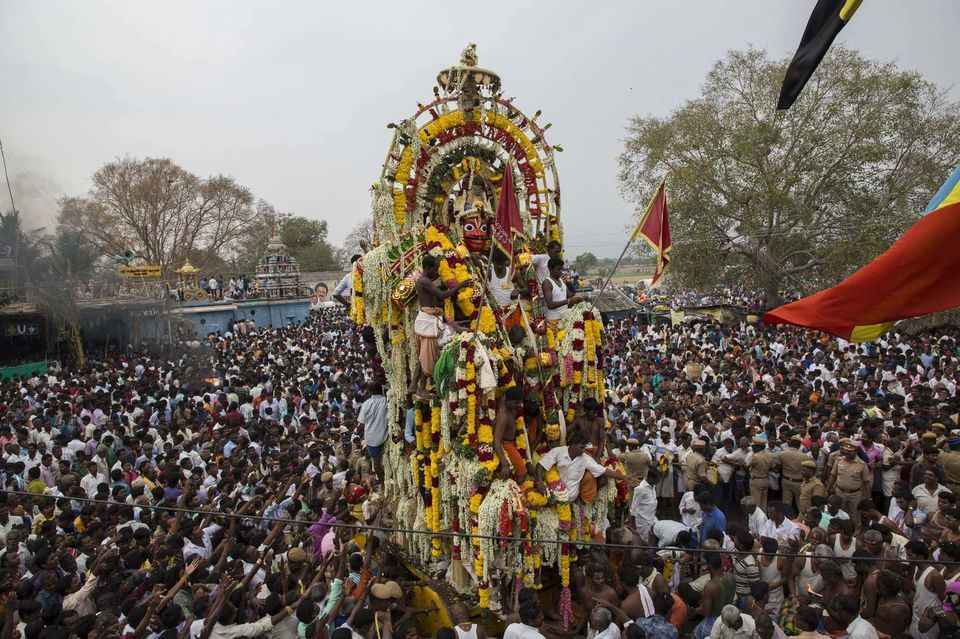
Visiting Koovagam during the festival is to step into another world. Imagine the scent of jasmine in the air, the sparkle of glass bangles catching the sun, and the rhythmic thud of drums echoing through narrow lanes. In one corner, a group of aravanis practise a dance for the evening’s competition. In another, a stall sells white sarees for the widowhood ritual. Children run about with sweets; priests chant from ancient verses; NGOs distribute pamphlets about health and rights. And through it all, there is laughter; unrestrained, infectious. When the night of the wedding comes, the entire village glows. Lamps flicker along doorsteps, and the temple courtyard becomes a sea of colour. The brides wait in line, their faces lit with excitement, their eyes glistening as the thali is tied. When the bells ring, a collective cheer rises, a sound both joyous and sacred. Then, two days later, the air grows heavy. The brides return in white, bare-necked and solemn. The sound of breaking bangles echoes through the streets, a ritual that reverberates like a heartbeat. The transition from noise to silence is profound. Few festivals in the world capture such a range of human feeling, love, loss, joy, grief, woven together in ritual and myth.
The story of Aravan is told in several ways across Tamil Nadu. In some versions, his head continues to live after the sacrifice, watching the war unfold. In others, it is said that he fought and killed a demon named Kuttacuran, which earned him the title Koothandavar. The very name “Koovagam” is said to come from the sound of his dying cry, “Kuva… kuva…” that echoed through the land.
Whatever the version, one truth remains: Aravan’s story is one of self-sacrifice for a greater cause. The transgender community’s devotion to him is a continuation of that ideal, the willingness to live authentically, even in the face of loss.
Like all living traditions, Koovagam has its challenges. The festival’s growing popularity has attracted tourists and media crews. While this visibility can be empowering, some participants feel that the deeper spiritual meaning risks being overshadowed by spectacle. There are also practical issues: sanitation, accommodation, and safety in a small village suddenly hosting tens of thousands of visitors. Environmental concerns, too, have become part of recent discussions. Beyond logistics, the larger challenge is social. For many transgender people, the acceptance they receive in Koovagam is fleeting. Legal recognition and societal inclusion remain ongoing struggles. And yet, there is hope. Each year brings more solidarity, more awareness, more conversations. Younger generations of transgender individuals are using Koovagam not only to connect with tradition but to advocate for change.
Koovagam is not just a festival, it is a mirror reflecting India’s complex tapestry of faith, gender, and humanity. It tells us that tradition is not static; it evolves. What began as a regional ritual has grown into a powerful movement of inclusion. In the figure of Aravan, we see courage and sacrifice. In the brides of Aravan, we see the courage to live truthfully, even in a world that often refuses to understand. The festival blurs boundaries: between male and female, sacred and profane, devotion and desire. It is a reminder that divinity is not limited by form or gender.
For those who visit, Koovagam is a lesson in humility and empathy. Observers are encouraged to watch respectfully, to understand that what unfolds here is deeply sacred. The rituals are not performances but prayers. Travellers who come to witness the festival often speak of being profoundly moved. Some come expecting spectacle and leave with silence, having witnessed something that defies easy categorisation. To visit Koovagam is to see the power of myth living in the modern world—not as nostalgia, but as identity in motion.

When the festival ends, the crowds disperse. The brides return to their cities and towns, the temple returns to its quiet rhythm, and the dust settles on the roads. But something lingers in the air, a feeling, a whisper, a promise. In the myth, Aravan’s head remained alive to witness the war. In Koovagam, his spirit remains alive through those who gather in his name. The aravanis carry with them not just memories of the wedding and mourning, but the reassurance that they belong to each other, to their god, and to the world. The Koovagam Festival is, in essence, a song of identity; one that rises each year from a small Tamil village to remind the world that love, in all its forms, is sacred. And when the last lamp fades, and the roads fall silent, you can still almost hear the echo of that truth in the wind—the echo of a thousand hearts that dared to love, even for a day.
 Memories and Such