

In the eastern stretches of the subcontinent, when the monsoon begins to loosen its grip, but the air still carries the weight of rain, villages gather around a tree branch. The soil is dark and damp. The fields are not yet ready to yield. There is a pause in the agricultural cycle, a moment where nothing is certain, and it is precisely here that Karam takes place.
In Jharkhand’s forested belts, in the agrarian rhythms of Bihar and Odisha, in the quieter rural pockets of West Bengal, and across to parts of Bangladesh, this festival arrives without spectacle. There are no grand processions or towering structures. Instead, there is a clearing, a branch of the Karam tree, and a circle of people marking something less visible but no less essential.
Karam is often described, somewhat too neatly, as a “harvest festival.” The label is not wrong, but it is insufficient. It suggests completion when Karam is about continuity. It suggests yield, when Karam is equally about restraint. It centres on crops, when the festival itself is about relationships between people, generations, and most importantly, between human life and the natural world.
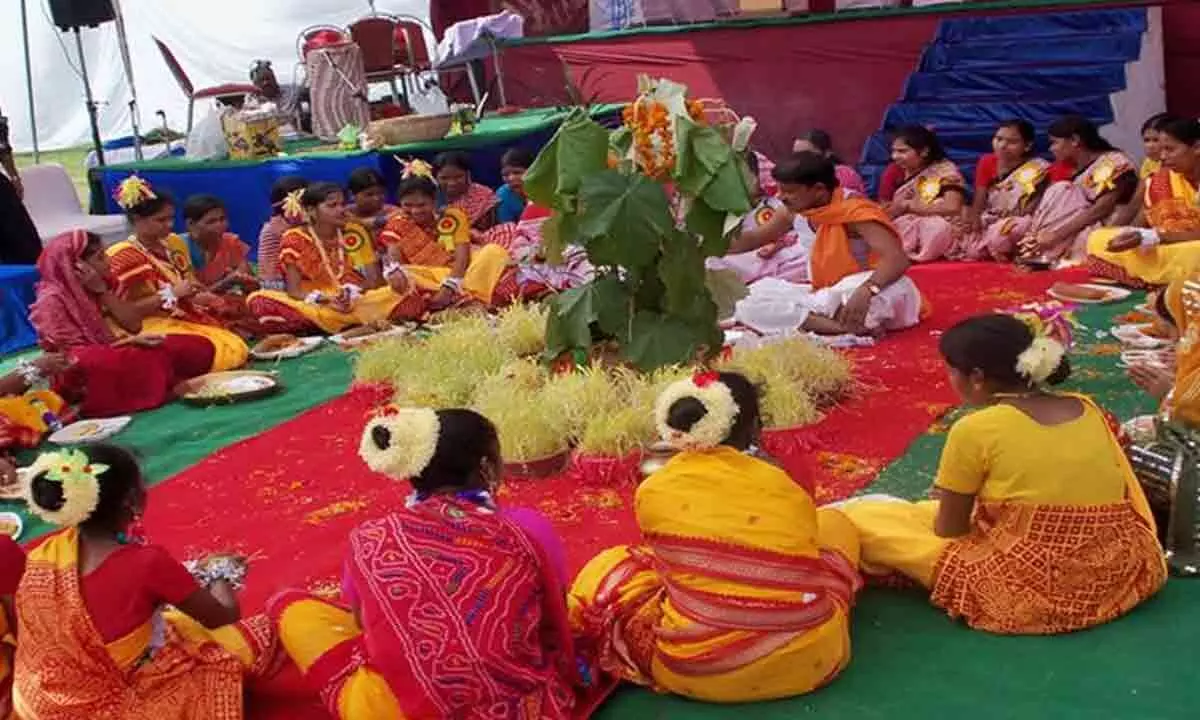
Across regions, details shift, but the structure holds. A branch of the Karam tree is cut with care and brought into the community space. It is planted, decorated, sung to, and kept at the centre of the gathering. Young women, in many communities, take the lead. They fast, prepare the rituals, and sing songs that carry both devotion and memory. There is music, dancing, and storytelling.
The ritual is not performed for an audience. It is lived.
It is important to say this plainly. Many of these practices emerge from Adivasi cultural worlds, where land is not treated as a resource but as something one lives within. Yet when Karam enters mainstream narratives, it is often absorbed into a broad idea of “Indian culture.” The specificity softens. The communities that have sustained these traditions, often with little visibility, are mentioned briefly, if at all.
This is not neutral. It allows appreciation without responsibility.
At its core, Karam is not simply about thanking nature. It reflects an understanding that human life is entangled with the natural world in ways that cannot be controlled. The timing matters. It takes place before harvest, not after. It acknowledges uncertainty. Growth is still underway. Outcomes are not guaranteed.
What we might call ecological intelligence sits quietly within this structure. It is visible in the centrality of the tree, not as a symbol but as a presence. It is visible in collective participation rather than individual display. It is visible in songs that carry knowledge forward without naming it.
And yet, this is where the tension begins.
Modern life has a way of preserving what it erodes. Festivals like Karam are documented, occasionally celebrated, and sometimes showcased. But their function shifts. A living ritual becomes a cultural display. Something rooted in everyday life is repositioned as heritage.
There is also a quieter discomfort. Many urban readers, myself included, encounter Karam from a distance. It does not appear in textbooks or dominant cultural calendars. Unless one belongs to these regions or communities, it is entirely possible to grow up without hearing of them.
When we do encounter it, we admire what we see. The sense of community. The closeness to nature. The simplicity of the ritual. But admiration can slip into romanticisation. We notice what feels different but do not always ask what sustains it or what pressures it faces.
The forests that anchor these practices are under strain. Land use is changing. Economic pressures are reshaping livelihoods. Migration is altering communities. In this context, the continued presence of Karam can suggest continuity, even as the underlying world shifts.
Even the language we use reflects this distance. To call Karam a “harvest festival” is to make it legible within a familiar framework. It allows it to be categorised and compared.

But this convenience comes at a cost.
The term centres outcome over process. It shifts attention to yield rather than the relationship. It fits the festival into an agricultural narrative that prioritises production, even though Karam is rooted in interdependence.
Why does this framing persist? Perhaps because it aligns with how modern systems understand land in terms of output and efficiency. In that sense, the label does not just simplify Karam. It reveals the lens we are accustomed to using.
In Bangladesh, where Karam is observed among certain communities, the patterns feel familiar even when visibility is lower. The rituals adapt, but the logic remains. A branch, a gathering, songs carrying memory across generations.
What stands out is not uniformity, but persistence.
Despite borders, administrative differences, and varying recognition, the relationship between land, season, and community continues to shape the festival. And yet, its relative invisibility raises a question. Which traditions are recorded and amplified, and which continue quietly, sustained only by those who live them?
To write about Karam is to sit with discomfort. The festival continues, but the conditions that sustain it are not guaranteed. Appreciation, on its own, is not enough.
And yet, it would be too simple to end there.
Karam resists reduction. Despite pressures, it continues not as a relic but as a practice. People gather. Songs are sung. The Karam branch is placed at the centre of a shared space and treated with care.
Perhaps what Karam offers is not a model to replicate, but a way of seeing. Relationships with land, community, and time cannot be abstracted. They have to be practised. Celebration is not separate from responsibility. Memory, when held collectively, can still shape how a community moves forward.
In a world that prioritises speed, extraction, and individual achievement, this can feel like an older language.
But it has not disappeared.
It is still there, in the gathering around a tree branch, in songs that carry devotion and memory, and in the quiet understanding that human life does not stand apart from the world that sustains it.

