Sacred Stones, Spaces and Stories: Shakthipeeta Part 19

Ujaani Temple, Mangalkot, West Bengal
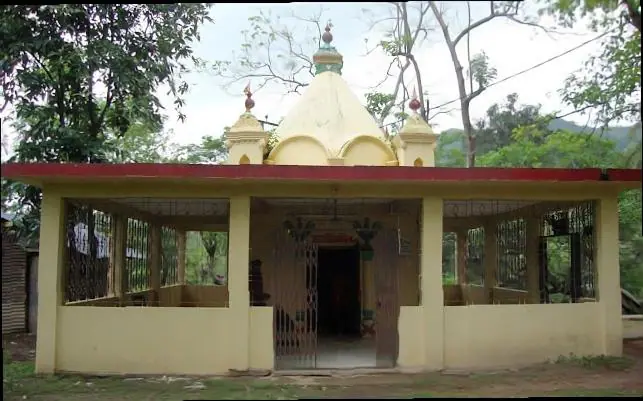
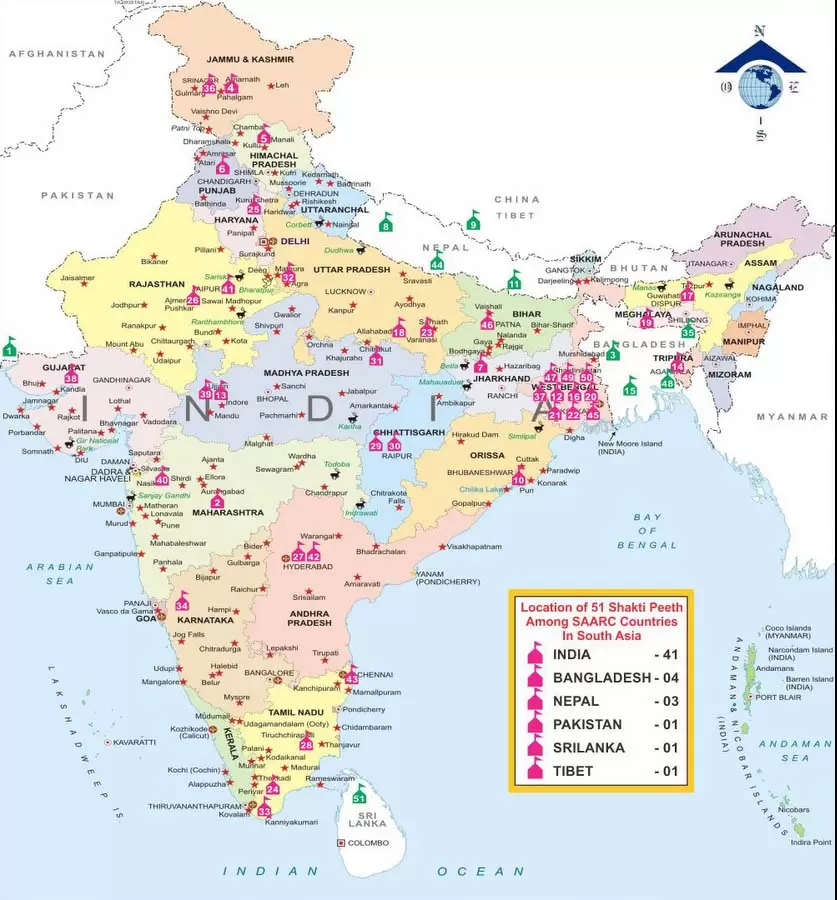
The Ujani Shakti Peeth, located in the serene village of Ujani near Guskara in Bardhaman district is dedicated to Maa Mangal Chandi, a powerful form of Goddess Durga. It is believed that Sati’s right wrist fell at this location in Ujani village.

The temple has been a centre of devotion for centuries. The name Mangal Chandi reflects the goddess’s role as a protector and benefactor of her devotees. The word Mangal means welfare, while Chandi refers to Goddess Durga’s fierce and protective aspect. The temple’s current structure is simple yet exudes an aura of divinity that draws pilgrims seeking peace and blessings. The temple is located about 16 kilometers from Guskara Railway Station and is easily accessible by road. Surrounded by lush greenery and ancient trees, the temple offers a serene environment for meditation and worship.

Goddess Sati is worshipped here as Maa Mangal Chandi, symbolising divine protection and nurturing energy. Lord Shiva is revered as Kapilambar Bhairava, representing his role as a guardian and protector. The combination of Maa Mangal Chandi and Kapilambar Bhairava represents the union of nurturing feminine energy with protective masculine power, making this Shakti Peetha a site of immense spiritual significance.

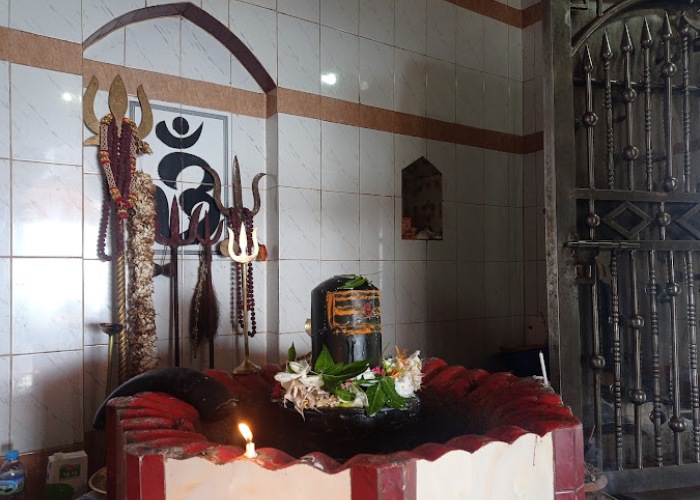
The Ujani Shakti Peeth stands out for its distinctive characteristics. The sanctum sanctorum houses two idols: one of Maa Mangal Chandi and another of Lord Shiva as Kapilambar Bhairava. Maa Mangal Chandi’s idol depicts her in a benevolent yet powerful form, adorned with ornaments and flowers offered by devotees. Kapilambar Bhairava’s idol symbolises Lord Shiva’s meditative yet protective aspect.

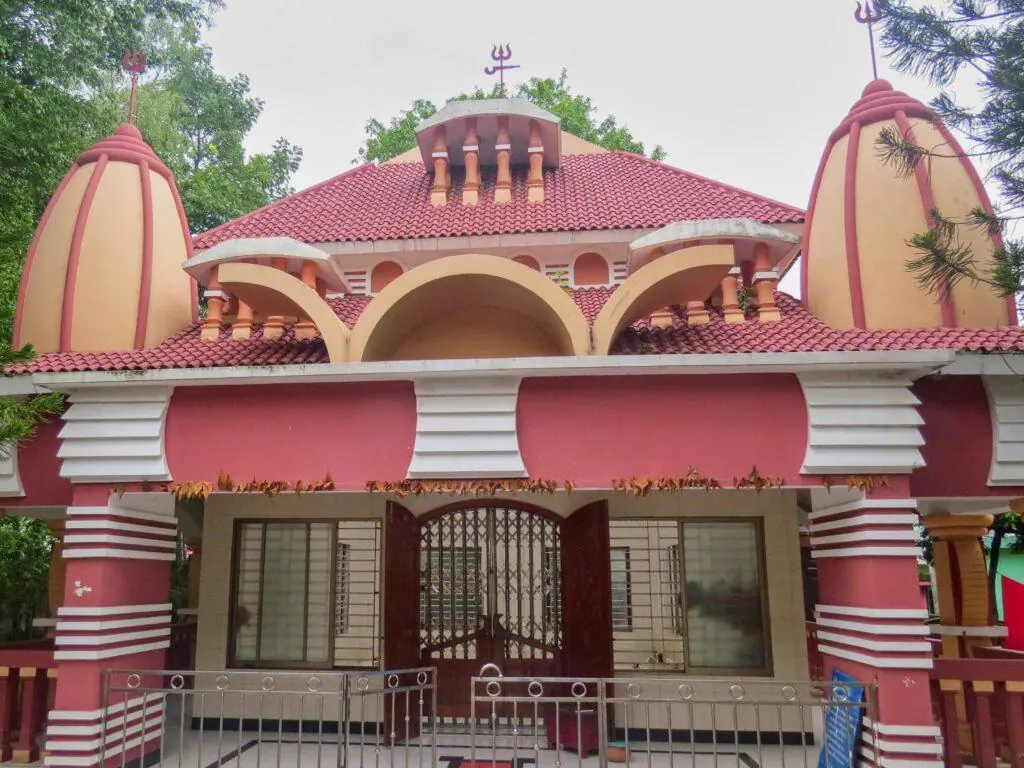
The temple structure is painted yellow and lacks elaborate architectural ornamentation. Its simplicity emphasizes spiritual connection over material grandeur. The courtyard is shaded by ancient trees that add to the temple’s serene ambiance. A pavilion or mandap in front of the deity provides space for devotees to sit and meditate. Pilgrims often describe entering meditative states effortlessly in this peaceful setting. Surrounded by greenery, the temple offers a calm environment ideal for introspection and prayer. Birds chirping in the trees add to its natural charm.

Daily pujas are performed by priests with morning Aarti begining at sunrise with chanting of hymns like Durga Saptashati and evening Aarti concluding with the lighting oil lamps around the temple premises. Durga Puja is celebrated with great fervor at Ujani Shakti Peeth. Elaborate rituals are conducted to honour Maa Mangal Chandi’s victory over evil forces. The deity is adorned with new clothes and jewelry donated by devotees during this time. Navratri is celebrated twice a year with grand rituals honoring Maa Mangal Chandi’s nurturing aspect. Devotees observe fasting during these nine days to seek blessings for prosperity and protection.

Dedicated to Lord Shiva who is worshipped as Kapilambar Bhairava, Mahashivratri involves night-long prayers and abhishekam with milk, honey, ghee, curd, and holy water. Devotees light oil lamps around the temple premises as part of their offerings. Yagnas are conducted during auspicious occasions like Navratri to invoke divine blessings for health, wealth, and spiritual growth.

According to legend, when Sati’s right wrist fell at this site after being dismembered by Vishnu’s Sudarshan Chakra, it radiated immense divine energy that sanctified not only Ujani but also its surrounding regions. Devotees believe that this energy can still be felt within the temple premises during meditation or prayer. Local lore suggests that Kapilambar Bhairava appeared in his fierce form to protect this sacred site from negative energies after Sati’s right wrist fell here. His presence ensures balance and harmony at Ujani Shakti Peeth. Devotees believe that Maa Mangal Chandi possesses miraculous healing powers. Many pilgrims visit the temple seeking relief from physical ailments or emotional distress after hearing stories of miraculous recoveries attributed to her blessings.

The Ujani Shakti Peeth offers visitors a unique spiritual experience rooted in mythology and devotion.
Bargabhima Temple, Tamluk, West Bengal
Located in Tamluk, Purba Medinipur district, the Vibhash Shakti Peeth, also known as the Bargabhima Temple, is dedicated to Maa Kapalini or Bhimarupa, an incarnation of Goddess Durga. As one of the 51 sacred Shakti Peethas, it is believed that the left ankle or heel of Goddess Sati fell at this site. Nestled on the banks of the Roopnarayan River, this ancient temple blends spirituality, history, and cultural heritage. Lord Shiva is worshipped here as Sarvanand Bhairava.

The temple is said to have been constructed during the reign of the Mayur dynasty, which ruled over Tamluk in ancient times. The current structure has undergone several renovations over centuries but retains its spiritual essence. Historical records suggest that the temple has been a centre of devotion for over 1,000 years. Tamluk itself holds special significance as a sacred Vaishnava Tirtha or pilgrimage site. According to the Jaimini Mahabharata and Kashidas Mahabharata, Lord Krishna visited Tamluk to release the divine horse for the Ashwamedha Yajna.

Goddess Sati is worshipped here as Maa Kapalini or Bhimarupa, symbolising power and protection. Lord Shiva is revered as Sarvanand Bhairava, representing his role as a guardian and protector. The left ankle or vama gulpha of Sati is believed to have fallen at this site.

The sanctum sanctorum houses an idol of Maa Kapalini in her fierce form. She is depicted with multiple arms holding weapons and adorned with ornaments offered by devotees. Adjacent to her shrine is a large black stone Shiva Lingam representing Sarvanand Bhairava. The Lingam is surrounded by a circular white marble boundary. The temple architecture reflects a blend of Hindu, Buddhist, and Oriya styles. Its pyramidal dome resembles Kalinga temple tombs, while the natmandir or prayer hall follows the traditional Bengali aatchala style. The intricate carvings on its walls depict scenes from Hindu mythology.

Situated on the banks of the Roopnarayan River amidst lush greenery, the temple offers a serene environment ideal for meditation and prayer. During India’s freedom struggle, revolutionaries like Khudiram Bose visited this temple to seek blessings before embarking on their missions. The temple served as an oath-taking site for many revolutionaries who vowed to free their motherland. Unlike most temples where vegetarian offerings are made, Maa Kapalini’s prasad includes non-vegetarian items such as cooked fish or sol mach. This practice reflects ancient traditions associated with Shakti worship.

The rituals at Vibhash Shakti Peeth reflect deep-rooted traditions combined with local customs. Daily pujas are performed by priests. The morning Aarti begins at sunrise with chanting of hymns like Durga Saptashati, while evening Aarti concludes with lighting oil lamps around the temple premises. Durga Puja is celebrated with grandeur at Vibhash Shakti Peeth. Elaborate rituals are conducted over nine days to honour Maa Kapalini’s victory over evil forces. Devotees participate in cultural programs and community feasts during this time.

Held during Makara Sankranti in January, Barunir Mela is an annual fair that attracts thousands of pilgrims who come to take a holy dip in the Roopnarayan River before offering prayers at the temple. On Sharad Purnima, special prayers are held under moonlight to invoke divine blessings for prosperity and happiness. Dedicated to Sarvanand Bhairava, Mahashivratri involves night-long prayers and abhishekam with milk, honey, ghee, curd, and holy water. Devotees light oil lamps around the Shiva Lingam as part of their offerings.

Tamluk holds special significance due to its association with Lord Krishna. According to local lore recorded in Jaimini Mahabharata and Kashidas Mahabharata, Lord Krishna visited Tamluk during his Ashwamedha Yajna and blessed the region with his divine presence. During India’s freedom struggle, many revolutionaries took oaths at Vibhash Shakti Peeth before embarking on their missions. They believed that Maa Kapalini’s blessings would protect them in their fight for independence.

The Vibhash Shakti Peeth offers visitors a unique spiritual experience rooted in mythology and devotion. Unique features like non-vegetarian prasad emphasise ancient traditions while preserving spiritual heritage. Whether you seek spiritual solace or wish to explore India’s rich cultural heritage, visiting this ancient shrine will leave you feeling connected to divine feminine energy embodied by Maa Kapalini.

Jogadya Temple, Kshirgram, West Bengal
The Jogadya Temple, located in Kshirgram, Purba Bardhaman district s dedicated to Maa Jogadya, a fierce form of Goddess Durga. Lord Shiva is worshipped here as Kshireshwar Bhairava. It is believed that the big toe of Sati’s right leg fell at this site, sanctifying it as a Shakti Peetha. Known for its unique rituals, historical significance, and mystical legends, the Jogadya Temple attracts devotees from across India who come to seek blessings and experience its divine energy.

Historical evidence suggests that the temple dates back to the 11th century CE. It was originally constructed as a brick temple surrounded by a compound wall. Over time, it underwent several phases of destruction and reconstruction. The temple was severely damaged during invasions by Kalapahar but was later restored by local rulers and devotees. The current structure reflects a blend of ancient and modern architecture.

The name Jogadya derives from two Sanskrit words: Jug meaning era and Adya meaning the first, symbolising the goddess as the primordial force who presides over all eras. Locals also refer to the temple as Maa-er Baari or the Mother’s Home, emphasising its importance in their lives. The combination of Maa Jogadya and Kshireshwar Bhairava represents the union of nurturing feminine energy with protective masculine power.

The main sanctum does not house a traditional idol but instead has an altar connected to an underground chamber symbolising Maa Jogadya’s connection to the underworld or Paatalnivasini. Devotees worship this altar as her divine presence. Adjacent to the temple lies a sacred pond known as Kshirdighi. It is believed that Maa Jogadya resides in this water body. The goddess is ceremonially brought out of the water only seven days a year for public worship. Devotees believe that bathing in this pond purifies sins and brings prosperity. A copper pot or kalash filled with water from the sacred pond, Kshirdighi, is placed on the altar during special rituals.

A beautifully carved decagonal statue of Mahishamardini Durga was created by Nabin Chandra Bhaskar in imitation of an older idol lost during invasions. This statue is housed in a new temple built by villagers and remains open for darshan throughout the year. The temple complex includes three main sections: the domed sanctum or the garbhagriha, an entrance hall or the ardhamandap, and a dance hall or the natmandir. Its design reflects traditional Bengali temple architecture with minimal ornamentation. A small shrine dedicated to Lord Shiva as Kshireshwar Bhairava stands near Maa Jogadya’s temple. The idol of Shiva is placed at an elevated height and is accessible via stairs.

Daily pujas are performed by priests with the morning Aarti at sunrise which begins with chanting of hymns like Durga Saptashati, while evening Aarti concludes with lighting oil lamps around the temple premises. On Baishakh Sankranti, the last day of Baishakh, Maa Jogadya is ceremonially brought out of Kshirdighi for public worship. This grand event attracts thousands of devotees who gather to witness her darshan. Buffalo sacrifices are performed during this ritual as part of ancient Shakti worship practices. Apart from Baishakh Sankranti, Maa Jogadya is brought out on select days like Asadh Navami, Vijayadashami or Dussehra, Paush Sankranti, and Makara Sankranti for worship by priests or specific community members. Durga Puja is celebrated with grandeur at Jogadya Temple. Elaborate rituals are conducted over nine days to honor Maa Durga’s victory over evil forces. Devotees participate in cultural programs and community feasts during this time. On new moon nights or Amavasya, special Tantric rituals are conducted by priests to invoke Maa Jogadya’s protective energy.

According to local legend recorded in Chandi Mangal and Jogadya Bandana, Hanuman carried Maa Durga on his back while searching for a suitable place to establish her shrine after rescuing her from Paatal Lok, the underworld. He chose Kshirgram due to its central position on Earth. This story reinforces the belief that Kshirgram is a spiritually significant location. During renovations of Kshirdighi in recent years, villagers discovered an ancient idol believed to be the original statue of Maa Jogadya hidden underwater for centuries to protect it from invaders. In medieval times, human sacrifices were reportedly performed at Jogadya Temple as part of Shakti worship rituals. These were later replaced by buffalo sacrifices under royal decree from the Bardhaman Raj family.

The Jogadya Temple is somewhere one should go if they are seeking spiritual solace or wish to explore India’s rich cultural heritage.

Sacred Stones, Spaces and Stories: Shakthipeeta Part 18

Ratnavali, Khanakul I, West Bengal
Also known as the Anandamayee Shakti Peeth, the Ratnavali Shakti Peeth is a sacred temple located in Khanakul-Krishnanagar, Hooghly district. Nestled on the banks of the Ratnakar River, this ancient shrine is dedicated to Maa Kumari, and Lord Shiva is worshipped as Bhairava.

It is believed that Sati’s right shoulder fell at this location in Khanakul-Krishnanagar. The temple has been a centre of devotion for centuries and is known locally as the Anandamayee Shakti Peeth. The name Ratnavali translates to a string of gems, symbolising the divine radiance and spiritual wealth associated with this sacred site. The current structure reflects traditional Bengali temple architecture and has undergone renovations over time to preserve its sanctity.

Goddess Sati is worshipped here as Maa Kumari, symbolising purity and divine energy. Lord Shiva is revered as Bhairava, representing his protective aspect. The right shoulder or dakshina skandha of Sati fell at this site.

The temple is situated on the tranquil banks of the Ratnakar River, adding to its serene ambiance. Devotees believe that the river’s waters carry divine blessings and often perform purification rituals before entering the temple. The sanctum sanctorum houses an intricately carved idol of Maa Kumari adorned with ornaments and flowers. Adjacent to her shrine is a smaller shrine dedicated to Bhairava, symbolizing Lord Shiva’s presence as her protector. The temple features traditional Bengali architecture with a curved roof or chala and terracotta designs on its walls. Its simplicity emphasizes spiritual connection over material grandeur. During Navratri, the temple becomes a hub of religious activity with grand decorations, cultural performances, and community feasts. Despite being located in a relatively remote area, the temple is well-connected by road and rail. Pilgrims often travel from Howrah or Kolkata to visit this sacred site.

Daily worship includes the morning and evening aartis and devotees offer flowers, especially hibiscus, fruits, sweets, incense sticks, and coconuts to Maa Kumari while chanting hymns like Durga Saptashati. Navratri is celebrated twice a year in March-April and September-October with great fervor. Special pujas are performed over nine days to honor Maa Kumari’s nurturing aspect. Devotees observe fasting during these nine days as an act of devotion. Durga Puja is one of the most vibrant festivals celebrated at Ratnavali Shakti Peeth. Elaborate rituals are conducted to honor Mahishamardini Durga’s victory over evil forces. The deity is adorned with new clothes and jewelry donated by devotees during this time.

Dedicated to Bhairava or Lord Shiva, Maha Shivratri involves night-long prayers and abhishekam with milk, honey, ghee, curd, and holy water. Devotees light oil lamps around the temple premises as part of their offerings. Havan ceremonies are conducted during auspicious occasions like Navratri and Shivratri to invoke divine blessings for prosperity and protection.

According to legend, when Sati’s right shoulder fell at this site after being dismembered by Vishnu’s Sudarshan Chakra, it radiated immense divine energy that sanctified the surrounding area. Devotees believe that this energy still permeates the temple premises, making it a powerful center for spiritual awakening. Local lore suggests that Bhairava appeared in his fierce form to protect this sacred site from negative energies after Sati’s right shoulder fell here. His presence ensures balance and harmony at Ratnavali Shakti Peeth. It is believed that devotees who pray earnestly at Ratnavali Shakti Peeth experience miraculous healing from ailments. Many pilgrims visit the temple seeking relief from physical and emotional hardships through Maa Kumari’s blessings.

The Ratnavali Shakti Peeth offers visitors a unique spiritual experience rooted in mythology, devotion, and natural beauty. Whether you seek spiritual solace or wish to explore India’s rich cultural heritage, visiting this ancient shrine will leave you feeling connected to the divine feminine energy.

Trishrota/Bhramari Devi, Jalpaiguri, West Bengal
The Bhramari Devi Temple, also known as the Trisrota Shakti Peetha, is a revered Hindu shrine located in Bodaganj village, Jalpaiguri district. Nestled on the banks of the Tista River, this temple is one of the 51 sacred Shakti Peethas, where it is believed that the thumb of Sati’s left leg fell.

The temple is named after Maa Bhramari, an incarnation of Goddess Durga who is associated with bees or bhramara in Sanskrit. According to legend, Maa Bhramari transformed into a swarm of bees to defeat a demon named Arun Asura who had terrorised heaven and earth. Her fierce yet protective nature earned her the title Goddess of Bees. Lord Shiva, worshipped here as Ambar Bhairava.

While the exact date of the temple’s construction remains unknown, it has been a center of devotion for centuries. The temple’s serene location on the banks of the Tista River adds to its spiritual ambiance and makes it an ideal destination for meditation and worship.

Maa Bhramari is known as the Goddess of Bees. Devotees believe that her divine energy manifests through bees that protect her temple. Honey, associated with bees, is offered as a sacred item during rituals. The temple is located on the banks of the Tista River, also known as Trisrota, meaning three streams. The river’s tranquil flow creates a serene environment that enhances meditation and spiritual practices. Unlike many temples that house stone or metal idols, Maa Bhramari is represented by a symbolic stone structure adorned with flowers and sacred cloths. The temple features traditional Bengali architectural elements with minimal ornamentation. Its natural setting amidst greenery adds to its charm. Devotees believe that Maa Bhramari possesses miraculous powers to heal ailments, bless couples with children, and protect devotees from evil forces.

The rituals at Trisrota Shakti Peetha reflect ancient Hindu traditions combined with local customs. Daily pujas are performed by priests who offer flowers, especially hibiscus, fruits, honey, incense sticks, and coconuts to Maa Bhramari. Morning Aarti begins at sunrise with chanting of hymns like Durga Saptashati. Evening Aarti concludes with lighting oil lamps around the temple premises. Bhramari Puja, a special 10-day festival dedicated to Maa Bhramari takes place annually in July-August. During this time the temple is decorated with flowers and lights, devotees offer honey as a sacred item, and cultural performances and community feasts are organised.

Navratri is celebrated twice a year in March-April and September-October with grand rituals honoring Maa Bhramari’s protective aspect. Devotees observe fasting during these nine days to seek blessings for prosperity and protection. Honey or madhu is considered sacred due to its association with bees and is offered daily at Maa Bhramari’s altar. Yagnas are conducted during auspicious occasions like Navratri to invoke divine blessings for health, wealth, and spiritual growth.

According to legend, Arun Asura was a cruel demon who terrorised heaven and earth after gaining immense power through penance. He drove out gods from their celestial abodes and harassed their families. In desperation, they sought help from Maa Parmeshwari, another form of Goddess Durga, who transformed into Maa Bhramari—a giant bee surrounded by swarms of bees. Maa Bhramari attacked Arun Asura with her swarm, piercing his chest repeatedly until he was defeated. This victory symbolises triumph over evil forces and establishes Maa Bhramari as a fierce protector.

Devotees believe that Maa Bhramari possesses miraculous healing powers. Many pilgrims visit the temple seeking relief from physical ailments or emotional distress after hearing stories of miraculous recoveries attributed to her blessings. It is said that those who offer honey at Maa Bhramari’s altar with sincere devotion often see their wishes fulfilled—whether related to financial stability, fertility, or personal growth.

The Trisrota Shakti Peetha with its unique rituals like honey offerings emphasise simplicity in worship while preserving ancient traditions. Whether you seek spiritual solace or wish to explore India’s rich cultural heritage, visiting this ancient shrine will leave you feeling connected to the divine feminine energy embodied by Maa Bhramari.

Nandikeshwari Temple, Sainthia, West Bengal
Believed to be where the necklace of Sati fell, the Nandikeshwari Temple, located in Sainthia, Birbhum district is dedicated to Maa Nandikeshwari, an incarnation of Goddess Durga. The origins of the Nandikeshwari Temple are deeply rooted in Hindu mythology. After Sati’s self-immolation during Daksha Yajna, Lord Vishnu dismembered her body with his Sudarshan Chakra to pacify Lord Shiva’s grief-stricken Tandava. It is believed that Sati’s necklace fell at this site in what was once known as Nandipur village, now part of Sainthia town. This event sanctified the location as one of the 51 Shakti Peethas.

The temple was constructed in 1913 CE, the year 1320 according to the Bengali calendar on an elevated platform. Over time, it has undergone renovations but retains its ancient charm. The name Nandikeshwari derives from Nandi, the sacred bull and follower of Lord Shiva, and Ishwari, meaning goddess. This etymology reflects the temple’s association with both Shiva and Shakti. Sainthia itself is derived from the Bengali term Sain, meaning Islamic priest, symbolising the region’s history of cultural coexistence. The temple stands on the banks of the Mayurakshi River.

Goddess Sati is worshipped here as Maa Nandikeshwari, symbolising divine protection and nurturing energy. Lord Shiva is revered here as Nandikeshwar Bhairava, representing his role as a guardian and protector. The necklace or mala of Sati is believed to have fallen at this site. The combination of Maa Nandikeshwari and Nandikeshwar Bhairava represents the union of nurturing feminine energy with protective masculine power, making this Shakti Peetha a site of immense spiritual significance.

The Nandikeshwari Temple stands out for its distinctive characteristics. The main idol in the temple is a black stone that has turned red over time due to the continuous application of vermilion by devotees. This stone is adorned with a silver crown and three golden eyes symbolizing divine vision. Devotees believe that touching or praying before this sacred stone brings blessings and fulfils wishes.

Adjacent to the temple is an ancient banyan tree where devotees tie red or yellow threads with prayers for wish fulfilment. This practice symbolises their faith in Maa Nandikeshwari’s divine grace. The temple features a pyramidal dome marking Maa Nandikeshwari’s sanctum. Surrounding it are smaller shrines dedicated to other deities like Lord Shiva, Ram-Sita, Radha-Krishna, Saraswati, Lakshmi-Narayana, and Hanuman. The walls overlooking the main temple feature carvings of the Dasa Mahavidya, the ten forms of Goddess Durga, symbolising her diverse manifestations.

The rituals at Nandikeshwari Temple reflect deep-rooted traditions combined with local customs. Daily pujas are performed by priests who offer flowers, fruits, coconuts, rice, incense sticks, and sweets to Maa Nandikeshwari. Morning Aarti begins at sunrise with chanting of hymns like Durga Saptashati, while evening Aarti concludes with lighting oil lamps around the temple premises.

The 10-day Nandikeshwari Utsav is a festival held annually in October-November is one of the most important events at the temple. During this time, the temple is adorned with flowers and lights, special yagnas are conducted to invoke divine blessings, and devotees from across India participate in cultural programs and community feasts. Celebrated on Buddha Purnima, the full moon day commemorating the birth of the Buddha, the festival of Baishakhi Purnima, involves special prayers and offerings at Maa Nandikeshwari’s altar. Devotees light lamps under the banyan tree to seek blessings for prosperity and happiness.

Kali Puja is celebrated with grand rituals honoring Maa Durga’s fierce aspect as Kali. Devotees offer red hibiscus flowers symbolic of power and victory over evil forces. On new moon nights or Amavasya, special Tantric rituals are conducted by priests to invoke Maa Nandikeshwari’s protective energy.

It is believed that when Sati’s necklace fell at this site, it radiated immense divine energy that sanctified not only Sainthia but also its surrounding regions. Devotees claim that this energy can still be felt within the temple premises during meditation or prayer. According to legend, tying threads around the banyan tree adjacent to the temple fulfills devotees’ wishes—whether related to health, prosperity, or personal relationships. Many pilgrims return annually to untie their threads as a gesture of gratitude after their wishes are fulfilled. Devotees believe that Maa Nandikeshwari possesses miraculous healing powers. Many visit the temple seeking relief from physical ailments or emotional distress after hearing stories of miraculous recoveries attributed to her blessings.

The Nandikeshwari Temple, on the banks of the Mayurakshi River provides an ideal setting for meditation and introspection. If one is seeking spiritual solace, visiting this ancient shrine will leave one connected to the divine feminine energy.

Sacred Stones, Spaces and Stories: Shakthipeeta Part 17

Bakreshwar Temple, Siuri Town, West Bengal
The Bakreshwar Temple, located in the Birbhum district, near Siuri Town, is also known as the Mahishamardini Shakti Peetha. The temple is dedicated to Goddess Mahishamardini, a fierce form of Durga, and Lord Shiva, worshipped here as Vakranath Bhairava. Nestled amidst serene surroundings on the banks of the Paaphra River, Bakreshwar Temple’s origins are deeply rooted in Hindu mythology and history. The name Bakreshwar is derived from two Sanskrit words: Vakra or curve or deformity and Ishwar or Lord, referring to Lord Shiva’s manifestation here as Vakranath. The temple complex is believed to have been established during ancient times, with its current structure dating back to 1761 AD, when it was rebuilt by King Darpanarayan.

It is believed that Sati’s eyebrows, symbolic of her mind fell at this location when Lord Vishnu dismembered her body with his Sudarshan Chakra to pacify Lord Shiva’s grief-stricken Tandava. This sanctified Bakreshwar as a Shakti Peetha. The temple also has historical ties to Sage Ashtavakra, who performed intense penance here for 10,000 years. His devotion led Lord Shiva to bless him and declare Bakreshwar a sacred site. The temple’s construction is attributed to Vishwakarma, the celestial architect, who built it on Shiva’s command.

Goddess Sati is worshipped as Mahishamardini, meaning the slayer of Mahishasura. Lord Shiva is worshipped as Vakranath Bhairava, symbolising his protective and meditative aspects. The portion between Sati’s eyebrows, symbolising her mind is believed to have fallen here.

The temple complex houses two main shrines: one dedicated to Goddess Mahishamardini and another to Lord Vakranath. This dual worship reflects the harmonious convergence of Shaivite and Shakta traditions. Bakreshwar is famous for its ten geothermal hot springs, which are considered sacred by devotees. These springs are believed to have been created by Lord Shiva’s tears when he carried Sati’s body. The most prominent spring is called Agni Kund, with water temperatures reaching up to 93°c. Devotees believe bathing in these springs purifies sins and cures ailments. The temple features intricate carvings and domes inspired by Oriya architectural styles. The sanctum houses a beautiful idol of Mahishamardini with ten hands slaying Mahishasura while seated on a lion. A shrine dedicated to Sage Ashtavakra lies within the temple complex. Devotees traditionally visit this shrine before entering the main sanctum. A unique red platform called Panchamukhi Asana or the seat of five skulls is used for Tantric rituals. It is believed that performing sadhana here enhances spiritual power.

The rituals at Bakreshwar Temple are deeply rooted in Tantric practices and traditional Hindu worship. The day begins with Mangala Aarti, the early morning prayers followed by offerings of flowers, fruits, coconuts, and sweets. Devotees chant hymns like the Mahishasura Mardini Stotram during pujas. Navratri is celebrated grandly with special rituals honoring Mahishamardini. Devotees offer red hibiscus flowers, symbolic of power and victory. Cultural programmes and community feasts are organised during this time. Dedicated to Vakranath Bhairava, Maha Shivratri involves night-long prayers and abhishekam, the ritual bathing with milk, honey, ghee, curd, and holy water. Bathing in the hot springs before entering the temple is considered an essential purification ritual for devotees. Tantriks perform esoteric rituals on the Panchamukhi Asana during auspicious nights like Amavasya or the new moon to invoke divine blessings.

One of the most popular legends associated with Bakreshwar revolves around Goddess Mahishamardini slaying the demon Mahishasura. According to Hindu mythology, Mahishasura terrorised heaven and earth with his tyranny. Unable to defeat him, the gods sought help from Goddess Durga, who manifested as Mahishamardini at this site. A fierce battle ensued between the goddess and Mahishasura at Bakreshwar. Armed with divine weapons in her ten hands and riding her lion mount, she vanquished the demon after days of combat. This victory symbolises the triumph of good over evil and establishes Bakreshwar as a site of immense spiritual power.

Sage Ashtavakra performed rigorous penance at Bakreshwar for 10,000 years after being cursed by Rishi Subrita during Satya Yuga, the age of truth. His body was twisted into eight deformities due to his anger but was healed by Lord Shiva after his intense devotion. Shiva not only cured him but also blessed him with enlightenment at this sacred spot. It is believed that those who worship Ashtavakra first before offering prayers at Vakranath Bhairava receive abundant blessings.

Another legend attributes Bakreshwar’s hot springs to Lord Shiva’s grief over Sati’s death. It is said that his tears fell on this land while carrying Sati’s body during his cosmic dance or Tandava, creating these geothermal springs as manifestations of his sorrowful energy. Devotees believe these springs possess healing properties due to their divine origin.

The Bakreshwar Temple offers a unique blend of spirituality, mythology, natural beauty, and cultural heritage. The convergence of Shaivite and Shakta traditions reflects India’s rich spiritual diversity while rituals like Tantric sadhana on Panchamukhi Asana make it an important center for esoteric practices. Whether you seek spiritual solace or wish to explore ancient traditions, visiting this sacred shrine will leave you enriched in mind and spirit!

Kankalitala Temple, Bolpur West Bengal
Located in the serene village of Kankalitala near Bolpur in Birbhum district, the Kankalitala Temple is dedicated to Goddess Sati, worshipped here as Kankaleshwari Devi, and Lord Shiva, revered as Ruru Bhairava. The temple holds immense spiritual significance as it is believed to be the site where Sati’s waist or kankal fell, sanctifying the location as a Shakti Peetha. Nestled on the banks of the Kopai River and surrounded by natural beauty, Kankalitala is a destination for devotees seeking divine blessings and spiritual solace.

According to legend, it is believed that Sati’s waist or kankal fell at this site, creating a depression in the earth that later filled with water to form a sacred pond or kund. The temple has been a center of devotion for centuries. Unlike many grand temples in India, Kankalitala stands out for its simplicity and natural surroundings. The sacred kund near the temple is considered the original form of the goddess at this Shakti Peetha and continues to be worshipped by devotees. The temple structure has undergone renovations over time but retains its ancient charm. The garbhagriha or sanctum sanctorum houses no traditional idol but instead features a large framed painting of Goddess Kali in her Dakshina Kali form, standing atop Lord Shiva.

Goddess Sati is worshipped as Kankaleshwari Devi, symbolising nurturing energy and protection. Lord Shiva is revered as Ruru Bhairava, representing his fierce yet meditative aspect. Sati’s waist or kankal is believed to have fallen here. The combination of Kankaleshwari Devi and Ruru Bhairava represents the union of nurturing feminine energy with protective masculine power, making this Shakti Peetha a site of immense spiritual energy.

The most sacred feature of Kankalitala is the kund or the pond, believed to have formed where Sati’s waist fell. Known as Dudh Pukur, this shallow pond is surrounded by protective walls and steps leading down to its waters. Devotees consider this kund to be imbued with divine energy. However, bathing or collecting water from it is strictly prohibited out of reverence for its sanctity. Unlike most temples that house idols made of stone or metal, Kankalitala features a framed painting of Goddess Kali in her Dakshina Kali form. This unique representation underscores the temple’s simplicity and spiritual focus. The garbhagriha or sanctum santorum is capped by a curved pyramidal roof adorned with a metal spire. Connected to it is a raised rectangular platform called the natmandir, which serves as an area for devotees to view the goddess and participate in rituals. The natmandir also provides respite from the sun and serves as a space for meditation and quiet reflection. Situated on the banks of the Kopai River, the temple offers a tranquil environment surrounded by greenery.

The rituals at Kankalitala Temple reflect traditional Hindu practices combined with local customs. The day begins with Mangala Aarti at dawn. Devotees offer flowers (especially hibiscus), coconuts, fruits, sweets, and incense sticks while chanting hymns dedicated to Goddess Kali. Navratri is celebrated grandly over nine days with special pujas honoring Kankaleshwari Devi. Devotees participate in rituals such as Kumari Puja, the worshipping young girls as manifestations of Shakti, and offer bhog made from rice, fruits, and sweets. During Durga Puja, elaborate rituals are performed to honor Mahishamardini Durga’s victory over evil forces. The temple witnesses large gatherings of devotees who come to seek blessings during this auspicious time.

Dedicated to Ruru Bhairava, Shivratri involves night-long prayers and abhishekam with milk, honey, ghee, curd, and holy water. On Sharad Poornima, the full moon night of the Hindu lunar month of Ashvin which falls in September/October and marks the end of the monsoon season, special prayers are held at the kund under moonlight to invoke divine blessings.

According to legend, when Sati’s waist fell at this site, it created a deep indentation in the earth that later filled with water from divine sources. This pond became known as Dudh Pukur due to its milky-white appearance under moonlight. Devotees believe that Sati’s waist bones lie beneath this pond, making it one of the most sacred features of Kankalitala. Another story explains why there is no traditional idol at Kankalitala Temple. It is said that when priests attempted to install an idol of Goddess Kali here, they experienced divine visions instructing them to preserve her presence through a painting instead. This framed image has since become the focal point of worship at this Shakti Peetha. Local lore suggests that Ruru Bhairava once appeared before devotees who were struggling with hardships and granted them boons after they prayed earnestly at his shrine within the temple complex.

The Kankalitala Temple on the banks of the Kopai River provides an ideal setting for meditation and introspection. Its unique features like the sacred kund and absence of traditional idols emphasise simplicity in worship while preserving ancient traditions. Whether one seeks spiritual solace or wishes to explore India’s rich cultural heritage, visiting this ancient shrine will leave one feeling connected to divine feminine energy.

Kiriteswari Temple, Kiritkona West Bengal
The ancient Kiriteswari Temple, located in the tranquil village of Kiritkona near Lalbagh in Murshidabad district is dedicated to Maa Kiriteswari, also known as Mukuteshwari, and Lord Shiva, revered here as Samvarta Bhairava. Known for its simplicity, spiritual energy, and unique rituals, the Kiriteswari Temple is one of Bengal’s oldest and holiest shrines.

According to legend, it is believed that Sati’s crown or kirit fell at this site in Kiritkona village, sanctifying it as a Shakti Peetha. The temple is one of the oldest in Bengal and has been a centre of devotion for over 1,000 years. Historical records indicate that the original temple was constructed in 1405 but was destroyed by a fire. The present structure was rebuilt in the 19th century by King Darpanarayan Roy of Lalgola. The temple served as the presiding deity for the ruling families of Murshidabad during its golden age. The temple’s architecture reflects a blend of Hindu, Buddhist, and Islamic styles, symbolising harmony and inclusivity. Despite its simplicity, it exudes an aura of divinity that draws devotees from across India.

Goddess Sati is worshipped as Vimala or Mukuteshwari, symbolising purity and divine power. Lord Shiva is revered as Samvarta Bhairava, representing his fierce yet protective aspect. Sati’s crown is believed to have fallen here. Unlike other Shakti Peethas where body parts fell, Kiriteswari is considered an Upa Peetha since an ornament, the crown, fell here instead. This makes it unique among the Shakti Peethas.

The temple does not house a conventional idol or deity. Instead, Maa Kiriteswari is represented by a red-colored stone placed on a high altar within the sanctum sanctorum. The red stone is veiled and is only unveiled during special occasions like Durga Puja Ashtami when it is given a sacred bath. The temple’s architecture reflects a blend of Hindu, Buddhist, and Islamic influences. Its garbhagriha, the sanctum sanctorum, features intricate carvings and a curved roof adorned with a metal spire. The original crown or kirit of Goddess Sati is preserved at Rani Bhabani’s Guptamath, located opposite the temple. Devotees believe this crown radiates divine energy and blessings.

The temple is often referred to as the sleeping place of Mahamaya due to its serene ambiance and association with Goddess Durga’s nurturing aspect. Local legends suggest that Nawab Mir Jafar sought Maa Kiriteswari’s blessings during his final days while suffering from leprosy. He requested her holy Charanamrita or sacred water, which reportedly alleviated his suffering.

Daily pujas are performed by priests who offer flowers, fruits, incense sticks, and sweets to Maa Kiriteswari. Devotees chant hymns like the Devi Mahatmyam during prayers. Durga Puja is celebrated with great fervour at this Shakti Peetha. On Ashtami, the eighth day of the Navaratri festival, special rituals are conducted where the red stone representing Maa Kiriteswari is bathed with milk, honey, ghee, curd, and holy water. A grand feast is organised on Ashtami that attracts thousands of devotees from nearby villages. On Sharad Poornima, special prayers are held under moonlight to invoke divine blessings. The Mahaprasad prepared in the temple kitchen using traditional methods is considered sacred by devotees who partake in it for spiritual fulfilment. Samvarta Bhairava’s shrine within the temple complex witnesses special pujas during Shivratri when devotees offer abhishekam with milk and water to seek his blessings for protection and prosperity.

According to legend, when Sati’s crown fell at this site, it radiated such immense divine energy that it created an aura visible across Murshidabad. Devotees believe this energy still permeates the area around Kiritkona village. Another intriguing story ties Nawab Mir Jafar to this sacred site. On his deathbed, while suffering from leprosy, he sought Maa Kiriteswari’s blessings through her holy Charanamrita. It is believed that her blessings eased his pain and brought him peace during his final moments. Rani Bhabani of Natore played a significant role in preserving Maa Kiriteswari’s legacy by safeguarding her crown at Guptamath. Her devotion ensured that future generations could continue worshipping the goddess with reverence.

The Kiriteswari Temple with its unique features like the absence of traditional idols emphasises simplicity in worship while preserving ancient traditions. Whether you seek spiritual solace or wish to explore India’s rich cultural heritage, visiting this ancient shrine will leave you feeling connected to the divine feminine energy embodied by Maa Kiriteswari.

Sacred Stones, Spaces and Stories: Shakthipeeta Part 16

Varahi Devi Temple, Panchsagar, Uttarakhand
The Varahi Devi Temple, located in the sacred land of Uttarakhand, in the town of Panchsagar is dedicated to Goddess Varahi. According to historical records, the temple’s present structure dates back to the 14th century, though much of its early history remains shrouded in mystery. According to tradition, it is believed that the lower teeth of Goddess Sati fell here. Interestingly, there is some debate about the exact location of this Shakti Peetha. While some sources place it in Varanasi, Uttar Pradesh, others identify it in Panchsagar, Uttarakhand.

At the Varahi Devi Temple, the goddess is worshipped as Varahi, a fierce form of Shakti. The name Varahi itself is significant, meaning with the face of a boar in Sanskrit. This unique representation of the goddess is closely associated with Lord Vishnu’s Varaha avatar. The Bhairava, the fierce manifestation of Lord Shiva who accompanies the goddess at each Shakti Peetha, is known here as Maharudra.

Goddess Varahi is depicted with the head of a female boar, wearing a red sari and adorned with jewels. The temple is revered by all three branches of Sanatana Dharma – Vaishnavism, Shaivism, and Shaktism. Unlike most temples, this shrine is open for only two hours daily, typically between 5:30 and 7:30 am. The temple is believed to be located near a sacred water body while the temple’s structure is said to glow uniquely when sunlight falls upon it, creating mesmerising views.

Despite its limited opening hours, the temple sees a constant flow of devotees offering prayers and seeking blessings. Navratri is celebrated with great gaiety at the temple, with Varahi Navaratri celebrated around June and July each year. Daily rituals include Kshirabhishekam or a milk bath and Kumkumarchana or a vermilion offering to the goddess. Sahasranamam and Ashtottara Shata Namavali are powerful chants that are recited during the daily pujas. The Rath Yatra is a major event celebrated with great devotion and festivals like Durga Puja, Vijaya Dashami, and Kalabham Festival are also celebrated with enthusiasm.

According to the Matsya Purana, Maa Varahi was created by Lord Shiva from the incarnation of Lord Vishnu’s Varaha avatar to slay a demon. She is primarily worshipped at night. It is said that there are two holes at the temple site, believed to be where Sati’s teeth fell. Legend has it that when someone tried to measure their depth years ago, he lost his power of sight. It is believed that Maa Varahi protects the holy city of Varanasi during the night, which is why the temple remains closed during the day. Some devotees believe that worshipping at this temple can help improve eyesight, likely connected to the legend of the unmeasured depth.

The Varahi Devi Temple, with its blend of myth, history, and living faith serves as a cultural centre, preserving ancient traditions and fostering community bonds. Its unique blend of Vaishnava, Shaiva, and Shakta traditions, coupled with its mysterious origins and limited accessibility, makes it a fascinating destination for both devotees and those interested in India’s spiritual heritage.

Attahas Temple, Attahas, West Bengal
The Attahas Temple, also known as the Phullara Shakti Peetha, is located in the village of Dakshindihi, near Katwa in Birbhum district. As one of the 51 Shakti Peethas, it is believed that this is where her lower lip is believed to have fallen. Here, the goddess is worshipped as Maa Phullora, symbolising blooming energy, and Lord Shiva is revered as Vishwesh Bhairava, her eternal consort and protector.

The origins of the Attahas Temple are deeply rooted in Hindu mythology and history. The name Attahas is derived from two Sanskrit words: Atta or excessive and Hasa or laughter, translating to loud laughter. This name is linked to the belief that Goddess Sati’s divine laughter resonates at this sacred site. The exact date of the temple’s establishment remains unknown, but archaeological evidence suggests that an ancient temple existed here centuries ago. The current structure was renovated and re-enshrined in 1915, after the original idol was moved to a museum for preservation. The temple houses a massive 15-foot-long stone that symbolises Sati’s lower lip, making it a unique representation among Shakti Peethas.

The temple’s location on the banks of the Ishani River, locally known as Kandor River, adds to its serene and spiritual ambience. Surrounded by natural beauty and dense forests, it is not only a place of worship but also a haven for environmentalists and birdwatchers who visit during December-January to observe migratory birds like Asian openbill storks and fruit bats.

As Goddess Sati is worshipped as Maa Phullora here, the name reflects her nurturing aspect that promotes growth and prosperity. Devotees offer items grown from the soil—such as grains, fruits, and flowers—as a symbol of gratitude for her blessings. Lord Shiva, in his fierce form as Bhairava, is worshipped here as Vishwesh, meaning Lord of the Universe. His presence ensures protection and balance at this powerful site of divine feminine energy.

Unlike conventional idols or murtis, the main deity at Attahas is represented by a massive stone measuring approximately 15 feet in length. This stone symbolises Sati’s lower lip and serves as a focal point for worship. The stone emanates an aura of divinity and uniqueness, making it one of the most distinctive representations among all Shakti Peethas. Though not grand in scale or opulence, the temple’s marble structure exudes elegance and serenity. Its understated design allows devotees to focus on spiritual connection rather than material grandeur. Adjacent to the main shrine is a smaller shrine dedicated to Lord Shiva as Vishwesh Bhairava, and Kal Bhairava.

A large pond near the temple holds immense religious significance. According to legend, Lord Hanuman collected 108 blue lotuses from this pond when Lord Rama required them for Durga Puja during his battle against Ravana. Devotees believe that bathing in this pond purifies sins and brings prosperity. The temple is surrounded by lush greenery and wildlife. Migratory birds like storks and butterflies add to its tranquil environment, attracting not just devotees but also nature enthusiasts.

The Attahas Temple follows traditional rituals steeped in Tantric practices and Shakta traditions. The day begins with Mangala Aarti or the early morning prayers, followed by offerings of flowers, especially hibiscus, coconuts, fruits, and grains. Devotees chant mantras dedicated to Maa Phullora while circumambulating the sanctum sanctorum. Navratri is celebrated with great fervour at Attahas. Special Tantric rituals are performed during these nine nights to invoke Maa Phullora’s blessings. Devotees offer anna bhoga or cooked rice offerings during these days as part of their prayers for prosperity.

A grand 10-day fair is held annually during Magh Purnima in January-February. Thousands of devotees gather at this time to offer prayers and participate in cultural programmes. The fair includes traditional music performances, stalls selling religious items, and community feasts. The temple is an important centre for Tantrik Shaktism. Many Tantriks perform rituals here seeking spiritual enlightenment or mastery over esoteric powers. These rituals often involve chanting mantras over specific yantras that are sacred geometric diagrams placed near Maa Phullora’s stone representation.

One legend explains how the name Attahas came into being. At Attahas, where her lower lip fell, it is believed that Shiva momentarily experienced divine laughter amidst his sorrow upon realising Sati’s eternal presence through these sacred sites. This laughter resonated across the cosmos and gave this place its name—Attahas or Loud Laughter. Another story links Lord Hanuman to this sacred site. During Lord Rama’s preparation for battle against Ravana in Lanka, he sought Maa Durga’s blessings through Durga Puja. As part of the ritual, he needed 108 blue lotuses. Hanuman searched far and wide until he discovered a pond near Attahas filled with these rare flowers. He collected them with devotion and presented them to Rama for his worship of Maa Durga. This act sanctified not only the pond but also reinforced Attahas as a site blessed by divine intervention.

An ancient terracotta inscription was discovered near the temple complex during archaeological excavations. While researchers are still deciphering its script, it is believed to contain information about early worship practices at Attahas or possibly references to Tantric rituals performed here centuries ago. This inscription adds an air of mystery to the temple’s history and underscores its significance as an ancient center of spirituality.

The Attahas Temple offers devotees a unique spiritual experience rooted in mythology, history, and natural beauty. Its distinct representation of Maa Phullora through a massive stone symbolising Sati’s lower lip sets it apart from other temples dedicated to Shakti. Whether you seek blessings for prosperity or wish to immerse yourself in serene surroundings steeped in divine energy, visiting this sacred site provides solace for both mind and soul.

Bahula Temple, Ketugram, West Bengal
Located in Ketugram village near Katwa in the Bardhaman district, the Bahula Temple is dedicated to Goddess Bahula, a manifestation of Shakti. The temple holds immense significance for devotees who come seeking blessings from the goddess, known for her nurturing and lavish nature. Here, Lord Shiva is worshipped as Bhiruk Bhairava, the divine protector of the Shakti Peetha.

The Bahula Temple is believed to date back to ancient times and is associated with the legend of Goddess Sati’s self-immolation during Daksha Yajna. It is said that Goddess Shakti’s left arm fell at this site in Ketugram and sanctified the location as a Shakti Peetha. The name Bahula has dual meanings: Bahu in Sanskrit means arm, signifying the part of Sati’s body that fell here, while Bahula translates to lavish or abundant, symbolising the prosperity and blessings bestowed by Goddess Bahula.

Historical records suggest that the temple was established by Raja Chandraketu, a local ruler who installed the stone idol of Goddess Bahula along with those of her sons, Lord Kartikeya and Lord Ganesha. Over time, the temple has undergone renovations but retains its ancient charm.

Goddess Sati is worshipped as Bahula, representing abundance and prosperity. Lord Shiva is revered as Bhiruk Bhairava, meaning one who has attained the highest levels of meditation or Sarvasiddhidayak or the grantor of all attainments.

The sanctum sanctorum houses a stone idol of Goddess Bahula in a serene form. She is depicted alongside her sons, Lord Kartikeya, symbolising war and fertility, and Lord Ganesha, representing auspicious beginnings and wisdom. The idol exudes simplicity yet radiates divine energy, drawing devotees into deep devotion. A separate shrine within the temple complex is dedicated to Bhiruk Bhairava, who protects this sacred site. His presence ensures balance and harmony at this powerful Shakti Peetha.

The temple features a spacious courtyard paved with red stone. This open space provides an area for meditation and spiritual reflection amidst the chiming of bells and chanting of mantras. The temple is located near the banks of the Ajay River, adding to its serene ambiance. The river is considered sacred by devotees who often take ritual baths before entering the temple. Unlike grand temples with elaborate carvings, the Bahula Temple boasts a simple yet elegant structure that emphasises spiritual connection over material grandeur.

The daily rituals and special ceremonies at Bahula Temple reflect deep-rooted traditions. The day begins with Mangala Aarti or early morning prayers at dawn. Devotees offer flowers, especially hibiscus, coconuts, fruits, sweets, and incense sticks as part of their prayers. Evening prayers include Sandhya Aarti followed by lighting lamps around the temple premises.

Navratri is celebrated with great grandeur at this Shakti Peetha. Special pujas are performed over nine days to honour Goddess Bahula’s nurturing aspect. Devotees offer bhog or sanctified food made from rice, fruits, and sweets during these celebrations. Durga Puja and Kali Puja are marked by elaborate rituals conducted by priests using tantric practices. Devotees participate in community feasts organised within the temple premises. Maha Shivratri is dedicated to Bhiruk Bhairava, where devotees perform night-long prayers seeking his blessings for spiritual growth and protection. Chhoti Navratri, a lesser version of Navratri celebrated in April includes yajnas or fire sacrifices performed to invoke divine blessings.

According to local lore, Raja Chandraketu was a devout follower of Goddess Shakti who had a vision instructing him to establish a temple at Ketugram where Sati’s left arm had fallen. Following this divine command, he installed stone idols of Goddess Bahula along with those of Kartikeya and Ganesha. It is said that Raja Chandraketu’s devotion was so intense that he never left empty-handed after praying at this temple—a belief that continues among devotees today. Another popular legend highlights how Maa Bahula blesses her devotees with prosperity and abundance. Farmers in Ketugram believe that offering prayers at this temple ensures bountiful harvests and protection from natural calamities.

The name Bahula, meaning lavish or abundant, reflects her role as a giver of wealth and well-being. Bhiruk Bhairava’s association with meditation as Sarvasiddhidayak has inspired many sages and ascetics to practice intense penance near this temple. It is believed that meditating here under Bhiruk Bhairava’s guidance leads to spiritual enlightenment and liberation from worldly attachments.

The Bahula Temple offers a unique spiritual experience rooted in mythology, history, and devotion. Its status as one of the 51 Shakti Peethas makes it a must-visit for devotees seeking divine blessings. The serene environment near Ajay River provides an ideal setting for meditation and introspection while the simple yet powerful representation of Maa Bahula through her stone idol emphasises humility in worship. Whether you seek prosperity or spiritual growth, visiting this ancient shrine will leave you feeling connected to divine feminine energy embodied by Maa Bahula!

Sacred Stones, Spaces and Stories: Shakthipeeta Part 15

Alopi Devi Mandir, Prayagraj, Uttar Pradesh
Located in the ancient city of Prayagraj, formerly Allahabad, the Alopi Devi Mandir is dedicated to Goddess Alopi Devi. While the exact date of the establishment of the Alopi Devi Temple is uncertain, the temple’s roots are deeply intertwined with Hindu mythology and the legend of Goddess Sati. The temple’s location in Prayagraj, near the sacred confluence or Sangam of the Ganges, Yamuna, and the mythical Saraswati rivers, adds to its spiritual importance. This proximity to the Sangam has made it a significant pilgrimage site, especially during the Kumbh Mela, the world’s largest religious gathering.

Historical evidence suggests that the area around the temple saw development during the Maratha period. The Maratha warrior Shreenath Mahadji Shinde is credited with developing the Sangam area during his stay in Prayagraj in 1771-1772. Later, in the 1800s, Maharani Baizabai Scindia undertook renovation on the Sangam ghats and temples in Prayagraj.

According to tradition, it is believed that the fingers of Goddess Sati fell here. The name Alopi is significant, meaning disappeared in Hindi. This name is derived from the belief that this is where the last part of Sati’s body fell and disappeared from the earthly realm. The goddess is worshipped as Lalita Devi while the bhairav in this location is known as Bhaveshwar.

What makes the Alopi Devi Mandir truly unique is the absence of a traditional idol or statue. Instead, devotees worship an empty wooden palanquin or cradle or doli. This unconventional form of worship is believed to embody the divine, ever-present spirit of the goddess, offering blessings and protection to those who visit.

The temple showcases a harmonious blend of Hindu and Islamic architectural styles. It features a rectangular layout with a spacious courtyard surrounded by smaller shrines and pavilions. The temple is dominated by a tall shikhara or tower and a central dome adorned with intricate carvings and vibrant colours. The temple complex includes a sacred pond known as Kund, which holds immense religious significance and is used for various rituals. The temple walls feature intricate stone carvings depicting mythological scenes and divine beings. Its location near the holy confluence of the Ganges, Yamuna, and Saraswati rivers adds to its spiritual significance.

The temple remains open from 7 am to 8 pm. The festival of Navratri is celebrated with special prayers, and rituals. Bhajans or devotional songs are performed, creating an aura of reverence and devotion. During the Maha Kumbh Mela, held every 12 years, the temple sees a significant increase in visitors. The temple is famous among locals for mundan or hair tonsuring ceremonies. Devotees offer prayers and seek blessings, especially for family welfare, protection, and the resolution of personal hardships.

According to local lore, the last remnant of Sati’s body, the palanquin or doli, vanished at this spot – hence the name Alopi, meaning disappeared. Many locals consider Alopi Devi as their guardian deity, believing in her power to protect and bless. Some devotees believe that as the last part of Sati’s body fell here, it makes this temple the holiest among all Shakti Peethas.

The Alopi Devi Mandir, with its blend of myth, history, and living faith invites all who visit to partake in its timeless spiritual journey. The temple’s significance extends beyond its religious importance. It serves as a cultural cornerstone for Prayagraj’s residents, bridging centuries-old mythology with the present. Its unique form of worship, centered around an empty palanquin, offers a profound spiritual experience that sets it apart from other temples in India.

Vishalakshi Temple, Varanasi, Uttar Pradesh
Located in Varanasi, one of India’s most ancient and spiritually significant cities, the Vishalakshi Temple is dedicated to Goddess Vishalakshi, meaning the one with large eyes. Archaeological evidence and ancient texts suggest that this location has been a place of worship for over two millennia. The temple’s importance is mentioned in several ancient Hindu texts, highlighting its longstanding significance in Hindu cosmology.

According to legend, the temple’s origins are tied to a pious devotee named Kaushalya. Her unwavering devotion to Lord Shiva and Goddess Parvati was so intense that it moved the divine couple to grant her a vision. Impressed by her dedication, Goddess Parvati, in her form as Vishalakshi, instructed Kaushalya to build a temple in her name. This temple was to be a place where devotees could seek blessings for wisdom, knowledge, and spiritual insight. It is believed that the earrings or eyes of Goddess Sati fell at this sacred spot.

The temple showcases a unique blend of architectural styles. While the main structure follows the North Indian temple architecture, the entrance features a South Indian-style gopuram or ornate tower. This fusion of styles reflects the temple’s pan-Indian significance. The temple is part of a group of six points in Varanasi that symbolise Shastanga or six-fold yoga. The other five points include the Vishwanath Temple, the holy River Ganges, the Kala Bhairava Temple, the Dhudiraj Temple, dedicated to Lord Ganesha, and the Dandapani temple, dedicated to Lord Shiva.

The main deity, Goddess Vishalakshi, is depicted with large, mesmerising eyes, symbolising her all-seeing nature and divine wisdom. The temple houses several sacred objects, including a sculpted horse and an alternative image of Goddess Vishalakshi, which are used during special processions. Inside the temple complex, there is a unique feature where nine statues representing the planetary deities from Vedic astrology are placed upon a platform. These sculptures are regularly worshipped, connecting the celestial with the earthly realm. The bhairav in this temple is worshipped as Kala Bhairaveshwar

The temple follows a strict schedule of daily worship rituals performed by specially trained priests. The morning begins with an aarti, where priests chant hymns and offer flowers, incense, and lamps to the goddess. Devotees traditionally take a bath in the holy waters of the Ganges before offering worship to Goddess Vishalakshi. Devotees bring various offerings to the goddess, including coconuts, sweets, and red saris, which are considered auspicious gifts. Unmarried girls often pray to find a suitable partner, childless couples seek blessings for progeny, and those facing misfortune pray for a change in their circumstances. Given its status as a Shakti Peetha, the temple is also associated with certain Tantric rituals, though these are typically performed by initiated practitioners.

Festivals celebrated at the Vishalakshi Temple include the nine-night Navaratri festival, celebrated twice a year, in spring and autumn which is one of the most important events at the temple. During this time, the temple is elaborately decorated, and special pujas are conducted for the nine forms of the goddess. The Kajali Tij festival, held on the third day of the Hindu month of Bhadrapada, usually in August, is particularly significant for women devotees while the harvest festival, Makar Sankranti that marks the sun’s transit into Capricorn, is celebrated with great fervour at the temple. Ganga Dussehra, celebrating the descent of the Ganges River to Earth, holds special significance due to the temple’s proximity to the river. While not specific to this temple, the celebration of Durga Puja sees increased activity and devotion at the Vishalakshi Temple, given its connection to the divine feminine.

Katyayani Temple, Vrindavan, Uttar Pradesh
Dedicated to Goddess Katyayani, the Katyayani Temple in the holy town of Vrindavan stands as a testament to the enduring power of faith and the rich tapestry of Hindu mythology. The spiritual significance of the temple predates its current structure, with references found in ancient Hindu texts. However, the present temple has a more recent history. It was constructed in 1923 by Yogiraj Swami Keshvanand Brahmachari, a devoted spiritual seeker. Swami Keshvanand spent nearly four decades traversing the Himalayas, meeting spiritual masters under the guidance of his guru, Shri Lahiri Mahasay. During his spiritual journey, he received a divine vision directing him to Vrindavan to fulfil an important spiritual mission – locating and establishing the Peethsthan or sacred site mentioned in the Puranas. The temple was consecrated on a full moon day of the Hindu month of Magh in 1923, which falls in February according to the Gregorian calendar. According to tradition, it is believed that the ringlets of the hair of Goddess Sati fell at this spot, making the temple a Shakti Peetha.

One of the most significant aspects of this temple is that it houses five separate deities representing five different sects or sampradayas of Hinduism. Each idol is worshipped according to its sampradaya’s specific methodology. The deities include Goddess Katyayani from the Shakta sampradaya, Lord Shiva from the Shaiva sampradaya, Lord Laxmi Narayan from the Vaishnava sampradaya, Lord Ganesha from the Ganapatya sampradaya, and Lord Surya from the Surya sampradaya. Additionally, Goddess Jagatdhatri Devi is also worshipped here.

The main idol of Goddess Katyayani is made of Ashtadhatu, an alloy of eight metals. This idol was installed after performing Sanatan Dharm rites by religious scholars from various parts of India, including Varanasi and Bengal. Within the temple, devotees also worship Uchawal Chandrahaas, the sacred sword of the Goddess. This unique aspect adds to the temple’s spiritual significance. The shakti is worshipped as Uma Devi while the bhairav is Bhuteshwar.

The temple showcases a unique blend of architectural styles. The exterior is made of white marble, while large pillars of black stone support the structure. This contrast creates a visually striking appearance. At the entrance to the main courtyard, two golden-colored lion statues stand guard. These lions represent the vahana or vehicle of Goddess Durga.

The temple follows a strict schedule of daily worship rituals performed by specially trained priests. The timings for these pujas are from 7 am to 11 am and between 5:30 to 8 pm. Priests chant the Durga Saptashati, also known as Chandi Path daily, invoking the blessings of the Goddess. The Shodashopachara is one of the most important rituals at the temple, involving sixteen different offerings made to the Goddess. These offerings include flowers, incense, lamps, and food items. Devotees perform Abhishekam, a ritual, which involves bathing the idol of Goddess Katyayani with sacred water, milk, honey, and other auspicious substances. This is believed to purify the idol and invoke the Goddess’s blessings. The recitation of sacred hymns, mantras, and prayers dedicated to Goddess Katyayani is an integral part of the worship here.

The Katyayani Shakti Peeth comes alive with numerous festivals throughout the year, attracting thousands of devotees from across India and beyond. The nine-night Navaratri festival, celebrated twice a year in spring and autumn, is one of the most important events at the temple. During Navaratri, the Durga puja is performed with the chanting of Shatchandi Path. Katyayani Vrat is a special observance dedicated to Goddess Katyayani, where devotees fast and offer prayers to her. The festival of colours, Holi, is celebrated here for five days, continuing a tradition that dates back to the time of Lord Krishna. Basant Panchami, the spring festival is celebrated with great devotion and is dedicated to Shri Chaitanya Mahaprabhu, a famous saint who played a significant role in reviving the spiritual essence of Vrindavan. Krishna Janmashtami marks the birth of Lord Krishna and is celebrated with great fervour. Devotees observe fasts and participate in midnight celebrations. Diwali is another important celebration at the Shakti Peeth.

Several stories and legends are associated with the temple. According to legend, the Gopis of Vrindavan worshipped Goddess Katyayani on the banks of the Yamuna River to receive her blessings and have Lord Krishna as their consort. It is said that the Goddess blessed them, and they attained the supreme state of devotion, performing the Maharaas or Krishna consciousness. In Vrindavan, it is said that the Gopis used to make a statue of Goddess Katyayani out of the sand from the banks of the Yamuna River. They would worship this statue and ask for Lord Krishna to be their husband. This practice is known as Katyayani-vrata and is remembered by devotees even today. There is a popular belief that Goddess Katyayani blesses young unmarried girls who pray to her. It is said that girls who offer prayers at the temple will be blessed with a good husband. The Shrimad Bhagwat Puran mentions that Lord Vishnu directed Yogmaya, his Shakti, to appear in Brij as the daughter of Nandbaba and Yashoda before He himself was to be born there as Krishna avatar for the establishment of Dharma or righteousness in this world.

The Katyayani Shakti Peeth stands as a testament to the enduring power of faith and the rich tapestry of Hindu mythology. As a Shakti Peetha that celebrates the divine feminine in its multiple forms, it continues to captivate the hearts and minds of devotees and scholars alike. The temple’s unique position within Vrindavan, its distinctive rituals, and its historical significance make it a crucial piece in understanding the spiritual landscape of India.

In our modern world, where the role of women and the feminine principle is being reevaluated and celebrated, the Katyayani Shakti Peeth offers a timeless perspective on the power and wisdom of the divine feminine. It reminds us of the importance of balance between masculine and feminine energies, both in spiritual practice and in everyday life.