
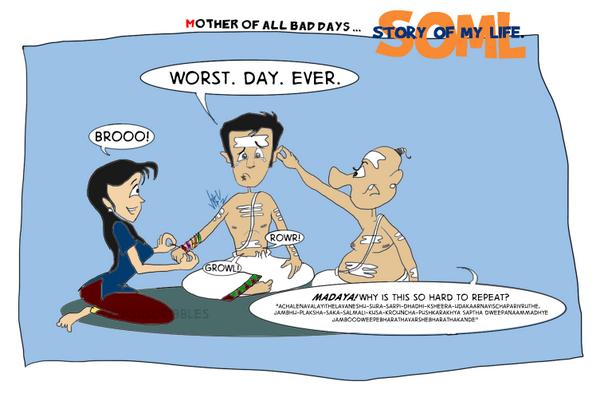
Today is the festival of Avani Avittam and Raksha Bandhan. Both are festivals which are male centric festivals and which come on the same day each year. I have written about both festivals previously so will not go into the details here. I have always wondered why two diverse festivals – one celebrated in North India and the other mostly in South India, which are possibly the only festivals in the respective cultures which are a celebration of the male gender fall on the same day. Recently I had a ephipany. In both these festivals, the star of the show, if we can call it that, are threads that bind us to our loved ones, to our traditions and to our roots.
During Avani Avittam, which typically falls on the full moon day of the Shravan month, male Brahmin men and boys who have had their thread ceremony done, reaffirm their faith as a twice born and by changing their sacred thread, they symbolically throw away their sins of the previous year and start the year on a clean slate.
The festival is one of the most auspicious festivals for Brahmins and the day is an important one for those who follow the Yajurveda as on this day they start reading Yajur Veda, which they continue to read for the next six months. It is believed that on Avani Avittam, Lord Vishnu has reincarnation himself as Lord Hayagriya, who is seen as the symbol of wealth and knowledge. On this day, God Vishnu who is worshiped as the high deity power actually restored the Vedas to Brahma.
There is a story behind these sacred threads. Lord Brahma, the creator was filled with pride for knowing the entire Veda. Lord Vishnu to crush his pride created two demons Madhu and Kaitabha to steal Vedas from him. Brahma then not being able to save Vedas, he asked Vishnu to help him restore it. Lord Vishnu took the form of Hayagriva and restored the Vedas and supressed the pride of Brahma. Hence, Hayagriva incarnation is associated with knowledge and wisdom.This day is celebrated as Upakarma(Beginning) also called as Hayagriva utpatti. Restoration of Vedas is known as a mark of new beginning and hence Upakarama is celebrated.This day is also referred as Hayagriva Jayanti.
The sacred thread comprises of three strands, joined by a knot known as Brahmagranthi or the knot of Brahma. The three strands symbolise the Hindu trinity – Shiva, Vishnu and Brahma. There are other interpretations which represent many of the other triads like Mahasaraswati, Mahalakshmi and Mahakali; or the three tendencies known as sattva or harmony, rajas or passion and tamas or chaos. You could also interpret the three strands as the link between the past, present and the future or the three states of wakefulness, dream and deep sleep. Some even say that it represents the three dimensions known as heaven or swarga, earth or martyaloka and the nether regions or patala. The sacred thread is also a kind of an indication to the marital status of the wearer. An unmarried man will wear one thread of three stands, a married man will wear two and a married man who has had his first child will wear three. In the old days, when most men did not wear a upper garment, this was the indicator people had about their marital status and if they had any children.
This year, the ceremony of changing the sacred thread was done online at our home. S and BB woke up early and after completing their morning prayers, sat down in front of the laptop where they joined others across the island on a video platform where the resident priest chanted the mantras and went through the ceremony with them. We also received the new sacred thread by post last week after signing up and paying for the ceremony online.
BB had to rush for school, so GG quickly tied her thread of love on his wrist before he headed out of the house.
These are the threads that tie us to our roots and our traditions. I call these ceremonies and functions our anchors because without them, we are left floundering and rootless. Especially in today’s world which is so uncertain and vague, it is good to hold on to traditions that are special to you. Your lineage, irrespective of where you come from, goes back at least a few hundred years, if not millennia, so be proud of who you are and where you come from, so you can show your children and your grandchildren where they can go to.
Happy Raksha Bandhan and Avani Avittam to everyone celebrating these festivals.


 Memories and Such