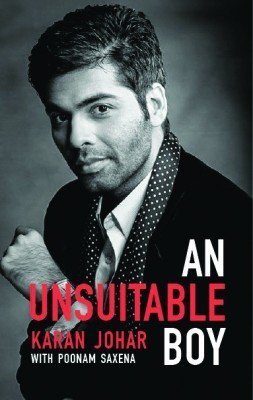
Karan Johar is synonymous with success, panache, quick wit, and outspokenness, which sometimes inadvertently creates controversy and makes headlines. KJo, as he is popularly called, has been a much-loved Bollywood film director, producer, actor, and discoverer of new talent. With his flagship Dharma Productions, he has constantly challenged the norms, written and rewritten rules, and set trends. But who is the man behind the icon that we all know?
Baring all for the first time in his autobiography, An Unsuitable Boy, KJo reminisces about his childhood, the influence of his Sindhi mother and Punjabi father, obsession with Bollywood, foray into films, friendships with Aditya Chopra, SRK and Kajol, his love life, the AIB Roast, and much more.
This book is both the story of the life of an exceptional filmmaker at the peak of his powers and of an equally extraordinary human being who shows you how to survive and succeed in life.
My Homage to All – Kanan Devi, translated by Indranee Ghosh
One of the most powerful women in the movies was thousands of miles from Hollywood.
Kanan Devi, one of the early singing stars, came into the film world in the silent era and, unlike many others, survived the transition to talkies. The product of a troubled childhood, her life took a dramatic turn when she was offered a film role and, encouraged by her uncle, took it.
In this lively and candid account of her experiences, originally published in 1973, Kanan Devi recalls the early days of cinema in Bengal, comparing conditions of film acting in the early 1930s with what she experienced two or three decades later when she herself was a producer and director, with her own film company, Shrimati Pictures.
Her fascinating and unusual story offers not only a different perspective on the growth of the film industry in Bengal but also a first-hand account of the position of women in the early decades of the last century.
Based on a real-life female spy immortalised in Harinder Sikka’s spy thriller, Calling Sehmat, Raazi was a real treat to watch.
Set in the months before the India-Pakistan war of 1971 and the liberation of Bangladesh, this film is all about Sehmat (Alia Bhat), a young 20-year-old Kashmiri Delhi University student. She comes from a family who believes in the adage, ‘country before self’ and whose father Hidayat Khan (Ranjit Kapoor), is a double agent for the Indian intelligence community whose close friend is Brigadier Syed (Shishir Sharma) from the Pakistan Armed Forces to whom he feeds carefully curated information.
Since Hidayat has been diagnosed with cancer, he decides to send his untrained daughter into the enemy camp in an audacious plan, get her married to Syed’s son Iqbal (Vicky Kaushal) and plant her into the home of the enemy to glean information and pass it to the Indian intelligence. The film is then all about how Sehmat tries to win over her in-laws and how she gathers information from their home and from that of the homes of their friends and colleagues and how she is almost caught every time.
She is never suspected by anyone, except an old family retainer, Abdul (Arif Zakaria) who came over from India at Partition and one day is caught by him. She then kills him by crushing him under a vehicle, her first murder in this operation. Her brother-in-law (Ashwath Bhatt) then starts suspecting her because the retainer tries to use her name when he is found and hospitalised, and she then kills him too.
The Pakistani intelligence then suspects that someone from the Syed household is leaking secrets and when Sehmat fears that she will get caught, she hides all her spying equipment in Abdul’s room. When the cache is found out, Iqbal realises it’s his wife and not Abdul who is the real spy. Sehmat also realises that Iqbal knows her secret and she flees from the home using the grandson of a senior officer as a shield and when Iqbal confronts her with the authorities, the Indian spymaster and her handler, Khalid Mir (Jaideep Alhawat) decide to eliminate both of them, only to realise that Sehmat had tricked everyone and she was safe. She returns back to India only to find out that she is pregnant. She refuses to abort the child and moves away from everything. It is shown that the child is now an officer in the Indian Armed Forces.
I found the casting absolutely spot on! The actors portraying the Pakistani characters seemed so authentic that it seemed to me I was watching a Hum TV drama (a Pakistani television channel).
With every movie that I see, Alia Bhat impresses me even more. I feel she has come a long way since her debut and her fresh-faced innocence as Sehmat is wonderful. She owns the movie and you find yourself rooting for her at every turn (even though you kind of know she will triumph in the end, this being a Bollywood film). The film also stars Alia’s mum Soni Razdan and when you see the two of them in the same shot, you realise how much Alia resembles her mum.
Jaideep Alhawat as Khalid Mir, the Indian spymaster and Sehmat’s handler was very impressive as the cold-blooded, ruthless spy for whom it is country before everything else. Vicky Kaushal as Iqbal was fantastic and the chemistry between him and Alia was superb!
The music in the film was evocative of the seventies and was fairly unobtrusive, never really becoming a focus of attention, but blended beautifully in the background. I loved both the rendering of Ae Watan.
Meghna Gulzar really deserves each and every award that she is sure to get when the awards season starts.
My verdict – please do go and watch the film, it’s worth it!
Padmaavat, the renamed version of Sanjay Leela Bhansali’s Padmavati was one of the most anticipated movies in recent times. You don’t have to be an Indian to know this as there have been reports across various media about how the Rajput Karni Sena was stalling the release of the film. Having finally watched the film, I actually failed to figure out what the hullabaloo was all about. In fact, they should be thankful to SLB for the positive spin he gave the whole community as the film seemed to be a pean of homage to this community. Instead of going to his set and slapping him, they should be applauding and felicitating him! On to the movie…
As is all Bhansali films, this film’s visuals were lush and beautiful and the beauty of Rajasthan was very well captured here. The contrast between the rugged desert beauty of Rajasthan and lush tropical Sri Lanka where Deepika’s character Princess Padmavati is from is very vivid. I ogled over the gorgeous clothes and jewellery that the main characters wore, but there were times when it looked like an extended clothes/jewellery commercial, especially scenes when the director focused on them for long periods of time.
Ranveer Singh excelled in his role as the villainous Alauddin Khilji, the ruler of Delhi, who lusts after Rani Padmavati, whom he has never seen actually, but heard about her beauty and so wants to possess her. Singh plays the role with his usual flamboyance, but there were times when watching the movie, I felt that I’ve seen this role before. He seems to do the pretty same larger than life role in almost every film and is probably already getting typecast. It does help that, from what I’ve seen and read so far, he has a similar personality in real life too! I’d love to see him a completely different role just to showcase his acting ability.
Deepika Padukone as the Sri Lankan immigrant Rani Padmavati was beautiful, graceful and poised. I feel she has grown in her acting and was pretty restrained throughout the movie. She really came on her own in the second half of the movie, when she goes to rescue her husband who was imprisoned by deceit by Khilji and also shows what a strategist she is when she gets revenge on the brahmin who was behind all the angst in her life by putting his death as a precondition to her even leaving her palace.
Shahid Kapoor as Maharawal Ratan Singh, the king of Chittor who goes to Singhal to purchase pearls which his first wife wanted and falls in love with the Singhal princess Padmavati and brings her back to his palace was regal and unflappable. He brims with Rajput pride and there are umpteen instances of dialogues from his mouth which talk about what an honourable Rajput should do and what are the qualities of a Rajput. He is shown to be everything that is good in a person, but the character felt very one dimensional. I mean, is there really anyone in the world who is so good and who does not have any flaws? Seemed to me that the director in his effort to showcase the differences between Ratan Singh and Khilji, made one saccharine sweet and the other a hated warmonger!
Other characters who caught my eye were Mehrunissa and Malik Khafur. Mehrunissa, Khiji’s wife and cousin, who fell in love with him and then was traumatised on her wedding day when she learnt about his infidelity is portrayed very understatedly by Aditi Rao Hydari. I wish there was more screen time for this character who tried, in her way to undermine Khiji’s atrocities especially when it came to Padmavati. Malik Khafur, Khilji’s ruthless eunuch general, played by Jim Sarb was another fine performance. The scenes between Khilji and Malik Khafur had lots of homophobic tones in their interactions.
I did find that there was not so much chemistry between Ratan Singh and Padmavati, which was a bit of a disappointment as in previous Bhansali films, the leads had intense chemistry which added to the film. Also, music which in previous films have always been wonderful didn’t really pull me in this time. Except for the controversial Ghoomar song, none of the other songs really stayed with me after I exited the theatre.
Another thing I really have to point out. This movie is set in the thirteenth century where women’s right’s were pretty non-existent, especially in patriarchy fuelled societies like the Rajputs. So in that sense, the director is not wrong in infusing the movie with a lot of patriarchy driven dialogues which had me cringing in my seat. The worst was towards the end of the movie, the night before Ratan Singh’s duel with Khilji (which Khilji won because Malik cheated and killed Singh with arrows on his back), Padmavati and Singh have some tender moments and during that, she asks her husband permission to kill herself and perform Jauhar should the need arise. The reason she gives is that she needs her husband’s permission to even die, which, in this day and age sounds weird to me.
The last scene, the controversial (I’ve used this word a lot in this post) Jauhar scene is quite over the top, showing hundreds of women, all dressed in bridal red, with the camera lovingly focussing on young girls and a pregnant woman, all walking towards a humongous funeral pyre led by Padmavati to escape the clutches of the evil enemies, whose main aim in the attack was getting Padmavati. I sat, cringing at this, because I don’t believe a woman’s existance ends when her man’s existance ends. But this is a film and the director’s vision, so I let it go. I also let it go because this was probably how men in ancient India kept their women firmly downtrodden.
As I walked out of the theatre, I thanked God, I was not born in that era!
Over the long Christmas weekend, we decided to catch Bajirao Mastani. This was one film I was quite eager to watch, having studied the history of the Maratha Kingdom in school. Also, outside of regional movies, you don’t actually see such characters in mainstream Bollywood movies and so it was something I wanted to see how the director interprets history. Last, it was a Sanjay Leela Bansali film and enough said I guess…
The film is rich, lush and every scene is very lovingly crafted. I guess showing around 20 odd years of a character’s life in something like 150 minutes is difficult, hence the bits and pieces look of the movie. Sometimes during this movement across years, it felt a bit jarring and sudden and takes the viewer a couple of seconds to figure that the scene now is not a continuation of the previous one, but something that is happening in the future.
The movie had a PG 13 classification in Singapore due to some of the violence and bedroom sequences in the film. But I think BB & GG, at the cusp of age 13, took it well…
Ranveer Singh is spot on as the valiant Peshwa Bajirao I, after this movie, I can’t imagine anyone else acting the same role, though in parts, I did find him being his usual flamboyant self. I also thought he and Priyanka Chopra as Kashibai (Bajirao’s first wife) had authentic Marathi accents, not being locals themselves. Deepika Padukone as the epynomous Mastani was fantastic, her eyes conveying a lot that dialogues do not…
Mastani who is said to be the daughter of Raja Chatrasal of Bundelkhand from his muslim wife and who is raised as one is married to a Peshwa Bajirao under a Bundelkhandi tradition where people marry by exchanging daggers when Bajirao comes to help her father fight the Mughals. She then comes to Pune and there starts the real movie where Bajirao’s family who are Chitvapan Brahmins do not want to have a Muslim Mastani to taint their lineage and who start their courtly intrigues to stop Bajirao and Mastani from meeting.
The film is not historically accurate, which they announce right at the beginning of the film, more of what goes inside the bedrooms of Mastani and Kashibai and the intrigues of Shanivarwada (the official palace of the Peshwas in Pune).
Priyanka Chopra as Kashibai gives a very understated and elegant performance, something that I really didn’t expect and Tanvi Azmi as Radhabai who was Bajirao’s ambitious mother was fantastic! Vaibhav Tatwavdi who played Bajirao’s brother, Chimaji who wanted to keep the purity of the Peshwa lineage at any cost was very good.
The Pinga song however, brought memories of Dola Re from Devdas to mind and comparisions are inevitable there. Pinga, a song liked very much was not really a match for Dola Re!
The movie is a must-watch according to me, especially since it showcases some of the lesser known historical figures of India. For students of Maratha history (casual ones like me), it was fun as I knew pretty much all the principal characters, having read about them in school. For those who don’t know about Maratha history, this is a good starting point to get interested in it and read more…
BB enjoyed the movie while GG found parts boring. S found it quite boring, so I think it will be a hit or miss with children and some adults!


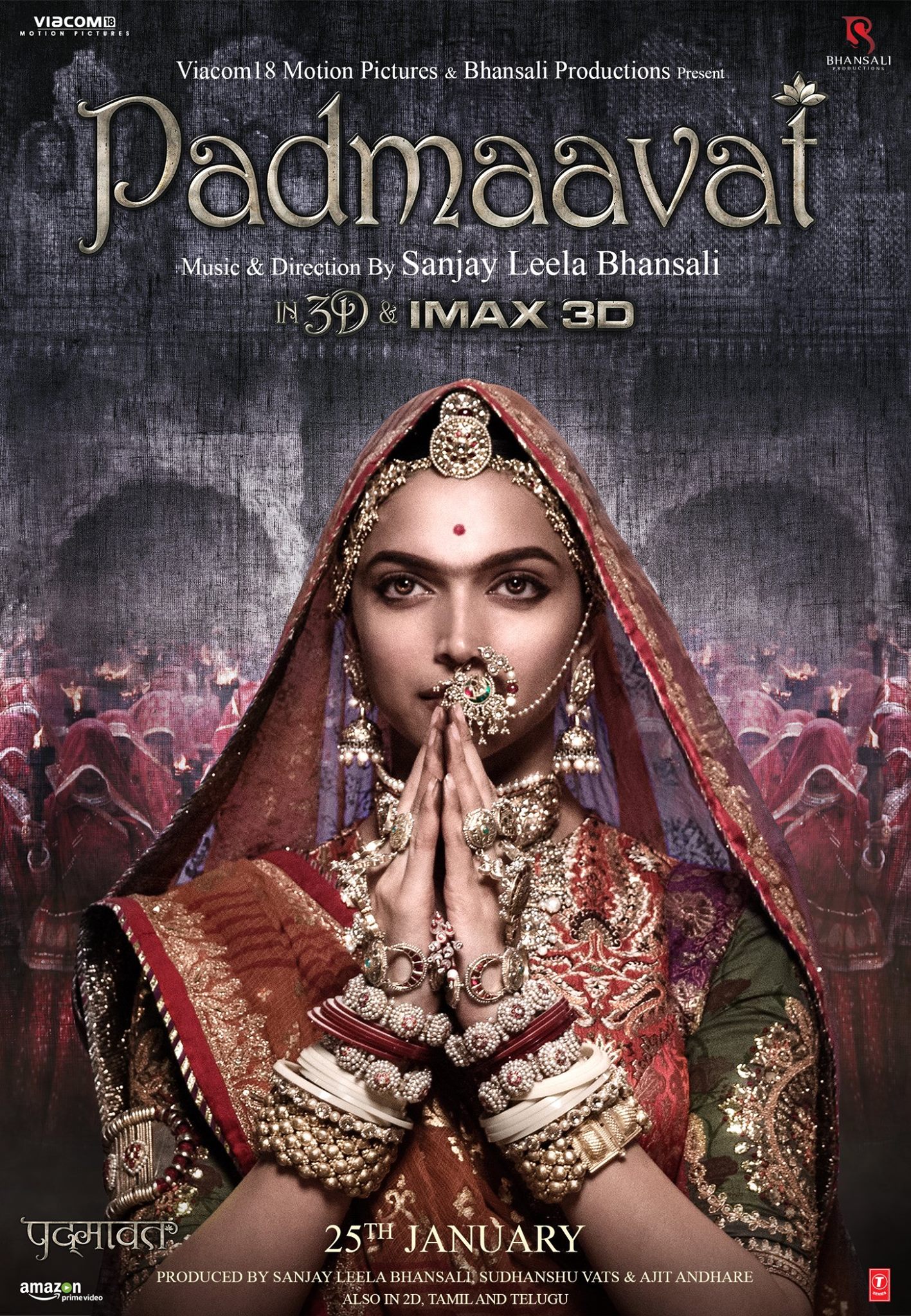 Padmaavat, the renamed version of Sanjay Leela Bhansali’s Padmavati was one of the most anticipated movies in recent times. You don’t have to be an Indian to know this as there have been reports across various media about how the Rajput Karni Sena was stalling the release of the film. Having finally watched the film, I actually failed to figure out what the hullabaloo was all about. In fact, they should be thankful to SLB for the positive spin he gave the whole community as the film seemed to be a pean of homage to this community. Instead of going to his set and slapping him, they should be applauding and felicitating him! On to the movie…
 Memories and Such