Festivals of India – Jallikattu

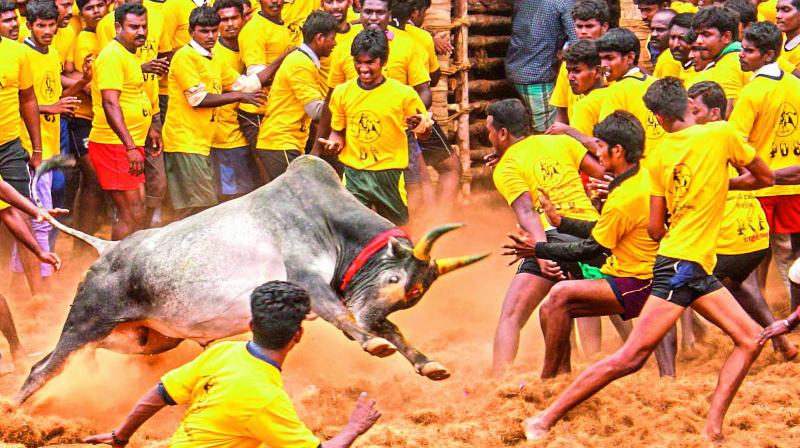
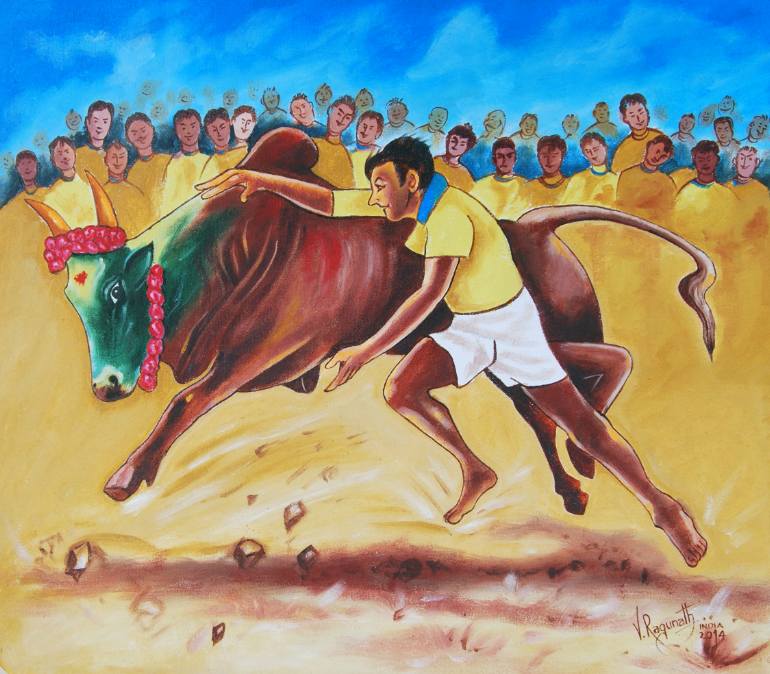
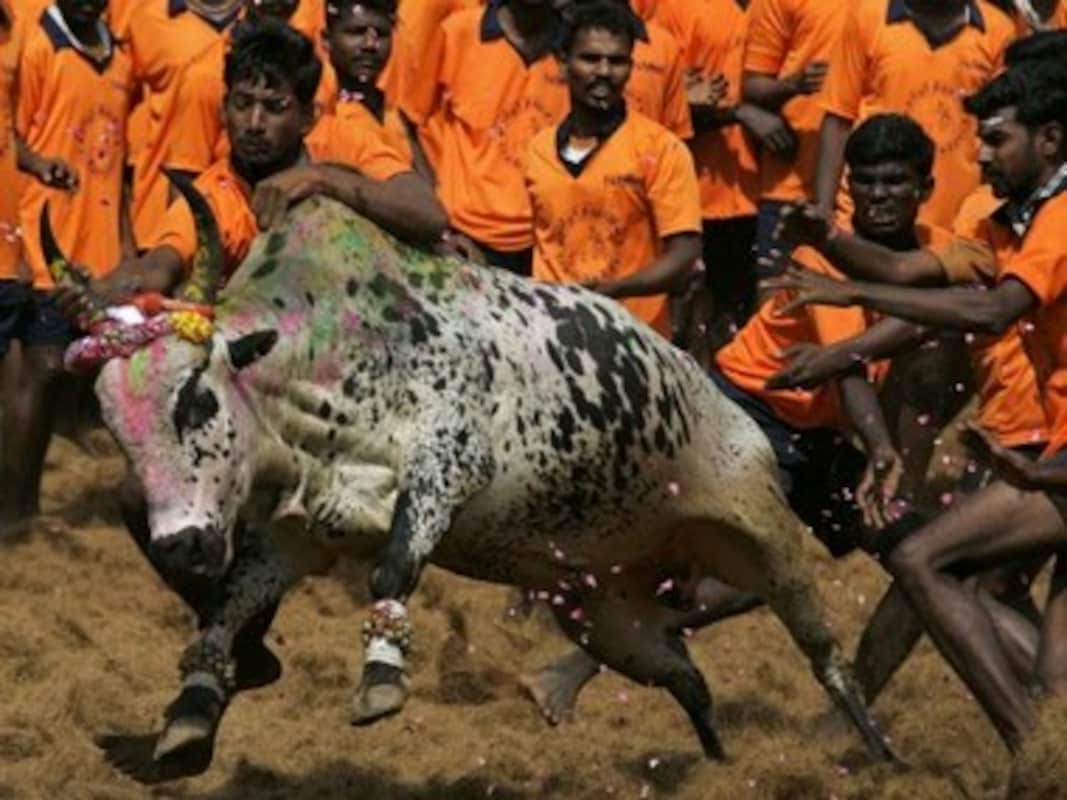
Jallikattu, also known as Eru Thazhuvuthal and Mañcuvirattu, is a traditional event during the Pongal festival in which a bull, of the Pulikulam or Kangayam breeds, is released into a crowd of people, and multiple human participants attempt to grab the large hump on the bull’s back with both arms and hang on to it while the bull attempts to escape. Participants hold the hump for as long as possible, attempting to bring the bull to a stop. In some cases, participants must ride long enough to remove flags on the bull’s horns. Jallikattu is typically practised in the Indian state of Tamil Nadu as a part of Pongal celebrations on Mattu Pongal day, which occurs annually in January. The most popular Jallikattu is the one celebrated at Alanganallur near Madurai.

Ancient Tamil Sangams described the practice as yeru thazhuvuthal or bull embracing. The modern term jallikattu or sallikattu is derived from salli or coins and kattu or package, which refers to a prize of coins that are tied to the bull’s horns and that participants attempt to retrieve. Mancu virattu means bull chasing.

Jallikattu has been known to be practised during the Tamil classical period between 400 and 100 BC. It was common among the Ayar people who lived in the Mullai geographical division of the ancient Tamizh Nadu. Later, it became a platform for the display of bravery, and the prize money was introduced for participation encouragement. A seal from the Indus Valley civilization depicting the practice is preserved in the National Museum in New Delhi. A cave painting in white kaolin discovered near Madurai depicting a lone man trying to control a bull is estimated to be about 1,500 years old.

The popular myth revolving around this festival is about how Lord Shiva asked Basava, his bull, to convey two messages. This bull twisted the words of the messages and expressed them in another way. It is said that the bull was asked to tell the human beings on earth to take an oil bath every day and that food must be consumed only once a month for six months. Instead of this message, the bull conveyed that food must be consumed daily and oil baths must be taken only once a month. This debacle made Lord Shiva angry and he cursed the bull to aid humans in cultivating their land for all eternity.

Some variants of Jallikattu include the Vadi Manjuviratttu, the most common category of Jallikattu. Here, the bull is released from a closed space or Vadi vasal and the contestants attempt to wrap their arms or hands around the hump of the bull and hold on to it to win the award. Only one person is allowed to attempt at a time. This variant is most common in the districts of Madurai, Theni, Thanjavur, and Salem. In Veli Virattu, the approach is slightly different as the bull is directly released into open ground. The rules are the same as that of Vadi Majuvirattu and this is a popular variant in the districts of Sivagangai and Madurai. In the Vatam Manjuvirattu, the bull is tied with a 15 m rope where a vatam means a circle in Tamil. There are no other physical restrictions for the bull and hence it can move freely anywhere. The maximum time given is 30 minutes and a team of seven to nine members can attempt to untie the gift token that is tied to the bull’s horn.

Bulls enter the competition area through a gate called the vadi vasal. Typically, participants must only hold onto the bull’s hump. In some variations, they are disqualified if they hold onto the bull’s neck, horns or tail. There may be several goals to the game depending on the region. In some versions, contestants must either hold the bull’s hump for 30 seconds or 15 m. If the contestant is thrown by the bull or falls, they lose. Some variations only allow for one contestant. If two people grab the hump, then neither person wins. Bulls for Jallikatu are bred specifically and bulls that participate successfully in jallikattu are used as studs for breeding and also fetch higher prices in the markets.

With the introduction of the Regulation of Jallikattu Act, 2009, by the Tamil Nadu legislature, before the event, a written permission is obtained from the respective collectors, thirty days before the event along with the notification of the event location. The arena and the way through which the bulls pass are double-barricaded, to avoid injuries to spectators and bystanders who may be permitted to remain within the barricades. The gallery areas are built up along the double barricades and necessary permissions are obtained from the collector for the participants and the bulls fifteen days prior. Final preparations before the event includes complete testing by the authorities of the Animal Husbandry Department, to ensure that performance-enhancement drugs, liquor or other irritants are not used on the bulls.

Incidents of injury and death associated with the sport, both to participants and animals forced into it, animal rights organisations have called for a ban on the sport, resulting in the court banning it several times over the past years. However, with protests from the people against the ban, a new ordinance was made in 2017 to continue the sport.

Between 2008 and 2020, more than 70 people died and about 10 4 bulls were killed in Jallikattu events. Animal welfare concerns are related to the handling of the bulls before they are released and also during competitors’ attempts to subdue the bull. Practices, before the bull is released, include prodding the bull with sharp sticks or scythes, extreme bending of the tail which can fracture the vertebrae, and biting the bull’s tail. There are also reports of the bulls being forced to drink alcohol to disorient them, or chilli peppers being rubbed in their eyes to aggravate the bull. During attempts to subdue the bull, they are stabbed by various implements such as knives or sticks, punched, jumped on and dragged to the ground. In variants in which the bull is not enclosed, they may run into traffic or other dangerous places, sometimes resulting in broken bones or death. Protestors claim that Jallikattu is promoted as bull taming, however, others suggest it exploits the bull’s natural nervousness by deliberately placing them in a terrifying situation in which they are forced to run away from the competitors which they perceive as predators and the practice effectively involves catching a terrified animal. Along with human injuries and fatalities, bulls themselves sometimes sustain injuries or die, which people may interpret as a bad omen for the village.

Animal welfare organisations such as the Federation of Indian Animal Protection Organisations or FIAPO and PETA India have protested against the practice. The former Indian Minister of Women and Child Development, Maneka Gandhi denied the claim by Jallikattu aficionados that the sport is only to demonstrate the Tamil love for the bull, citing that the Tirukkural does not sanction cruelty to animals.

The Jallikattu Premier League is a professional league in Tamil Nadu for Jallikattu. The league was announced on 24 February 2018, to be organised in Chennai by the Tamil Nadu Jallikattu Peravai and the Chennai Jallikattu Amaippu. Kabaddi is usually played as a warm-up sport before the players enter the arena for Jallikattu.

Festivals of India – Rongker

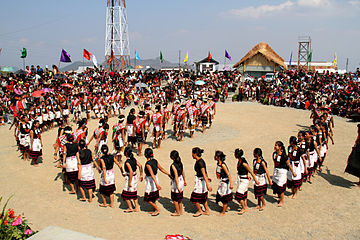
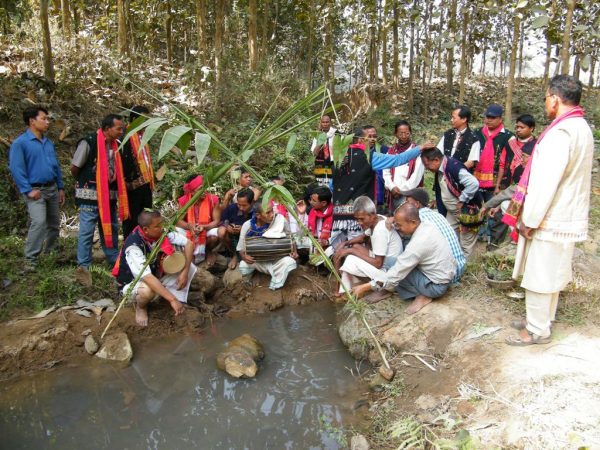
A major spring and harvest festival in northeast India, Rongker is celebrated by the Karbis who were earlier known as the Mikir and are indigenous to the state. The Karbis are a major important ethnic group of Assam in Northeast India, especially in the hill areas of Assam. The Karbis are the primary inhabitants of the Karbi Anglong district. They are also found in the North Kachar district, Kamrup, Nagaon, and Sonitpur districts of Assam. The Karbis are found in the states of Meghalaya, Arunachal, Manipur, and Nagaland.

The festival does have a specific time although it is usually observed at the beginning of the Karbi New year, Thang thang on February 5. Different villages may observe it at different times depending on their convenience. Rongker is celebrated as a Thanksgiving to God for peace, prosperity and a good harvest as well as asking for their assistance to protect them from any evil harm that may happen to the village. It is a post-harvest festival where the community comes together and celebrates with much pomp and gaiety.

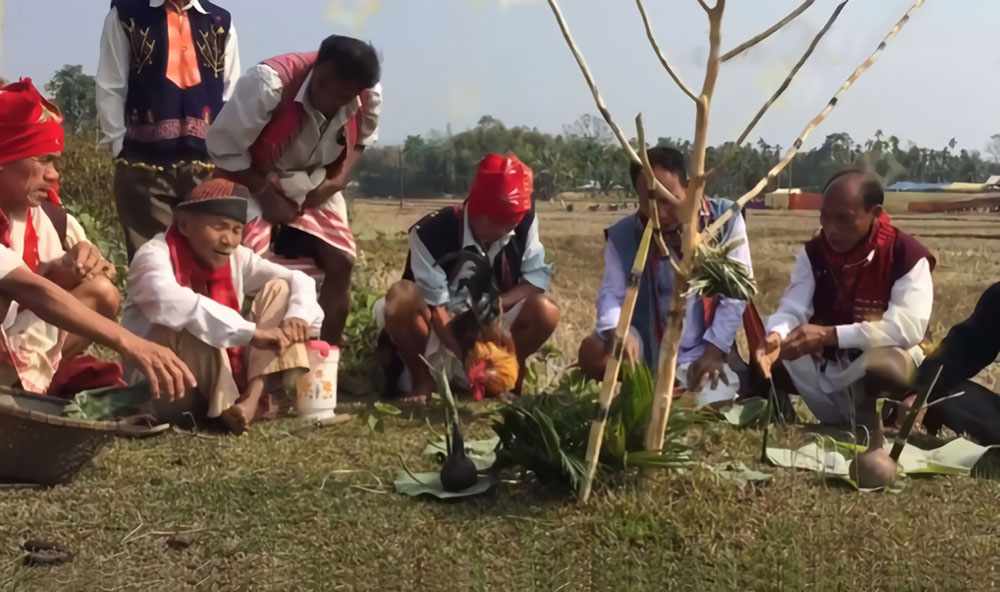
The Kurusar or the priest performs prayers and offers animal sacrifices to appease the Karbi deities and seek their blessings for the welfare of the village and its protection from evil entities and natural calamities. The community believes that non-observance of the ritual will invite misfortune upon the village and its inhabitants. It is a yearly religious festival of the Karbis which is performed by every village. Every Karbi village has an allotted place for performing Rongker and every year, villagers across the entire district form a committee to overlook the preparation for Rongker puja. The festival lasts for three days with all villagers contributing in cash and kind as well as donations collected from neighbouring villages to meet the expenses of the rituals.

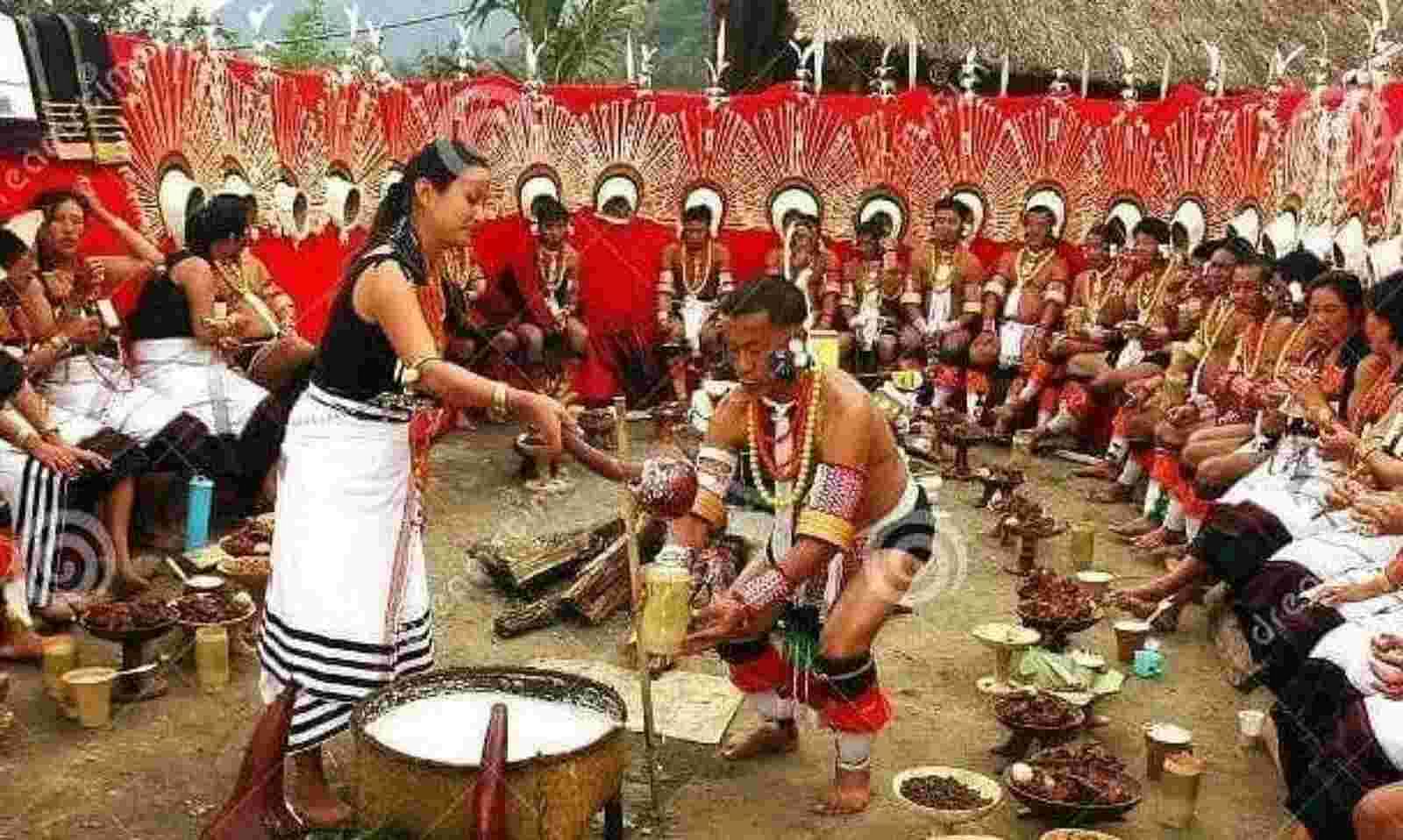
10 earthen altars against all the deities are installed on the eastern side of the site where the festival is to be held. They are constructed in a row heading in the south-north direction and named after the deities. The shape of altars is made in such a manner that the respective Gods can rest there comfortably. Although 12 deities are worshipped, only 10 altars are set up. A gourd with a tapering mouth full of the first-made rice beer is placed on the altars in the name of the respective deities and other than that, nothing else is placed on the altars. However, two small branches of bamboo are erected on the altar of Ningding Sarpo, a few branches of Basil and a few bamboo sticks are erected on the altar of Murti and a branch of Fongrong, a kind of tree used for worshipping is placed on the altar of Arlok.

The festival is divided into four major parts. During Sadi, all the deities are invited. In Karkli, the deities are worshipped in two ways – Kibo-Kaba, offering meals to the deities and Koia-abida, which is the offering of areca-nut and betel leaves to the deities. All the menfolk take part in the festival and gather in the particular site in the morning with all items required to worship. The main task is performed by the Kurusar, the main priest, assisted by some other religious specialists, the village headman, an official of the Karbi Kingdom, the youth leader of the village, and a few elderly villagers well-versed in worshipping the deities. It is not mandatory to take bath before performing the rituals but they must be purified by sprinkling water with the leaves of the sacred basil. All the sacrifices are made in the names of the deities except for the deity Bamun, who is vegetarian. Then the thek-kere, the religious specialists predict the future of the village at the heart and intestine of the sacrificed animals. At the end of the ritual, a feast is organised. Rongphu-Rongling-Kangthin is also called the Ajo-Rongker and is performed on the night of the second day. Here, the evil spirits are driven out from the lower to the upper part of the village through dancing. An altar is made at the end of the village road and a chicken is sacrificed in the name of Ajo-Angtarpi. Langhe Rongker is the concluding part of the festival observed on the third day of the festival. It is performed near a ghat by making an altar and sacrificing a cock in the name of Arnam-teke, the tiger god, to prevent tigers from attacking.

During this festival, some taboos are observed. The taboos include things like prohibiting husking, not allowing females to participate in the festival, no one is allowed to take part in any agricultural activities during the festival and none of the villagers is allowed to leave the village.

Traditional Dance performance like Ritnong chingdi, Nimso kerung, Hacha kekan, Chong kedam take place as well as displays of Indigenous games.

There is another kind of Rongker performed on a greater scale which is celebrated every five years and is called Wofong Rongker. Wofong Rongker is performed for the well-being of all the people of the villages that fall within a larger jurisdiction and each village is represented by the village headman and several male village elders and is celebrated for two days.

Festivals of India – Navaratri

Dedicated to the Mother Goddess and the feminine energy, one of Hinduism’s most revered festivals, the Navaratri is a biannual festival spanning over nine nights and ten days, first in the month of Chaitra which translates to March/April of the Gregorian calendar and again in the month of Sharada which translates to September/October in the Gregorian calendar. It is observed for different reasons and celebrated differently in various parts of the country.

The word Navaratri means nine nights in Sanskrit, with nava meaning nine and ratri meaning nights. Navaratri, which is dedicated to Goddess Durga is all about the victory of good over evil. Goddess Durga fought the demon king Mahishasura for nine days and killed him, marking the triumph of good over evil. In the eastern and northeastern states of India, Durga Puja is synonymous with Navaratri, where Goddess Durga battles and emerges victorious over the buffalo demon Mahishasur to help restore dharma. In the southern states, the victory of Durga or Kali is celebrated. In all cases, the common theme is the battle and victory of good over evil based on a regionally famous epic or legend such as the Devi Mahatmya.

Celebrations include worshipping nine goddesses during nine days, stage decorations, recital of the legend, enacting of the story, and chanting of the scriptures of Hinduism. The nine days are also a major crop season cultural event, such as competitive design and staging of pandals, a family visit to these pandals, and the public celebration of classical and folk dances of Hindu culture. Many devotees often celebrate Navaratri by fasting. On the final day, called Vijayadashami or Dusshera, the statues are either immersed in a water body such as a river or ocean, or the statue symbolising evil is burnt with fireworks, marking the destruction of evil. During this time preparations also take place for Deepavali or Diwali which is the festival of lights which is celebrated twenty days after Vijayadashami.

The nine forms of Goddess Durga, collectively known as Navdurga, are celebrated during Navratri. Every day of the festival is dedicated to a different incarnation of the Goddess. There is a colour for every day that can be worn throughout the festival. These colours have a lot of importance and are considered auspicious.

On the first day, Goddess Durga is worshipped as Shailputri, the daughter of the king of mountains, or Goddess Parvati who is worshipped as the wife of Lord Shiva. This avatar embodies the combined power of Brahma, Vishnu, and Mahesh. The colour for the first day is red indicating strength. An individual who leads a frugal lifestyle, who is cheerful and bestows happiness, richness, tranquillity, and grace upon all of her devotees, Brahmcharini is worshipped on the second day. Brahmcharini is supposed to be the way to Moksha and royal blue is the colour for the day, associated with a calm yet powerful soul. On the third day, Goddess Durga is worshipped as Chandraghanta who is the epitome of grace and dignity. A symbol of peace and prosperity, she is a strong woman with a lot of power and so yellow is the colour for the day.

Kushmunda who is worshipped on the fourth day, is believed to be the founder of the cosmos and is said to have created the universe and enriched it with flora and fauna. This is why the colour of the day is green which symbolises the globe and greenery. Skand Mata, the commander-in-chief in their war against evil is worshipped on the fifth day. She is the representation of the vulnerability of a mother who can fight anyone when anyone troubles her children. The colour of the day is grey which represents a mother’s fear when her child is in danger and she is determined to do everything it takes to keep her child safe. On the sixth day, Katyayani is worshipped. She was born to the great sage Kata as an avatar of Goddess Durga. While clothed in orange, she emits immense courage and so orange is the colour of the day symbolising bravery.

Worshipped as Kalratri for her three eyes, dark skin, unkept hair and exuding a fearless attitude with her breath-producing flames, Kalratri resembles Goddess Kali, Goddess Durga’s most terrifying aspect. She wears white, the colour of peace and tranquilly and so the day’s colour is also white. On the eighth day, Goddess Durga is worshipped as Maha Gauri, representing intelligence, peace, prosperity and calm. Her hue was said to have changed from white to black after spending time in the deep Himalayan forests. After Shiva bathed her in the waters of the sacred River Ganga, her body regained its beauty, and she was given the name Maha Gauri, which means extremely white. Pink is the colour of the day, representing hope and a fresh start. On the last day, she is worshipped as Siddhidatri who has incredible healing abilities. She has four arms and looks to be in a cheerful mood. She blesses everyone as a manifestation of the Mother Goddess. The goddess is shown in a happy state as if she were a clear day’s sky. As a result, this day’s colour is sky blue, symbolising awe at nature’s splendour. In South India, on this day, Goddess Saraswati is worshipped who is the manifestation of learning, knowledge, music and the arts through the Ayudha Puja. On this day, everyone worships their tools of the trade so students pray to their books, musicians thank their instruments, office workers pray to their laptops etc. Students visit their teachers, express respect, and seek their blessings.

The festival ends with Dusshera on the tenth day when Goddess Durga was victorious over the demon Mahishasura. In some parts of India, Dussehra is associated with the victory of the God Rama over the demon-king Ravana. In northern India, the Ram Lila of the Play of Rama is the highlight of the festival with different episodes of the epic Ramayana dramatised on successive nights. On Dusshera, the actor playing Lord Rama fires a flaming arrow at an effigy of Ravana which is then burned. In many regions, Dussehra is considered an auspicious time to begin educational or artistic pursuits, especially for children.

Today, we are on the third day of Navaratri and my prayer is that may Goddess Durga and her various incarnations protect you from everything and remove all obstacles from your lives. May the divine feminine energy grant you all your wishes!

Festivals of India: Pola

A little-known thanksgiving festival, Pola or Bail Pola is celebrated by farmers in Maharashtra and Chhattisgarh to acknowledge the importance of bulls and oxen, who are a crucial part of agriculture and farming activities. It falls on the day of the Pithori Amavasya the new moon day in the month of Shraavana, which usually falls in August. During Pola, farmers don’t work their bulls in the farmland, and the day is a school holiday in the rural parts of Maharashtra. This year, the festival of Pola falls today, 26 August.

The cow is considered a sacred animal and is worshipped in the Hindu religion. The states of Maharashtra, Chhattisgarh, Madhya Pradesh, Telangana, and Karnataka celebrate the festival called Bail Pola whereas, in states like Madhya Pradesh and Chhattisgarh, the day is also celebrated as Pola Amavasya. The Hindu God and Goddesses are accompanied by animals like a bull named Nandi to Lord Shiva, and the Cow to Lord Krishna. This day is celebrated by the farmers of Maharashtra to pay importance to the cows and bullocks named Bail Pola, meaning Bullock Pola.

The festival is celebrated among the Marathas of central and eastern Maharashtra with a similar festival observed by farmers in other parts of India, known as Mattu Pongal in the South and Godhan in the North and West India. In Telangana, a similar festival is celebrated on full moon day and is called Eruvaka Purnima.

In preparation for the festival, bulls are washed and massaged with oils and then decorated with shawls, bells, and flowers, and their horns coloured, and they get new reins and ropes. The decorated cattle are offered a special food called khichadi, made of bajari or pearl millet. The decorated bulls and oxen are walked in a procession to the village field accompanied by music and dancing with lezhims, a musical instrument found in Maharashtra made of a wooden rod and an iron chain full of metallic pieces and drums. The first bullock to go out is an old bullock with a wooden frame called makhar tied on its horns. This bullock is made to break a toran, a wreath of mango leaves stretched between two posts, and is followed by all the other cattle in the village. A big fair is also organised during the festival including various sports activities including volleyball, wrestling, kabaddi and kho-kho.

Homes in the village are decorated with rangolis and toran on top of doors. Puja thalis with kumkum, water, and sweets are prepared, and when the cattle are returned from the procession they are formally greeted by family members, with an earthen lamp with ghee for puja and aarti. On the day following Pola, children decorate wooden bulls with beads and flowers.

It is believed that the festival has gotten its name from mythological events and texts. In one of the episodes of Lord Krishna’s life where he killed a demon named Polasur to save the villagers while still a child. And so this day is dedicated to children and animals and children get special treatment on this day.

Festivals of India: Muharram

This is the month of Muharram, the first month of the Islamic calendar and one of the four sacred months of the year when warfare is forbidden. It is held to be the second holiest month after Ramadan. The tenth day of Muharram is known as Ashura and as part of the Mourning of Muharram, Shi’i Muslims mourn the tragedy of Ḥusayn ibn ʿAlī’s family, and Sunni Muslims practice fasting on Ashura.

Muslims mourn the martyrdom of Ḥusayn and his family, honouring the martyrs by prayer and abstinence from joyous events. Shiʿi Muslims eat as little as possible on the Ashura; however, this is not seen as fasting. Alevis fast twelve days, each day for one of the Twelve Imams of Shiʿa Islam, to commemorate and mourn the Imams, as if a very close relative has died. Some, excluding children, the elderly or the sick, don’t eat or drink until zawal or afternoon as a part of their mourning for Husayn. In addition, there is an important ziyarat or a form of pilgrimage book, the Ziyarat Ashura about Ḥusayn. In Shiʿism, it is popular to read this ziyarat on this date.

The sighting of the new moon ushers in the Islamic New Year. The first month, Muharram, is one of the four sacred months mentioned in the Quran, along with the seventh month of Rajab, and the eleventh and twelfth months of Dhu al-Qi’dah and Dhu al-Hijjah, respectively, immediately preceding Muharram. During these sacred months, warfare is forbidden. Before the advent of Islam, the Quraish and Arabs also forbade warfare during those months. Muslims believe that in this month of Muharram, one should worship Allah a lot.

Muharram is a month of remembrance. Ashura, which means the Tenth in Arabic, refers to the tenth day of Muharram and is well known because of the historical significance and mourning for the Shahadat or martyrdom of Ḥusayn ibn Ali, the grandson of Muhammad. Muslims begin mourning from the first night of Muharram and continue for ten nights, climaxing on the 10th day of Muharram, known as the Day of Ashura which is considered the most important by both Shia and Sunni Muslims. Tomorrow, the 10th day of Muharram or the Day of Ashura will be commemorated. Shia Muslims observe it as a day of mourning to commemorate the death of the grandson of Prophet Muhammad, Hussayn Ibn Ali. The last few days up until and including the Day of Ashura are the most important because these were the days in which Hussain and his family and followers, including women, children and elderly people were deprived of water from the 7th day onward and on the 10th day, Husayn and 72 of his followers were killed by the army of Yazid I at the Battle of Karbala on Yazid’s orders. The surviving members of Husayn’s family and those of his followers were taken captive, marched to Damascus, and imprisoned there. This was because, according to legend, Imam Hussayn objected to the legitimacy of the Caliph Yazid and revolted against him leading to the battle of Karbala in 680 AD. Sunni Muslims believe that the religious leader Moses led Israel through the Red Sea and got victory over the Egyptian Pharaoh and his army of war chariots on the 10th day of Muharram. There is another belief that Adam and Eve were created by God on the 10th day of this month. It was also during this time that Prophet Muhammad migrated from Mecca to Medina, which is known as Hijrah, and so Muharram marks this important event as well.

In India, though both Shias and Sunnis observe Muharram, for the Shias, it is a day of observance and not joy, and thus, they are in mourning for the 10 days. They dress in black, attend special prayer meetings at mosques and even refrain from listening to music or attending events like weddings. On the 10th day, street processions take place in which they walk barefoot, chanting and whipping their chests until it draws blood to commemorate the sufferings of Imam Hussayn. Sunnis observe this day with fasting from the first to the 10th or 11th day of the month. This is voluntary, and the ones who fast are believed to be rewarded by Allah.