Milagu Kozambu (Pepper Sauce)

My Bible and go-to book for everything in traditional Iyer cooking is the “Cook and See (Samaithu Paar)” series by S. Meenakshi Ammal. The series of three book was originally written in the late sixties/early seventies. I refer to them all the time, especially when I want to make traditional food. This book takes the place of calls to my mum, especially since international calls are so expensive!

The recipe I made today is Milagu Kozambu or Pepper Soup as Meenakshi Ammal calls it. I am copying the recipe exactly as it was in the book and I made it also the exact same way it said in the recipe.

Milagu Kozambu

(This recipe prepares 1 cup)

 Ingredients:

  • 1 tsp Peppercorns
  • 6 Red Chillies
  • 1 tsp Black Gram Dal (Urad Dal)
  • 2 tsps Bengal Gram Dal (Chana Dal)
  • ½ tsp Cumin Seeds
  • 2 tsps Coriander Seeds
  • 1 tsp Mustard Seeds
  • Tamarind as big as a small piece of lime
  • Salt
  • A handful of curry leaves
  • Asafoetida
  • Oil

 Method:

Heat oil in a kadhai and fry peppercorns, red chillies, Bengal gram dal, 1 tsp black gram dal, cumin seeds and coriander seeds. When the dals turn red, add the curry leaves and fry till the curry leaves are crisp. At this point, add the asafoetida. Grind to a smooth paste with the tamarind, salt and a little water. The paste should be very smooth.

Heat oil and fry 1 tsp mustard seeds and 1 tsp black gram dal. Mix the paste with enough water to make 1.5 cups of the paste. Add this to the oil and let it cook on a slow flame till it reduces to 1 cup.

This kozambu will keep for about 2 days outside and about a week in the fridge. Eat with hot rice and some papad. So soul satisfying on a cold or rainy day!

Curry Leaves Chutney

I had a load of curry leaves today and while talking to my mum, told her about this chutney I make sometimes using these leaves. Now curry leaves are mostly used in South Indian cooking as part of the tadka, but you can also make chutneys and thogayals out of it. Here is my version.

Curry Leaves Chutney

Ingredients:

1 cup curry leaves
1/4 cup black raisins
A small sized ball of tamarind
6-7 green chillies
1/2 cup chopped coriander leaves
1/2 cup raw peanuts
1 inch piece ginger
Salt to taste

Method:
Dry roast the curry leaves until they just start becoming crisp. In the meantime, put
the raisins and tamarind in a small bowl and pour just enough hot water to cover. Once the water has cooled a bit, grind everything together – the curry leaves, raisins, tamarind, chillies, coriander leaves, peanuts and ginger. Add water as needed and  grind it to a fine paste. Add salt to taste and you have yummy curry leaves chutney

This is yummy even with bread, idli, dosa etc.

Pav Bhaji

Mention the word ‘Pav Bhaji’ to a Mumbaikar (a native of Mumbai) and see them go into a food swoon, thinking about their favourite Pav Bhaji thela (street stall) or restaurant. I remember this restaurant very close to my college which was supposed to have one of the best pav bhaji’s in our part of Mumbai and people used to come from near and far to eat this.

Pav Bhaji, which is a complete meal in itself started life as a quick on-to-go meal for the mill workers in what was then Bombay in 1850s. According to Wikipedia, “The mill workers used to have lunch breaks too short for a full meal, and a light lunch was preferred to a heavy one, as the employees had to return to strenuous physical labor after lunch. A vendor created this dish using items or parts of other dishes available on the menu.” In time this dish, along with a few others like Vada Pav, have come to become ubiquitous dishes that define Mumbai.

Since we had the long CNY break last week, I decided to make Pav Bhaji on one of the days. So without much further ado, here’s my take on the Mumbai street-food.

Pav Bhaji

IMG_3432[1]IMG_3436[1]Ingredients:

  • 1 head cauliflower, chopped into small pieces
  • 3 carrots, peeled and chopped into small pieces
  • ½ head broccoli, chopped into small pieces
  • 3-4 potatoes, peeled and chopped into small pieces
  • 1 cup frozen green peas
  • 1 cup French beans, finely chopped
  • 1 green capsicum, finely chopped
  • 8-10 red onions, finely chopped
  • 7-8 ripe red tomatoes, finely chopped
  • 1 tbsp ginger paste
  • 2 tbsps garlic paste
  • 1-2 tbsps green chilli paste
  • 2 tbsps red chilli powder
  • 2 tbsps Kashmiri red chilli powder (optional, for the colour)
  • Salt to taste
  • 3-4 tbsps Pav Bhaji Masala
  • Ghee or butter (optional, but if added gives a delicious taste to the bhaji)
  • Pav (We usually don’t get Pav, so use Burger or Hotdog bread)
  • 2-3 tbsps oil

Method:

Finely chop all the vegetables. In a pressure cooker, cook the cauliflower, carrots, broccoli, potatoes, French beans and peas for 3-4 whistles with little water, just enough that it does not burn. If you don’t have a pressure cooker, cook in a large pot until they become mushy. Do not add a lot a water as then the bhaji will become watery. Once the pressure is released, mash the vegetables till you get a nice consistency, none of the vegetables should be really seen.

In a separate pan, pour oil and when it heats up, add in the ginger, garlic and chilli pastes. Fry it for a while till the raw smell goes away, then add the onions, fry for a minute and add the capsicum. Once the raw smell of the onions and capsicum is gone, add the tomatoes and cook till they turn mushy. You can add some salt here to help the process. Also mash them so that they have the same consistency as the vegetables.

Once both the vegetables and the onion-tomato paste is of the same consistency, pour the paste into the vegetables. Add salt to taste, then add the pav bhaji masala and the Kashmiri red chilli powder. After a few minutes, add the ghee/butter and your bhaji is ready!

To serve, cut the bread into halves and toast lightly. You can also add butter to this to make it authentically Mumbai, but I prefer to dry toast it. Serve with loads of finely chopped onions and coriander with a dash of lime.

Enjoy and imagine you are in Mumbai!

Thai Style Inspired Green Apple Salad

I haven’t been cooking in a long time, in fact ever since my present helper came on board – 2 years ago! When she takes her weekly off on Sundays, I usually just put together something, nothing that I take effort to make, or make old favourites that everyone likes. So me cooking this dish is unusual in the current scenario.

I usually have a salad with every meal and was getting tired of the same ole, same ole vegetable salad! Then saw some green apples at home and went online to see if there were any recipes that I could use or adapt. I came across this one and felt this was something I could adapt for us. So here’s my version of a Thai Style Inspired Green Apple Salad

IMG_3386[1]

Ingredients:

  • 2 medium sized green apples
  • 8 strawberries
  • 2 smallish red onions
  • A handful of raw peanuts
  • A handful of raw cashewnuts
  • 2-3 tbsp olive oil
  • Salt, sugar and lemon juice to taste
  • A bit of freshly ground black pepper

Method:

Cut the red onions into thin slices. Heat oil in a pan and first fry the peanuts and cashew nuts till they are crisp. Take out and drain in kitchen paper. In the same oil, fry the onion till they become brown and crisp. Drain on kitchen tissues.

Chop the strawberries into halves and chop them lengthwise. Make thinish slices of the green apple, and chop it into matchsticks. Add the sugar and salt and keep aside.

Just before eating, add the onions and nuts to the salad. Season with lemon juice and freshly ground pepper and enjoy!!

We ate this with Moong Dal Khichadi (recipe coming soon)

Note: Make this salad as close to the eating as possible as the green apples will turn brown otherwise. Also, if the green apples are sour, you can skip the lemon juice altogether.

Verdict: Yummy and different from what I usually make. My version was a tad sour, so when I make it again, I will either go easy on the lemon juice or omit it.

Rajma Paratha – Indian Red Kidneybean Flatbread

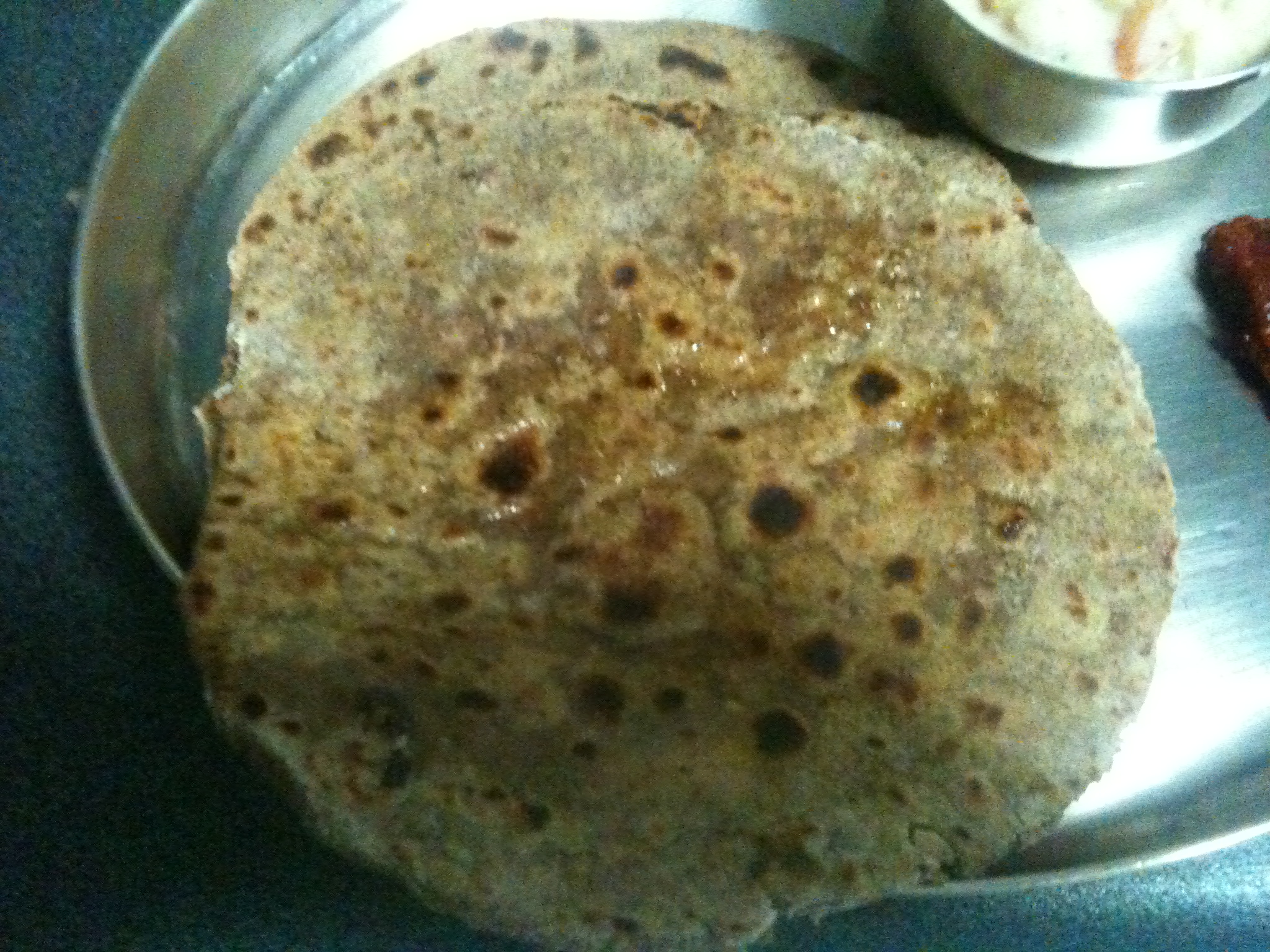
I had made Rajma over the weekend and as usual made too much for all of us to eat. We had leftovers and I didn’t know what to do with them. I love Rajma, so thought I will eat them with rotis when I chanced upon this recipe by The Steaming Pot. I tweaked it a bit and voila – spicy, tasty rajma parathas which we had with a dash of ginger pickle and a quick raita of baby cucumbers, tomatoes and onions.

Rajma Parathas

Ingredients:

  • 1.5 cup pre-made rajma masala, blended and pureed well to make it a smooth paste
  • 3 cups whole wheat flour
  • Some warm water to kneed the dough
  • 1 tsp oil for the dough
  • ghee/oil for the parathas (optional)

Method:

In a large dish mix the pureed rajma and the wheat flour and if needed, use the warm water to make it a smooth dough. Use 1 tap oil at the very end and mix into the dough to avoid stickiness.

Roll out into slightly thicker than usual parathas. In a non-stick tava, put the parathas in medium high heat and once the first side is done, flip and put a few drops of ghee in the first side. Repeat for the second side and remove and eat hot!

3 cups of wholewheat flour gave me around 12 parathas.