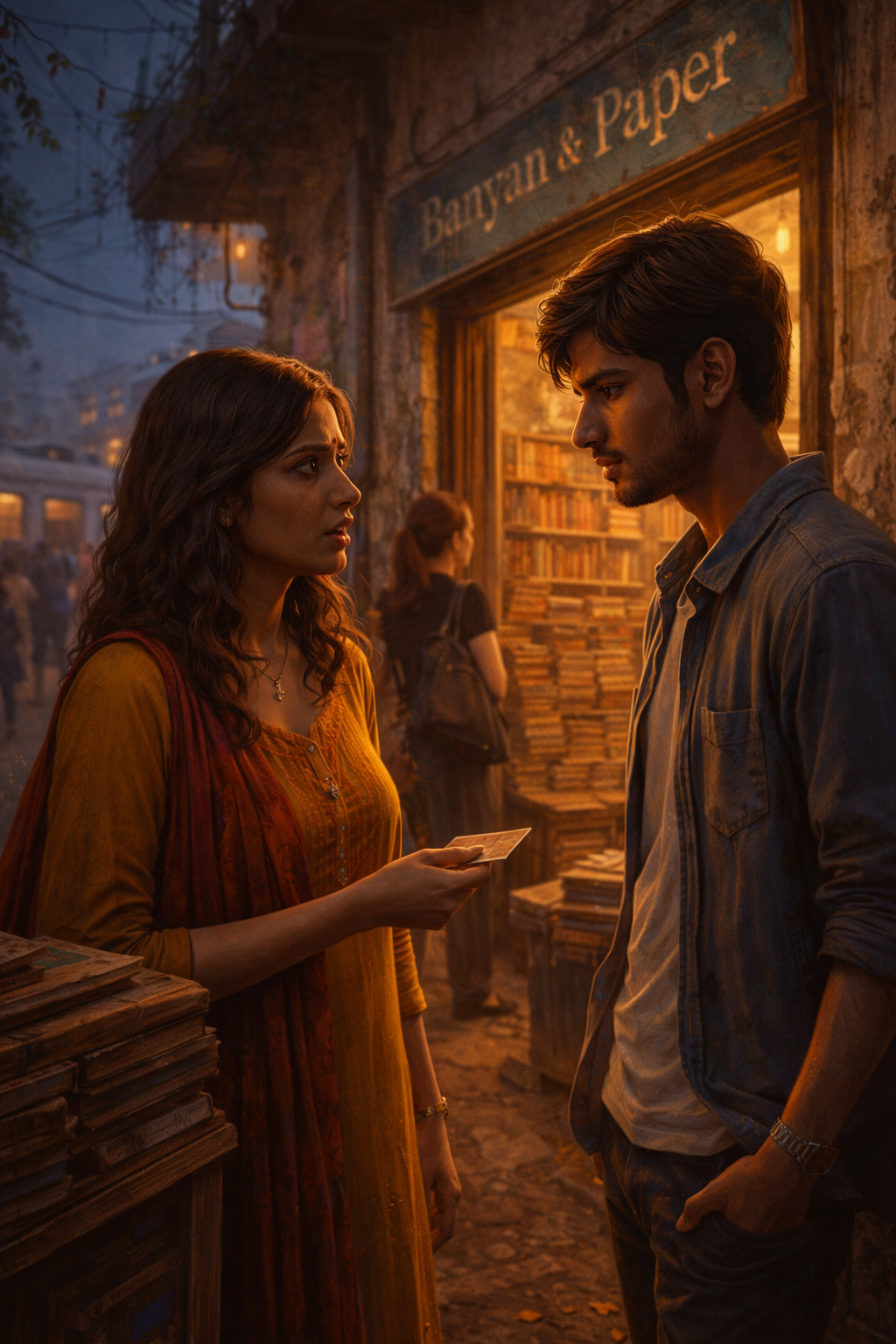
Short Story: When the City Sleeps

(Mumbai, late 1980s)

By the time the last local groaned into Marine Lines, Ramesh’s ledger lines were still dancing in his head like impatient ants. Columns that refused to add up, numbers that snickered at him from the margins. He had stayed back again, Junior Clerk (Probation) at Mehta & Sons Exporters, Fort, because Mr. Mehta had started dropping words like “tightening belts” and “rationalisation,” which were dignified ways of saying “some of you are unnecessary.” Ramesh had never liked the feeling of being unnecessary. It followed him to the train like a stray dog.

He stepped onto the platform and swallowed the tang of sea salt and iron. The station, which earlier in the evening had pulsed with elbows and voices and bodies, now yawned like a huge mouth catching its breath. One stall was still open, its owner scraping burnt tea leaves from a vessel, the air fragranced with cardamom and something singed. A bored constable leaned against a pillar, tapping a stick gently on his calf, eyes distant. Somewhere above the glass roof, a gull scolded something invisible, and then the sound was gone.

Ramesh adjusted the cloth bag at his shoulder. It held the day’s leftovers: a steel tiffin dabba with the last smear of baingan bharta, a fountain pen with its cap cracked, and his worries, which seemed to take the most space.

Outside the station, a kaali-peeli idled under a sputtering streetlamp. The driver’s turban had slipped, the fabric a little tired at the edges. He dozed with his mouth half open, the ghost of a bidi clinging to his fingers. A few steps away, the tea stall that never slept, the one everyone called “Karim’s,” though the painted board claimed “Lucky Tea & Snacks”, was open, as it always was, regardless of storms, cricket matches, or election nights.

“Arre, Ramesh bhai,” called Karim without lifting his eyes from the kettle. He had memorized his regulars’ footsteps long ago. “Late again?”

“Hmm,” Ramesh said, the sound falling somewhere between a yes and a sigh.

Karim poured chai into a glass so thin it was almost cruel, tied a knot with his rag, and slid it across the counter. “Sugar less today. Your face is already sweet sad.”

Ramesh smiled despite himself. “Bas, Karim bhai. Aap bhi na.”

He cupped the glass and let the heat bite his palm just enough to remind him he was alive. Behind him, the sea growled and spat, throwing foam at the tetrapods as if annoyed by the very idea of concrete. A boy pedalled by, wobbling slightly, newspapers stacked so high they orbited him like a satellite. He would soon deliver headlines to doors still heavy with sleep, ringing small bells that said everything and nothing at once: Wake up, something’s happened again.

“Office?” Karim asked. He didn’t look up, just listened to the pitch of Ramesh’s breathing, to the city’s residual hum. The kettle hissed. A moth auditioned for suicide against the yellow tube light.

“Office,” Ramesh said. “Figures don’t behave.”

“Figures are like people,” Karim said, stirring. “They behave if you hold them gently and threaten them at the same time.” He grinned, revealing a gold tooth that caught the light like an extra star.

Ramesh laughed, the sound surprising himself. He finished the tea and placed the glass upside down, respectful. The habit came from his father, who had believed that the way you left things mattered: a glass, a conversation, a day.

He ambled toward Marine Drive. At this hour, it belonged to dogs and whisperers. Yellow pearls of light looped the curve of the Queen’s Necklace, the streetlamps leaning like sleepy sentries. On a bench, an old man stared so hard at the horizon it seemed he might pull dawn up by its ears. A couple walked shoulder to shoulder, not touching, measuring a distance only they understood.

Ramesh sat on the seawall and let the damp creep into his trousers. He watched the moon wipe its face on a passing cloud. He wondered, not for the first time, if he should give up and go back to Nagpur. There was safety back there: a mother who would still scold, a sister who saved the crispest bhakris for him, an old bicycle with a bell that sounded like a cough. But the thought also made him restless in a way that felt like suffocation.

He looked at his palm lines. Somewhere in them, a fortune-teller had once said, there was water. “You will live near water. Or drown in it,” the man had added, noncommittal, as if hedging his bets against karma.

The taxi under the streetlamp coughed awake. The driver rubbed his face and squinted at the road. He spotted Ramesh and raised his chin in inquiry.

“Girgaon,” Ramesh said, getting up. “Near Thakurdwar.”

“Chalo,” the driver said, patting the seat in a way that suggested the car was a temperamental animal that needed soothing.

As the taxi nudged into motion, the driver flicked the radio on. A woman’s voice floated, Lata, as soft and inevitable as the ocean. Advertisements for Nirma and Rasna elbowed their way in between. The city’s soundtrack, even at this hour, asked you to buy and believe.

“Late night?” the driver asked.

“Late year,” Ramesh said before he could simplify the truth. The driver chuckled.

They glided past an Irani café with its shutters half down. A solitary man sat on a chair outside, smoking into a notebook. Grant Road’s corners still held their secrets; a line of posters: Mithun’s dance pose, Amitabh’s fist, a sari-clad heroine with eyes like dark lakes, wrinkled in the damp.

At a red light, obedient to rules because it was too sleepy to think otherwise, the taxi slowed. A group of young men in shirtsleeves pushed a stalled truck, laughing at their own effort. From a nearby building, a night watchman’s whistle punctured the air at timed intervals. A rooftop flapped with laundry long forgotten.

“Nights suit you?” Ramesh asked the driver, surprising himself again with a question.

“Nights suit my face,” the driver replied, tapping the mirror. “Less scrutiny.”

Ramesh looked properly at him now. He had the kind of face that had once been beautiful and then decided to become interesting: cheekbones chipped by life, eyes like old coins. He wore a thin gold chain with a tiny Ganesha that lurched with the car’s movements.

“I am Shankar,” the driver said, as if meeting in darkness demanded some exchange of names. “And you?”

“Ramesh. Clerk. Mehta & Sons.”

“Ah,” said Shankar, as if this explained some philosophy. “I used to be a clerk in my first life. Textile mill. Parel side.”

“What happened?”

Shankar smiled without teeth. “Bombay happened,” he said. “Then taxi happened. To drive is to be in motion even when life stalls.”

The signal changed to green as if in agreement. The taxi slid forward like a yawn. As they approached Charni Road, a burst of light exploded from a paan shop shuttering itself; tin clapping like a cymbal. Ramesh thought of Mr. Mehta’s watch: thin, silver, cutting seconds into obedient slices. He sometimes felt he lived inside that watch.

A boy darted across the road suddenly, a stack of newspapers teetering in his arms. Shankar braked gently. The boy wobbled, steadied, but a single paper escaped, skittering to the median and plastering itself there like a tired fish.

“Tomorrow’s truths, scattering,” Shankar murmured. “Every night I think of the boys. They are the first to know and the first to be forgotten.”

They were two lanes from Girgaon when the taxi shuddered, complained, and died. Shankar petted the steering wheel. “Bas, bas, darling,” he muttered, then sighed. “She wants tea.”

He pulled over near a small island of a tea stall, the flame underneath a blackened kettle painting the faces around it with a mythic glow. The board read “Sagger Cold Drinks & Tea,” but nothing could be more ironic. It was pure heat.

“Two cutting,” Shankar said, lifting two fingers. Ramesh pulled out money reflexively.

“Arre, Ramesh-bhai,” called the tea boy. It was Karim’s cousin, as it seemed every tea seller in the city was. “Second shift? You’re becoming a bat.”

“Bas yaar,” Ramesh said, and leaned on the counter. Tea arrived: bitter, sweet, scalding. He felt it spread through him as a small courage.

Next to him, a man in a watchman’s cap blew into his hands. His whistle dangled from a braided rope like an amulet. He nodded at Shankar, then at Ramesh. “Night is long if you watch it alone,” he said. “Name’s Lobo.”

“Ramesh.”

“Shankar.”

Introductions done, the city ticked forward by another, different measure.

“What building?” Shankar asked.

“Art Deco one,” Lobo said, jerking his head toward a handsome facade with curves like a thoughtful woman. “We call it ‘Seaview,’ but the sea is shy behind other buildings now. Once upon a time you could see ships.”

“Ships are like promises,” Shankar said. “When you see them, you believe. When they go behind buildings…”

“You keep believing,” Lobo finished. He laughed, and the laugh made them like him.

“Any ghosts?” Ramesh asked lightly, unsure if the question was the kind of night question that would make morning regret it.

“Plenty,” Lobo said cheerfully. “Mostly of rent-controlled tenants. They never leave.”

Ramesh imagined these gentle, stubborn ghosts bristling at renovations, at VCR stores, at the first whispers of satellite television like contraband.

A small commotion erupted near the PCO booth on the corner, a glass cubicle with a phone that ate coins and gave back hope. A woman in a faded sari was banging the receiver cradle repeatedly. “Koi nahi uthata!” she hissed. No one is picking up.

“Problem?” Lobo asked, approaching with a professional authority he wore lightly.

“My husband,” she said. Her voice carried exhaustion and a dignity that refused to outsource itself to panic. “Taxi driver. He should have been home by now. Whole evening gone. I called the stand. They say he left. Where is he to go? Our boy…fever.”

“What’s the taxi number?” Shankar asked, stepping forward.

“MH-01 G something something,” she said, flustered, wiping her forehead with the edge of her sari. “I forget. It is always the same and then today…”

“We’ll help,” Shankar said, as if the city had deputised him. “Come, sit. Drink water.” He looked at Ramesh, then at Lobo. The unspoken math was simple: three people divide the night into manageable parts.

“Which stand?” Ramesh asked. “Where does he usually take last fare?”

“Near Crawford,” she said. “Sometimes Opera House. He does vegetable market mornings.”

Shankar glanced at his car. “She’ll start,” he said, patting the bonnet, making a promise he had no right to make. He slid into the seat, turned the key, whispered something that sounded like a prayer, and the engine answered like an old lion, grumpy but game.

“You come,” Shankar said to Ramesh. “Two eyes more. Lobo?”

“I will be here if the police van comes, to direct,” Lobo said, tapping his whistle. “I’ll speak to Sub-Inspector if needed. And I’ll keep the phone line for you.”

The woman hesitated, then nodded. “I am Savita,” she said. “Thank you.”

“Chalo,” said Shankar. “We’ll go Crawford first.”

They slid into the lane, the city obliging by making space because it always did, somehow, even when it insisted there was none. The roads wore monsoon’s leftover scars, potholes like bad memories. At an intersection, two dogs conducted a long conversation in barks that sounded like philosophy.

“What is his name?” Ramesh asked gently.

“Ravindra,” Savita said. “He complains of back. He says he will leave taxi and go back to village. But the village…” She didn’t finish the sentence, and she didn’t have to.

Crawford Market rose from the darkness like a red-brick ship anchored in a sea of crates. It smelled of coriander dreams and fish arguments and wet jute. A few men squatted on upturned baskets, playing cards by the light of a single dangling bulb. A tea seller sloshed hot liquid from glass to glass like a magician passing light through his fingers.

Shankar slowed at the taxi stand. A man in a vest approached, scratching his chest theatrically. “Kya hua?”

Shankar described Ravindra as best he could with Savita feeding details. The man nodded as information slotted into a mental register he kept more reliable than any notebook. “Haan, haan, he took a fare to Opera House, then said he will drop taxi here later. But a police nakabandi is near Lamington Road. Maybe he got stuck.”

“Lamington then,” Shankar said, and they were off, the engine developing a companionable clatter that suggested it had accepted its role in this small crusade.

Lamington Road was a sleeping dragon. Electronic shops with names like “Sancheti Radios” and “Vijay Time” had pulled their shutters like eyelids. A paan stain on a wall glistened, surprisingly elegant in the lamplight. A constable waved them down at a makeshift barricade.

“Routine checking,” he said, peering in. “Theft at Grant Road. You from where?”

“Looking for a driver,” Shankar said, his voice both humble and official. He explained rapidly, oiling the facts with familiarity. The constable muttered into a walkie-talkie that crackled back a universe of half-heard instructions.

“Two taxis detained for papers,” he said finally. “Take left, go towards Opera House. Maybe he is waiting near the Irani on the corner. Or at police chowky.”

Opera House held itself like a dowager, elegant even in the rain’s afterthought. The Irani café on the corner had its shutters up halfway, enough for a boy to sneak in and out with bun maska for the policemen inside the chowky. A small group had gathered: a driver gesticulating, an officer making notes lazily, and a boy with a black-and-white puppy cradled in his arms.

“Ravindra!” Savita cried, and the driver’s head whipped around. His eyes were bleary with hours and worry.

“Ai, Savita!” He grabbed her shoulders as if to confirm she wouldn’t evaporate. “I tried calling, but line busy. I stopped at chowky to report; there’s a boy I found near Kalbadevi, lost. He wouldn’t speak. Only the dog would wag its tail. So I brought him.”

“Boy speaks now,” said the Sub-Inspector mildly, chewing on a pencil. “Name is Selvam. He ran away. He says he lives, what is it, Grant Road chawl, near the tailoring shop with Amitabh poster. Father drinks. Mother cries. He got bored of it today and followed puppy.”

The boy stared at the floor, embarrassed at having ended up the subject of adult narratives. The puppy sneezed.

“We will take him home,” the Sub-Inspector said. “I sent constable. These are everyday things at night. The day has headlines. Night has footnotes.” He looked at Ramesh and Shankar and Savita. He nodded, a small gratitude.

Ravindra fished at his pocket, came up with a paper-wrapped parcel. “I brought medicines,” he told Savita. “For fever. The pharmacist near Majestic gave discount. He knows us.”

“You didn’t come home,” she said, the reprimand dilute with relief. “I was scolding you in my mind and worrying at the same time.” She swatted his arm with two fingers and then squeezed that same arm, both acts having equal force.

“Come, come,” said Shankar. “Let us leave the police to their footnotes.”

Outside, the city seemed to have shifted again. The sky had paled by a degree you could only measure with a night worker’s eye. The first BEST bus sighed awake somewhere far and near. A rooster, imported perhaps by mistake into Mumbai’s logic, crowed from a corrugated roof.

They sat in the taxi for a moment, all four of them, and listened to the engine, which seemed to have acquired a heart.

“Come home,” Savita said to Ravindra, the words plain but landing like a warm blanket. “Then you can go again.”

Ramesh watched them go, a pair that made sense even when the city did not. He looked at Shankar.

“You drive nights to be alone?” he asked.

“I drive nights to remember I am not,” Shankar said, and smiled with his eyes.

They returned to the tea stall, which had welcomed crises and reunions for years without committing to either as a policy. Lobo was there, of course, pouring tea into saucers for two constables who were pretending not to enjoy the decadence. He waved. “All sorted?”

“All sorted,” Shankar said. “Boy followed a dog. Man followed a conscience. Woman followed a fear. We followed them.”

“City followed itself,” Lobo said, satisfied. He pushed a cup toward Ramesh. “It’s on me. Actually it’s on the building’s watchman fund. Same thing.”

They drank, all of them, the cup a small anchor against the flood of time. Ramesh felt the tea move into him with authority. Around them, the city tested its limbs, flexing the parts that would soon need to run: the baker lighting ovens, the first dabbawalas tying their white Gandhi caps and aligning their tiffin codes like mantras, the milkman rattling aluminum cans like bells. The streets corresponded with the sky in a language that was not taught but inherited.

“Sometimes I think of leaving,” Ramesh said, surprising himself for the third time in one night. “Nagpur. My mother is there. She’ll be happy if I come back. The city will not notice if I leave. The city has too many faces to miss one.”

Lobo nodded, a slow, sympathetic metronome. “I’m from Vasai,” he said. “Came in seventy-nine, when the trains still believed in empty seats. I have left Mumbai many times, on days off, for weddings, for funerals. Each time I arrive back at Churchgate, my feet accelerate on their own. That is how I know I belong to the city. Not the other way around.”

Shankar scratched the back of his head. “We think city is a machine,” he said. “But it is a net. If you fall, someone catches. Not always with soft hands. But still catches.”

Ramesh thought of the night’s choreography: Karim’s cousin’s tea, Shankar’s engine prayers, Lobo’s whistle diplomacy, the PCO’s stubborn dial tone, the chowky’s footnotes, a lost boy and a found dog. He felt, for a precise second, the city’s pulse line up with his own. It was not romantic. It was mechanical and magnificent, like a lung.

“I am a clerk,” he said softly, perhaps only to himself. “I make columns add up. Maybe I can make something else add up.”

“Arre wah,” Lobo grinned. “Listen to poet-saab. You write?”

“Sometimes,” Ramesh said, thinking of a notebook under his mattress where he collected sentences like bus tickets.

“Write about us,” Shankar said, patting the dashboard. “Write about the city when it is pretending to be asleep.”

They parted like people on a platform; tidily and forever and for now. Lobo returned to his building, where a tenant would soon complain about the lift’s noble decision to rest between floors. Shankar slid back into the stream, his taxi’s meter clicking into moral ambiguity. Ramesh walked toward Girgaon, his bag lighter, though he had not removed anything.

At the mouth of his lane, a man in a lungi hosed down the front step in a ritual that declared: new day, old dust, we will do this again. A woman on a balcony shook a doormat as if punishing it for its hospitality. The faint drift of agarbatti threaded the air. An elderly neighbor, a Parsi auntie with her hair in a stubborn bun, wiped her glasses with the end of her sari and said, “Good morning?” like a question that suspected it knew the answer.

“Good morning,” Ramesh said, and meant it.

Inside his kholi, he put his tiffin on the shelf, peeled his shirt off, and washed his face with water so cold it argued with his sleepiness. In the mirror, his eyes looked like they belonged to an older man and a younger boy at the same time. He reached under the mattress and pulled out his notebook.

He wrote quickly, before the day’s logic marched in with its boots: When the city sleeps, it is not silence. It is a low hum, a hand on your shoulder telling you to keep breathing. A dog leads a boy home. A watchman’s whistle is a metronome for faith. A taxi requests tea and receives it. A clerk decides to do sums that cannot be written in ledgers.

He paused and drew the edge of his thumb along the paper, savouring the grain. He flipped to a new page.

Then, for reasons he would later explain as borrowed bravery, he wrote a plan. Not poetry, not anything fine. Just a list of neat, practical steps like the ones he imagined the dabbawalas must use in their heads each day:

  • Review the dispatch registers at Mehta & Sons; spot bottlenecks like a watchman spots shadows.
  • Suggest a dabba-code system for consignment tracking. Simple marks. No fancy machines.
  • Volunteer to coordinate between back office and drivers. Be the knot in the net.
  • Ask for a trial week. Promise measurable outcomes. Numbers that do behave.
  • If they laugh, smile. If they listen, work. If they refuse, leave with dignity and join someone who understands nets.

He closed the notebook and lay down, the city’s sounds pinwheeling into a lullaby: a vendor calling “doodh!”, the temple bell just down the lane offering its daily deal to god, the train in the distance rehearsing its promise of return. He slept with his mouth slightly open, like a man who has let something go.

When he reached the office later that morning, wrinkled shirt ironed by the pressure of resolve, Mr. Mehta was already in. He wore a tie that had prevented him from entirely swallowing his moustache. “Late again?” he said, checking his watch for drama rather than information.

“Sir,” Ramesh said, standing in the doorway with his cloth bag clutched politely. He felt the usual stage fright, the feeling of being a small character auditioning for a generous role. Then he remembered Shankar’s calm and Lobo’s grin and Savita’s blended scold-love, and the feeling dissolved like jaggery in hot tea.

“I have a suggestion,” he said. “For reducing dispatch delays. No cost, small system. One week trial. You can fire me if it fails.”

Mr. Mehta took his glasses off. It made him human for exactly three seconds at a time. “You?” he said, not unkindly, just surprised to see a clerk misbehave with initiative. “Explain.”

Ramesh explained. He drew the marks on a scrap of paper: circles and slashes, dots in quadrants. He spoke of routes and rhythm, of stitching two departments with string rather than rope. He did not use big words. He did not apologise for small ones.

Across the window, Fort peeped at them with its colonial eyebrows. The noon bell from a church somewhere cleared its throat respectfully.

“Hmm,” Mehta said at last, the syllable like a suitcase being unlatched. “We can try. One week. You will coordinate. I will not pay extra. If it fails, you will not cry.”

Ramesh shook his head. “No crying, sir,” he said, and thought of the sea’s refusal to apologize for its moods.

The week that followed felt like balancing on a bamboo stick held up by two acrobats. He listened to drivers who had developed skepticism the way others developed ulcers. He learned the names of loaders whose backs held the city like invisible scaffolding. He mapped the building’s stubbornly independent floors into a partnership. He stood at the godown door, at the dispatch gate, at the office window, and drew dots on paper that ended up being more persuasive than a memo.

At night, he still walked past Marine Lines, sometimes. Karim would look up and say nothing, which was his way of saying everything. Shankar flashed by occasionally, two fingers lifted in a salute that belonged to a shared country. Lobo’s whistle kept time with the city’s arterial beat. The boy Selvam, it turned out, had been enrolled in a night school run by a church and delivered newspapers in the morning with the same puppy (now named Raja) trotting like a secretary. Ravindra and Savita waved sometimes from a corner near Opera House, their marriage looking like a busy shop: crowded but open.

By Friday, Ramesh’s code had begun to bite. The numbers arranged themselves like mild-mannered guests. A consignment that had previously sulked for hours in the courtyard now made it from receiving to loading with the efficiency of a rumor. The drivers nodded at him with something like respect, which in Mumbai was more precious than any recommendation letter.

On Saturday, Mr. Mehta called him in. Ramesh stood again in the doorway, the hallway fans chopping the air into obedient squares.

“Not bad,” Mehta said, his moustache dislodging the syllables gently. “We saved thirty-seven minutes on an average per consignment. This is not a small thing. Who taught you this?”

“Night taught me,” Ramesh said, then realized how it sounded and corrected himself without correcting himself. “The city taught me, sir.”

Mehta stared at him. The gaze lasted exactly as long as it takes a ledger line to accept a correction. Then he nodded. “You will oversee dispatch for two weeks,” he said. “Then we will talk. Do not make me regret believing a clerk.”

“I won’t,” Ramesh said, and meant it so precisely that the sentence could have balanced on a fingernail.

That night, he walked again to the sea. The sky had decided to be generous with stars, an act it rarely performed in the city out of what Ramesh suspected was a commitment to realism. He sat on the seawall, trousers damp in the usual places, and listened.

The city was, again, in that half-sleep that belonged to it like a habit: one eye closed, the other on duty. Somewhere a radio sang of unfulfilled love in a voice that made unfulfillment sound like a virtue. A bus rattled by, half full of people who did not owe the morning any explanation. On a bench, a woman in a cotton sari unwrapped a foil packet and ate quietly, each bite measured, her eyes on nothing in particular. Two friends argued about cricket with the seriousness that had saved whole neighborhoods from despair.

Ramesh thought of Nagpur, of his mother, of letters written and not sent. He thought of boys with puppies. He thought of nets that did not look like nets, and of columns that held up buildings as well as pages. He thought of the way the city, even when it looked away, still watched you enough to keep you standing.

“When the city sleeps,” he whispered into his sleeve, “it is learning your name.”

The sea obliged him with a salty nod. The lights along Marine Drive blinked, each doing its little job of burning without complaint. The old man on the bench from nights ago was not there, but Ramesh could imagine him anyway, waiting for horizons to behave.

He got up. He had a day to meet halfway. Behind him, the city rolled onto its other side, adjusted its pillow, and kept its ear open, listening for the footfalls of all those who belonged to it, whether they admitted it or not.

Mumbai Memories: Start of the School Day

It’s been a while since I shared any story about my school, so today is the day when I do that. In Singapore, next to my home is a primary school. Every day at 7:25 am, on the dot, I can hear the school announcement asking the children to stop doing whatever they are doing and stand up for the national anthem. The Singapore national anthem is followed by the national pledge, and this school then follows it up with their school pledge, and on some days, it is followed by the school song. This routine of the national anthem, followed by the pledge, is seen across all primary, secondary, and junior colleges in Singapore. Most primary and secondary schools have an official start of 7:30 am, though some days, they may have a later start. 

This made me think about how we started our school day in Mumbai. Growing up, most schools started the day with the national anthem, but my school was different. In my school, which was a Parsi school and was very proud of its secular roots, every day was a different prayer. Also, my school had a public announcement system in each classroom, and the infant (aka kindergarten) and primary systems were separate from the secondary ones. 

Once we reached school, we were expected to go straight to our classroom and keep our bags on our desks. Then, if you were early enough, you could go and play outside, which was something the kindergarteners or early primary students did. Most of us spent the time inside the classroom, chatting with friends, catching up on homework, or reading. 

The school’s official start time was about 8:30 am, which was common across all classes. But for the older students, say starting from class 6 or 7, we had what was called a morning class. This was period 0, which started around 8 am but did not have a starting bell. Given that it was widespread, most students would be dropped off at school before 8 am, and those who didn’t have a morning class had an extra 30 minutes to themselves. 

At 8:25 am, the first bell would ring, and everybody had to rush to their class to get ready for morning prayers. My school did not believe in the national anthem daily; that was reserved for special days and national holidays. Instead, we had prayers from all religions on a rotating basis. Some days, it would be Parsi prayers; some days, it would be Hindu prayers in Sanskrit or Tamil or Gujarati or Marathi; or some days, we would have Jain prayers. Sometimes, we would have parents come and say the morning prayers, especially if they had something special to share. This was for both the primary and secondary schools. The only exception to the rule was when any sad news was announced. On those occasions, one of the teachers would recite a special Parsi prayer—the Yatha Ahu Vairyo, a Zoroastrian prayer, widely regarded as something of a talisman, a very potent charm, capable of producing extraordinary effects. On trying to learn more about this prayer, I’ve learned that it is recited by Zoroastrians for the protection and benefit of departed souls, particularly during the mourning period following a death. The prayer’s powerful, primordial nature is believed to offer comfort and aid to the soul on its journey after death. I’ve heard this prayer so many times during my years in school that when writing this paragraph, I unconsciously found myself saying the prayer! After the prayer, we would wish our teacher well and start our day.

At the end of the school day, this was repeated. But because different sections ended their days at different times, the infant school had their prayer at noon, the primary school at 2:30 pm, and the secondary school at 3-3:30 pm. The close of the day prayer would be a short one, and after wishing the teacher well, we would be released.

Next to my home in Mumbai is a school. Growing up, they started much later than me, so I don’t really remember much about their start days. But recently, the school has expanded and now works on a shift system. This means their first shift starts around 6:45 am and the second shift around noon. So during our trips to Mumbai, we have been sometimes awakened to both the Indian national anthem, some Sanskrit shlokas and other national songs at 6:30 am, then again around noon when the first shift ends their day, followed by the second shift around 1 pm and then again around 6 pm when the second shift ends their day. Then I knew how people living around my school probably felt, though we had strict instructions not to make any noise, and any noise complaints by residents in the buildings close to my school were taken very seriously!

Writing this blog post brought back so many memories of a time when we were innocent and carefree, and I wrote this with a huge smile on my face. Thanks for allowing me to share my memories with you…

Mumbai Memories: The Preservation of the Agraharam Tamil Dialect

Growing up, everyone around me spoke Tamil or a Malayalam-tinged Tamil, and I didn’t think anything was amiss. This was my normal. I did hear a slightly different Tamil in the movies, but I didn’t really think too much about it, assuming it was normal for films to sound that way. However, after I moved to Singapore, I experienced culture shock in terms of the Tamil language spoken. The first one came from S and his family, who spoke Tamil, but it was slightly different from what I spoke and had heard spoken all my life. When I asked them, they said their Tamil is the Tamil of the masses, and when they spoke the Tambram dialect, they were teased and made fun of in school and outside, so over the years, the Tambram community in Singapore slowly stopped speaking that dialect and instead switched to the more locally spoken version.

But I am adamant about preserving my heritage, and so far have refused to succumb to subsuming my dialect into the standard Tamil. I don’t speak a lot of Tamil here in Singapore, but when I do, it’s the Tambram Tamil I spoke while growing up. Even with GG & BB, I always spoke to them in this dialect, but given their mostly English language usage, there’s not much hope that they will continue to speak this dialect, and so, at least in my family, the dialect will end with me.

However, the Tamil Brahmins from Tamil Nadu and Kerala who migrated to Mumbai in the 1930s, 1940s, and 1950s have remarkably preserved their Agraharam-style Brahmin Tamil dialects, setting them apart from their counterparts who remained in South India and gradually adapted their speech to local influences. This linguistic retention became a hallmark of communities in areas like Matunga and Chembur, where strong social bonds and cultural traditions reinforced the continuity of dialect and identity across generations.

The migration of Tamil Brahmins to Mumbai was driven by economic opportunities, education, and employment, especially in the early to mid-20th century. Communities from Palakkad in Kerala and Tanjore in Tamil Nadu settled in “urban agraharams” in Mumbai, where they recreated their traditional neighbourhoods with proximity to temples and strong community networks. These settlements fostered a unique microcosm reminiscent of their ancestral villages, creating an environment conducive to linguistic and cultural preservation.

Unlike Brahmins in Tamil Nadu and Kerala, who gradually incorporated elements of regional dialects and accents due to increased interaction with other linguistic communities, those settled in Mumbai retained the Brahmin Tamil dialect, often marked by Sanskritised vocabulary, specific pronunciation patterns, and unique idiomatic expressions. This form of speech, sometimes referred to as “Brāhmik” or “Agraharam Tamil,” remained virtually unchanged for decades because within these tight-knit Mumbai communities, Tamil was spoken largely among themselves, with limited outside influence.

Agraharam Tamil, as spoken by Mumbai’s Tamil Brahmin community, is distinguished by specific lexical, phonetic, and grammatical features that have remained remarkably consistent over decades. Vocabulary features include the extensive use of Sanskrit loanwords or Sanskritised Tamil vocabulary, even for everyday terms (e.g., “upahara” instead of “tiffin” or “snack”); a preference for traditional Brahmin Tamil words such as “aathu” (home) instead of the more common “veetu”; and words and phrases for family, kinship, and rituals that retain old usage (e.g., “aaththu manushaa” for family members).

Pronunciation and phonetic features include the retention of retroflex and “zh” sounds, as in “Tamizh”; here, the older pronunciation is kept alive. Pronunciation is stricter with consonant stress and word-final vowels that are preserved, sometimes more closely adhering to Sanskrit or North Indian phonology (e.g., “Bhāratham” rather than “Bāratham”). The word-final “u” pronounced as a full back vowel in specific contexts.

Grammatical distinctions include specific verb conjugations unique to Brahmin Tamil, such as “varela?” (Are you coming?) versus “vareengla?” in non-Brahmin Tamil. The imperatives use “vaango” (please come) instead of “vaanga”, while the third person plural is often merged with feminine forms, maintaining certain archaic grammatical constructions.

Idiomatic and register features include the frequent use of polite, honorific forms and respectful address stemming from Agraharam culture (words like “mama” and “mami” used for elders or equals), and idioms, greetings, and proverbs rooted in traditional religious or familial contexts.

Social features of the Agraharam Tamil include the use of the dialect within the community for cultural, religious, and domestic discourse, but a code-switch to standard Tamil, English, or Hindi in broader Mumbai society. These features set Mumbai’s Agraharam Tamil apart from both non-Brahmin Tamil and the evolving Tamil of South India, preserving an older, Sanskritised, culturally distinctive dialect in a modern urban setting.

Matunga, Chembur, and similar neighborhoods facilitated daily use of Tamil in religious, social, and family settings. Social gatherings, festivals, and temple activities provided communal reinforcement, allowing younger generations to hear and use the traditional dialect frequently. The cultural insularity of these groups, everyone known as “mama” (uncle) or “mami” (aunt), further insulated their speech patterns from citywide influences, slowing language attrition compared to other urban South Indian populations.

First-generation migrants spoke fluent Palakkad or Tanjore Tamil and often Malayalam, while their children balanced multilingualism, learning Hindi, Marathi, and English for school and work but still using traditional Brahmin Tamil at home. Over time, the third generation adopted more of Mumbai’s urban culture, leading to some language shift, but remnants of the original dialect persist in family conversations, proverbs, and religious contexts.

Brahmins remaining in Tamil Nadu and Kerala were more exposed to local non-Brahmin speech and urban Tamil developments. Political changes and cultural movements led to linguistic adaptation, and many Brahmin families shifted towards regionally dominant accents. In contrast, Mumbai’s Tamil Brahmins maintained a diaspora-style “mini Madras,” echoing older, more formal acculturations of Tamil.

Brahmin Tamil is generally characterised by an elevated use of Sanskrit borrowings, a conservatism in pronunciation and grammar, distinct idiomatic expressions, greetings, and terms, and the retention of certain words, sentences, and intonations associated with temple rituals or traditional family interactions.

These urban agraharams not only preserved language but also traditional food, dress (such as “pavadai” for girls), festivals, and rituals, further reinforcing linguistic distinctiveness. The synergy between physical environment (temple proximity, cohesive housing) and social activities ensured that dialect and culture remained intertwined and resistant to outside change for many decades.

The enduring legacy of the Agraharam-style Tamil dialect among Mumbai’s Tamil Brahmins is a testament to the resilience of cultural identity in the face of migration and urbanization. These communities have preserved not just a way of speaking, but a way of being, deeply rooted in tradition, even as they embraced the cosmopolitan vibrancy of Mumbai.

Short Story: Echoes of Memory

Source

The first drops of monsoon rain struck the weathered stone steps of the Rajabai Clock Tower, and Meera Sharma felt her world tilt sideways.

She pressed her palm against the Gothic archway, the same way she had done… when? The memory flickered at the edge of her consciousness like candlelight in the wind. Her assignment from the Heritage Preservation Society had been simple: photograph the colonial-era buildings in the Fort district before the rains made the work impossible. But standing here, watching the storm clouds gather over Mumbai’s skyline, she felt an inexplicable dread settling in her chest.

Run, Kamala. Run before they find you.

The whisper came from nowhere and everywhere at once. Meera spun around, but the courtyard was empty except for a security guard dozing under a canvas awning. She’d never been called Kamala in her life.

Her phone buzzed. A text from Arjun, her research partner: Meeting cancelled. Strange dreams again. We need to talk.

Arjun Malhotra had joined the heritage project six months ago, bringing with him an encyclopedic knowledge of Mumbai’s independence-era history that often startled their supervisors. He was brilliant, dedicated, and lately, deeply troubled by nightmares he wouldn’t discuss. Meera had found herself drawn to his quiet intensity, the way he seemed to carry some invisible weight.

Thunder cracked overhead, and suddenly she wasn’t standing in 2024 anymore.

The year was 1924, and Kamala Devi’s sari clung to her legs as she ran through the narrow lanes of Girgaon. The monsoon had started early that year, turning the unpaved roads into rivers of mud. In her hand, she clutched a leather portfolio containing documents that could change everything, proof that someone within their freedom-fighting group was feeding information to the British authorities.

Someone she trusted. Someone she loved.

Behind her, footsteps splashed through the puddles. Getting closer.

“Kamala!” Vikram’s voice echoed off the tenement walls. “Please, let me explain!”

But there was nothing to explain. She had seen the money changing hands in the shadows of Crawford Market, watched him pass along the names of their comrades who had subsequently disappeared into the British prisons. How many freedom fighters had died because of his betrayal?

She turned into a dead-end alley, her heart hammering against her ribs. The old warehouse loomed before her, its broken windows like dead eyes. Nowhere left to run.

“Kamala.” Vikram appeared at the mouth of the alley, his white kurta soaked with rain and mud. In the lightning’s flash, she saw tears streaming down his face. “They threatened my mother. My sisters. I had no choice.”

“There’s always a choice,” she whispered, backing against the warehouse wall. “You chose their lives over our cause. Over our people’s freedom.”

“I choose you,” he said, stepping closer. Something metallic glinted in his hand. “Come with me. We can leave Mumbai tonight. Start over somewhere else.”

“With blood on our hands? With the screams of tortured patriots in our ears?” Kamala pressed the portfolio against her chest. “Never.”

The knife entered her stomach like a cold whisper. She looked down in shock at the spreading crimson stain on her cream-colored sari, then up into Vikram’s anguished eyes.

“I’m sorry,” he sobbed as she slid down the wall. “I’m so, so sorry, my love.”

Kamala’s last coherent thought was not of pain or fear, but of a fierce, burning determination: somehow, someday, there would be justice.

Meera gasped, finding herself on her knees in the courtyard, rain soaking through her jeans and cotton shirt. The security guard was shaking her shoulder, speaking rapidly in Hindi.

“I’m fine,” she managed, struggling to her feet. But she wasn’t fine. The memories, Kamala’s memories, felt more real than her own childhood. She could still taste the copper of blood in her mouth, still feel the betrayal cutting deeper than any blade.

Her phone rang. Arjun.

“Meera?” His voice was shaky. “Something’s happening to me. I keep remembering things that never happened. A woman named Kamala. I think… I think I killed her.”

The phone slipped from her numb fingers, clattering on the wet stones.

Three hours later, they sat across from each other in a small café in Colaba, two cups of chai growing cold between them. Arjun looked like he hadn’t slept in weeks, his usually immaculate appearance dishevelled. Dark circles shadowed his eyes.

“It started three months ago,” he said, staring at his hands. “Dreams at first. Then waking visions. I thought I was having a breakdown until…” He looked up at her. “Until I saw you at the heritage site and recognised your face. Not Meera’s face. Kamala’s.”

“You killed me,” Meera said simply. The words should have filled her with rage, but instead she felt only a deep, bone-weary sadness. “In 1924. In an alley behind a warehouse in Girgaon.”

Arjun flinched as if she’d slapped him. “The British were going to kill my family. My mother, my two younger sisters. The officer, Captain Morrison, showed me photographs of their bodies, other informants’ families who had refused to cooperate. He said it would look like a robbery gone wrong.”

“So you gave them our people instead.”

“Yes.” The word came out as a whisper. “And when you found out…”

“I tried to expose you. To save others from the same fate.”

They sat in silence as the rain hammered against the café’s windows. Around them, Mumbai’s life continued its relentless pace: street vendors calling their wares, traffic honking, people rushing through the downpour with newspapers held over their heads.

“Why now?” Meera asked finally. “Why are we remembering now?”

Arjun reached into his laptop bag and pulled out a manila folder. “I’ve been researching it. Cross-referencing historical records with our… experiences. I think it’s because of the construction project.”

He spread photocopied documents across the table. Municipal records, architectural surveys, and newspaper clippings from the 1920s. Meera’s breath caught as she recognised a grainy photograph of the warehouse where Kamala had died.

“They’re tearing it down next month,” Arjun continued. Building a shopping complex. But first, they had to do a structural survey of the foundation. They found something.”

He handed her a recent newspaper clipping. The headline read: “MYSTERIOUS REMAINS DISCOVERED IN GIRGAON CONSTRUCTION SITE.”

“The construction crew found bones,” Arjun said. Wrapped in fabric. The forensics team is calling it a cold case from the independence era.”

Meera’s hands trembled as she held the article. “They found her. They found me.”

“The remains are in the police evidence locker. They’re trying to identify them, but the records from that period…” He shrugged helplessly. “Most were destroyed or lost.”

“But we know,” Meera said. “We know who she was. Who killed her? Where it happened.”

“What are you suggesting?”

She looked directly into his eyes, the same dark eyes that had filled with tears as Kamala died. “I’m suggesting we give her the justice she never got. We solve her murder.”

“Meera, I can’t…”

“Vikram’s name isn’t on any of the historical records as a freedom fighter. In this life, you’re a historian with an impeccable reputation. The police would listen to you.”

Arjun was quiet for a long moment, processing. “You want me to confess to a murder I committed in a previous life.”

“I want you to help me prove what happened to Kamala Devi. The British records still exist. Captain Morrison’s files were transferred to the national archives after independence. If we can prove she was murdered for her political activities, she could finally be recognised as a martyr.”

“And what about… this life? Us?”

The question hung in the air between them. In her recovered memories, Meera could feel the love Kamala had felt for Vikram before the betrayal, a love so deep it made the betrayal cut even deeper. Looking at him now, she could sense the echo of that connection, complicated by knowledge and pain.

“I don’t know,” she said honestly. “I know that Kamala loved Vikram until the very end, even as he killed her. I know that you’ve spent ninety years carrying guilt that followed you into this lifetime. Maybe that’s punishment enough.”

Over the next week, they worked together like the scholars they were, piecing together the historical puzzle of Kamala’s death. Arjun used his connections to access the British colonial archives, while Meera interviewed elderly residents of Girgaon whose grandparents might have remembered the freedom fighting activities in their neighbourhood.

The picture that emerged was exactly as their memories suggested. Kamala Devi had been a courier for the independence movement, carrying messages between different revolutionary cells. Several freedom fighters had been arrested in July 1924, all betrayed by someone with inside knowledge. Kamala had disappeared shortly after, presumed to have fled the city.

Captain Morrison’s files, when they finally gained access to them, contained payment records to an informant identified only as “Subject V.” The amounts and dates matched perfectly with Arjun’s memories.

But it was Meera who found the most crucial piece of evidence.

“Look at this,” she said, spreading a hand-drawn map across Arjun’s kitchen table. She’d found it tucked into a notebook that had belonged to her grandmother, a notebook she’d never bothered to read carefully until now. “My grandmother was Kamala’s cousin. She kept some of Kamala’s belongings after she disappeared.”

The map showed the streets of Girgaon, with several locations marked in Kamala’s careful handwriting. Safe houses, meeting points, dead drops for messages. And in the corner, written in a different ink, was a note: “A betrayed me. Evidence hidden in Warehouse 7. Tell no one until the British are gone.”

“She documented everything,” Arjun breathed. “Even after she discovered my betrayal, she was still trying to protect the cause.”

They took their evidence to Inspector Rashid Khan, a senior officer known for his interest in historical cold cases. Khan listened with growing fascination as they laid out their research, carefully omitting any mention of recovered memories or reincarnation.

“Remarkable work,” Khan said, examining the documents. “If even half of this is accurate, Kamala Devi deserves recognition as a freedom fighter. But you understand, solving a hundred-year-old murder case…”

“The remains,” Meera said. “If we could search the area where they were found, there might be more evidence. Kamala’s note mentions hiding something in the warehouse.”

Khan was sceptical, but their research was thorough enough to warrant a controlled excavation of the site. Three days later, they stood in the rubble of the old warehouse as forensic archaeologists carefully sifted through a century of accumulated debris.

“Here,” called Dr. Priya Nair, the lead archaeologist. “Metal box, wrapped in oilcloth.”

Inside the box was a collection of documents that made Meera’s heart race. Letters in Kamala’s handwriting, describing the informant’s activities. Photographs of money changing hands. And most damning of all, a partial confession in Vikram’s handwriting from 1924, apparently started but never completed.

“My name is Vikram Malhotra,” the confession began, “and I have betrayed everything I believed in…”

Standing in the ruins where Kamala had died, Arjun read his own words from a century ago with tears streaming down his face.

“It was never supposed to happen,” he said. “I kept trying to find another way, to protect both my family and the movement. But Morrison kept pushing, demanding more names, more information. When Kamala found out…”

“You panicked,” Meera finished.

“I couldn’t let her expose me. My sisters were so young, my mother had already lost my father to British bullets. But afterwards…” He gestured to the incomplete confession. “I couldn’t live with what I’d done. I tried to write it all down, to turn myself in, but I was too much of a coward.”

“What happened to your family?”

“Morrison killed them anyway, three months later. Said I’d outlived my usefulness. I fled Bombay that night and spent the rest of that lifetime running from what I’d done.”

The confession, combined with the other evidence, was enough to officially classify Kamala Devi as a martyred freedom fighter. Her name would be added to the memorial wall at the Gateway of India, alongside other recognised patriots. The story made national news: “Lost Freedom Fighter Finally Gets Recognition After Century-Long Mystery Solved.”

But for Meera and Arjun, the real resolution came later, in the quiet of his apartment as they sat looking through Kamala’s recovered letters.

“She wrote about you, you know,” Meera said, holding up a letter dated just weeks before the betrayal. “About how much she loved you, how proud she was to fight alongside you for India’s freedom.”

“Don’t,” Arjun whispered.

“Vikram has such a pure heart,” Meera read aloud. “Sometimes I think he cares too much, loves too deeply. But that’s what will make us strong when independence comes. Love for our families, our land, our future.”

“She was wrong about me.”

“Was she?” Meera set down the letter and looked at him. “You made a terrible choice out of love for your family. It was wrong, but it wasn’t evil. And you’ve spent two lifetimes trying to atone for it.”

“How can you forgive me? How can you even look at me?”

Meera was quiet for a long moment, feeling the weight of Kamala’s memories alongside her own feelings. “Because,” she said finally, “I think that’s why we both came back. Not for revenge, but for understanding. For the chance to heal something that was broken.”

“And us? In this lifetime?”

She reached across the space between them and took his hand. “I don’t know what we are to each other now. We’re not Kamala and Vikram from 1924, we’re Meera and Arjun from 2025. We have different choices to make.”

“I want to try,” he said. “If you’ll let me. I want to see who we can become when we’re not carrying the weight of old wounds.”

Six months later, Meera stood once again in the Fort district, but this time in front of the newly unveiled memorial plaque for Kamala Devi. Arjun stood beside her, and she could feel the peace that had settled over both of them like a blessing.

“Do you still dream about her?” she asked.

“Sometimes. But they’re not nightmares anymore. She’s at peace.”

“Good.” Meera squeezed his hand. “She deserves that.”

As they walked away from the memorial, leaving flowers and a quiet prayer behind, neither of them looked back. The past had been honoured, justice had been served, and the future, their future, stretched ahead like an unwritten page.

Sometimes, Meera thought, the greatest stories weren’t about the wounds we carry, but about our courage to heal them. And sometimes, love was patient enough to wait not just years, but lifetimes, for the chance to begin again.

Behind them, rain began to fall on the memorial plaque, washing the stone clean and carrying their whispered prayers out into the vast, forgiving sea.

Mumbai Memories: Mumbai’s Lifelines

Growing up in the 1980s and 1990s in Mumbai, we mostly took the BEST bus and the Mumbai train to school, college, or work.

The red BEST or Brihanmumbai Electric Supply and Transport Undertaking, along with Mumbai’s train lines, are the lifeline and heartbeat of the city. For any Mumbaikar, the memory of the city is incomplete without recalling the daily dramas and quiet moments lived out aboard these iconic buses.

Since its inception in 1873, originally as a horse-drawn tram service, BEST has evolved into one of India’s most extensive bus systems, ferrying millions through the city’s bustling arteries every day. With over 3,800 buses and more than 440 routes, the system stretches far beyond the city’s traditional limits, reaching into the far suburbs like Thane, Navi Mumbai, and Mira-Bhayandar. Whether you’re braving the monsoon or the peak summer heat, the sight of a red double-decker lurching through traffic is a sign of Mumbai’s indomitable spirit. Stepping into a BEST bus is to step into a true cross-section of Mumbai society. Amidst the constant jostle, you hear the familiar clang of coins in the conductor’s pouch as they dispense paper tickets. There’s a heritage to BEST that transcends function. The city even hosts a dedicated BEST Transport Museum at Anik depot, where you can find miniatures and memorabilia tracing the journey from electric trams to today’s modern fleet.

When I was in school, we used to take a school bus and then started walking to school as we grew older. I used to take the bus sometimes when coming or going to tuition, but this was rare. It was only when I started college that I became a regular bus commuter. Every bus had a driver who sat up front and one or two conductors. If it were a single-decker, there would be a single conductor, while a double-decker would have two conductors, one on each deck. These conductors were responsible for collecting fares, giving out tickets and maintaining the decorum of the bus. Even though I had a few buses that would take me to the bus stop nearest my college, I almost always took one particular bus number. College started at 7:30 am, and I would take the bus from my bus stop at 7 am. And because I always took that particular bus, a double-decker where I would always sit in the lower deck, the conductor became a fixture in my life, and I became recognisable to him. We would greet each other, and if I didn’t take the bus for a few days at a time, he would check on me the next time I took the bus. Because of the bus’s timing, it was popular with students as there were multiple schools and colleges on its route. Two stories come to mind about this conductor.

Both stories took place in a three-year time period, when I was doing my degree. In the first instance, I boarded the bus as usual and paid my fare and took my ticket. I don’t know how it is now, but in those days, it used to be a paper ticket with your stop punched. Sometime between taking the ticket and halfway to college, a ticket checker got into the bus and immediately went to the upper deck to check. I checked my bag for my ticket so I could show it to the checker and get down, and that’s when I realised I had dropped my ticket somewhere. I was frantic and started checking my bag, between my books and inside my wallet. I didn’t want to get caught by the ticket checker as the fine would be too much for a poor college student, not to mention the humiliation that went with it. The conductor saw me being agitated and came to ask him what had happened. I mentioned that I couldn’t find my ticket and that the ticket checker was going to come down anytime to check tickets. At that moment, the bus stopped at a scheduled stop and someone started to get down. Immediately, the conductor asked him for his ticket and passed it to me. The fare would be something similar, as this person apparently got in a couple of stops before me and got off two stops before mine. I was thankful to both the conductor and the passenger, and showed the ticket checker my ticket before alighting to go to college.

The second story was also in the same period. My sister had purchased a new watch and I wanted to wear it. After pleading and cajoling her, I finally got permission to wear it to college. I proudly wore it and boarded my bus. The watch was shaped like a bangle, and unknown to me, the clasp was not very secure. I got on the bus and sat in one of the seats that face sideways, close to the entrance of the bus, in the lower deck. The same conductor as the story above was on duty that day. After a few stops, I looked down and to my horror, the watch was missing! I started looking everywhere, below the seat, in my bag and even patted my clothes, but the watch was not to be found. I was almost in tears. I knew not only would my sister blame me for losing her new watch, and rightly so, but my parents would also not let it go. I would hear about this for years to come. Again, the conductor came to my rescue. After asking me what happened and learning about the watch, he got more information from me about how it looked. Then he made an announcement to the lower deck about my lost watch and got everyone to look for it beneath their seats and near them. The whole bus was busy for the next few minutes trying to locate it. Finally, someone found it close to the other end of the bus. It seemed that the watch fell down when I was sitting and got kicked inside the bus as other passengers got in and found seats. Again, I was so thankful to the conductor when I was handed my watch and was able to go to college in a much lighter mood..

I only started taking the train when I started my second job. I used to take a local to Andheri and then a bus to work and the reverse in the evening. Because I only went to the office three days a week (the other days, I used to go to our office in the city, in the opposite direction), I was never a regular, and so I don’t have stories to share.

For every Mumbaikar, the local train is more than transportation; it is the pulse of daily life, dictating schedules, shaping friendships, and weaving together countless stories along the city’s expansive rail corridors. Regular train commuters, especially those travelling long distances, have created communities and train friend is a Mumbai special friendship. Some train friendships have traversed the divide, and these train friends have not only become friends in real life, but in many instances, they have become relatives, having siblings, children or other relatives married to each other or their relatives.

Mumbai’s suburban railway, often lovingly called the “local,” is the oldest and busiest commuter rail system in India and among the world’s top in daily passenger volume, ferrying over 7.5million commuters every single day. First run in 1853, the system stretches across approximately 465km and is divided among six major lines: the Western, Central, Harbour, Trans-Harbour, Vasai Road–Roha, and the Nerul–Uran lines. It connects the heart of Mumbai to distant suburbs like Virar, Dahanu, Kalyan, Khopoli, and Panvel, truly earning the moniker “the city’s lifeline.”

The western line: runs from Churchgate in South Mumbai through posh neighbourhoods northwards, ending at Dahanu Road. This route is a lifeline for thousands who journey from the extended suburbs into the southern business districts each day. The central line begins at Chhatrapati Shivaji Maharaj Terminus (CSMT), branching out at Kalyan toward Kasara and Khopoli, capturing the hustle of commuters travelling to and from eastern and northeastern corridors. The harbour line, which is the one that stops at the station closest to my home, links CSMT to Panvel through Navi Mumbai; less crowded but vital for east-west connectivity, this line opens up the satellite city for daily business and education. The harbour line also has a branch line that connects the central and western lines, branching out after Wadala and moving to the western line at Mahim, and when I used it, it used to end at Andheri. Today, the western branch of the harbour line ends at Goregaon.

Locals run from before dawn with the first training rolling out at 4 am until late at night, with most lines’ last train running at 1 pm, and some services ending even later. The stations are the stages for daily dramas: the surge onto the platform as the train approaches, the precise choreography to catch a footboard, and the silent understanding to make space for one more commuter in the already-packed compartment.

Trains are designated “fast” or “slow,” with the former skipping minor stations to speed up long-distance travel, and the latter stopping at every halt, accommodating the needs of neighbourhoods, both big and small. Special ladies’ compartments offer safe passage for women, while luggage compartments are a godsend for vendors and small traders transporting goods across the city.

Each ride on a Mumbai local imprints memories, sights of the city whizzing past open windows, street vendors plying their trade at major junctions, or quiet philosophical moments watching the city transform in the monsoon. Rail maps stuck to station walls and painted on signboards become sacred: they are, to many, a navigational scripture. The fast local between Churchgate and Virar or the crisscrossing services out of CSMT are more than routes; they are lifelines, their rhythm marking the intervals of a Mumbai day.

What began with simple steam trains in the 19th century now operates as a massive, modern fleet of electrical multiple units (EMUs), seamlessly blending history with the scale demanded by a modern megacity. Indian Railways continues to advance, phasing out old rolling stock for modern, more efficient carriages and electrifying the entire network for speed and sustainability.

BEST buses don’t just move people, they move stories. For years, they have connected the city’s extremes, providing a democratic, affordable way to traverse the chaos and beauty that is Mumbai. It’s hard not to get nostalgic about the local. Even with the rise of metro lines and air-conditioned buses, the Mumbai train network remains unparalleled in its reach and spirit, a thread uniting millions in the great urban tapestry that is Mumbai.

Both the BEST buses and the local train network are more than functional necessities; they are an essential part of Mumbai’s memoryscape: resilient, chaotic, joyful, and eternally moving forward. So if you are ever in Mumbai, maybe you should take a trip in a BEST bus or a local, but be prepared for the chaos and the spirit of the city.