In My Hands Today…

Word Perfect: Etymological Entertainment For Every Day of the Year – Susie Dent

From ‘Turning a Blind Eye’ (Nelson putting the telescope to his missing eye to ignore the order to stop fighting) to why May Day became a distress call; from stealing someone’s thunder to the real Jack the Lad, from tartle (forgetting someone’s name) to snaccident (unintentionally eating a whole packet of biscuits), Word Perfect is her brilliant linguistic almanac full of unforgettable true stories tied to every day of the year. You’ll never be lost for words again.

In My Hands Today…

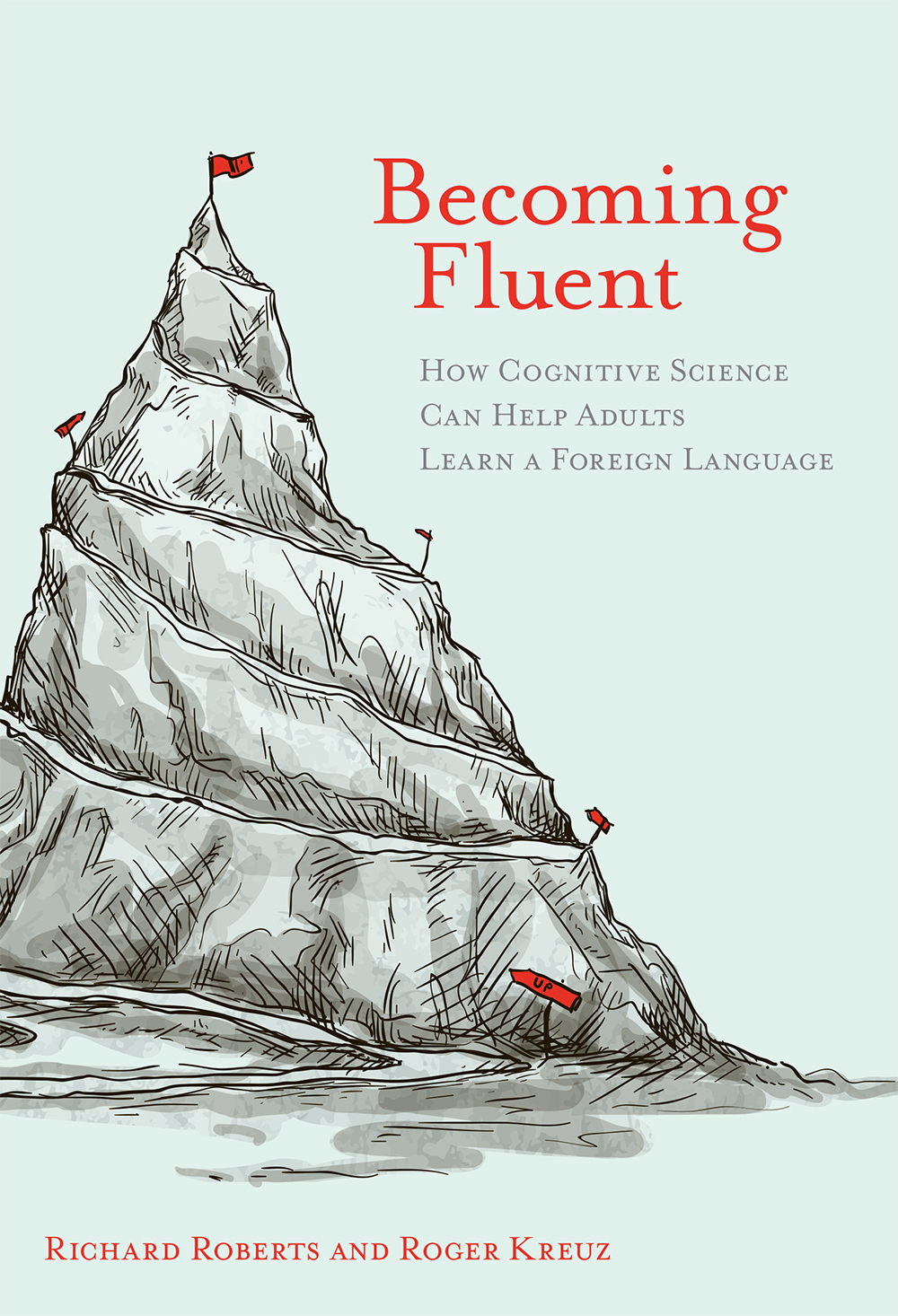
Becoming Fluent: How Cognitive Science Can Help Adults Learn a Foreign Language – Roger J. Kreuz, Richard Roberts

Adults who want to learn a foreign language are often discouraged because they believe they cannot acquire a language as easily as children. Once they begin to learn a language, adults may be further discouraged when they find the methods used to teach children don’t seem to work for them. What is an adult language learner to do? In this book, Richard Roberts and Roger Kreuz draw on insights from psychology and cognitive science to show that adults can master a foreign language if they bring to bear the skills and knowledge they have honed over a lifetime. Adults shouldn’t try to learn as children do; they should learn like adults.

Roberts and Kreuz report evidence that adults can learn new languages even more easily than children. Children appear to have only two advantages over adults in learning a language: they acquire a native accent more easily, and they do not suffer from self-defeating anxiety about learning a language. Adults, on the other hand, have the greater advantages—gained from experience—of an understanding of their own mental processes and knowing how to use language to do things. Adults have an especially advantageous grasp of pragmatics, the social use of language, and Roberts and Kreuz show how to leverage this metalinguistic ability in learning a new language.

Learning a language takes effort. But if adult learners apply the tools acquired over a lifetime, it can be enjoyable and rewarding.
Genres
Nonfiction
Language
Linguistics
Science
Psychology
Audiobook
Self Help

In My Hands Today…

A Place For Everything: The Curious History of Alphabetical Order – Judith Flanders

In A Place for Everything, historian Judith Flanders draws our attention to both the neglected ubiquity of the alphabet and the long, complex history of its rise to prominence. For, while the order of the alphabet itself became fixed very soon after letters were first invented, their ability to sort and store and organize proved far less obvious.

To many of our forebears, the idea of of organising things by the random chance of the alphabet rather than by established systems of hierarchy or typology lay somewhere between unthinkable and disrespectful. The author fascinatingly lays out the gradual triumph of alphabetical order, from its possible earliest days as a sorting tool in the Great Library of Alexandria in the third century BCE, to its current decline in prominence in our digital age of Wikipedia and Google.

In My Hands Today…

Wanderers, Kings, Merchants: The Story of India through Its Languages – Peggy Mohan

One of India’s most incredible and enviable cultural aspects is that every Indian is bilingual, if not multilingual. Delving into the fascinating early history of South Asia, this original book reveals how migration, both external and internal, has shaped all Indians since ancient times.

Through a first-of-its-kind and incisive study of languages, such as the story of early Sanskrit, the rise of Urdu, and language formation in the North-East, it presents the astounding argument that all Indians are of mixed origins. It explores the surprising rise of English after Independence and how it may be endangering India’s native languages.

In My Hands Today…

The Professor and the Madman: A Tale of Murder, Insanity and the Making of the Oxford English Dictionary – Simon Winchester

The Professor and the Madman, masterfully researched and eloquently written, is an extraordinary tale of madness, genius, and the incredible obsessions of two remarkable men that led to the making of the Oxford English Dictionary — and literary history.

The compilation of the OED, begun in 1857, was one of the most ambitious projects ever undertaken. As definitions were collected, the overseeing committee, led by Professor James Murray, discovered that one man, Dr. W. C. Minor, had submitted more than ten thousand.

When the committee insisted on honoring him, a shocking truth came to light: Dr. Minor, an American Civil War veteran, was also an inmate at an asylum for the criminally insane.