

The world’s largest festival for tribals, the Medaram Jatra, is held every two years over four days and, in the last decade, has become a major pilgrimage. The festival is held in the Medaram village of Tadvai Mandal, deep in the heart of the thick forests of the Mulugu district in the state of Telangana. Declared a state festival in 1998, the Jathra will take place between February 21 and 24 this year.
Pilgrims make their way to this tiny village whose population otherwise does not exceed 300, but during the jathra, it swells to almost ten million from Telangana, Andhra Pradesh, Orissa, Maharashtra and Madhya Pradesh to pay their respects and pray to the deities Sammakka and Saralamma.
The origins of the Medaram Jatara are shrouded in legend and mythology, tracing back to the valiant tale of Sammakka and Saralamma—the revered tribal deities of the region. The Jathara commemorates the fight of a mother and daughter, Sammakka and Saralamma, with the reigning rulers against an unjust law. According to folklore, Sammakka, a fearless warrior queen of the Koya tribe, waged a fierce battle against injustice and tyranny, ultimately sacrificing her life to protect her people. In her honour, a grand temple was erected in Medaram, where pilgrims flock to seek blessings and offer prayers to this day. It is believed that after the Kumbha Mela, the Medaram Jathara attracts the largest number of devotees in the country. It is celebrated in Medaram during the time the goddesses of the tribals are believed to visit them. Medaram is a remote place in the Eturnagaram Wildlife Sanctuary, a part of Dandakaranya, the largest surviving forest belt in the Mulugu.

There are many legends about the miraculous powers of Sammakka. According to a tribal story, in the 13th century, some tribal leaders who went hunting found a newborn girl, aka Sammakka, emitting enormous light while playing amidst tigers. She was taken to their home. The head of the tribe adopted her and brought her up as a chieftain. When she came of age, she was married to Pagididda Raju, a feudatory tribal chief of the Kakatiyas, who ruled the country of Andhra from Warangal City between 1000 AD and 1380 AD. She was blessed with two daughters and one son, namely Sarakka, Nagulamma and Jampanna, respectively.
The festival has no Vedic or Brahmanic influence. Until 1998, the only way to reach Medaram was by a bullock cart. In 1998 the state government declared the 1000-yr-old festival official and laid down a motorable road. In recent times the gatherings in the Jathara are roughly near 10 million. The traffic jam during the festival sometimes goes as far as 60 km on the Warangal highway.
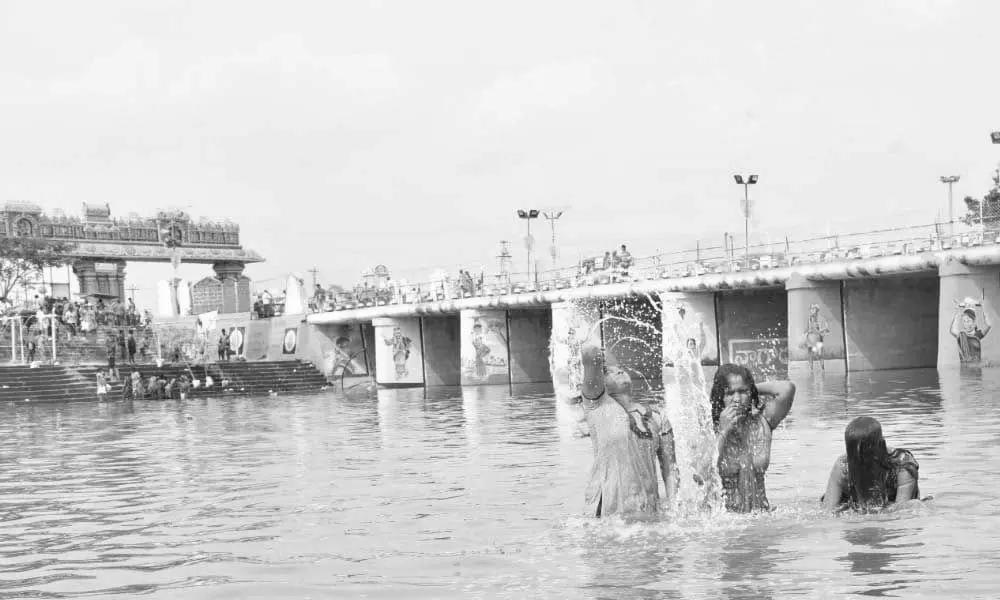
Jampanna Vagu is a tributary of the River Godavari. According to history, Jampanna is the tribal warrior and the son of the tribal goddess Sammakka. Jampanna Vagu took his name as he died in a battle fighting against the Kakatiyan army in the stream. The Jampanna vagu is still red, marked with the blood of Jampanna, though scientifically the red colour of the water is attributed to the soil composition. Tribals believe that taking a holy dip in the red water of Jampanna Vagu reminds them of the sacrifice of their Gods who will save them and also induces courage into their souls. There is a bridge constructed on top of Jampanna Vagu, known as Jampanna Vagu Bridge.
At the heart of the Medaram Jatara are the sacred rituals and traditions that define the festival’s essence. From the ceremonial installation of the gaddelu—wooden poles adorned with sacred symbols—to the ritualistic offering of jaggery and bangaram (jaggery and gold) at the feet of the deity, each gesture is imbued with deep spiritual significance.
The first day of the festival is celebrated as the arrival of Saralamma onto the Medaram Gaddhe or platform. Saralamma was the daughter of Sammakka. Saralamma is installed in a temple at Kannepalli, a small village near Medaram. In the morning pujaris perform pujas secretly. The unmarried women and men, those who want to have children and those who are suffering from diseases perform special pujas to Saralamma on this day. The villages of Kannepalli perform Aarti and organise a grand farewell to Saralamma. From there, the idol of Saralamma is brought to Medaram Gaddhe through the Jampanna Vaagu and after arriving at the Gaddhe, Saralamma is worshipped with special pujas and other rituals.
Day 2 of the Jathra is celebrated as the arrival of Sammakka on the Medaram Gaddhe. Sammakka is welcomed amidst the official homage from the police and government. On this day, pujaris bring bamboo sticks and place them on the Gaddhe. Amidst the protection and official homages of police, Pujaris bring Sammakka to the Gaddhe. Sammakka is usually installed at Chilukala Gutta in the form of a Kumkuma Bharina. Sammakka is the presiding deity of Medaram Sammakka Saralamma Jathara At Chilukala Gutta, as the indication of the arrival of Sammakka, the district Superintendent of Police fires his gun thrice in the air and inaugurates the bali to please Sammakka. Amidst the slogans praising Sammakka, pujaris bring the deity onto Gaddhe.

On the 3rd day of the Medaram Jathara, devotees and pilgrims can finally have a glimpse of their beloved deities. After taking a bath in the Jampanna Vaagu, devotees visit the Goddesses and offer various offerings to Sammakka and Saralamma. Women offer Odi Biyyam or sacred rice and saare which is a combination of necessary daily items to the Goddesses. The third day is the busiest one among the four festival days. The important offering in Sammakka Sarakka Jathara is Bangaram or jaggery which is offered as gold to the Goddesses.
The 4th day, which is the last day of the jathra is celebrated as Vana Pravesham of Sammakka and Sarakka. After getting worshipped the goddesses return to the forest. The day marks the conclusion of the 4-day Sammakka Saralamma Jathara. The same security and the official homage they have got while arriving on the platform are paid to the Goddesses while returning to the forest.
The Medaram Jatara is not just a religious pilgrimage but a celebration of Telangana’s rich cultural heritage. Traditional folk dances, music performances, and theatrical presentations captivate audiences, transporting them to a bygone era of rustic charm and rural splendour. In recent years, efforts have been made to promote environmental sustainability and conservation during the festival. Initiatives such as waste management, water conservation, and tree plantation drives aim to mitigate the ecological impact of the massive congregation while preserving the natural beauty of the surrounding landscape.
With the growing influx of pilgrims and visitors, there is a pressing need for infrastructure development to accommodate the increasing footfall. Investments in road networks, sanitation facilities, and accommodation options can enhance the pilgrim experience while ensuring the sustainable growth of the festival. As the Medaram Jatara embraces modernity, there is a delicate balance to be struck between tradition and innovation. Efforts must be made to preserve the authenticity of the festival’s rituals and traditions while embracing opportunities for cultural exchange and enrichment.

The Medaram Jatara stands as a symbol of faith, resilience, and cultural identity. In an era of rapid change and upheaval, the festival stands as a testament to the enduring spirit of the tribals of not just Telangana, but also the neighbouring states.
 Memories and Such