Karnataka’s state festival or Nadahabba, the Dasara festival in Mysore is a 10-day festival, starting with the nine nights of Navaratri and the last day being Vijayadashami or Dasara. The festival is observed on the tenth day in the Hindu calendar month of Ashvina, which typically falls in the Gregorian months of September and October. The 10-day extravaganza marks the triumph of good over evil and pays homage to the goddess Chamundeshwari, the presiding deity of Mysuru.
Dasara, Navratri and Vijayadashami was the day in Hindu mythology when Goddess Chamundeshwari or Goddess Durga killed the demon Mahishasura, whose slaying by the Goddess gave the city its name of Mysuru. The Mysuru tradition celebrates the warriors and the state fighting for the good during this festival, ritually worshipping and displaying the state sword, weapons, elephants, and horses along with the Hindu Devi goddess in her warrior form, predominantly as well as the Vishnu avatar of Lord Rama. The origins of the Dasara festival can be traced back to ancient Hindu mythology, specifically the great epic, Ramayana. It is believed that Lord Rama, the seventh avatar of Lord Vishnu, worshipped the goddess Durga before embarking on his journey to rescue his wife, Sita, from the demon king Ravana. In commemoration of the divine blessings bestowed upon him, Lord Rama emerged victorious on the day of Vijayadashami, the tenth day of the festival. The ceremonies and a major procession are traditionally presided by the king of Mysuru.
The Dasara festivities began with the Vijayanagar kings as early as the 14th or 15th century and played a historical role in the 14th-century Vijayanagara Empire, where it was called Mahanavami and the festivities are shown in the relief artwork of the outer wall of the Hazara Rama temple of Hampi. The Italian traveller Niccolò de’ Conti described the festival’s intensity and importance as a grandeur religious and martial event with royal support. The event revered Durga as the warrior goddess or Chamundeshwari and hosted athletic competitions, singing and dancing, fireworks, a pageantry military parade and charitable giving to the public.
After the fall of the Vijayanagar to the Deccan Sultanates, these Hindu celebrations came to an end under Muslim rulers. The Wodeyars of Mysore formed a kingdom in Southern parts of the Vijayanagara Empire and continued the Mahanavami or Dasara festival celebration, a tradition started initially by Raja Wodeyar I in mid-September 1610 at Srirangapatna. The city of Mysuru has a long tradition of celebrating the Dasara festival with grandeur and pomp. The Dasara festival in Mysuru completed its 409th anniversary in 2019. Over the centuries, the Dasara festival evolved and assimilated various regional customs and traditions, ultimately becoming an essential part of Mysuru’s cultural identity. The festival showcases the city’s rich heritage and its reverence for its ruling family, the Wadiyars, who have played a pivotal role in preserving and promoting the festival’s grandeur.
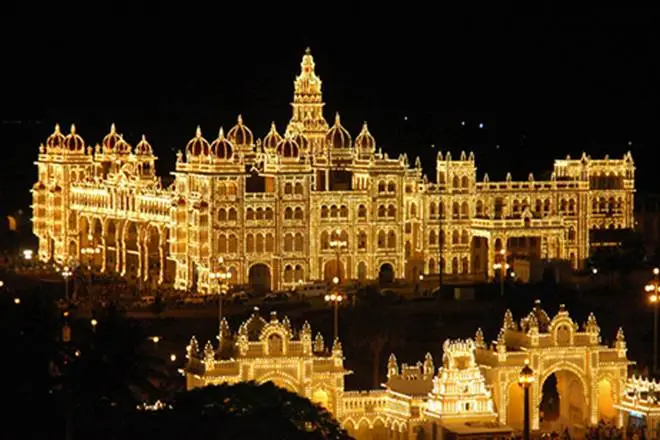
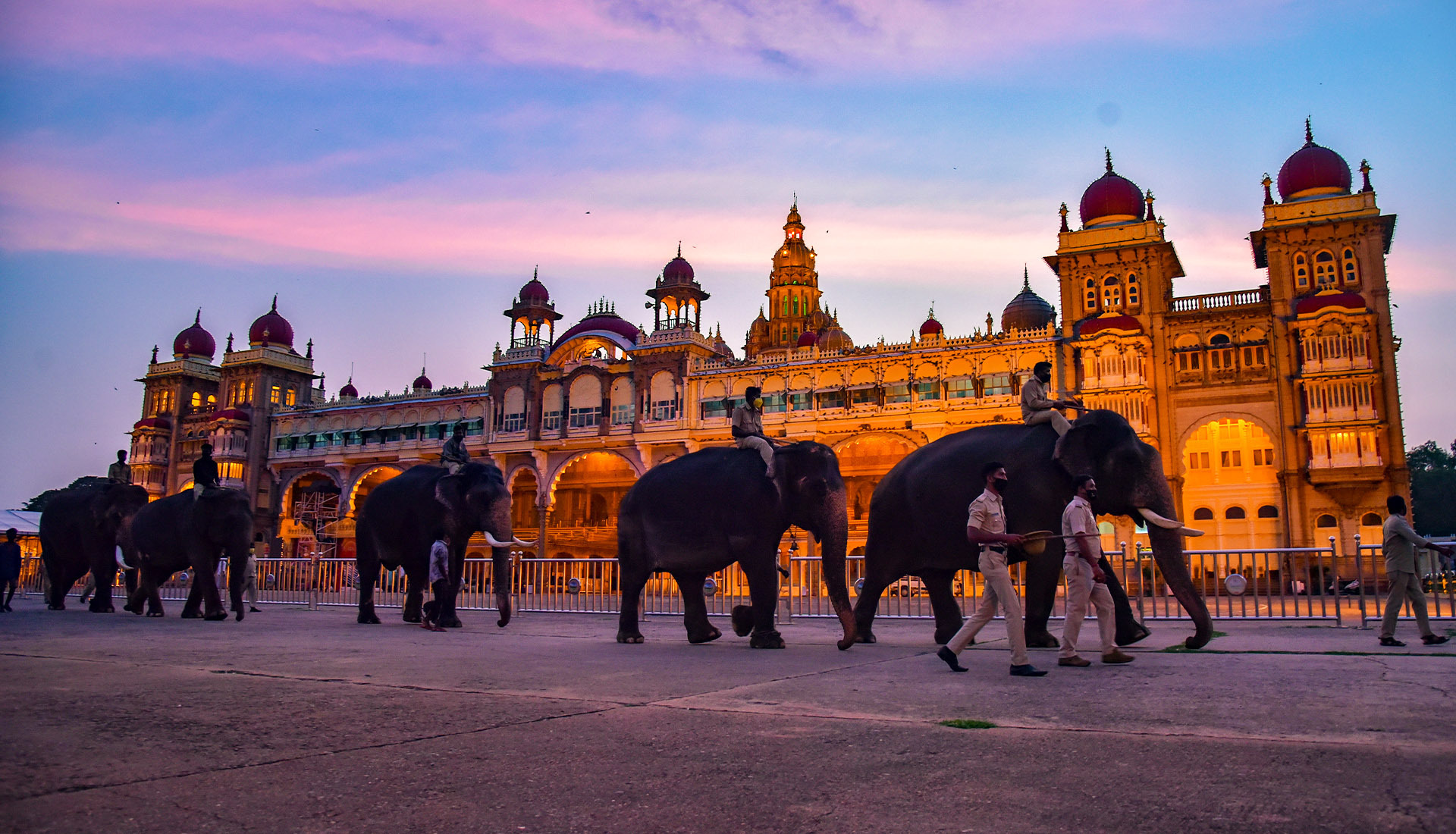
The festival is the jewel in the city’s crown and the entire city springs into action. Adorned with colourful lights and decorations, the iconic Mysuru Palace, a masterpiece of Indo-Saracenic architecture, takes centre stage as it is beautifully illuminated with nearly 100,000 light bulbs from 7 to 10 pm on all days of the festival, presenting a breathtaking sight. The Nadahabba is inaugurated with great fanfare at the Mysuru Palace by the current scion of the royal family. Dressed in traditional regal attire, the Wadiyars carry the golden idol of the goddess Chamundeshwari in a magnificent procession, accompanied by traditional music, dance, and the beats of ceremonial drums. The spirit of the festival is infectious as locals and visitors alike gather to witness this majestic spectacle. The intricate floral rangoli, known as Rangoli Patha, adorn the palace grounds, and the aromatic fragrance of flowers fills the air, adding to the festive ambience. Various cultural and religious programs highlighting the dance, music and culture of the State of Karnataka are performed in front of the illuminated Palace.
The heart of Dasara lies in the nine nights of Navaratri, a time to celebrate the various forms of the divine goddess. Mysuru becomes a cultural haven during this period, with vibrant performances of classical music, dance, and folk arts taking place at various venues across the city.
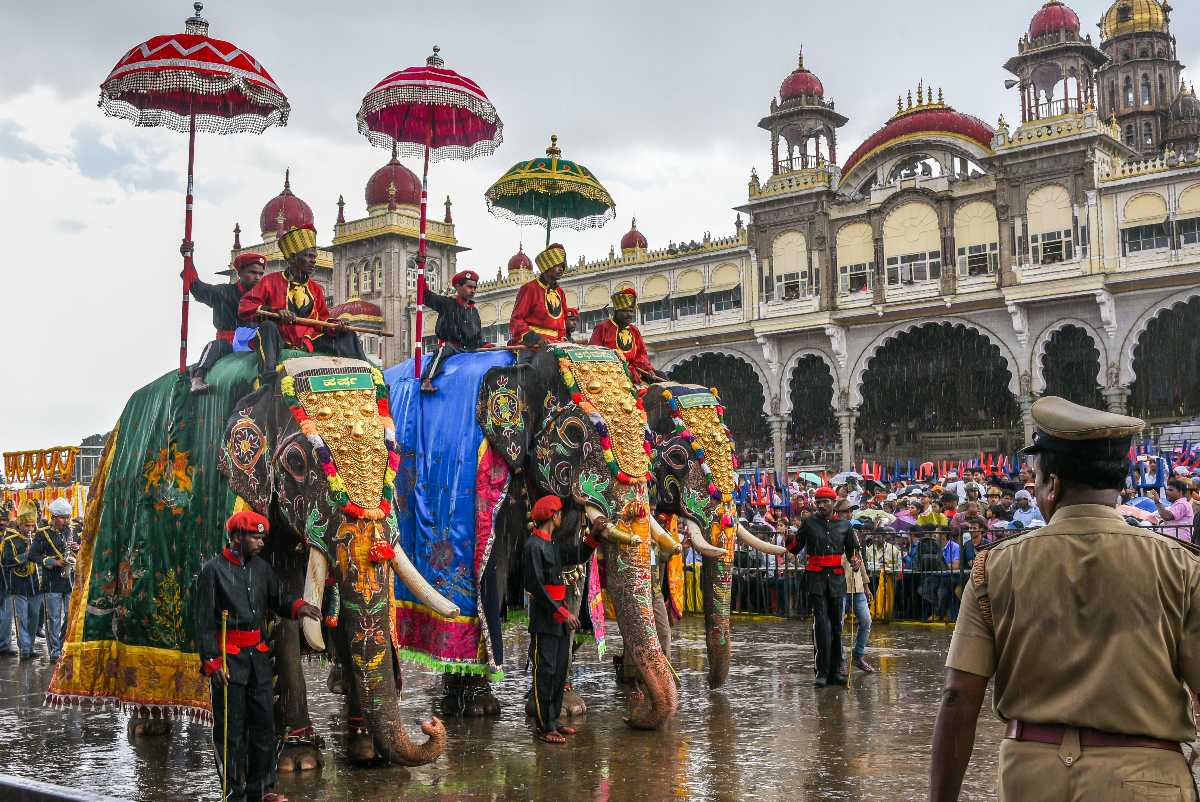
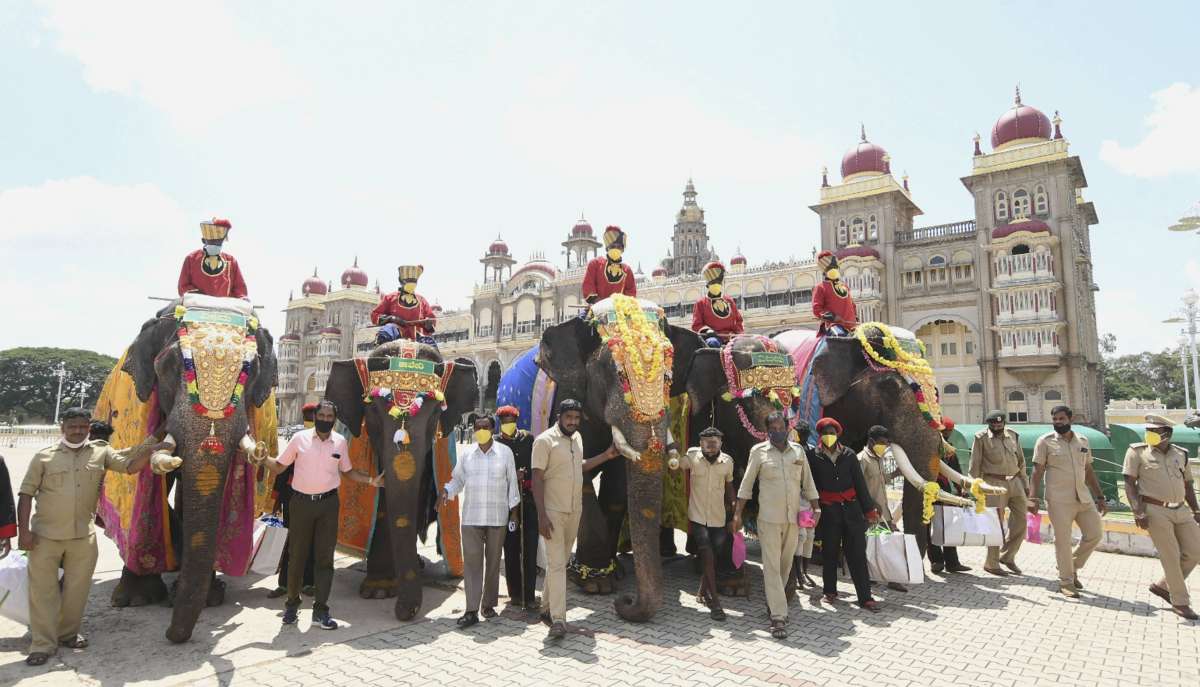
The grand finale of the Dasara festival is the Vijayadashami procession, a regal pageantry that captivates all. The streets of Mysuru come alive with an unending sea of spectators, eagerly awaiting the arrival of the adorned elephant carrying the idol of goddess Chamundeshwari. The traditional Dasara procession, locally known as Jumboo Savari is held on the streets of Mysuru. The main attraction of this procession is the idol of the Goddess Chamundeshwari which is placed on a golden mantapa, made out of 750 kg of gold on the top of a decorated elephant. This idol is worshipped by the royal couple and other invitees before it is taken around in the procession. Colourful tableaux, dance groups, music bands, decorated elephants, horses and camels form a part of the procession which starts from the Mysore Palace and culminates at a place called Bannimantap where the Banni tree or Prosopis spicigera is worshipped.
According to a legend from the Mahabharata, the banni tree was used by the Pandavas to hide their weapons during their one-year period of Agnatavasa where they had to live incognito. Before undertaking any warfare, the kings traditionally worshipped this tree to help them emerge victorious in war. The Dasara festivities would culminate on the night of Vijayadashami with an event held on the grounds at Bannimantap called Panjina Kavayatthu or the torch-light parade.
The procession features beautifully decorated tableaux showcasing the city’s rich history and mythological stories. Folk dancers, performers, and cultural troupes from across the state add a vibrant touch to the procession, reiterating Karnataka’s diverse cultural heritage. The procession culminates with a breathtaking display of traditional music and fireworks, illuminating the night sky and leaving spectators in awe. After the Jamboo Savari, a torchlight parade takes place in the evening at the Bannimantap Parade Grounds.
The famous Mysuru Dasara Exhibition, held in the exhibition grounds opposite the Mysore Palace is a major highlight, where a carnival-like atmosphere enthrals visitors with thrilling rides, games, and mouthwatering street food. Local artisans and craftsmen showcase their talents in the exhibition, adding a touch of traditional artistry to the festivities. The exhibition was started by the Maharaja of Mysore, Chamaraja Wodeyar X in 1880 with the sole aim of introducing timely developments to the people of Mysore. The task of holding the exhibition is now entrusted to the Karnataka Exhibition Authority or KEA. This exhibition starts during Dasara and goes on till December. A play area containing attractions like a Ferris wheel is also present to provide entertainment and various Governmental agencies set up stalls to signify the achievements and projects that they have undertaken.
The Dasara Sports Meet, reminiscent of the days of the Maharajas, draws enthusiastic participants and spectators alike. The traditional sport of Kusti or wrestling and other indigenous games and races bring back the nostalgic charm of a bygone era and attract wrestlers from all around India. On all the 10 days of Dasara, various music and dance concerts are held in auditoriums around Mysore city. Musicians and dance groups from all over India are invited to perform on this occasion.
The Dasara procession has faced increasing pressure from activists and campaigners to end its controversial use of elephants. Procession elephants, as well as their handlers known as mahouts, have died from several shocking incidents over the years. In 2018, leaked footage from the elephants’ training ground showed an elephant swaying in distress. International press labelled the video heartbreaking and reported on how the elephants must undergo two months of rigorous training to perform in the procession.
Dasara in Mysuru is not just a festival; it is a testament to the city’s deep-rooted heritage and the enduring spirit of its people. It is festivals like this, that help us to cherish and preserve our cultural legacies for generations to come.



 Memories and Such