Navratri Recipes: Peanut Sundal

This year, on a whim, I have decided to make an offering or neividhyam to the Goddess on all days of the Navratri festival. One of the offerings I made was this peanut sundal. This is a very quick recipe and takes just a few minutes to temper and finish.

Peanut Sundal

Ingredients:

  • 2 cups raw peanuts
  • 1 tsp mustard seeds
  • 1 tsp broken urad dal
  • 1/4 tsp asafoetida
  • 3-4 curry leaves, torn
  • 1-2 green chillies, chopped
  • 2 tbsps grated coconut
  • 1 tbsp oil
  • Salt to taste

Method:

  • Soak the raw peanuts either overnight in normal water or for 2-3 hours in hot water. Drain and pressure cook for 2-3 whistles with some salt or until the peanuts are tender.
  • Heat the oil in a pan and when the oil warms, add in the mustard seeds and let the seeds pop. Then add the urad dal and let it start to turn golden. Then add the asafoetida, curry leaves and green chillies and stir for a couple of seconds.
  • Now add the cooked peanuts and stir well for a while. Season it with salt if not enough. When the peanuts have absorbed all the spices, sprinkle the grated coconut, stir well and switch off the flame.
  • Serve hot. You can also sprinkle a few drops of lemon juice if you need it to be slightly tangy.

This is an alternative to a healthy protein-filled snack, especially when you have school children coming home hungry!

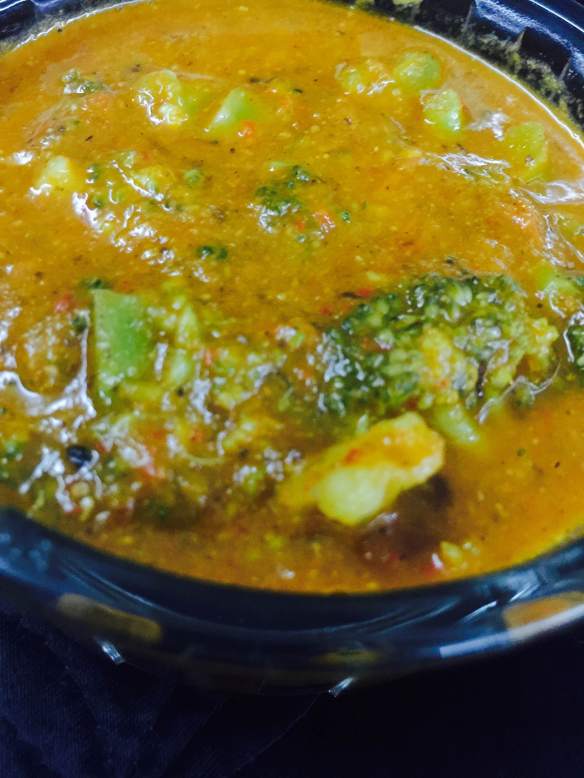
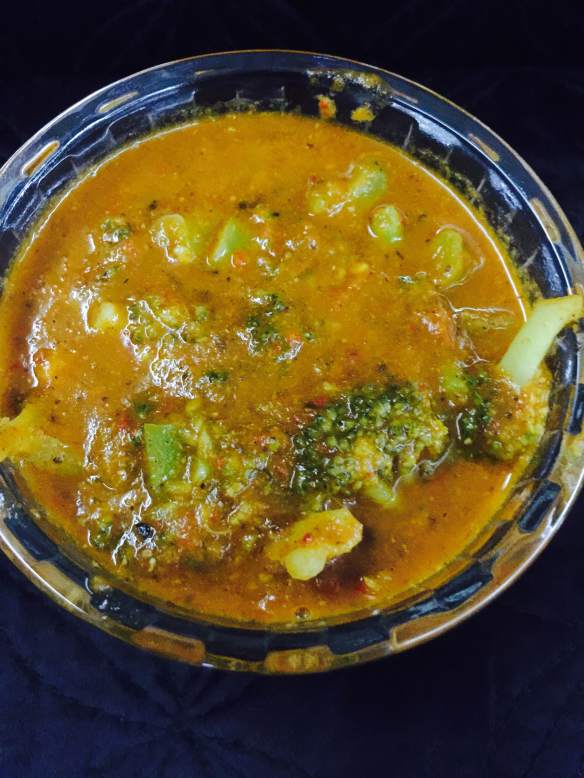
Recipe: No Onion, No Garlic Broccoli in Red Pepper Gravy

img_6138

During the 10/11 days of Navratri, I do not eat food which has onions and/or garlic added to it. So this means, we’re usually cooking traditional south Indian Brahmin food, which does not incorporate these two vegetables. After a few days of cooking traditional dishes, I was bored and so decided to make something north Indian, but to make these gravy-based vegetables without onions and garlic is a challenge. I also had two heads of broccoli which were going to spoil soon so I experimented with this dish which tried to replace garlic and onions with asafoetida and cashew nuts and sesame seeds. It was a hit and even though I made enough for the whole day, we only ate for a single meal and I had to make something else for dinner!

img_6139

No Onion, No Garlic Broccoli in Red Capsicum Gravy

Ingredients:

  • 2 heads broccoli, cut into florets, washed and kept aside
  • 2 tsp cumin seeds
  • 1 tsp coriander seeds
  • 1 tsp fennel seeds
  • 1 tsp carom seeds/ajwain
  • 4-5 cashew nuts
  • 1 tsp white sesame seeds
  • 2 tsp red chilli powder
  • ½ tsp turmeric powder
  • ¼ tsp asafoetida
  • 1 tsp garam masala powder or sabzi masala powder
  • Salt to taste
  • 4 tomatoes, chopped roughly
  • 1 red bell pepper, chopped
  • 2 tbsps oil
  • Coriander leaves to garnish

Method:

  • Heat 1 tbsp oil in a pan and add 1 tsp cumin seeds.
  • When it splutters, add the coriander seeds, fennel seeds, carom seeds and cashew nuts.
  • Let the cashew nuts brown and then add the red bell peppers and the tomatoes.
  • When the tomatoes start to dissolve, switch off the gas and add the sesame seeds.
  • Let it cool completely and when cool, blend it into a fine paste.
  • In another clean pan, heat the remaining oil and add the balance cumin seeds.
  • When it splutters, add the asafoetida and turmeric and stir for a couple of seconds.
  • Now add the washed broccoli heads and stir-fry for a few minutes till the broccoli gets coated with the spices.
  • When the broccoli is half cooked, add the blended paste and season it with salt, red chilli powder and garam masala powder or sabzi masala.
  • Add water if the gravy is very thick and dry and bring it to the consistency you want.
  • Cook this gravy and the broccoli for a few minutes. Do not overcook the broccoli and keep it slightly al-dente.
  • Garnish with coriander leaves and serve hot with any rice or flat bread.

img_6140

Saraswati Puja

Today is the last day of the Navaratri festival with the Saraswati Puja and Dusshera tomorrow. Then it’s the anticipation of Diwali!


Saraswati Puja is celebrated all over India and across the world today with the day being dedicated to Goddess Saraswathi. In Hinduism, Saraswathi is the goddess of knowledge, wisdom, studies, science and technology, music, arts etc. She is also said to be the consort of Lord Brahma, who is said to be the creator of the world in Hindy mythology. Goddess Saraswati is depicted as a beautiful woman wearing a spotless white saree symbolising the purity of knowledge with four hands embodying mind, intellect, ego and alertness. She is usually seated on a white lotus or a white swan which is also her vehicle of transport, with a peacock close to her. She also holds the following in her four hands – a book, which is usually the vedas representing universal, eternal and true knowledge as well as her power over knowledge and the sciences; a rudrashka or rosary representing the power of spirituality, a veena, which is a musical intrument representingin her perfection in all arts and sciences and a pot of gangajal or sacred water which represent creative adn purification powers. Unlike most Goddesses in Hindu mythology, she is usually dressed very simply and not adorned with loads of jewellery showing that she prefers the intellectual and the artistic over the material.

Saraswati is also the main goodess of the Sringeri Sarada Peetham, which is what my family has been following for generations and the Jagadguru Shankaracharya at the Sarada Peetham is whom we consider our guru. I’ll post more about this later, just is just a teaser.

In South India and our brahmin community, we worship the Goddess on the ninth day of Navaratri. On that day, after bath, we keep books and some new clothes at her feet and worship her. I made a payasam today as the prasad. On this day, children also do not look at their books since she is supposed to be sitting on them and to use them is to disrespect her. The next day, we have to read a couple of pages from each book that was kept at the pooja so that she blesses us with good intellect and the most important thing for children – marks!

I’ve kept BB & GG’s books at the altar and asked them to pray to Saraswati Ummachi (God) so that she can bless them. They both prayed “Ummachi, please bless us so that that we can study well and get good marks in our exams“.

One of the first shlokas that I learnt from my ammama and have taught GG & BB is the one about Goddess Saraswati. It goes like this:

Saraswati namasthubiyam, varade kamarupini
Vidyarambham karishyaami, siddhir bhavatume sadaa

O Goddess Saraswati, salutations to you, the giver of boons, the one who fulfills all desires. I begin my studies. May there always be accomplishments for me.

The picture in this post is the picture of Goddess Saraswati in my pooja.

Catching up with friends

On Sunday evening, we went to my inlaws place for haldi Kumkum and it was a fun evening. BB & GG got to meet up with some old friends whom they hardly see these days since they’ve moved away and are in different schools. At one point there was so much noise, we couldn’t hear ourselves talk – there were about 9 kiddos in the house, including two little ones. It was funny seeing how they split themselves gender-wise – the boys playing with their cars in one room and roaring with laughter at bodily functions, something that only little boys are capable of finding humour in and the girls playing god knows what but which included loads of shouting, dancing and singining in one room. The two little ones shuttled between both rooms, somtimes scared as they saw the noise levels there.

Image source - Wikipedia

It was really fun catching up with friends like this and we have decided to do it once again soon (after the exams). While talking about the different activities our kiddos do I was stuck by something. Most of their friends who came visiting on Sunday were learning Indian things (classical music, classical dance etc) since they learn they non-Indian things in school, something which every self-respecting tambrahmkid does, but BB & GG are different. BB & GG have been

Image from Wikipedia

learning Indian classical Carnatic music for about a year now and GG as a counterpoint to this has been learning Ballet since the time she was around three years old. She enjoys ballet, but is not very good at it. It’s not something that she’ll be doing as a career, but it is something that gives her pleasure. I enjoy this dischotomy and it gives me pleasure that GG is blending the traditional with the modern, just like this world that is all hers!

Now I have to get BB to take something that complements what GG is doing – but BB is alll boy and so I am unsure if he will enjoy it. Well, there’s always hope. Next year, when they go to Primary 3, they need to take up some compulsary Co-Curricular Activities. Since BB is always at home – on the iPhone, on the computer or on the TV, both S and me want him to take up some physical activity like soccor, wushu or chookball!

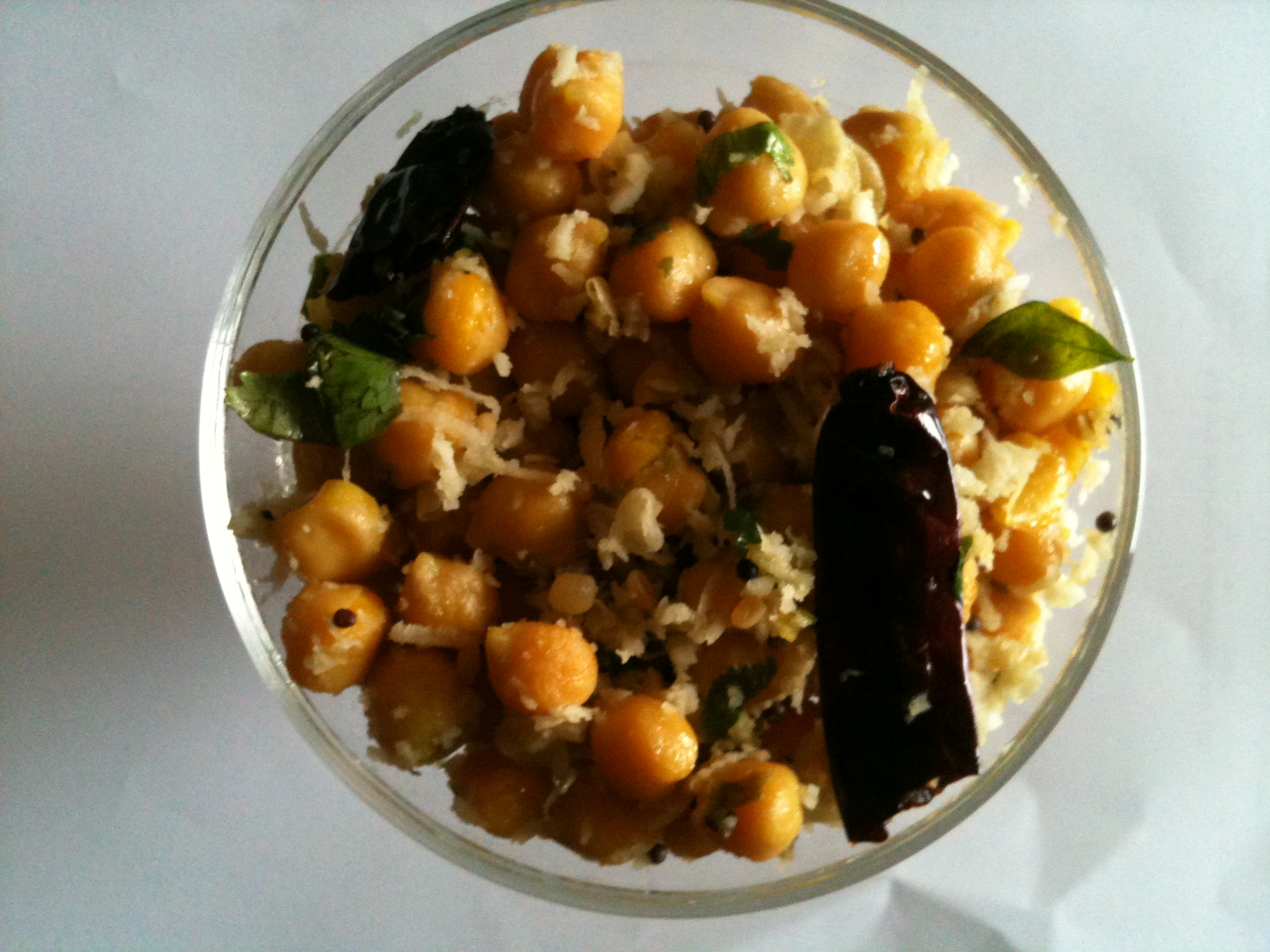
Navratri Chick pea Sundal

Yesterday GG & BB had a small concert in a nearby temple where they, along with their group mates sang one song the Lingashtakam. It was so cute seeing them sing it. I have recorded it and would love to put it here, but you the rules….Instead here is S.P. Balasubramanian singing the same song


Anyways, the temple has Sundal as one of the prasadams and so I also wanted to make it at home. It’s very easy and a very traditional Navratri offering.

Chickpea Sundal

Ingredients:

1 cup dry chick peas (Chole), soaked in water overnight, then pressure-cooked for about 4-5 whistles till it is soft

1 tsp oil

t tsp mustard seeds

1 tsp black gram dal or urad dal

a handful of curry leaves

half a tsp of green chilli paste

3 dried red chillies, broken

a pinch of asafoetida (hing)

2 tbsps dessicated cocounut

Salt to taste

coriander leaves to garnish

Method:

In a pan, heat oil and put the mustard seeds. When the seeds splutter, add the urad dal and the asafoetida. Now add the dried red chillies, curry leaves and green chilli paste. Stir for a few seconds and add the pressure-cooked chole along with salt. Stir again for a couple of seconds and then add the dessicated coconut. Stir well and switch off the gas, add the coriander leaves and serve.