
After visiting Kashmir, let’s go slightly south to visit the province of Jammu.

Jammu
The winter capital of the erstwhile state and protected and blessed by Mata Vaishno Devi, who seems to have found her earthly abode on the Trikuta Hills, Jammu City is almost a sacred place to visit. Dubbed the city of temples, this city brims with grand ancient temples and beautiful palaces.
Nestled against the backdrop of the snow-capped Pir Panjal Mountains, the region of Jammu constitutes the southernmost unit of the state of Jammu & Kashmir. It forms part of the transition between the Himalayan range in the north and the dusty plains of Punjab in the south. Between these two extremities lie a series of scrub-covered hills, forested mountain ranges and river valleys, encompassing several microclimatic regions that extend from Kishtawar in the north-east to Akhnoor in the south-west, and the historic town of Poonch in the north-west to the borders of Kangra (Himachal Pradesh) in the south-east. The Shivalik hills cut across the area from the east to the west while the rivers Ravi, Tawi and Chenab cut their way through the region.
The unmatched divinity at Raghunath temple, Ranbireshwar temple, Mahamaya temple, Peer Baba and Peer Khoh invigorates visitors. One must visit the Bahu temple, which is situated inside the majestic Bahu Fort. The temple is dedicated to presiding deity of Jammu, Goddess Kali or Bawe Wali Mata as she is popularly called in the region. Besides the temple, a travel enthusiast can witness architectural grandeur of Bahu Fort and Mubarak Mandi Palace. The Aquarium at Bagh-e-Bahu (Bahu Fort) also catches the eyes of the tourists as it is the largest underground aquarium in the country.
Jammu was founded by Raja Jambu Lochan in 14th century, when he constructed Bahu fort on the banks of river Tawi. There also have been excavations found 32 km away from Jammu, in the city of Akhnoor which suggest that Jammu was once a part of Harappan Civilization as well. Remains from Maurya and Gupta dynasties have been found, followed by the invasions by Mughals and Sikhs. The Dogra rule brought back the glory to the city. After the partition of India, Jammu continued to be the official winter capital of the state.

Patnitop
Perched on a hilltop at an altitude of 2024m, with endless meadows and panoramic views of the snow capped peaks of the Himalayas, Patnitop is the best place to experience nature at its picturesque best. With views of the Shivalik Range, the area has a plethora of activities like skiing and trekking as well as water springs.
Visit Gaurikund, which not only holds great spiritual value, but you can also see the holy Kailash Mountain. A leisure walk to the Pine forest is ideal for the nature lovers. At Shivgarh, you can enjoy a spot of trekking at Shivgarh and paragliding, abseiling (rappelling), rock climbing and camping at Sanasar. At a little distance from Patnitop, there is a village called Kud that is famed for multitude varieties of sweets, so enjoy and don’t worry about calories!

Rajouri
The refuge of several Gujjars and Bakerwalas, Rajouri is situated around 154kms away from Jammu. The district shares border with Pakistan and is blessed with many charming places to visit; Dehra Ki Gali, Thanamandi and Kotranka Budhal are few places that are apt for sightseeing. One can retire to these remote places in summers as the weather remains pleasant here all year round. The magnificent Rajauri Fort, Balidan Bhavan, Dhanidhar Fort and Rama Temple are few places that can be visited in the vicinity of Rajouri.
Udhampur
Named after Raja Udham Singh, Udhampur city is the second-largest city in Jammu region. Set amidst lush green surroundings and fringed by eucalyptus trees, Udhampur is one of the best tourist attractions in Jammu & Kashmir. A delight for history lovers, the city offers many relics dating back to the time of epic of Mahabharata. The Krimachi group of temples are said to be the oldest structures in the city. Udhampur is also famous for the underground river Devika, which is considered the sister of Ganga. Visit the Ramnagar fort, located approximately 40kms from Udhampur and built by Raja Suchet Singh. Moungri Cave shrine, Pingla Mata and Sudh Mahadev temple are other prominent places that must be visited in Udhampur.
Kathua
Owing to the existence of a large number of Sufi shrines, Kathua is dubbed as the City of Sufis. True to its title, Kathua houses several religious places including Jasrota temple (inside Jasrota fort), Mata Sundrikote, Mata Bala Sundri, Sapt Sarober and Airwan temple. It is ideal to pay homage to one of these sacred places as in to understand the spirituality prevailing in Kathua. A recreation park called Dream has also been set up in Kathua promising an enthralling rafting experience. The Ujh Barrage located 20kms away from Kathua is an idyllic picnic spot. History buffs can also visit the Jasrota Fort to witness the grandeur built by Maharaja Ranbir Singh. Also the temple of Maha Kali in the Jasrota village has emerged as a popular pilgrimage centre in the region.

Katra and Vaishno Devi
It is often seen that whenever Katra is discussed; it is referred merely as a base camp for devotees who visit Vaishno Devi. Katra is worth visiting, even if you are not on a pilgrimage, because attractions like the Banganga, the Chenab river, and a large amount of peaks around offer great places for mountain climbing and family outings.
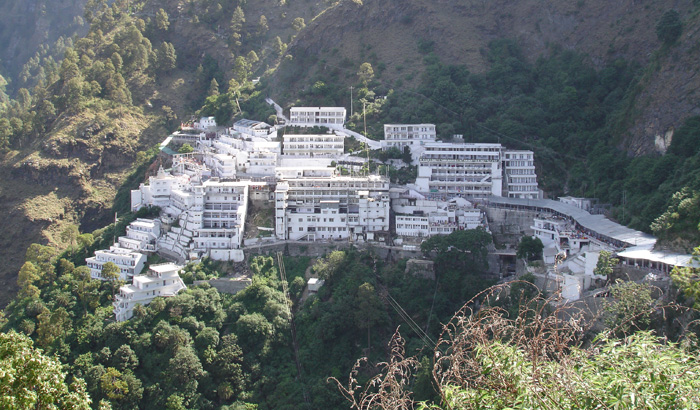
The shrine of Vaishno Devi, one of the most important places of worship in India calls the little town of Katra its home. Located in Trikuta hills, 13 km from Katra at the height of 1560 m above sea level this town is the holy cave temple of Mata Vaishnodevi. This famous shrine is a beacon for millions of devotees from all over the world. Popularly known as Mata Rani, Vaishno Goddess is a manifestation of the Hindu Goddess Durga. It is believed that during the pooja and Aarti, Goddesses arrive at the Holy cave to pay their respect to Mata Rani. Devotees believe goddess herself calls the devotees to reach here.
Thousands of pilgrims visit each year to seek blessings and show unflinching faith in this temple. Vaishno Devi is a religious trekking destination where pilgrims walk about 13 km uphill to reach the little caves which are among one of the 108 Shakti Peetha. It takes about 6 to 9 hours depending on the fitness, age and weather conditions. Ponies and palanquins, as well as helicopter services, are available by various vendors to take you there at the top.
The pilgrimage route is only complete when Shiv Khori, 1.6 km away from Vaishno Devi is also visited. Shiv Khori is second to Vaishno Devi in religious value and is famed for its 4ft tall naturally formed Shiva Linga.

Kishtwar
Kishtwar is another gem from the crown of Jammu & Kashmir. Situated approximately 255kms away from Jammu city, Kishtwar is surrounded with lofty mountains and dense deodar and pine forests. Situated on a plateau above chenab river and below the nagin sheer glacier, Kishtwar has saffron growth in a limited time and its harvesting is accompanied by ceremonies and festivals, this is typically during summer.
There is a 400 sq km National Park in Kishtwar called Kishtwar National Park. Spread over an area of 400 sq.km the park contains 15 mammal species including the musk deer and Himalayan black and brown bear. Even though Kishtwar is not the only high altitude wildlife sanctuary, it is made special because of its large variety of flora and fauna. There are also two sacred voyages namely, Machail Yatra and Sarthal Yatra that begins from Kishtwar.
 Memories and Such

Pingback: Travel Bucket List – India: Jammu, Kashmir and Ladakh Part 2 — Memories and Such – Truth Troubles