
Let’s dive straight into Malacca City’s treasures.

A’Famosa
Also known as Kota A Famosa in Malay was a Portuguese fortress built in 1512, A Famosa is amongst the oldest surviving European architectural remains in Southeast Asia. The oldest part of the fortress was a five-storey keep which gave its name to the fortress as a whole. A former Portuguese Fortress, A Famosa is among the oldest surviving European architectural remains in Southeast Asia. Sometime following the Battle of Malacca in 1641 and the occupation of the city by the Dutch, the keep was destroyed but the outer walls of the fortress were reinforced. However, in 1807 the British destroyed most of the fortress. The Porta de Santiago gateway, and the restored Middelburg Bastion, are the only parts of the fortress that remain today.
At the time of its construction, A’Famosa acted as the residence of the Portuguese administration. It consisted of long ramparts and four major towers. One was a four-story keep, the others held an ammunition storage room, the residence of the captain, and an officers’ quarters. The village was mostly clustered within the fortress walls in townhouses. In 1586, extensions were added to the fort to accommodate the expanding population. The fort changed hands in 1641 when the Dutch drove the Portuguese out of Malacca and they renovated the gate in 1670, which explains the logo ANNO 1670 inscribed on the gate’s arch. Above the arch is a bas-relief logo of the Dutch East India Company. The fortress changed hands again in the late 18th century when the Dutch handed it over to the British to prevent it from falling into the hands of Napoleon’s expansionist France. The English were wary of maintaining the fortification and ordered its destruction in 1806. The fort was almost demolished but for the timely intervention of Sir Stamford Raffles. Captain William Farquhar, tasked with the destruction of the fort and town, decided to save two of the gateways to the fort, including the Santiago Gate, as well as the Stadthuys, church and jail.

In late November 2006, a part of the fort, believed to be the Middelburg Bastion, was accidentally uncovered during the construction of 110-meter revolving tower. The construction of the tower was ceased and it was officially opened on 18 April 2008. In June 2004, a watchtower named Santiago Bastion was discovered during the construction of the mall, Dataran Pahlawan. In 2006-2007 the Middelburg Bastion was restored.

Stadthuys
The oldest surviving Dutch building in the east, Stadthuys which means city hall in old Dutch, is a historical structure situated in the heart of Malacca in the Red Square. Stadhuys is known for its red exterior and the red clock tower. It was built by the Dutch in 1650 as the office of the Dutch Governor and Deputy Governor. Spread over 49,200 sq ft, the iconic red terracotta building now houses the History and Ethnography Museum showcasing Malaccan culture and traditions. Among the displays in the museum are traditional costumes and artefacts throughout the history of Malacca, which makes it Malacca’s premier museum. It is a reproduction of the former Stadhuis, the town hall of Frisian town of Hoorn in the Netherlands. Apart from housing the Ethnography Museum, Stadthuys complex also has the Museum of Literature. It depicts the local legends and accounts through maps, prints and photographs. Located nearby is another attraction worth visiting – the Tang Beng Swee Clocktower. Admission to the building allows entry to all the museums inside. Photography is allowed and there are free guided tours from 10:30 am to 2:30 pm on weekends and Stadthuys is open from 9 am to 5 pm on Mondays to Thursdays and between 9 am to 8:30 pm on Friday to Sunday.
Dutch Square
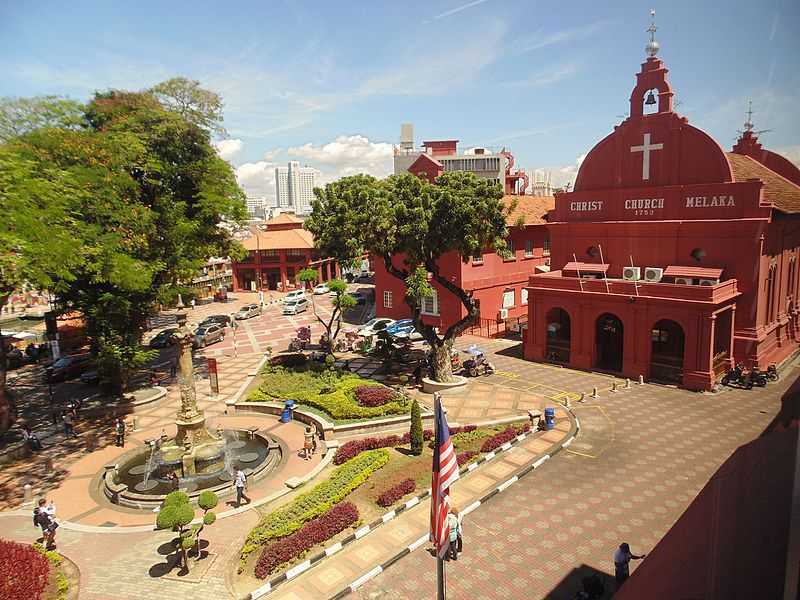
The Dutch Square is one of Malacca’s most famous landmarks. The square is surrounded by buildings painted in red, which gives rise to its popular name Red Square with Stadthuys being the most prominent. Built between the 1660s and 1700s, the red buildings are characterised by large windows and wrought iron hedges. A major highlight of the Red Square is the Queen Victoria Fountain, standing proudly at its centre. Built in 1901, the fountain commemorates the diamond jubilee of Queen Victoria. The Red Square is a popular photography area.

The Tang Beng Swee Clock Tower is located at the centre of Dutch Square and is named after Chinese billionaire Tan Beng Swee. Popularly known as the Red Clock Tower, it is a famous landmark due to its unique architecture and symbolic value. Stadthuys was used as a town hall during British colonial rule and served as a residential complex for Dutch governors. The building has now been converted into a collection of several museums. Christ Church faces the Queen Victoria Fountain and is also the oldest Protestant Church in Malaysia. The church pays homage to World War II Veterans by putting up plaques on the walls recording the events and deaths of World War II. The red bricks used for the construction of the church were shipped from Holland. Queen Victoria Fountain was built in 1901 in honour of Queen Victoria and is one of the last architectural footprints of the colonial British Power in Malaysia. The fountain functions still date and makes for a good backdrop for photographs near Dutch Square. The Malaysia Youth Museum and Art Gallery was built in 1784 and is located between Christ Church and Laksamana Road. It was used as a Dutch Administrative Complex and a school before finally being converted into a museum. The lane between Christ Church and Stadthuys is well known for its souvenir shops that sell a wide variety of mementoes and are quite popular among visitors.

Baba & Nyonya Heritage Museum
Also known as the Baba Nyonya House Museum, the Baba Nyonya Heritage Museum is a museum that showcases the local history of ethnic Chinese-Malays called Baba-Nyonya or Peranakan. The museum was established in 1986 by Chan Kim Lay, the fourth generation of his family to reside in the large house built by his great-grandfather in 1896 and is known for its elaborate woodwork, furniture, and porcelain. The museum is a complex of three restored houses showcasing the typical 19th-century Baba-Nyonya residence. The Chinese Palladian houses were converted into Peranakan Museum, now known for its exquisite woodwork, porcelain, and furniture. Guided tours are available. The house consists of three terraces which are almost 20 feet in width and 180 feet long with an air well in the middle for proper air circulation. The house is filled with lavish Blackwood furniture with woodwork, pearl, marble, unique decor and 5 metres high silk embroidery. The stairs to the second storey has woven gold-leaf carvings and solid cenggal wood.
The Thia Besar is the Reception Hall where only men of the family were allowed and is decorated with tall panels of Chinese silk embroidery and interesting stories of generals and scholars with Chinese tales, present in the patriarchal structure of the Chan household. The next room is Dapur which is the Kitchen where ladies along with close relatives were allowed along with Chung Po, the chef to make traditional food. The next hall is known as Thia Abu, which is the ancestral hall. The family still observes the role of the museum as an ancestral home by conducting prayers seven times a year on the death and birth dates of their ancestors and also the Chinese New Year.
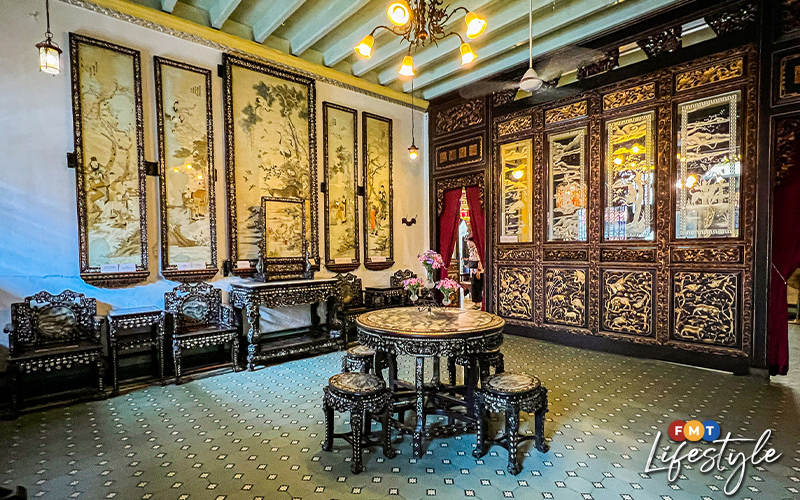
The museum exhibits the original layout of the actual ancestral home of the Chan family items showcasing cultures of various countries like the mosaic and oil lamp from the UK, Chinese porcelain, fine art products, unique costumes, antique furniture, woodwork, Peranakan tchotchkes in glass cases along with kitchen items like hand churner. A tour of the museum can be booked online for a and there is a group of 15 or more people, the booking should be made a month in advance with Chinese tours and an activity tour provided in case of special ones. For a group of fewer people, a self-guided book or audio tour can be bought or a guided tour can be taken too. The cost of a audio tour is RM 4 per person. Photography is not allowed inside the museum. The museum is open between 10 am and 5 pm on Mondays to Thursdays and from 10 am to 6 pm on Fridays to Sundays. The last admissions are about 45 minutes before the museum closes. The museum is closed for three days during the Chinese New Year. Entry Fees are RM !6 for an adult and RM 11 for a child between 5 and 12 years.
Melaka Sultanate Palace
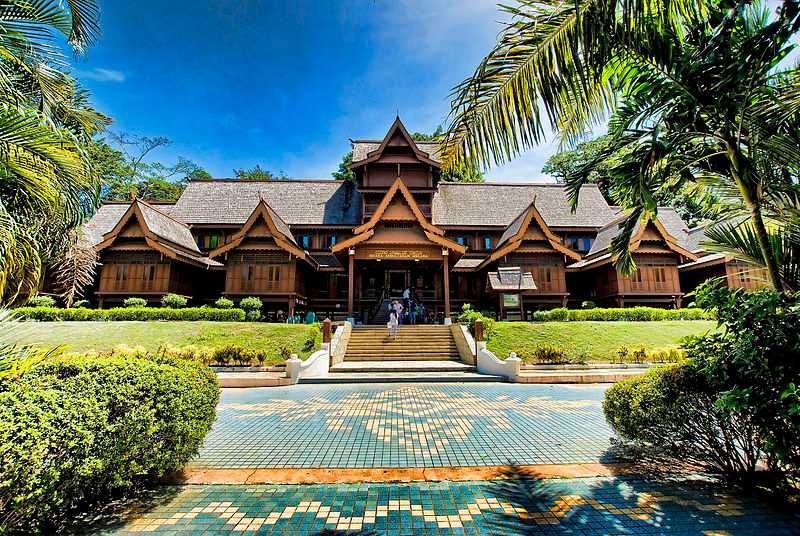
Located at the foot of St. Paul’s Hill, the Melaka Sultanate Palace is a replica of the 15th-century palace of Sultan Mansur Shah. Also known as Muzium Kebudayaan or the Cultural Museum, it is now converted into a museum of the Malay Sultanate’s heritage and history. It is made up of hardwood for its structure, Belian wood for the roof and wooden pegs instead of nails and was constructed in 1984. The palace is supported by wooden pillars and is covered by a copper roof. The museum was officially opened on 17 July 1986 by then-Prime Minister Mahathir Mohamad.
The three-story Melaka Sultanate Palace Museum is divided into eight chambers with traditional costume, art, weaponry, jewellery and other artefacts on display. The museum also houses three galleries showcasing local legends through dioramas. A major highlight is the sculpture of the sultan’s headdress, standing regally at the centre of the museum garden. The museum was built from the information derived from the Malay Annals, which helped the architects build a replica of the original palace design. It is also home to three galleries which feature legendary clashes between legendary Malaysian warriors Hang Tuah and Hang Jebat. The museum features more than 1350 artefacts and photographs detailing the Sultanate’s history and regime. It features the Throne Room and the Royal Bedchamber among several other artefacts belonging to the royal household. Visitors can also find traditional Malay costumes that have historical significance on display in the museum.
Weapons used by Malay warriors during the Sultanate regime can also be found on the premises of the museum. The museum is open from 9 am to 5:30 pm on Mondays, Tuesdays and Wednesdays.
Villa Sentosa
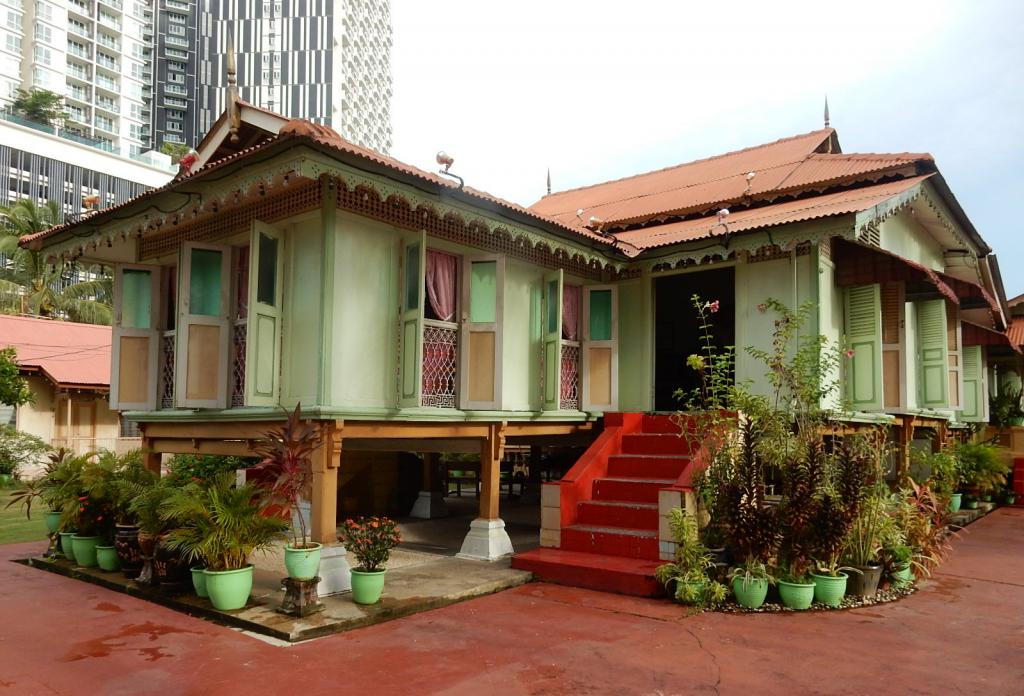
Villa Sentosa Melaka is a traditional Malay house converted into a Malay living museum in Kampung Morten. Positioned near the banks of the Malacca River, it is open to the public as a private museum with family members giving a tour of the house, talking about the diverse family relics and period objects. Villa Sentosa is also known as the Malay Living Museum.
The rooms of Villa Sentosa are connected by a patio and an open courtyard, which ensures that the residents and visitors get plenty of breezes even during the summer months. The building is entirely made up of wood and is raised from the ground level using stilts, which ensures that rodents and water flooding do not affect the house. Visitors are free to explore the rooms in the house, such as the guest room which is filled with antique furniture and crockery. The house also has a wedding room which was used by young couples to stay before they moved out. Villa Sentosa is open from 9 am to 6 pm from Saturday to Thursday and from 2 pm to 6 pm on Fridays. There is no entry fee, but they accept donations.

Cheng Ho Cultural Museum
A must-visit for history buffs, the Cheng Ho Cultural Museum is located north of the Melaka River. The museum features historical items, information, and details about the Chinese Ming dynasty admiral, Zheng He’s life and explorations. The museum was founded and opened in 2006 by Tan Ta Sen, also the president of the International Zheng He Society.
Covering a total floor area of 5,110 m, the museum is divided into three levels and occupies eight units of old shophouses, some built before 1786. A drum and a bell tower are located in front of the museum. The museum building is believed to sit at the original site of the warehouse complex Guan Chang, built by Zheng He around 600 years ago to temporarily store goods he acquired during his travels. The warehouse complex originally occupied 10 acres of lowland along the northern bank of the Malacca River. Five Ming-era wells were unearthed during the museum’s construction.
The museum exhibits the life of Zheng He and his world voyage in his fleets. It displays his travel with big pictures of Chinese history. The museum can roughly be divided into several sections, which include Old Malacca Village, Ship Gallery, Treasure Ship, Antique Gallery and Garden Courtyard. The museum’s gift shop is popular for its Chinese tea, Malaysian white coffee and durian souvenirs. The museum is open daily from 9 am to 6:30 pm and adults need to pay RM 20 while children under the age of 12 need to pay RM 10. The ticket price includes a video presentation.

Melaka Maritime Museum
The Melaka Maritime Museum showcases the maritime history of Malacca through its three different sections. The highlight of the three is a replica of the Portuguese ship – the Flor de la Mar – that sank in Malacca due to an unfortunate accident. The museum was officially opened to the public by Prime Minister Mahathir Mohamad on 13 June 1994. The museum’s main exhibit is the replica of Flor do Mar which is 34 metres high, 36 metres long and 8 metres wide and houses exhibits, artefacts and documents from the golden era of Malacca and shows how political control of Malacca was essential to the establishment of maritime dominance in the region. It also displays the trading link of Malacca from the early time through the colonial era until independence.
There are several paintings in the museum which depict the strategic importance of the Straits of Malacca. The museum also has several exhibits of articles such as silk and textiles and is home to sunken treasures from shipwrecks such as the Diana. Visitors can see the history of Malaccan Maritime and see Malacca’s progress through different eras and rulers. The museum also boasts several ship models and is a treat to ship enthusiasts. Visitors are free to explore the ship while learning about its functions and operation abilities. Visitors are supposed to remove their shoes before entering the museum, so it is advised to wear appropriate footwear and socks. Between Mondays and Fridays, the museum is open from 9 am to 5:30 pm while over the weekend, it is open from 9 am to 9 pm.

Jonker Street
Jonker Street, also popular as the Jonker Walk, is the main street of Chinatown, Melaka. It is popular for the shops selling clothes, antiques and souvenirs, apart from being a major street food hub. The highlight of Jonker Street is the night market held here every Saturday and Sunday. Jonker Street starts from across the Malacca River near Stadthuys, with the street in the area filled with historical houses along its left and right sides dating back to the 17th century, many of which are shops selling antiques, textiles, foods, handicrafts and souvenirs such as keychains and shirts. The area turns into a night market every Friday, Saturday and Sunday in the evening from 6 pm until midnight, with its street blocked for traffic.
Jonker Street is not just about the delicious food and market The bustling Jonker Street is not just about delicious food, artistic creations and bargaining, but it, but also has many attractions in and around it. The street depicts the fast, rich, traditional and modern cultural life of Malaysia and forms a smooth knot between the ancient and the modern.

Jonker Walk Night Market is one of the most awaited weekly affairs in Melaka. Set up for only three days a week, it has every possible stall from hawker food and trinket sellers to fortune-tellers and DIY workshop centres. The stalls open up late in the evening and don’t close until midnight giving out carnival vibes and uplifting everyone’s demeanour. The Baba Nyonya Heritage Museum is owned and operated by the descendants of Chan’s family who used to be one of the most prosperous and influential families in Melaka. Cheng Ho’s Cultural Museum is a well-planned gallery showcasing the Mallacan life of Cheng Ho. This ancient building has a bell tower and a drum right at its entrance in such a way that it resembles Ming architecture.

The Cheng Hoon Teng Temple has multiple UNESCO architectural awards and is the oldest Buddhist place of worship in Malaysia. It is also known as the Merciful Cloud Temple by locals because all of the materials used for the construction of the temple have been imported from China. The temple is built on the principles of Feng Shui and is dedicated to Guan Yin or the Goddess of Mercy. The Kampung Kling Mosque is historical because is one of the few cross-cultural mosques which unites the Chinese, the Buddhists, the Sumatrans and the local Malays. The mosque is structured out of designs from all around the world with glazed tiles and wooden beams and pulpits drawing their inspiration from the Portuguese and English culture and carvings over the walls having the traditional Chinese and Hindu texts. The Sri Poyyatha Vinayagar Moorthi Temple is an ancient temple dedicated to Lord Ganesha. The two most prominent festivals which are celebrated here on a large scale are the Feast for Lord Muruga and the Dato Chachar Festival.
At the Mamee Jonker House, both kids as well as adults get to learn how to make noodle snacks, decorate their very own noodle cups and chopsticks and choose their favourite toppings and sauces and create their very own instant noodle cups. The 3D Jonker Walk is probably the only structure which is a unique combination of the Upside Down House and a 3D art gallery. Although there are only 25 creations on display, each one of them appears so real that one might get illusioned by what’s in front of them. The main show stopper is the 5D fluorescent museum chamber, where one’s sense of touch, as well as sight, gets tested unlike ever before.

Bukit Cina
Bukit China or Chinese Hill is a hillside of historical significance, located to the north of the historical centre of Malacca and today is surrounded by the city on all sides. Bukit Cina is the largest and oldest burial ground of Malacca’s Chinese community outside of China with over 12,500 graves and stretches over 3 hills and also includes 20 Muslim tombs. The forested paths of Bukit Cina are a popular spot for jogging and walking offering incredible views from the park. Bukit Cina Hill has been listed as a UNESCO World Heritage Site.
According to local tradition, in the mid-15th century, the legendary Hang Li Po was sent to be married to the sultan of Malacca, Mansur Shah, to seal relations between the two states. The hill, Bukit Cina, a gift from the sultan, was established as their residence. Marine archaeology of a shipwreck, the Royal Nanhai wreck from about 1460 AD suggested royal gifts from China, shipped during Sultan Mansor Shah’s reign. The Well of Perigi Raja, situated next to Poh San Teng Temple at the foot of the hill was constructed by Hang Li Po’s followers for her personal use but was also an important source of water for much of the town. It was reputed never to have dried up even during droughts. Today, the well has acquired the reputation of a wishing well and it is believed that anyone who throws a coin into the well will return to Malacca.

Admiral Zheng He’s Seven Wells lie at the foot of Bukit Ciina, beside the Poh San Teng Temple. The well is also known as Li Po’s Well or the King’s Well. The wells were dug by Admiral Zheng He’s expedition force during their stopover in Malacca during the Ming dynasty. The Seven Wells is also known as the Dragon’s Wells according to Feng Shui. Some of these wells were bulldozed during the 1950-60s for road building. To date, only three wells are left intact and they have never been dried even in the worst of drought and today is perceived as a wishing well and is believed that people who throw a coin into the well would return to Malacca.
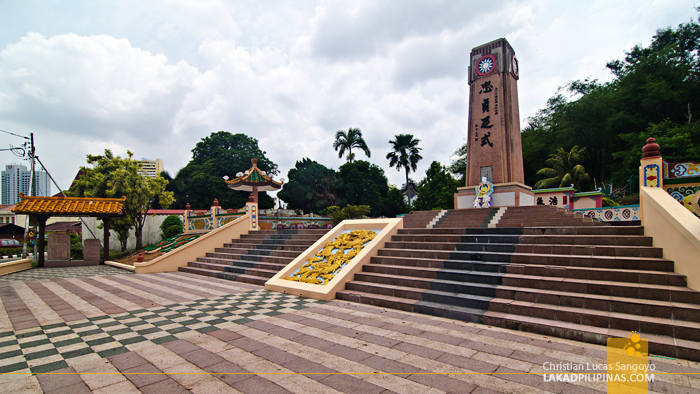
Ming’s Bridge name originates from the Ming Bride who came to Malacca with her large retinue including 500 handmaidens who set their home on the hill. Built in 1795, the Poh San Teng Temple is dedicated to Admiral Cheng Ho. Located at the left of the well and the base of Bukit Cina, the temple houses images of the Taoist entity Kuan Yin and Dabo Gong. A cenotaph with Chinese calligraphy has been mounted on a platform with a Kuomintang flag at the top in remembrance of the people who were brutally killed during the Japanese Occupation. There is a replica of the palace where Sultan Mansur Shah lived with all his wives including Hang Li Po which also houses the Malacca Cultural Museum.
 Memories and Such