
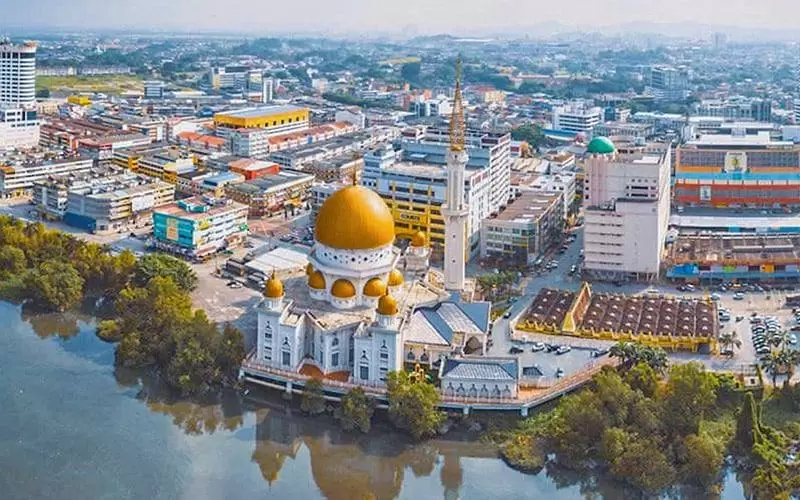
Klang
Officially known as Selangor’s Royal Town, Klang is the former capital of the state. With a unique old-world charm, Klang is known for its rich heritage sites and colonial architecture. Located 45 km from Kuala Lumpur, Klang is a popular day trip for most tourists. The colourful town is split between the town and port and is small enough to explore on foot. The Klang River flows through the town and divides it into South Klang and North Klang. Port Klang is the 12th busiest transhipment port and the 12th busiest container port in the world.
Klang has been a site of human settlement since prehistoric times. Bronze Age drums, axes and other artefacts have been found in the vicinity of the town and within the town itself. Commanding the approaches to the tin-rich Klang Valley, Klang has always been of key strategic importance. It was mentioned as a dependency of other states as early as the 11th century. Klang was also mentioned in the 14th century literary work Nagarakretagama dated to the Majapahit Empire, and the Klang River was marked and named on the earliest maritime charts of Chinese Admiral Cheng Ho who visited Malacca from 1409 to 1433.
Klang was under the control of the Malacca Sultanate in the 15th century. Klang was known as a producer of tin, it produced one hundred bares of tin a year when the Portuguese occupied Malacca. Klang however remained in Malay hands after the fall of Melaka to the Portuguese in 1511 and was controlled by the Sultan of Johor-Riau. In the 17th century, the Bugis began to settle in the coastal region of Selangor including Klang, and the Selangor sultanate was created in 1766, which then controlled Klang.

In the 19th century, the importance of Klang was greatly increased by the rapid expansion of tin mining as a result of the increased demand for tin from the West. The desire to control the Klang Valley led directly to the Klang War, also called the Selangor Civil War of 1867–1874 when Raja Mahdi fought to regain what he considered his birthright as territorial chief against Raja Abdullah. During the Klang War, in 1868, the seat of power was moved to Bandar Temasya, Kuala Langat, and then to Jugra which became the royal capital of Selangor. In 1874, Selangor accepted a British Resident who would advise the Sultan, and Klang became the capital of British colonial administration for Selangor from 1875 until 1880 when the capital city was moved to Kuala Lumpur due to the growth of Kuala Lumpur.
Until the construction of Port Swettenham, now known as Port Klang in 1901, Klang remained the chief outlet for Selangor’s tin, and its position was enhanced by the completion of the Klang Valley railway to Bukit Kuda in 1886, which was then connected to Klang itself via a rail bridge, the Connaught Bridge, completed in 1890. In the 1890s its growth was further stimulated by the development of the district into the state’s leading producer of coffee, and later rubber. In 1903, the royal seat was moved back to Klang when it became the official seat of Sultan Alauddin Sulaiman Shah. The official boundary of Klang was first defined in 1895. The first road bridge over the Klang River connecting the two parts of the town, the Belfield Bridge, was constructed in 1908.

Klang may have taken its name from the Klang River which runs through the town. The entire geographical area near the river, which begins at Kuala Lumpur and runs west to Port Klang, is known as the Klang Valley. One popular theory on the origin of the name is that it is derived from the Mon–Khmer word Klong, which may mean a canal or waterway. Alternatively, it has also been argued that it means warehouses, from the Malay word Kilang as in the old days, it was full of warehouses. Today kilang means factory. Klang was also once known as Pengkalan Batu which means stone jetty. Unlike most other place names in Malaysia, the Chinese name for Klang is neither a direct transcription nor translation, but likely a transcription of another Malay word Pasang, referring to the rising tides around the Klang Valley.
The economy of Klang is closely linked with that of the greater Klang Valley conurbation which is the most densely populated, urbanised and industrialised region of Malaysia. Rubber used to be an important part of the economy of the region, but from the 1970s onwards, many rubber plantations switched to palm oil and were then converted again for urban development and infrastructure use. Port Klang forms an important part of the economy of Klang. It handled almost 50% of Malaysia’s sea-borne container trade in 2013. The Port Klang Free Zone was established in 2004 to transform Port Klang into a regional distribution hub as well as a trade and logistics centre. The port is part of the 21st century Maritime Silk Road that runs from the Chinese coast to Singapore, towards the southern tip of India to Mombasa, from there through the Red Sea via the Suez Canal to the Mediterranean, there to the Upper Adriatic region to the northern Italian hub of Trieste with its connections to Central Europe and the North Sea.

Established in 1932, the Sultan Sulaiman Royal Mosque houses the royal mausoleum. The building reflects an excellent blend of neo-classical, Western, and Mughal architecture. It was the state mosque until the opening of the Sultan Salahuddin Abdul Aziz Mosque in the new capital city of Shah Alam. Standing at the foot of a hill. The Royal Palace is located right next to the mosque but is not open to visitors. The mosque has a beautiful central hall, and it serves free food during Ramadan. Some of its interesting features include the Tangga Diraja, or royal stairs, from Istana Alam Shah and a royal mausoleum. The late Sultan Salahuddin was buried on the mosque’s grounds.
The semicircular-shaped dome of the mosque is painted egg yellow, not gold. The large dome of the main prayer space is surrounded by four smaller domes. The main dome represents the Sultan of Selangor, while the smaller domes refer to Dato’ Besar Empat Suku Selangor. Five domes at the main entrance of the mosque symbolise the Five Pillars of Islam and the five Daeng Brothers, while two umbrella-shaped domes are symbolic of the royal umbrella. There are eight smaller towers around the mosque and a large tower in the middle, with a higher entrance from the main porch. The tower is also decorated with a yellow dome at the summit. The original design of the mosque was like a crossbar when viewed from above, as is so often used in church plans in Europe, but after renovations by the Selangor Islamic Religious Department, the mosque now has a square footprint. The main prayer room is octagonal at the bottom, but it slowly smooths into a circle at a height of 10 meters. The upper floors can be accessed with a cat ladder, and there are decorative iron frames under the dome that support the multi-coloured patterned glass. The mosque was designed to accommodate about 1,000 pilgrims at a time.

Kuan Yin Teng or the Goddess of Mercy Temple, is the oldest Chinese temple in Malaysia dedicated to the Goddess Guan Yin. The temple building is a heritage structure often visited by Buddhists and a local attraction for Chinese visitors during Chinese New Year or any festive season. The temple was established in 1892 and bustles with devotees during the first day and the fifteenth day of the lunar calendar. On the eve of Chinese New Year, the temple is open all night, and the street is often packed with devotees queuing shoulder to shoulder to enter the temple hall to offer their incense to the Kwan Yin in the hope of an auspicious start to the New Year. It has marvellous exteriors with beautiful archways and carvings, along with a peaceful interior setting. The temple is open daily between 7 am and 5 pm.
The Church of Our Lady of Lourdes is a catholic church that lies in the Little India area with a lovely chapel outside and marvellously designed interiors with glass panels and dome structures housing artefacts, statues and other memorabilia describing the history of Klang.

Locally known as the Klang Perumal Temple, the Sri Sundararaja Perumal Temple is the oldest Vishnu temple in Malaysia. The 127-year-old temple was built in 1892 and reconstructed in 2015. Often referred to as the Tirupati of Southeast Asia after its famous namesake in India, it is the first granite temple in Malaysia. The gopuram, or spire, of this temple is a Klang landmark. Inside the temple, there are several complexes dedicated to different deities. At the centre of the temple is the Perumal Sannathi, where Lord Perumal and His consort, Goddess Mahalakshmi, are situated. The centre complex of Lord Perumal Sannathi contains a small gopuram with the statues of all of Lord Vishnu’s avatars surrounding it. On the right of the Perumal Sannathi is the Shivan Sannathi, which consists of Lord Shiva, Lord Parvathi, Lord Ganesh, Lord Muruga, and Lord Ayyappan. On the left side of Perumal Sannathi is Saneshwara Sannathi, where Lord Shani and the Navagrahas are situated. Adjacent to the center complex is Lord Anjaneya Sannathi and just at the corner outside the temple is Lord Nagaraja Sannathi. The temple also has a multi-purpose hall which is used by the Indian community for weddings. The temple is home to a large Navalar Mandapam and a historic Palmyra tree, which is a cultural symbol to Tamils. The temple is open from 6 to 9:30 am and then between 4 and 9:30 pm.
Built on the top of a hill, Kota Raja Mahadi is a historic site that witnessed two civil wars in the 19th century. It was built in 1866 by King Raja Mahdi to gain a power edge over his enemy Raja Abdullah. Once built as a spy fort, today, it houses Klang’s Municipality Council.
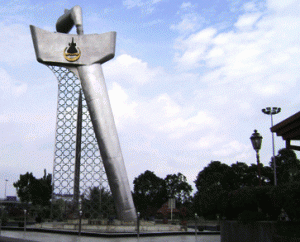
Also known as the Tugu Keris, the silver-coloured kris-shaped monument was constructed by then emperor Almarhum Sultan Salahuddin Abdul Aziz Shah to celebrate his 25th anniversary as the Sultan of Selangor. The kris is a wavy dagger and the locals believe it to be an epitome of strength and unity. Located in the Klang Royal Gardens, the monument stands tall and is visible while travelling from Kuala Lumpur. There is a playground next to the monument and is close to the Church of Our Lady of Lourdes. It was originally located along the Federal Highway near Taman Kris and the Sungai Rasau toll plaza. In September 2014, the monument was relocated to its present site because the original monument was blocked by a flyover being built just after the Sungai Rasau toll plaza.

Tanjung Harapan, loosely translated to Cape of Good Hope, is located in the Northport area of Klang. The sunset views from the cape are breathtaking. A calming walk along the coastline of the well-built industrial area of Bandar Sultan Suleiman is a fantastic way to explore the area. Fronting the Straits of Malacca, the Esplanade is a seaside family recreation spot near Northport that houses several seafood restaurants. It’s a nice place to view the sunset and also for anglers to fish.

The official residence of the Sultan of Selangor is Istana Alam Shah. It is built of wood and marble and incorporates 15 iconic rooms. Between 1903 and 1957, there existed an older palace on the same site, known as Istana Mahkota Puri. It was built in 1903 during the rule of Sultan Sulaiman Shah, the fifth Sultan of Selangor, and the design closely resembles the Sultan Abdul Samad Building in Kuala Lumpur. The Sultan lived there for 35 years until he died in 1938. In the 1950s it was briefly used as a student dorm and was demolished in October 1957, soon replaced by the present-day structure. Most royal ceremonies, like the coronation of a new Sultan, involving the Selangor royal family are held in Istana Alam Shah. The palace has 15 rooms and was built using wood and marble. In early 2000, extensive renovations were carried out by Sultan Salahuddin Shah.

One of the oldest bridges in Malaysia’s Klang Valley region, the Connaught Bridge, was built in 1948 by the British. At one time, the Connaught Bridge could only be crossed by one vehicle at a time, and heavy vehicles were banned from the bridge. The wooden bridge closed in 1993–1994, and in 1995, the wooden bridge was replaced by a concrete box girder bridge. Kota Bridge is the first and only double-decker bridge in Malaysia and Southeast Asia. The bottom deck is a pedestrian walkway bridge, while the top deck is a motor vehicle bridge. The bridge was closed to car traffic in the 1990s due to high demand, which necessitated the construction of a new bridge. The new Jambatan Kota is located beside the old bridge. The old bridge was constructed between 1957 and 1960 and was officially opened in 1961 by the late Sultan of Selangor, Almarhum Sultan Salahuddin Abdul Aziz Shah, as part of the celebration of his coronation as the ninth Sultan of Selangor.

The Sultan Abdul Aziz Royal Gallery is all about the former Selangor Sultan Salahuddin Abdul Aziz Shah. The museum building was initially constructed as the Sultan Sulaeman Building in 1909. During British Malaya, the British government used the building as the land and administration office. During the Japanese rule of Malaya, it was used as a war headquarters. After independence in 1957, it was used as the Klang District office. The museum was initially opened in 1988 as the Memorial Museum and was officiated on 19 October 2007 by Sultan Sharafuddin. The gallery displays the history and heritage of the Sultanate of Selangor since 1766 with more than 2,000 artifacts.
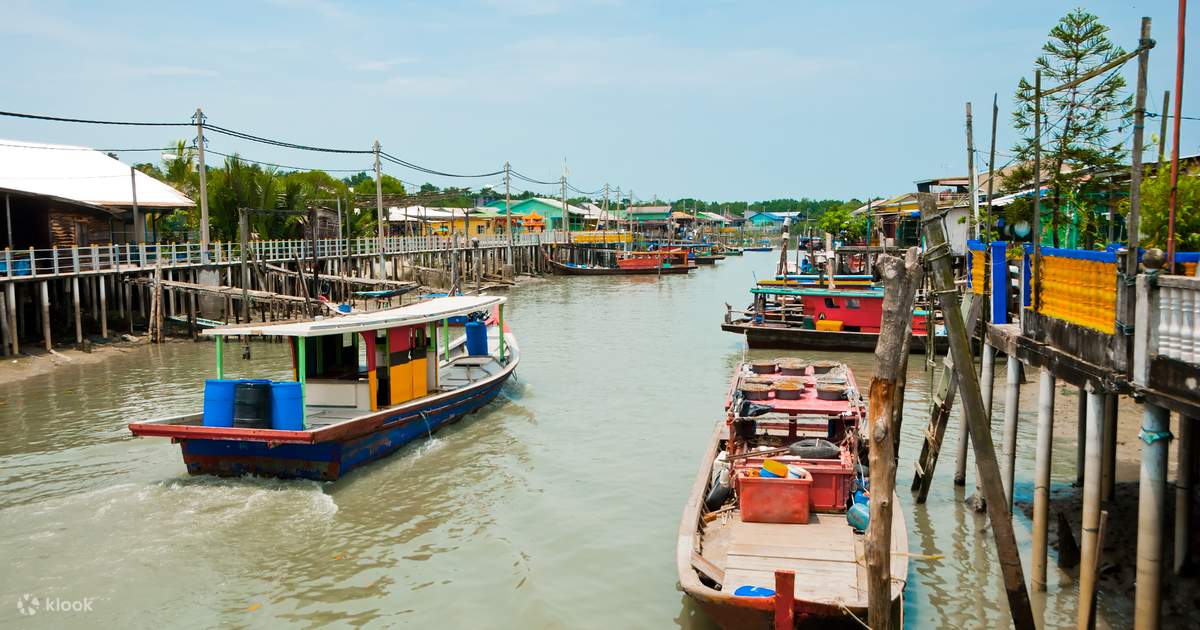
Pulau Ketam, or Crab Island, is an island located off the coast of Port Klang in the intertidal zone, and the chief vegetation is mangrove. The island is home to two predominantly Chinese fishing villages founded in 1880. The main village on the southern side of the island is also known as Pulau Ketam. The other village on the northeastern side is called Sungai Lima or the Fifth River, its location being at the fifth inlet from the main village. The villagers are mainly Teochew and Hokkien Chinese, with Teochew, Hokkien, and Mandarin Chinese as the main dialects spoken. There is also a small, recently relocated Orang Asli community at the second inlet. The rest of the island consists of mangrove swamps. As the island is submerged during high tide, housing on the island consists of floating houses perched on wooden stilts 1 to 10 m above sea level. The main thoroughfares are narrow concrete pavements, while in the residential areas, the older, rickety wooden plank bridges can still be seen. There are no cars on the island; bicycles, some of which are motorized, are the main means of transportation within the villages. No pavement links the villages, with boats being the only means of transportation between villages. Daily ferry services link the island to Port Klang jetty on the mainland. The main economic activity on the island is fishing. The island is also a tourist spot.

The One Fathom Bank Lighthouse, Rumah Api One Fathom Bank or Rumah Api Permatang Sedepa refers to two offshore lighthouses in the Strait of Malacca, specifically, on a shoal within Malaysian waters, dubbed One Fathom Bank or Permatang Sedepa, off the coast of Selangor. The One Fathom Bank station was originally served by a lightship stationed in 1852 before a permanent screw-pile lighthouse was built in 1874; the lighthouse has since been replaced twice throughout its service, in 1907 with a concrete pile lighthouse, and 1999 when a larger modern counterpart was built parallel to the 1907 lighthouse, superseding its predecessor’s duties. The lighthouses have since been referred to as the old One Fathom Bank Lighthouse and the new One Fathom Bank Lighthouse. Due to being well out to sea, both lighthouses are only accessible by boat. While both sites of the lighthouses are open, their towers remain off-limits.
 Memories and Such