

The Penang State Museum and Art Gallery is dedicated to modern and contemporary art and is a declared UNESCO World Heritage Site. Tucked on Farquhar Street in George Town, it is considered to be one of Malaysia’s best-presented and well-maintained museums. This museum and art gallery is a must-visit for history buffs and is divided into temporary and permanent exhibits. The museum houses various artefacts, including historical documents and relics, maps, costumes, ancient betel boxes, weapons used during wars and trades, paintings and photographs of old transportations, royal families and attractions of early Penang.
The museum is divided into two segments: Permanent Exhibit and Temporary Exhibit. While the Permanent Exhibit houses the historical events and community history of Penang, the Temporary Exhibit engages in works of present local artists and overseas prints embedding the traditional Malay seamanship and paintings of Old Penang. Visitors can walk through the Permanent Exhibit and embrace the history of Penang in form of the panoramic photographs of the city street and major attractions, numerous artefacts, historical relics and documents, maps, costumes, weapons, Chinese furniture, old vivacious countryside paintings and ethereal postcards belonging to the history of Penang Island. The upper level is where one can take a break, rest and even play some interesting historical and innovative board games. The museum is closed on Fridays and public holidays and is open from 9 am to 5 pm on Saturdays and Thursdays with free entry.
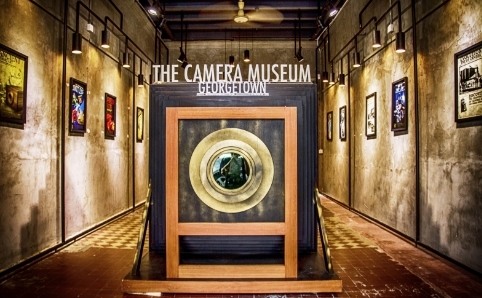
Step into the world of cameras at Georgetown’s Camera Museum. The two-storey shophouse building of the museum is a highlight in itself. Displaying around 1000 vintage came and accessories, the museum is divided into Pinhole Room, Dark Room and Obscura Room. Southeast Asia’s first camera museum, the museum includes unique cameras through the ages, information on the history of these devices and of course, wall displays. The museum is open daily between 10 am and 6 pm.
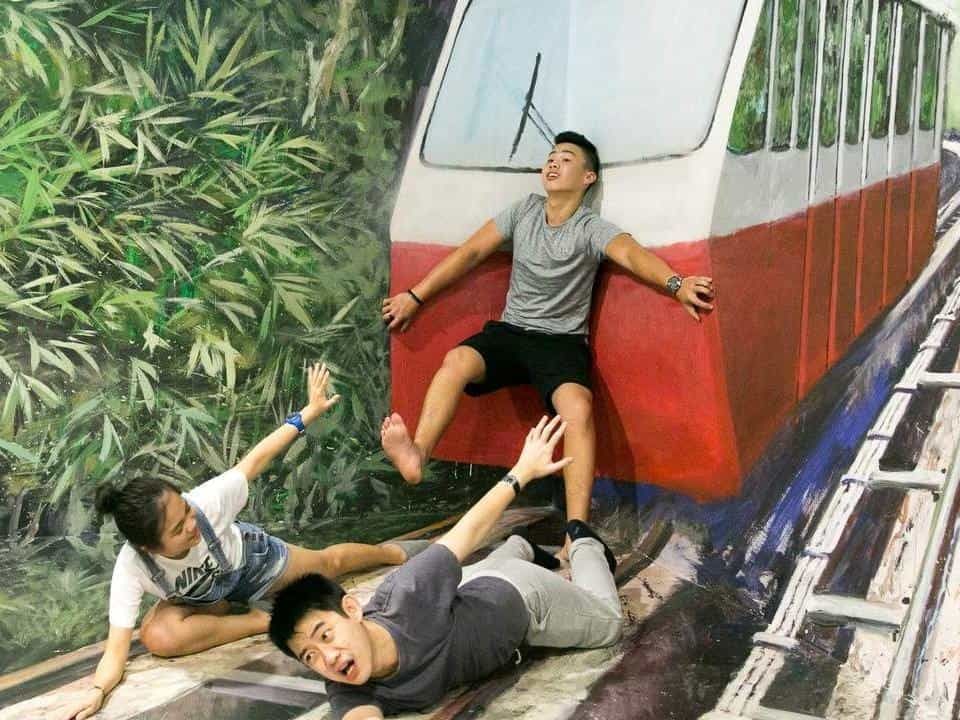
The Made in Penang Interactive Museum is a trick-art museum with a vast collection of 3D art and murals to bring life to creativity. This two-storey museum features works of local Penangite artists that describe the spirit of Penang via its wall canvases, miniature dioramas and 3D interactive trick arts. Located in one of the historic buildings of Penang built in 1891, Made in Penang Interactive Museum is located in the Behn Meyer Building at Weld Quay in George Town. The museum showcases the amalgamation of the history and culture of Penang Island in the form of 30 interesting isometric artworks via 3D wall paintings, murals, and dioramas set in a pleasant musical environment. Visitors can also spot some miniature scale models of Penang and watch a movie reflecting upon the history and culture of the Island. The top attractions include the Great Wall of Penang, the Miniature World, the 3D Trick Art Gallery, the Art and Craft Workshop and the Go Gaming section. The museum is open from 10 am to 6:30 pm with the last admission at 5:30 pm. Entry fees for adults are RM 35 and for children between 3 to 12 is RM 25.
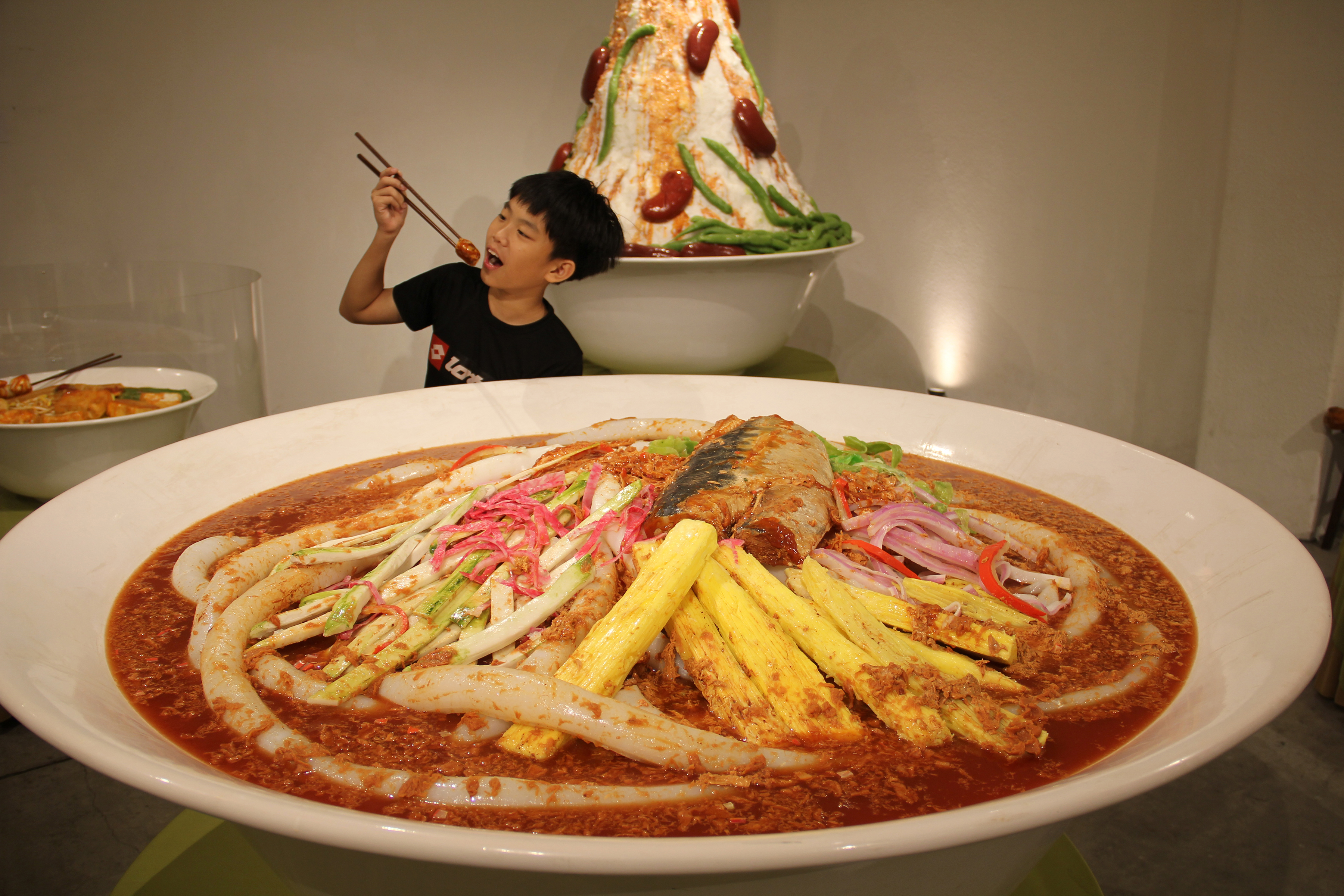
The Wonderfood Museum is a unique museum in Penang that features oversized replicas of traditional Malaysian dishes, art and historical information. Discover interesting larger-than-life delicacies from across Asia, and learn about Malaysian cuisine, street food and cooking methods at Information Zone. Close to Victoria Memorial Clocktower, the Wonderfood Museum is open daily from 9 am to 6 pm and entry fees are RM 50 per person.
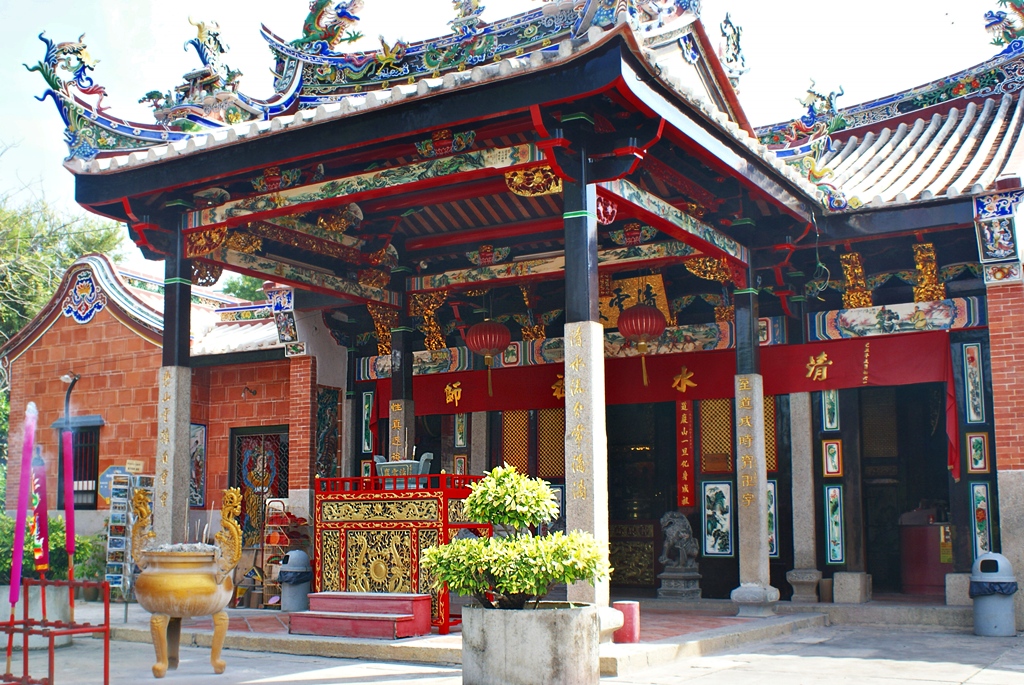
The Penang Snake Temple, previously known as the Temple of the Azure Cloud, is a Chinese temple built in memory of Chor Soo Kong, a Buddhist priest and healer. Located in Bayan Lepas in southwest Penang, this temple is one of the few places where one can get close to the venomous snakes and live to tell the tale. The Snake Temple in Penang has many unique features, like a giant incense burner, whose incense spreads through the main prayer hall, rendering the snakes to fall asleep or to prevent them from approaching the visitors. There are also small exhibit areas which house harmless pythons and cobras with de-venomed and defanged snakes.
Constructed in 1805, the Snake Temple was created to pay homage to the Buddhist monk and healer- Chor Soo Kong, who was a prominent figure in the Song Dynasty era. He was said to have gained supernatural powers through his skills in dharma and meditation and his uncanny ability to heal the wounded and the ailing. Chor was very fond of snakes and his own house was often a refuge for a variety of snakes and reptiles. Strangely, the same cycle of events took place in this temple where the Wrangler’s pit viper snakes, said to have appeared mysteriously once the area was consecrated. Thus, this temple, which was initially called the Temple of Azure Cloud, soon adopted the new name: Snake Temple.
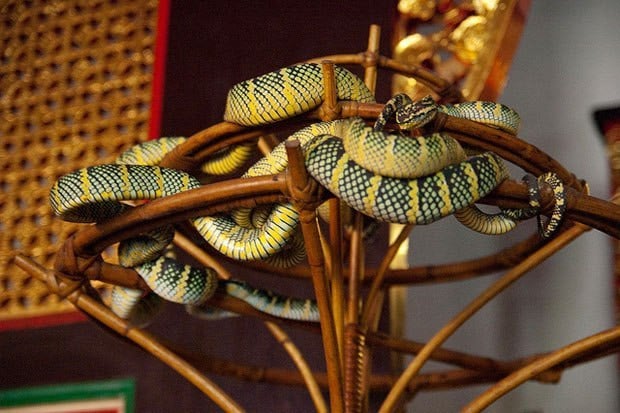
The original temple was just a simple attap structure adorned with red and yellow patterns which used to be a popular traditional housing style in Indonesia, Malaysia and Singapore. However, after years and years of renovations and upgrades, the Snake Temple has now developed into a magnificent structure with intricate carvings and tapestries. Not far away from the shrine is the snake farm which is designed in such a way that heat doesn’t enter the glass boundaries within which baby snakes are allowed to grow and the wounded ones are allowed to heal.
The main temple leads us to the courtyard where the Shrine of Kuan Yin is located. There are narrow pebbled pathways around the shrine which lead to a beautiful pond area with green, leafy trees all around it on whose branches numerous snakes reside. The temple is from 6 am to 7 pm. Entry fees to the temple are free while to the snake farm are RM 5 for adults and RM 3 for children.
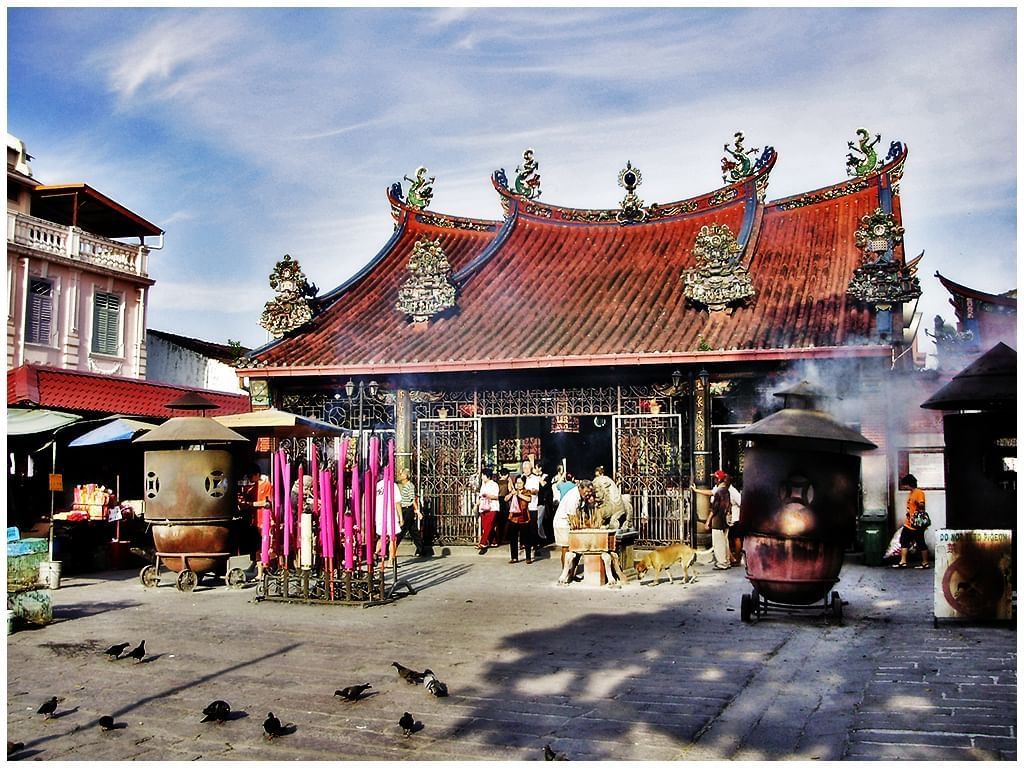
The Kuan Yin Temple in Georgetown is devoted to the Goddess of Mercy and is one of the main centres of worship for the Chinese Taoists in the city. Also known as Kuan Yin Teng, it is also home to the worship of Ma Chor Ooh, the patron saint of seafarers. The temple has three wells; the two visible ones have long since fallen into disuse, representing the eye of the dragon, while the third hidden well is believed to have medicinal properties and is located beneath the front altar of the Goddess and is the dragon’s third eye.
The temple is built according to the principles of Feng Shui. Located on a small hill, the temple is believed to represent a dragon in Feng Shui, making it an auspicious choice of site for a temple, according to Feng Shui. The temple has huge doors depicting the images of deities and pillars with carvings of entwined dragons.
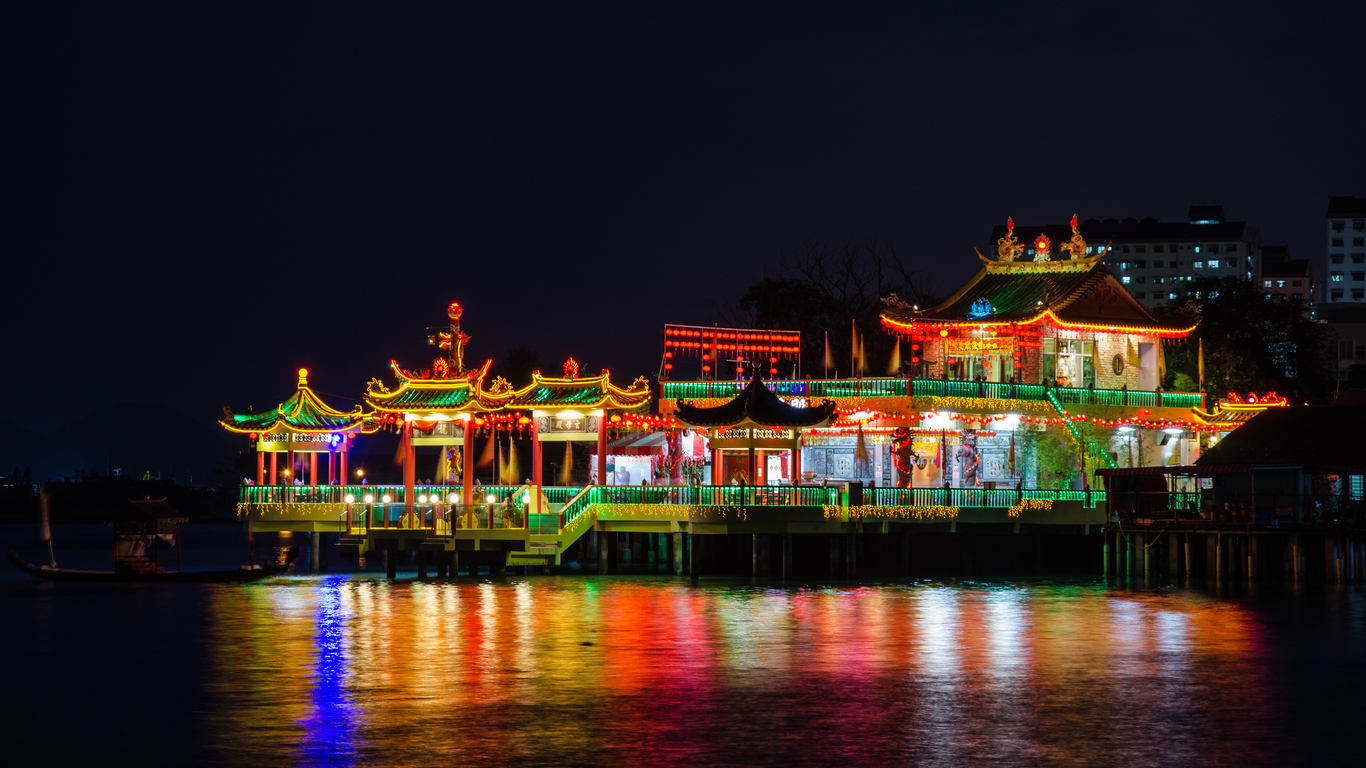
Kuan Yin Teng is viewed as the mother temple for the Taoists in the city. At the time of its construction in the early 18th century, it was where a sea god was worshipped. With the shift in the economy from naval trade to urbanisation, there was also a shift in the values of the people, and therefore the Goddess of Mercy became the primary deity in the 19th century. The temple is especially crowded with worshippers on what are known as the Temple Days and the days of the feast of the temple Goddess which are determined by the lunar calendar. Puppet shows and Chinese operas are commonly presented on these days in the name of the Goddess. The temple is open from 6 am to 6 pm daily.

Khoo Kongsi, also known as Leong San Tong Khoo Kongsi is one of the largest clan temple-cum-house of the Hokkien clan. A major attraction in the city, the clan temple complex sits in a granite paved square housing 19th-century rowhouse, a traditional theatre and an authentic association building. Although the grand, heavenly Khoo Kongsi clan house had been reduced to ruins and had to be built all over again, this newer version is just as lavish as the original structure, and its beauty continues to mesmerize visitors from all over the world. The highly ornamental sculptures and carvings on the walls of the temple are truly an architectural wonder. The historic Chinese Opera is conducted annually, with utmost precision during the Chinese New Year.
Right in front of the clan house-cum-temple, there is a huge courtyard which consists of the houses and cottages of the former clan members, which has now been turned into an exhibit displaying the various utensils they used, the types of clothes they used to wear and the cots on which they use to sleep. Not far away from the courtyard lies the art gallery with an attached souvenir shop. The art gallery allows visitors to learn more about the traditional Thai and Malay art forms and the materials used to create them. Starting from organic paints made by crushing out flower petals and fruit pulps to the modern abstract and minimalistic art forms, this art gallery has an unimaginable collection of portraits, murals and handicrafts made by the Hokkien clan.
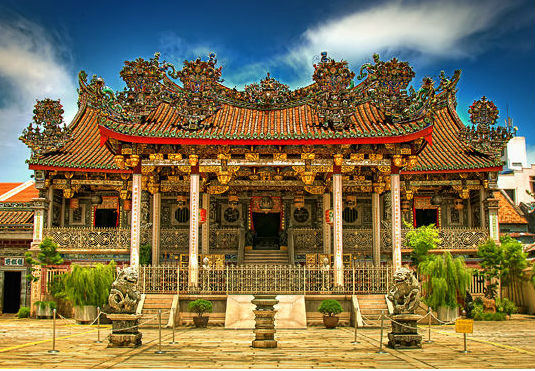
Behind the main temple lies the museum which has murals and tapestries hung all over the walls depicting the history of Penang’s Chinese community and the history of Khoo Kongsi. There are numerous statues of Sikh, Thai and Malay soldiers placed at intervals throughout the temple and clan house area. The temple is open from 9 am to 5 pm and from 9 am to 1 pm on Saturdays. It is closed on Sundays and public holidays.

Situated on the hilltop at Air Itam near Penang Hill, Kek Lok Si is one of the largest Chinese Buddhist temples in Southeast Asia. Comprising monasteries, temples, prayer halls, and gardens, the temple complex is a chief pilgrimage centre for Buddhists from the Philippines and Singapore. Kek Lok Si translates as the Temple of Serene Bliss in Hokkien. The highlight of the temple is the seven-storey white and gold Pagoda of Rama VI. Other places of interest at Kek Lok Si Temple are the many magnificent images of Buddha, different sculpture carvings in both the interior and exterior and the elevated position of the temple which provides an extraordinary view overlooking George Town and Penang. One of the best times to visit Kek Lok Si Temple is during the Chinese New Year festivities.
The Temple can be broadly divided into 3 zones, the Temple ground consists of the turtle liberation pond, food and drinks and souvenir stalls and the hill entrance, the middle section consists of a pagoda, temples, gardens and four heavenly kings pavilion and the hilltop consists of an enormous 120 feet bronze statue of Kuan Yin or the Goddess of Mercy and more gardens and temples. The rich and impressive architecture of the Kok Lok Si Temple includes intricate woodwork, carved pillars and a plethora of lanterns.
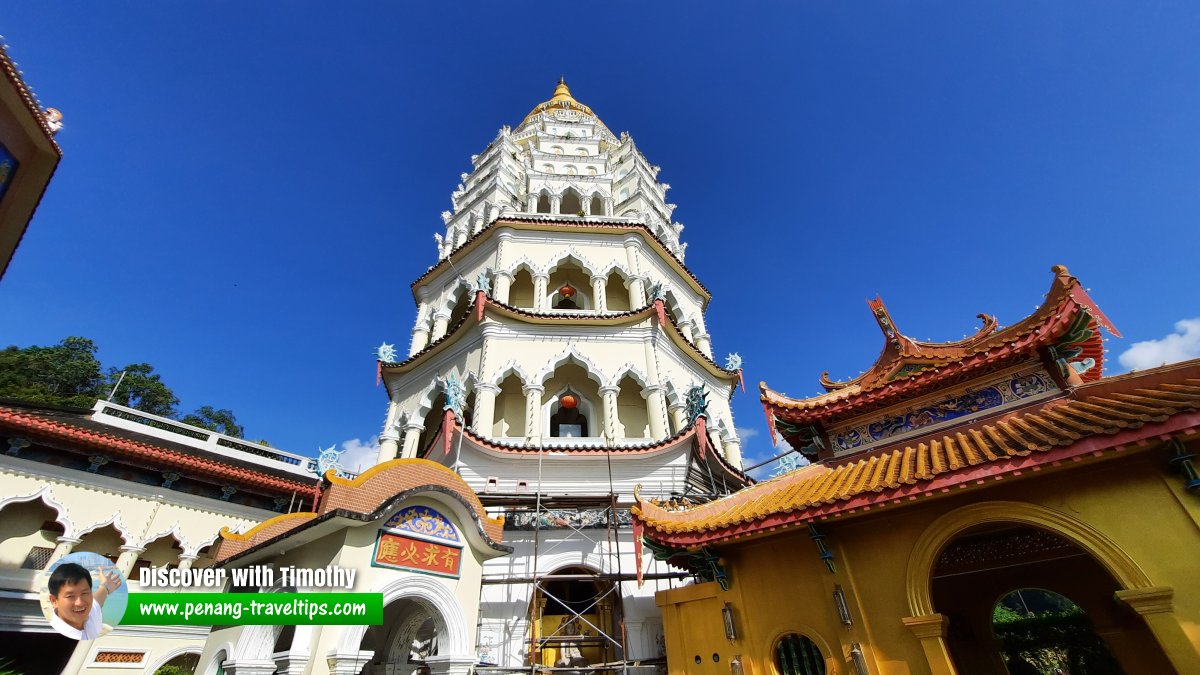
The central attraction of the temple is the seven-storey Pagoda of Rama VI, a pagoda of 10,000 bronze statues of Buddhas or Ban Po Thar which symbolises the harmony between Theravada Buddhism and Mahayana Buddhism. The top comprises a Burmese Crown, the middle tiers are made of Thai design and the lower octagonal base is Chinese. The 120-feet bronze statue of Kuan Yin is another attraction of Kek Lok Si temple which is worshipped by women to beget children. Inside the House of the Devas, there are statues of the Four Heavenly Kings each of whom controls a point of the compass. Kwang Mu, the Guardian of the West, Chi Kuo, the Guardian of the East, Tou Wen, the Guardian of the North and Tseg Chang, the Guardian of the South. There are gardens, fish ponds and also statues of animals that represent the Chinese zodiac. There is also a turtle pond named The Liberation Pond. According to the Chinese tradition, turtles symbolize long life, endurance and strength and the act of capturing and freeing them is a symbol of spiritual liberation.
Kek Lok Si temple acts as a central point for festivals of the Chinese community. The major festival is the Chinese New Year or Lunar New Year and is celebrated elaborately. The temple remains open till late for 30 days after the New Year and there is a plethora of lanterns which represent the donations of the devotees and lights which add to the festive decoration. Long marches undertaken by hundreds of Buddhist monks from Thailand to the temple once or twice a year are another festive feature of the temple. The temple is open from 7 am to 5:30 pm daily.
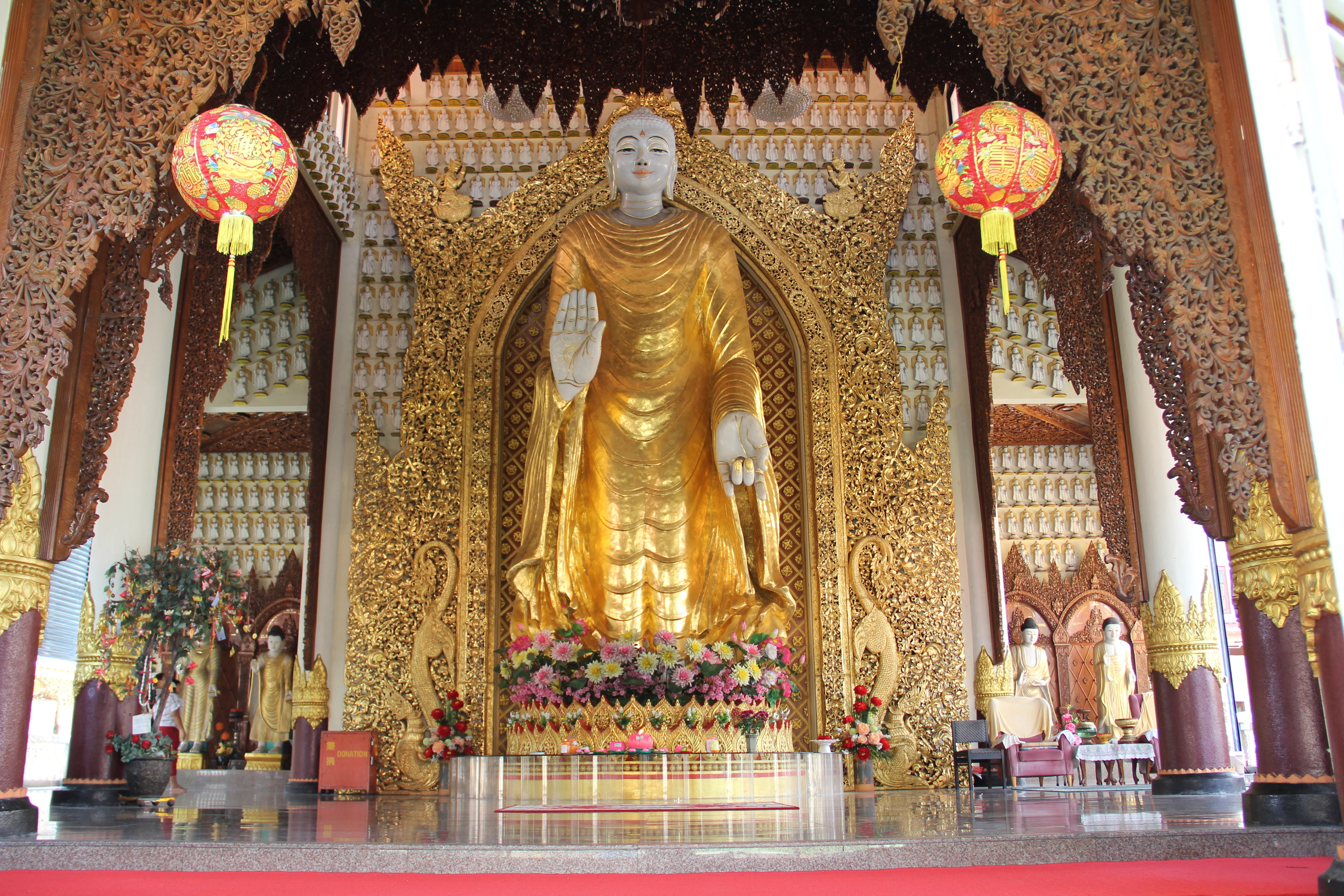
Formerly known as the Nandy Moloh Burmese Temple, the Dhammikarama Burmese Temple is one of the oldest Burmese Buddhist temples in Malaysia. It is famed for housing the huge marble Buddha statue and a 200-year-old well. The Dhammikarama Burmese Temple narrates the rich history of the Burmese in Penang through elaborate paintings and murals. The temple compound houses a large Bodhi tree, various statues of meditating Buddha, a wishing well and a few apartments for monks.
The temple has intricately designed gold interiors, ornamental gold exteriors of the roof, stupas and chandis. The most notable feature of the temple is the Pancha Rupa statues or chinthes – a form derived from the amalgamation of an elephant, a bird, a fish, a lion and a deer who are the guardian protectors of the world, that stand over a globe. The main entrance is connected to the main hall via a grand corridor with Burmese-styled cravings on beautifully decorated pillars along which stands various serene meditating structures of Gautam Buddha. The main hall holds a mighty tall structure of Buddha, which is elaborately decorated in gold and surrounded by intricate wallworks. Other distinctively designed structures at the temple include a huge mural depicting the renunciation of Prince Siddharth to become Gautama Buddha, a 200-year-old wishing pond with carp fishes, a bell pavilion, several golden chandis housing Buddha statues, and a large four-storey Golden Pagoda Bell Tower that offers exceptional views of the city of George Town from the 3rd floor of the Pagoda. The temple is also home to an award-winning gardening landscape within its premises. The best time to visit the temple complex is around 8 am before tourist buses crowd the complex. The temple is open from 5 am to 6 pm daily.
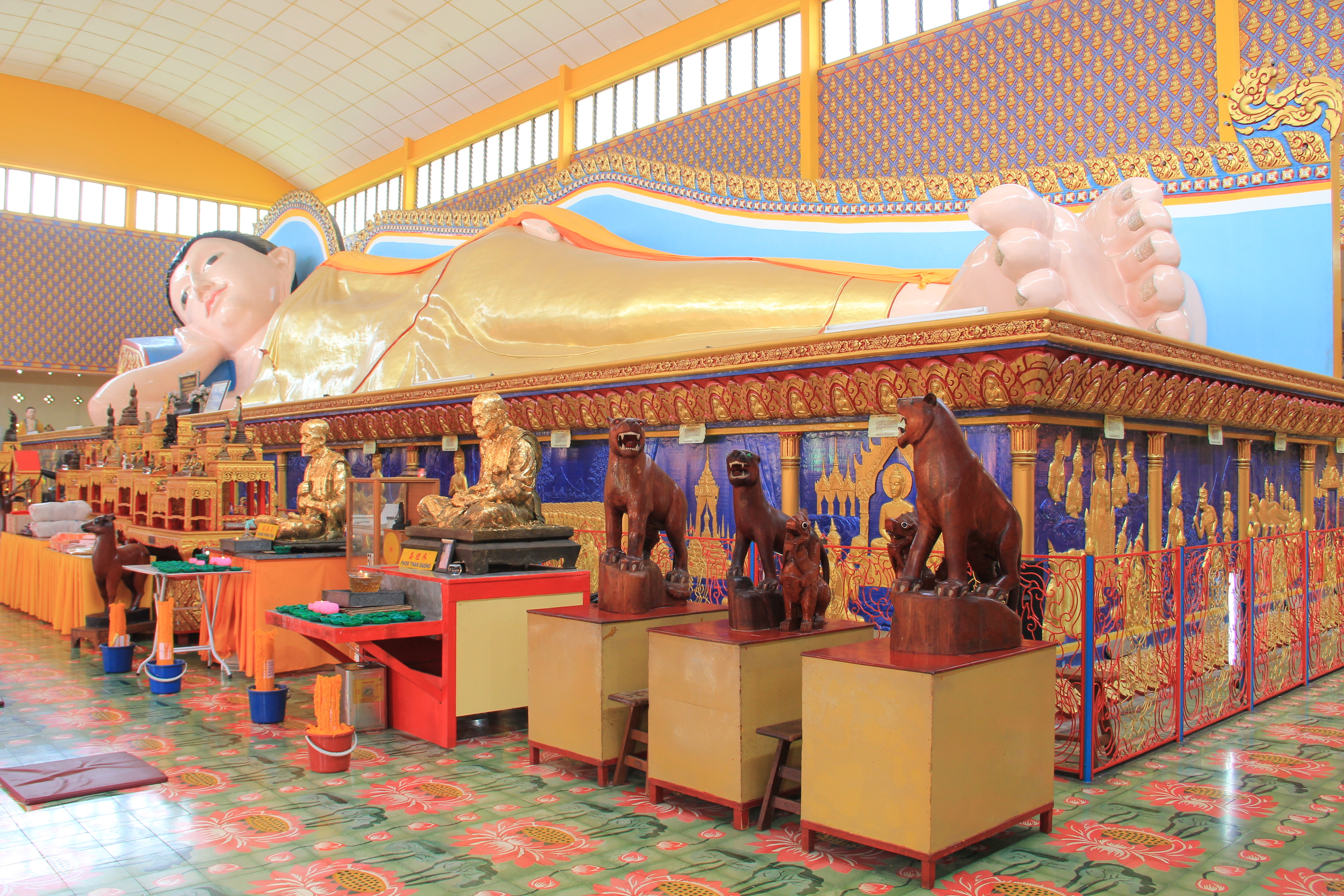
Wat Chayamangkalaram, located in Pulau Tikus is a Thai Buddhist temple. Also known as Chayamangkalaram Buddhist Temple it is famous for housing one of the world’s longest reclining Buddha statues. The gold-plated 33-metre reclining statue is believed to be the 14th biggest reclining Buddha statue in the world. The colourful Wat Chayamangkalaram also houses statues of Yaksha, Buddha and Devas, along with other mythical creatures throughout the temple complex. The temple’s main attraction is the reclining Buddha statue is a gold-plated 33-meter-long masterpiece. The temple architecture is inspired by traditional Thai Buddhist structures dating back to the early 1700s. The 12 animals of the Chinese zodiac signs have been sculpted at different points on the inner walls.
While forming the base for Wat Chayamangkalaram, sacred stones or Loog Nimit were buried beneath the smaller pagodas surrounding the shrine to make the place holy. Murals and rugs depicting the different scenes from Buddha’s life are hung throughout the interior of the temple. These murals carry the social messages Buddha wanted to spread amongst the people to promote the ideas of ahimsa or non-violence and social acceptance for all. Photography is prohibited inside the main shrine which is enhanced during the Songkran festival. The temple is open every day from 6 am to 5:30 pm.

The 200-year-old St. George’s Church is an Anglican church is the oldest Anglican Church in Southeast Asia and also one of the oldest buildings in Penang. The main highlight of St George Church is its recently inaugurated heritage centre. The church was awarded the National Heritage Status in 2007 and has been revamped several times.
The church is a combination of Neo-Classical, Georgian and English Palladian type of architecture. The building was built using Indian convict labour and for 60,000 Spanish Dollars. It uses bricks on a solid stone base. The original roof of the church was flat, however, it was soon discovered that a flat roof would be unsuitable for Penang’s weather. After ramifications, it was made into an octagonal-shaped steeple. The interior of the church is tiled with marble floors and cool pastel blue. Grecian columns and a gable-shaped roof can be seen in front of the building.
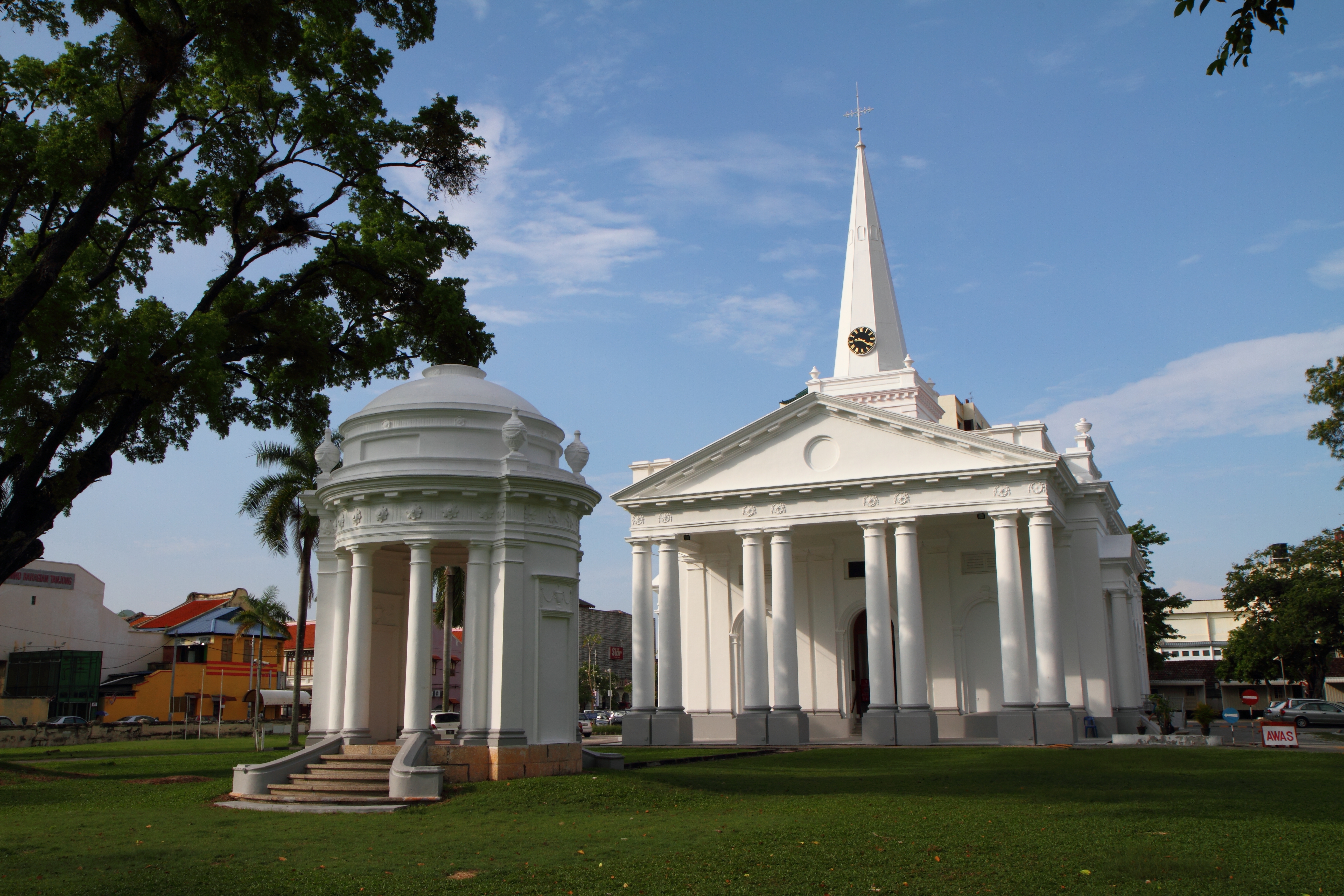
The Francis Light Memorial is also located on the lawn of St. George’s Church. The memorial is in the form of a Greek Temple and the architecture of the temple is in Victorian Style. The church also opened the Heritage Center in 2016 which sells souvenirs, books and other items of historical importance. The church is open from 7:30 am to 5 pm every day.
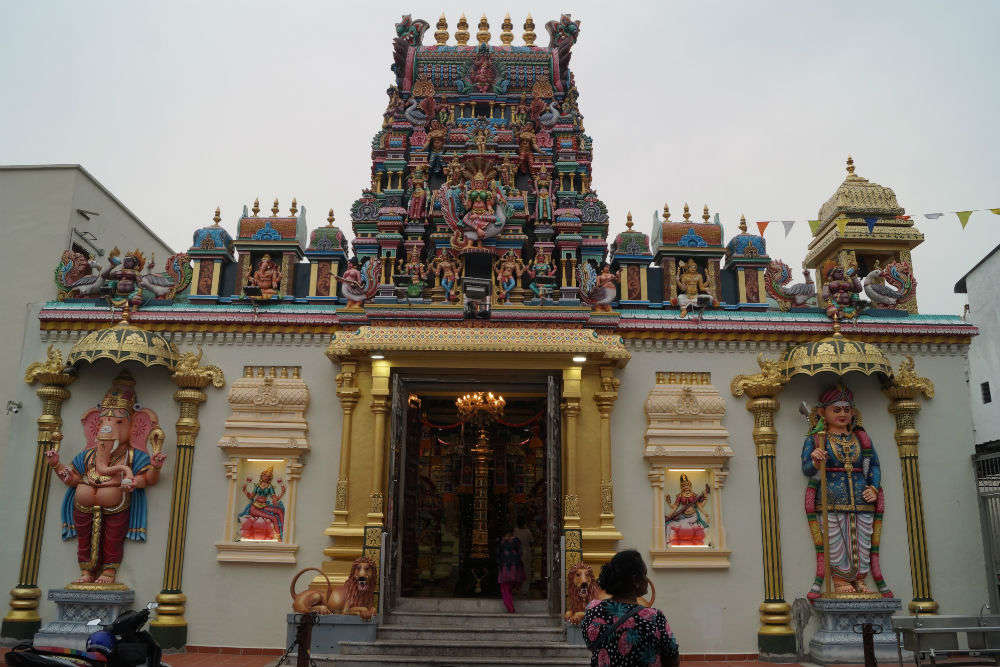
The popular Arulmigu Sri Mahamariamman Temple is the oldest Hindu temple in Penang. Also known as Queen Street Indian Temple, the highlight of the temple is the exquisite carving of various Gods and Goddesses over its facade and entrance gate. Built in 1883, the temple has a typical south Indian style Gopuram above the entrance and is open from 6:30 am to 12 noon.
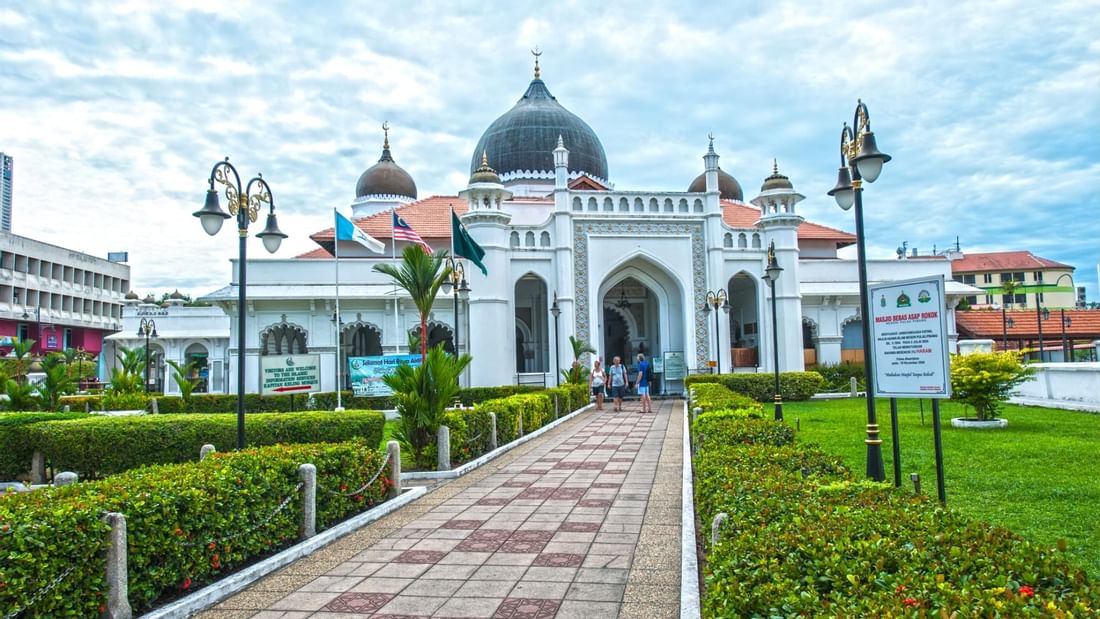
The Kapitan Keling Mosque is the city’s largest mosque, located at Jalan Buckingham. It is part of the World Heritage Site of George Town. Built-in 1801 in the Islamic style of architecture by Indian Muslim traders, it sits in the neighbourhood of Tamil Muslim residents known as Chulias. A long passageway leads to Kapitan Keling Mosque, surrounded by gardens. The leader of the Chulias community, Cauder Mohuddeen Merican is the founder of the mosque. He was called Kapitan Kling, giving the mosque its name. During prayer time, non-muslims are not allowed to enter the mosque.
The architectural style of Kapitan Keling Mosque is Islamic or Moorish with whitewashed walls and large yellow domes of the Mughal style. The long passage leads to the prayer hall with arches alongside gardens along with white arches of Gothic, Moorish and Roman style in the huge hall, shining brightly by the big and beautifully crafted chandelier hung above. The calligraphed wall panels and glass windows with floral and geometrical motifs and glass panels with the Star of David, are a major attraction. There are crescents and stars on the domes and a marble floor with rugs for prayer. Covering an area of 8 acres, there is a tall minaret and a madrassah for classes in the compound.
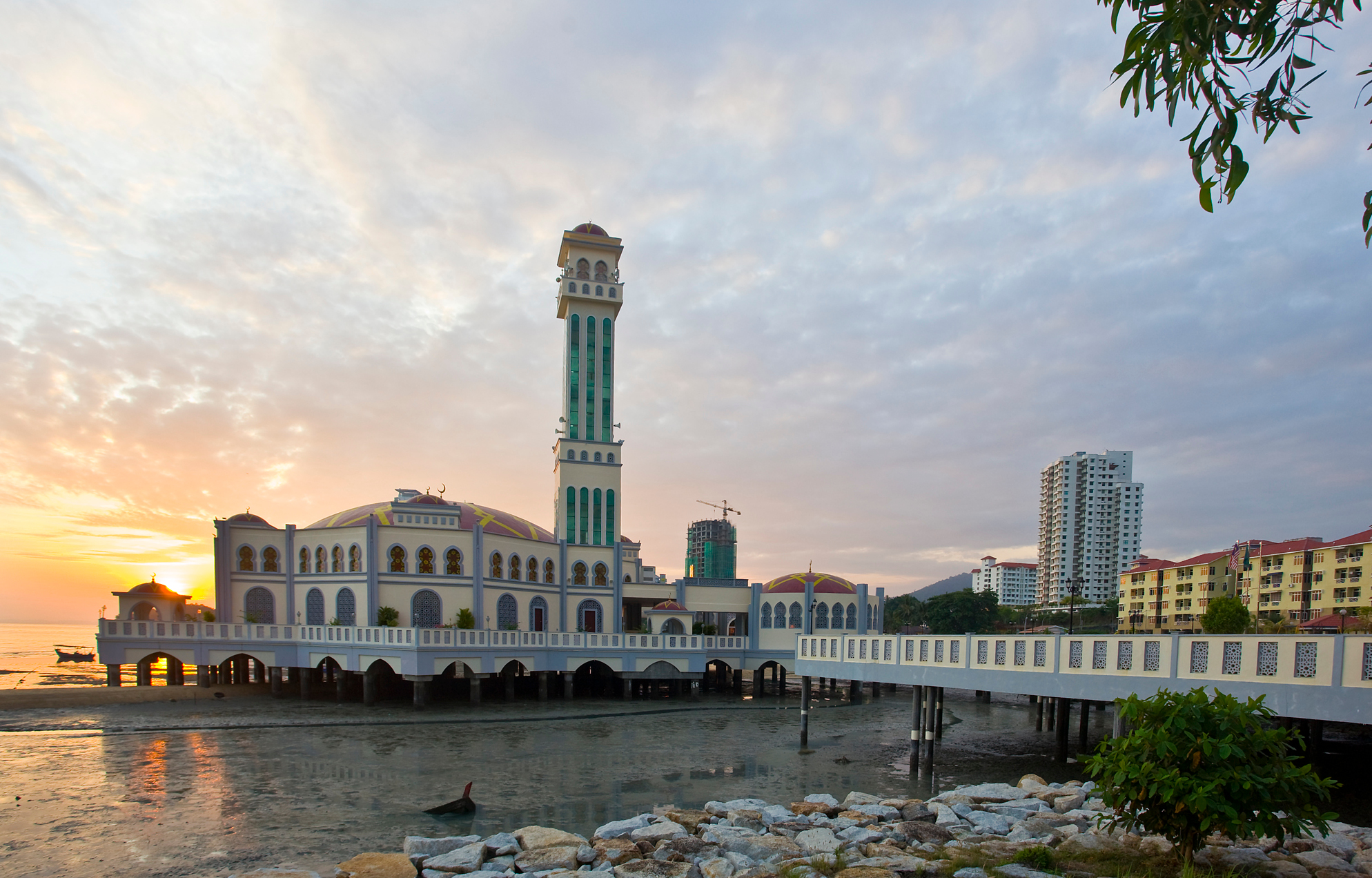
Located at Tanjung Bungah Road, Masjid Terapung Pulau Penang, popularly known as the Floating Mosque, is a famous landmark and the first mosque in Malaysia built on the sea. During high tide, the mosque appears to be floating when someone gazes at the sea. The Floating Mosque was built to replace an older mosque, Tanjung Bungah Mosque, that was destroyed in the 2004 tsunami. The seven-storey building with its Moorish design combines Middle Eastern and local elements. There is also a towering minaret where the calls for prayers or azan are announced during the day.
Originally, the Tanjung Bungah Mosque was a wooden mosque which was upgraded to a half-stone mosque in 1963. When the mosque could no longer accommodate all the people, the need for a bigger mosque arose. Masjid Terapung Pulau Penang was built in 2004 and was inaugurated by Tun Abdullah Ahmad Badawi, former Prime Minister on 16 March 2007. It is about 300 metres above sea level. The dome of the Floating Mosque is aerodynamic according to the ocean environment. The seven-storey tower is decorated with calligraphy from Indonesia and teakwood carvings. At the front door of the mosque is a sunflower fence wall as well as a place where marriages take place. The mosque is open at all times except on Friday during the prayer time from 12 to 2:30 pm. Visitors require permission from the mosque officials to enter during this time.
 Memories and Such