

The first state we will be exploring in East Malaysia, Sarawak is the largest among the 13 states, with an area almost equal to that of Peninsular Malaysia. Located in the region of East Malaysia in northwest Borneo, Malaysia’s only Christian-majority state, Sarawak is bordered by Sabah to the northeast, the Indonesian portion of Borneo, Kalimantan to the south, and Brunei to the north. The state capital, Kuching, is the largest city in Sarawak, the economic centre of the state, and the seat of the Sarawak state government.
The head of state is the Governor, also known as the Yang di-Pertua Negeri, while the head of government is the Premier. Sarawak is divided into administrative divisions and districts, governed by a system that is closely modelled on the Westminster parliamentary system and was the earliest state legislature system in Malaysia. Under the Malaysian constitution, Sarawak has greater autonomy than the states in Peninsular Malaysia.
Sarawak is ethnically, culturally, religiously and linguistically diverse; ethnic groups include Iban, Chinese, Malay, Bidayuh, Melanau, Orang Ulu, Indian, Eurasian and Kedayan. English and Malay are the two official languages of the state; there is no official religion.
The generally accepted explanation of the state’s name is that it is derived from the Sarawak Malay word Serawak or Cerava by Portuguese cartographers in the 16th century, which means antimony. A popular alternative explanation is that it is a contraction of the four Malay words purportedly uttered by Pangeran Muda Hashim, uncle to the Sultan of Brunei, “Saya serah pada awak” which means, I surrender it to you, when he gave Sarawak to James Brooke, an English explorer in 1841. However, the latter explanation is incorrect: the territory had been named Sarawak before the arrival of James Brooke, and the word awak was not in the vocabulary of Sarawak Malay before the formation of Malaysia.

Sarawak is nicknamed the Land of the Hornbills or Bumi Kenyalang. These birds are important cultural symbols for the Dayak people, representing the spirit of God. It is also believed that if a hornbill is seen flying over residences, it will bring good luck to the local community. Sarawak has eight of the world’s fifty-four species of hornbills, and the Rhinoceros hornbill is the state bird of Sarawak.
Foragers are known to have lived around the west mouth of the Niah Caves, located 110 km southwest of Miri, 40,000 years ago. A modern human skull found near the Niah Caves is the oldest human remains found in Malaysia and the oldest modern human skull from Southeast Asia. Chinese ceramics dating to the Tang and Song dynasties found at Santubong, near Kuching hint at its significance as a seaport.
The settlement known as Vijayapura was a vassal-state to the Buddhist Srivijaya empire and was thought to be located in Borneo’s Northwest which flourished in the 7th century. One of the earliest Chinese records of an independent kingdom in Borneo is the 977 AD letter to the Chinese emperor from the ruler of Boni, which some scholars believe refers to Borneo. The Bruneians regained their independence from Srivijaya due to the onset of a Javanese-Sumatran war. Marco Polo suggested in his memoirs that the Great Khan or the ruler of the Mongol Empire attempted and failed many times to invade “Great Java” which was the European name for Bruneian-controlled Borneo. In the 1300s the Chinese annals, Nanhai zhi, reported that Brunei invaded or administered Sarawak and Sabah as well as the Philippine kingdoms of Butuan, Sulu, Ma-i or Mindoro, Malilu, or present-day Manila, Shahuchong or present-day Siocon, Yachen or Oton, and Wenduling or present-day Mindanao, which would regain their independence at a later date.

The Bruneian Empire was established in the coastal regions of Sarawak by the mid-15th century, and the Kuching area was known to Portuguese cartographers during the 16th century as Cerava, one of the five great seaports of Borneo. It was also during this time that witnessed the birth of the Sultanate of Sarawak, a local kingdom that lasted for almost half a century before being reunited with Brunei in 1641. By the early 19th century, the Bruneian Empire was in decline, retaining only a tenuous hold along the coastal regions of Sarawak which were otherwise controlled by semi-independent Malay leaders. Away from the coast, territorial wars were fought between the Iban and a Kenyah-Kayan alliance.
The discovery of antimony ore in the Kuching region led Pengiran Indera Mahkota, a representative of the Sultan of Brunei, to increase development in the territory between 1824 and 1830. Increasing antimony production in the region led the Brunei Sultanate to demand higher taxes, which ultimately led to civil unrest. In 1839, Sultan Omar Ali Saifuddin II assigned his uncle Pengiran Muda Hashim the task of restoring order but his inability to do so caused him to request the aid of British sailor James Brooke. Brooke’s success in quelling the revolt was rewarded with antimony, property and the governorship of Sarawak, which at that time consisted only of a small area centred on Kuching.
The Brooke family, later called the White Rajahs, set about expanding the territory they had been ceded. With expansion came the need for efficient governance and thus, beginning in 1841, Sarawak was separated into the first of its administrative divisions with currency, the Sarawak dollar, beginning circulation in 1858. By 1912, a total of five divisions had been established in Sarawak, each headed by a Resident. The Brooke family generally practised a paternalistic form of government with minimal bureaucracy but were pressured to establish some form of legal framework. Since they were unfamiliar with local customs, the Brooke government created an advisory Supreme Council, mostly consisting of Malay chiefs, to provide guidance. This council is the oldest state legislative assembly in Malaysia, with the first General Council meeting taking place at Bintulu in 1867. In 1928, a Judicial Commissioner, Thomas Stirling Boyd, was appointed as the first legally trained judge. A similar system relating to matters concerning various Chinese communities was also formed. Members of the local community were encouraged by the Brooke regime to focus on particular functions within the territory: the Ibans and other Dayak people were hired as militia while Malays were primarily administrators. Chinese, both local and immigrant, were mostly employed in plantations, mines and as bureaucrats. Expanding trade led to the formation of the Borneo Company Limited in 1856. The company was involved in a wide range of businesses in Sarawak including trade, banking, agriculture, mineral exploration, and development.
Between 1853 and 1862, there were several uprisings against the Brooke government but all were successfully contained with the aid of local tribes. To guard against future uprisings, a series of forts were constructed to protect Kuching, including Fort Margherita, completed in 1871. By that time Brooke’s control of Sarawak was such that defences were largely unnecessary. Charles Anthoni Brooke succeeded his uncle in 1868 as the next White Rajah. Under his rule, Sarawak gained Limbang and the Baram and Trusan valleys from the Sultan of Brunei, later becoming a protectorate in 1888 with Britain handling foreign affairs but the Brooke government retaining administrative powers. Domestically, Brooke established the Sarawak Museum – the oldest museum in Borneo – in 1891 and brokered peace in Marudi by ending intertribal wars there. Economic development continued, with oil wells drilling from 1910 and the Brooke Dockyard opening two years later.
1941 saw the British withdrawing its air and marine forces defending Sarawak to Singapore. With Sarawak now unguarded, the Brooke regime adopted a scorched earth policy where oil installations in Miri were to be destroyed and the Kuching airfield held as long as possible before being destroyed. Nevertheless, a Japanese invasion force led by Kiyotake Kawaguchi landed in Miri on 16 December 1941 and conquered Kuching on 24 December 1941, with British ground forces retreating to Singkawang in neighbouring Dutch Borneo. After ten weeks of fighting there, the Allied forces surrendered on 1 April 1942. Charles Vyner Brooke, the last Rajah of Sarawak, had already left for Sydney, Australia; his officers were captured by the Japanese and interned at the Batu Lintang camp.

Sarawak remained part of the Empire of Japan for three years and eight months. During this time it was divided into three provinces – Kuching-shu, Sibu-shu, and Miri-shu – each under their respective Provincial Governor. The Japanese otherwise preserved the Brooke administrative structure and appointed the Japanese to important government positions. Allied forces later carried out Operation Semut to sabotage Japanese operations in Sarawak. During the battle of North Borneo, the Australian forces landed at the Lutong-Miri area on 20 June 1945 and penetrated as far as Marudi and Limbang before halting their operations in Sarawak. After the surrender of Japan, the Japanese surrendered to the Australian forces at Labuan on 10 September 1945. The following day, the Japanese forces at Kuching surrendered, and the Batu Lintang camp was liberated. Sarawak was immediately placed under British Military Administration and managed by the Australian Imperial Forces (AIF) until April 1946.
Lacking the resources to rebuild Sarawak after the war, Charles Vyner Brooke decided to cede Sarawak as British Crown Colony and a Cession Bill was put forth in the Council Negri, now Sarawak State Legislative Assembly, which was debated for three days. The bill was passed on 17 May 1946 with a narrow majority which caused hundreds of Malay civil servants to resign in protest, sparking an anti-cession movement and the assassination of the second colonial governor of Sarawak, Sir Duncan Stewart. Despite the resistance, Sarawak became a British Crown colony on 1 July 1946.
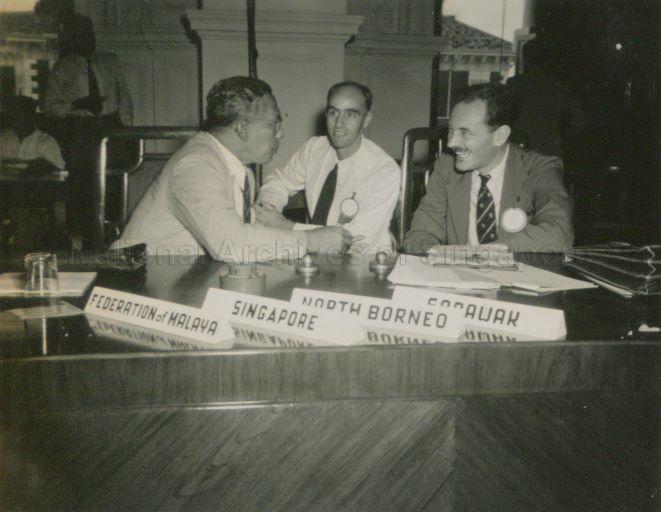
On 27 May 1961, Tunku Abdul Rahman, the prime minister of the Federation of Malaya, announced a plan to form a greater federation together with Singapore, Sarawak, North Borneo and Brunei, to be called Malaysia. On 17 January 1962, the Cobbold Commission was formed to gauge the support of Sarawak and Sabah for the plan; the Commission reported 80 per cent support for the federation. On 23 October 1962, five political parties in Sarawak formed a united front that supported the formation of Malaysia. Sarawak was officially granted self-government on 22 July 1963, and became federated with Malaya, North Borneo, now Sabah, and Singapore to form a federation named Malaysia on 16 September 1963. The governments of the Philippines and Indonesia opposed the new federation, as did the Brunei People’s Party and Sarawak-based communist groups, and in 1962, the Brunei Revolt broke out. Indonesian President Sukarno responded by deploying armed volunteers and, later, military forces into Sarawak. Thousands of Sarawak communist members went into Kalimantan, Indonesian Borneo, and underwent training with the Communist Party of Indonesia. The most significant engagement of the confrontation was fought at Plaman Mapu in April 1965. The defeat at Plaman Mapu ultimately resulted in the fall of Sukarno and he was replaced by Suharto as president of Indonesia. Negotiations were restarted between Malaysia and Indonesia and led to the end of the confrontation on 11 August 1966.
Sarawak is separated from Kalimantan Borneo by ranges of high hills and mountains that are part of the central mountain range of Borneo. These become loftier to the north and are highest near the source of the Baram River at the steep Mount Batu Lawi and Mount Mulu. Mount Murud is the highest point in Sarawak. Sarawak has a tropical geography with an equatorial climate and experiences two monsoon seasons – a northeast monsoon and a southwest monsoon. Sarawak is divided into three ecoregions. The coastal region is rather low-lying and flat with large areas of swamp and other wet environments. Hilly terrain accounts for much of the inhabited land and is where most of the cities and towns are found. The third region is the mountainous region along the Sarawak–Kalimantan border, where many villages are located. Sarawak can be divided into two geological zones: the Sunda Shield, which extends southwest from the Batang Lupar River, near Sri Aman and forms the southern tip of Sarawak, and the geosyncline region, which extends northeast to the Batang Lupar River, forming the central and northern regions of Sarawak.
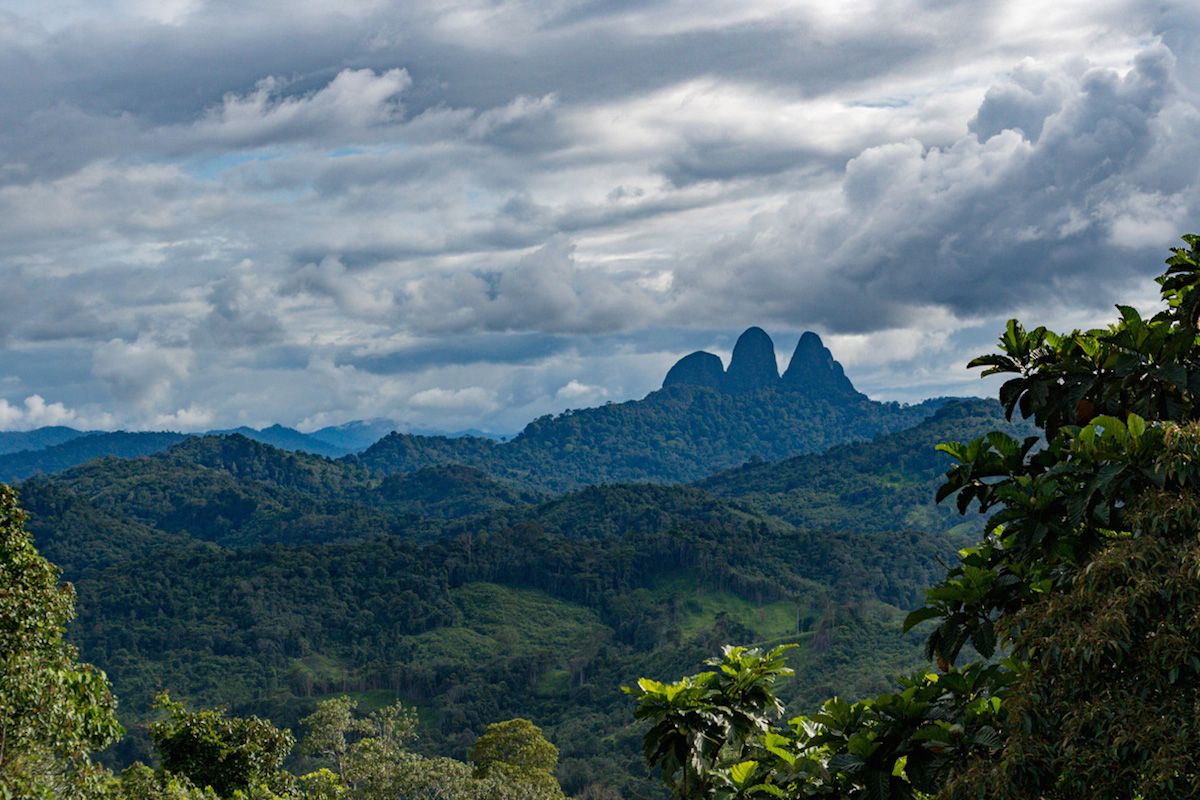
Sarawak contains large tracts of tropical rainforest with diverse plant and animal species, including 2000 tree species. The state is the habitat of endangered animals, including the Borneo pygmy elephant, proboscis monkey, orangutans and Sumatran rhinoceroses. In 1854, Alfred Russel Wallace visited Sarawak. A year later, he formulated the “Sarawak Law” which foreshadowed the formulation of his and Darwin’s theory of evolution by natural selection three years later.
Sarawak’s rainforests are primarily threatened by the logging industry and palm oil plantations. Deforestation has affected the lives of indigenous tribes, especially the Penan, whose livelihood is heavily dependent on forest produce. This led to several blockades by indigenous tribes during the 1980s and 1990s against logging companies encroaching on their lands. Illegal logging in particular has decimated the forest regions indigenous populations depend on for their livelihoods, depleting fish, wildlife, but also traditional medicinal herbs and construction staples like Palm. There have also been cases where Native Customary Rights (NCR) lands have been given to timber and plantation companies without the permission of the locals. The indigenous people have resorted to legal means to reinstate their NCR. Through the course of 2016 over 2 million acres of forest, much of it in orangutan habitats, were declared protected areas.
Sources vary as to Sarawak’s remaining forest cover. Former chief minister Abdul Taib Mahmud declared that it fell from 70% to 48% between 2011 and 2012, the Sarawak Forest Department and the Ministry of Resource Planning and Environment both held that it remained at 80% in 2012, and Wetlands International reported that it fell by 10% between 2005 and 2010, 3.5 times faster than the rest of Asia combined.
Historically, Sarawak’s economy was stagnant during the rule of the previous three white Rajahs. After the formation of Malaysia, Sarawak’s GDP growth rate has risen due to an increase in petroleum output and the rise in global petroleum prices. However, the state economy is less diversified and still heavily dependent upon the export of primary commodities when compared to Malaysia overall. Sarawak is one of the world’s largest exporters of tropical hardwood timber, constituting 65% of the total Malaysian log exports in 2000. Tourism plays a major role in the economy of Sarawak and contributed 7.9% of the state’s GDP in 2016. The Rainforest World Music Festival is the region’s primary musical event, attracting more than 50,000 people annually.
Sarawak is Malaysia’s fifth most populous state, but because this population is distributed over a large area, Sarawak has the lowest population density in the country, with only 20 people per sq km.
 Memories and Such