
In the vast and intricate tapestry of Indian spirituality, certain symbols resound across centuries, uniting story, devotion, architecture, and memory. Among these, the concept of Jyotirlinga occupies a place of deep reverence. These are not simply temples, not merely shrines, but radiant embodiments of the infinite cosmic light of Lord Shiva, that manifest in forms that bridge the seen and unseen, the earthly and transcendent.
In Sanskrit, Jyoti means “light” and Linga means “mark” or “sign.” Thus, a Jyotirlinga is the “radiant sign of Shiva.” Devotees believe that these shrines are not representations of Shiva crafted by human effort but are rather natural manifestations of his infinite energy, breaking through the earthly veil as columns of light.
There is a famous story in the puranic tradition: once, the gods Vishnu and Brahma debated the supremacy of creation and preservation. To settle their disagreement, Shiva manifested as an endless pillar of light, extending beyond all measure. No beginning, no end, just infinite brilliance. Brahma and Vishnu, even with all their might, failed to find its origin or terminus. That boundless beam is the essence of the Jyotirlinga.
Each Jyotirlinga temple is thus not merely a place of worship but a cosmic reminder that divinity cannot be contained, only glimpsed. While many Shiva temples exist across the subcontinent, thousands upon thousands, the twelve Jyotirlingas are especially sacred, each considered a direct site where Shiva revealed himself as light.
The Shiva Mahapurana recounts that originally Shiva manifested in innumerable Jyotirlingas, but twelve came to hold supreme prominence. These are spread across India, forming not a neat geographical circle but a sacred web binding disparate landscapes into a single spiritual network.
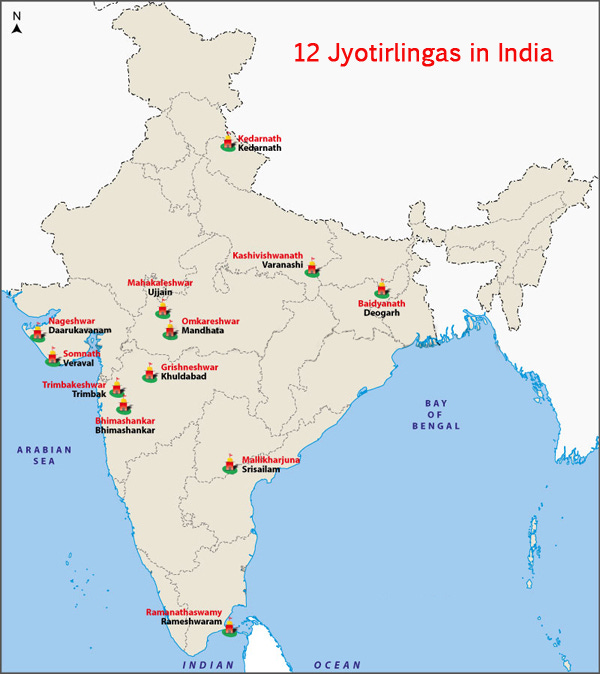
The 12 Jyotirlingas are traditionally named as: Somnath, Mallikarjuna, Mahakaleshwar, Omkareshwar, Kedarnath, Bhimashankar, Vishwanath (Kashi Vishwanath), Trimbakeshwar, Vaidyanath, Nageshwar, Rameshwaram, and Grishneshwar.
Each has its unique legends, but collectively, they narrate a larger cultural truth: the omnipresence of Lord Shiva. From the Himalayan slopes of Kedarnath to the coastal waves of Rameshwaram, from the deserts of Gujarat to the dense temples of Maharashtra, the Jyotirlingas embody the principle that divinity pervades all terrain, all time, all people.

Unlike pilgrimages that cluster around one region, the circuit of Jyotirlingas cuts across the entire Indian subcontinent. This makes them not only holy destinations but also cultural highways through which stories, practices, and communities travelled.
North and South: Kedarnath rises in the snow-clad Himalayas, while Rameshwaram marks the southern reach of the Tamil coast.
East and West: Vaidyanath lies in today’s Jharkhand, while Somnath shines on Gujarat’s western shoreline, carrying centuries of resilience in the face of invasions.
The Central Heartland: Madhya Pradesh hosts temples like Omkareshwar and Mahakaleshwar, where Narmada and timeless cityscapes converge.
In this way, the Jyotirlingas collectively become not just a religious map but also a civilizational geography, showcasing the range of India’s landscapes, heritage, and local traditions. For pilgrims over centuries, undertaking journeys to one, several, or all of the Jyotirlingas was not just about devotion but about experiencing the vastness of their own homeland: mountain, river, plain, forest, desert, and sea, each sanctified by Shiva’s light.
At the heart of every Jyotirlinga is a story. But unlike fixed myths, these narratives exist in multiple versions, layered and adapted across regions. Somnath tells of the moon god’s relief from a curse; Omkareshwar emerges from the tale of divine contest on the Narmada; Kedarnath is linked with the penance of the Pandavas after Kurukshetra; Rameshwaram connects to Rama’s journey before crossing the sea to Lanka. In these stories, we glimpse a pattern: the Jyotirlinga shrines don’t emerge only from abstract theology but are deeply entwined with epic history, cosmic events, and moral lessons. Some legends highlight the consequences of pride, others the power of repentance, still others the compassion of Shiva as healer, protector, or cosmic witness. These stories also underscore a uniquely Indian way of sacralising geography: temples are not arbitrary but spring from mythic episodes rooted in the very soil, waters, or mountain where the shrine arose.
Though united in sanctity, the Jyotirlinga temples are strikingly diverse in architectural style. This diversity mirrors India’s regional creativity with each temple absorbing the styles of dynasties, local artisans, and materials at hand. Somnath rebuilt multiple times, embodies defiance and renewal, its sandstone spire rising against the Arabian Sea. Mahakaleshwar holds its sanctum underground, where rituals unfold in the raw intimacy of stone. Kedarnath, perched high in the Himalayas, stands austere and unyielding amid glacier and storm. Rameshwaram is famed for its magnificent corridors, among the longest in the world, echoing with chant and silence. Grishneshwar, smaller in scale, radiates intimacy with its sculpted beauty.
In each, stone becomes story, architecture becomes theology. Shikhara towers stretch skyward like frozen prayers. Mandapas receive wandering pilgrims. Intricate carvings unfold symbolic worlds: snakes, lotuses, cosmic wheels—all testifying to Shiva’s manifold nature.

The Jyotirlinga temples remain not relics of the past but vibrant centres of living tradition. Daily rituals unfold in sequence: dawn abhisheka with waters, milk, and flowers; chants of Vedic mantras; fragrance of incense; the rhythmic ringing of bells. Pilgrims arrive with hopes, vows, burdens, and gratitude. Water from sacred rivers is poured over the linga. Ashes are smeared on brows. Offerings are carried with devotion in baskets of marigold and bilva leaves. Nights resound with hymns and processions.
Beyond individual worship, festivals magnify the spirit of the Jyotirlingas: Mahashivaratri, in particular, transforms each temple into a vibrant ocean of chanting and fasting devotees, who hold vigil through the night to honour Lord Shiva’s cosmic dance.
The core symbolism of Jyotirlinga worship is profound. Where icons depict form, the Jyotirlinga signifies the formless infinite. The lingam is not an idol in the conventional sense but a symbol, a reminder of the ineffable, suggesting that the divine cannot be confined within anthropomorphic imagery. The idea of Shiva as formless light aligns with deep philosophical currents in Indian thought, especially Advaita philosophy: reality as one without a second, beyond image, beyond time, infinite like light itself. Worship of the Jyotirlinga thus becomes not just an act of bhakti or devotion, but also a gateway into contemplative realisation: the one who bows before the linga is also bowing before the boundless within themselves.
Perhaps one of the most remarkable aspects of the Jyotirlinga temples is their resilience. They have faced invasions, destruction, natural calamities, and yet have been rebuilt time and again, symbolising not just survival but renewal of faith. Somnath, for example, was desecrated multiple times across centuries, yet always rose anew. Kedarnath witnessed devastating floods, but continues to be a magnet of devotion. Rameshwaram has absorbed tidal rhythms of history and faith.
In this resilience lies a lesson: that the sacred, even when broken, is never truly destroyed. Faith finds ways to rebuild, to sing, to remember, to sanctify again. The Jyotirlingas are living examples of this civilisational continuity.

The Jyotirlingas are not only pilgrimage sites but cultural fountains. They have inspired poetry, devotional songs, art, and ritual practices across centuries. Saints and mystics, such as Tulsidas, Adi Shankaracharya, and countless regional poets, have sung of Shiva’s presence in these sacred shrines. Economically, the temples have long sustained communities of artisans, priests, and pilgrims. Socially, they facilitate gatherings that dissolve barriers: rich and poor, scholar and villager, all queue together to pour water over the same linga. They also serve as cultural markers: to say one has walked to Somnath, climbed to Kedarnath, bathed at Rameshwaram, is not only to claim devotional merit but to claim a deeper cultural identity.
In today’s world of fast travel, the Jyotirlinga circuit has taken new shapes. Devotees sometimes attempt to visit all twelve within a single journey, aided by trains, flights, and tour packages. For others, the pilgrimage is spread across a lifetime, an unfolding quest where each temple marks a personal milestone. Yet, even amidst modernity, the essence remains untouched: to travel to a Jyotirlinga is to step outside ordinary routine, to participate in a timeless cycle, to stand beneath stone spires and remember the infinite light.
Finally, the significance of the Jyotirlingas is not limited to geographical shrines. Many teachers remind us that the truest Jyotirlinga resides within, as the spark of consciousness and light at the core of being. The pilgrim’s outer journey, through dust roads and mountain passes, is mirrored by an inward journey, through meditation and realisation. The twelve Jyotirlingas may be seen as stations of the larger inner pilgrimage: toward recognizing the self as shaped by nothing but light, infinite and eternal.
The Jyotirlinga temples are not twelve stones scattered across India. They are twelve flames in a greater fire, twelve windows into infinity, twelve markers reminding us of the endless dance of destruction and renewal that is Shiva himself. To reflect on them is to reflect on a civilisation’s memory, on resilience against time, and on humanity’s longing to touch the infinite. So follow me along, as together we will walk more slowly into each temple’s world, pausing to hear its legends, study its architecture, savor its rituals, and glimpse how community and culture intertwine around its sacred space.
For now, let us hold this wider vision: that across mountains, coasts, rivers, forests, and deserts, the Jyotirlinga temples stand as luminous testimonies to the eternal light of Lord Shiva: stones that carry story, spaces that breathe devotion, shrines that forever point beyond themselves to the formless, radiant source of all.
 Memories and Such