Thrive: The Third Metric to Redefining Success and Creating a Life of Well-Being, Wisdom, and Wonder – Arianna Huffington
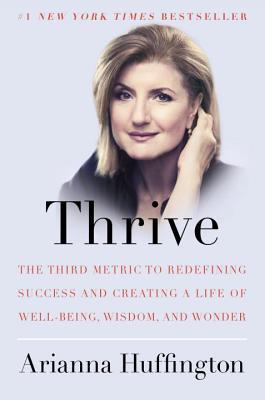 In Thrive, Arianna Huffington makes an impassioned and compelling case for the need to redefine what it means to be successful in today’s world.
Arianna Huffington’s personal wake-up call came in the form of a broken cheekbone and a nasty gash over her eye – the result of a fall brought on by exhaustion and lack of sleep. As the cofounder and editor-in-chief of the Huffington Post Media Group – one of the fastest growing media companies in the world – celebrated as one of the world’s most influential women, and gracing the covers of magazines, she was, by any traditional measure, extraordinarily successful. Yet as she found herself going from brain MRI to CAT scan to echocardiogram, to find out if there was any underlying medical problem beyond exhaustion, she wondered is this really what success feels like?
As more and more people are coming to realize, there is far more to living a truly successful life than just earning a bigger salary and capturing a corner office. Our relentless pursuit of the two traditional metrics of success – money and power – has led to an epidemic of burnout and stress-related illnesses, and an erosion in the quality of our relationships, family life, and, ironically, our careers. In being connected to the world 24/7, we’re losing our connection to what truly matters. Our current definition of success is, as Thrive shows, literally killing us. We need a new way forward.
In a commencement address Arianna gave at Smith College in the spring of 2013, she likened our drive for money and power to two legs of a three-legged stool. They may hold us up temporarily, but sooner or later we’re going to topple over. We need a third leg – a third metric for defining success – to truly thrive. That third metric, she writes in Thrive, includes our well-being, our ability to draw on our intuition and inner wisdom, our sense of wonder, and our capacity for compassion and giving. As Arianna points out, our eulogies celebrate our lives very differently from the way society defines success. They don’t commemorate our long hours in the office, our promotions, or our sterling PowerPoint presentations as we relentlessly raced to climb up the career ladder. They are not about our resumes – they are about cherished memories, shared adventures, small kindnesses and acts of generosity, lifelong passions, and the things that made us laugh.
In this deeply personal book, Arianna talks candidly about her own challenges with managing time and prioritizing the demands of a career and raising two daughters – of juggling business deadlines and family crises, a harried dance that led to her collapse and to her “aha moment.” Drawing on the latest groundbreaking research and scientific findings in the fields of psychology, sports, sleep, and physiology that show the profound and transformative effects of meditation, mindfulness, unplugging, and giving, Arianna shows us the way to a revolution in our culture, our thinking, our workplace, and our lives.

 Set in India’s Old Delhi, Clear Light of Day is Anita Desai’s tender, warm, and compassionate novel about family scars, the ability to forgive and forget, and the trials and tribulations of familial love.
 On the evening of March 17, 1959, as the people of Tibet braced for a violent power grab by Chinese occupiers—one that would forever wipe out any vestige of national sovereignty—the twenty-four-year-old Dalai Lama, Tibet’s political and spiritual leader, contemplated the impossible. The task before him was immense: to slip past a cordon of crack Chinese troops ringing his summer palace and, with an escort of 300, journey across the highest terrain in the world and over treacherous Himalayan passes to freedom—one step ahead of pursuing Chinese soldiers.
 A naked teenage girl is found dead near the beautiful Byzantine Yoros Castle in Turkey. She has stabbed herself through the heart but there is evidence of bizarre sexual practice. In another part of Istanbul, a young boy seems to have committed suicide in similar circumstances. What dark rituals could have compelled them to fatal self-abuse? Inspectors Cetin Ikmen and Mehmet Suleyman follow an internet trail that leads them to an underworld of Goth nightclubs and Satanic worship. But even those murky shadows hide more than they reveal and the answers to an ever increasing number of suspicious deaths is more shocking and terrible than they could ever have imagined.
 “Half of our family, the better-looking half, is missing,” Nomi Nickel tells us at the beginning of A Complicated Kindness. Left alone with her sad, peculiar father, her days are spent piecing together why her mother and sister have disappeared and contemplating her inevitable career at Happy Family Farms, a chicken slaughterhouse on the outskirts of East Village. Not the East Village in New York City where Nomi would prefer to live, but an oppressive town founded by Mennonites on the cold, flat plains of Manitoba, Canada.
 Memories and Such