In My Hands Today…

The Third Pole: Mystery, Obsession, and Death on Mount Everest – Mark Synnott

Shivering, exhausted, gasping for oxygen, beyond doubt . . .

A hundred-year mystery lured veteran climber Mark Synnott into an unlikely expedition up Mount Everest during the spring 2019 season that came to be known as “the Year Everest Broke.” What he found was a gripping human story of impassioned characters from around the globe and a mountain that will consume your soul—and your life—if you let it.

The mystery? On June 8, 1924, George Mallory and Sandy Irvine set out to stand on the roof of the world, where no one had stood before. They were last seen eight hundred feet shy of Everest’s summit, still “going strong” for the top. Could they have succeeded decades before Sir Edmund Hillary and Tenzing Norgay? Irvine is believed to have carried a Kodak camera with him to record their attempt, but it, along with his body, has never been found. Did the frozen film in that camera have a photograph of Mallory and Irvine on the summit before they disappeared into the clouds, never to be seen again? Kodak says the film might still be viable. . . .

Mark Synnott made his own ascent up the infamous North Face along with his friend Renan Ozturk, a filmmaker using drones higher than any had previously flown. Readers witness first-hand how Synnott’s quest led him from oxygen-deprivation training to archives and museums in England, to Kathmandu, the Tibetan high plateau, and up the North Face into a massive storm. The infamous traffic jams of climbers at the very summit immediately resulted in tragic deaths. Sherpas revolted. Chinese officials turned on Synnott’s team. An Indian woman miraculously crawled her way to frostbitten survival. Synnott himself went off the safety rope—one slip and no one would have been able to save him—committed to solving the mystery.

Eleven climbers died on Everest that season, all of them mesmerized by an irresistible magic. The Third Pole is a rapidly accelerating ride to the limitless joy and horror of human obsession.

In My Hands Today…

The Devil’s Picnic – Taras Grescoe

From Norwegian moonshine to the pentobarbital sodium sipped by suicide tourists in Switzerland—and, in between, baby eels killed by an infusion of tobacco, a garlicky Spanish stew of bull’s testicles, tea laced with cocaine, and malodorous French cheese—Taras Grescoe has written a travelogue of forbidden indulgences.

As Grescoe crisscrosses the globe in pursuit of his quarry, he delves into questions of regional culture and repressive legislation—from the clandestine absinthe distillation in an obscure Swiss valley to the banning of poppy seed biscuits in Singapore—and launches into a philosophical investigation of what’s truly how something as fundamental as the plants and foods we consume could be so vilified and demonized.

An investigation into what thrills us, what terrifies us, and what would make us travel ten thousand miles and evade the local authorities, The Devil’s Picnic is a delicious and compelling expedition into the heart of vice and desire.

In My Hands Today…

How to Say Babylon – Safiya Sinclair

Throughout her childhood, Safiya Sinclair’s father, a volatile reggae musician and militant adherent to a strict sect of Rastafari, became obsessed with her purity, in particular, with the threat of what Rastas call Babylon, the immoral and corrupting influences of the Western world outside their home. He worried that womanhood would make Safiya and her sisters morally weak and impure, and believed a woman’s highest virtue was her obedience.

In an effort to keep Babylon outside the gate, he forbade almost everything. In place of pants, the women in her family were made to wear long skirts and dresses to cover their arms and legs, head wraps to cover their hair, no make-up, no jewelry, no opinions, no friends. Safiya’s mother, while loyal to her father, nonetheless gave Safiya and her siblings the gift of books, including poetry, to which Safiya latched on for dear life. And as Safiya watched her mother struggle voicelessly for years under housework and the rigidity of her father’s beliefs, she increasingly used her education as a sharp tool with which to find her voice and break free. Inevitably, with her rebellion come clashes with her father, whose rage and paranoia explodes in increasing violence. As Safiya’s voice grows, lyrically and poetically, a collision course is set between them.

In My Hands Today…

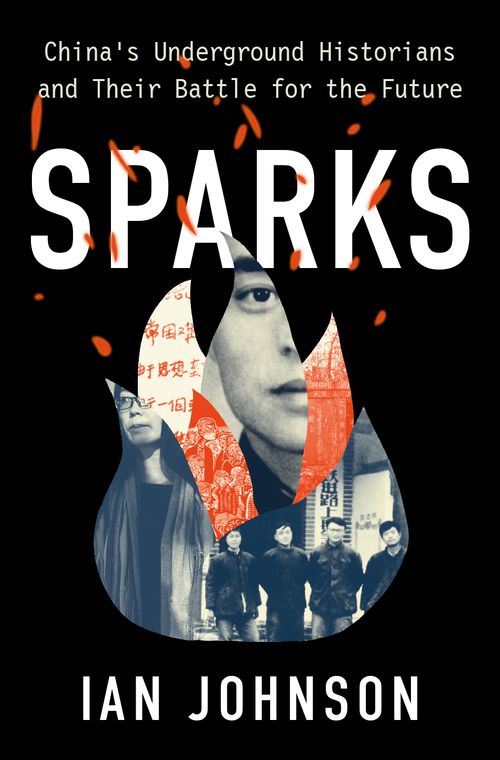
Sparks: China’s Underground Historians and their Battle for the Future – Ian Johnson

China’s Underground Historians and their Battle for the Future describes how some of China’s best-known writers, filmmakers, and artists have overcome crackdowns and censorship to forge a nationwide movement that challenges the Communist Party on its most hallowed its control of history.

The past is a battleground in many countries, but in China it is crucial to political power. In traditional China, dynasties rewrote history to justify their rule by proving that their predecessors were unworthy of holding power. Marxism gave this a modern gloss, describing history as an unstoppable force heading toward Communism’s triumph. The Chinese Communist Party builds on these ideas to whitewash its misdeeds and glorify its rule. Indeed, one of Xi Jinping’s signature policies is the control of history, which he equates with the party’s survival.

But in recent years, a network of independent writers, artists, and filmmakers have begun challenging this state-led disremembering. Using digital technologies to bypass China’s legendary surveillance state, their samizdat journals, guerilla media posts, and underground films document a regular pattern of from famines and purges of years past to ethnic clashes and virus outbreaks of the present–powerful and inspiring accounts that have underpinned recent protests in China against Xi Jinping’s strongman rule.

Based on years of first-hand research in Xi Jinping’s China, Sparks challenges stereotypes of a China where the state has quashed all free thought, revealing instead a country engaged in one of humanity’s great struggles of memory against forgetting―a battle that will shape the China that emerges in the mid-21st century.

In My Hands Today…

Border: A Journey to the Edge of Europe – Kapka Kassabova

In this extraordinary work of narrative reportage, Kapka Kassabova returns to Bulgaria, from where she emigrated as a girl twenty-five years previously, to explore the border it shares with Turkey and Greece. When she was a child, the border zone was rumored to be an easier crossing point into the West than the Berlin Wall, and it swarmed with soldiers and spies. On holidays in the “Red Riviera” on the Black Sea, she remembers playing on the beach only miles from a bristling electrified fence whose barbs pointed inward toward the enemy: the citizens of the totalitarian regime.

Kassabova discovers a place that has been shaped by successive forces of history: the Soviet and Ottoman empires, and, older still, myth and legend. Her exquisite portraits of fire walkers, smugglers, treasure hunters, botanists, and border guards populate the book. There are also the ragged men and women who have walked across Turkey from Syria and Iraq. But there seem to be nonhuman forces at work here too: This densely forested landscape is rich with curative springs and Thracian tombs, and the tug of the ancient world, of circular time and animism, is never far off.

Border is a scintillating, immersive travel narrative that is also a shadow history of the Cold War, a sideways look at the migration crisis troubling Europe, and a deep, witchy descent into interior and exterior geographies.