In My Hands Today…

Losing Music: A Memoir – John Cotter
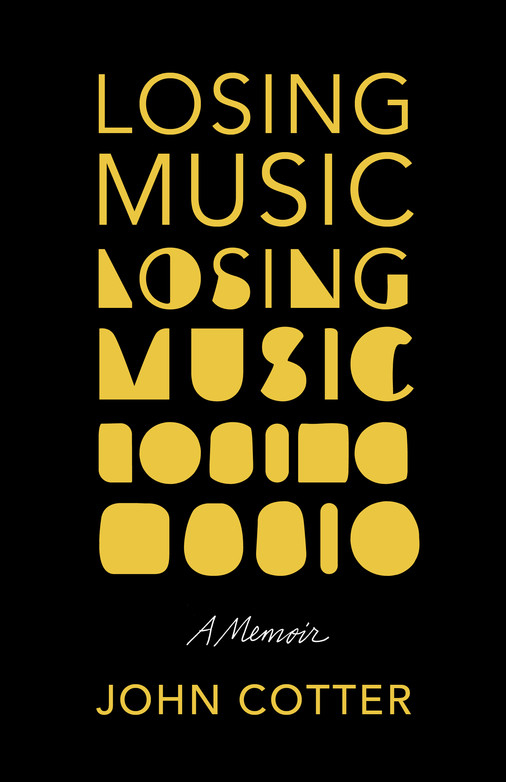
John Cotter was thirty years old when he first began to notice a ringing in his ears. Soon the ringing became a roar inside his head. Next came partial deafness, then dizziness and vertigo that rendered him unable to walk, work, sleep, or even communicate. At a stage of life when he expected to be emerging fully into adulthood, teaching and writing books, he found himself “crippled and dependent,” and in search of care.

When he is first told that his debilitating condition is likely Ménière’s Disease, but that there is “no reliable test, no reliable treatment, and no consensus on its cause,” Cotter quits teaching, stops writing, and commences upon a series of visits to doctors and treatment centers. What begins as an expedition across the country navigating and battling the limits of the American healthcare system, quickly becomes something else entirely: a journey through hopelessness and adaptation to disability. Along the way, hearing aids become inseparable from his sense of self, as does a growing understanding that the possibilities in his life are narrowing rather than expanding. And with this understanding of his own travails comes reflection on age-old questions around fate, coincidence, and making meaning of inexplicable misfortune.

A devastating memoir that sheds urgent, bracingly honest light on both the taboos surrounding disability and the limits of medical science, Losing Music is refreshingly vulnerable and singularly illuminating—a story that will make readers see their own lives anew.

In My Hands Today…

Enchantment: Awakening Wonder in an Anxious Age – Katherine May

Many of us feel trapped in a grind of constant change: rolling news cycles, the chatter of social media, our families split along partisan lines. We feel fearful and tired, on edge in our bodies, not quite knowing what has us perpetually depleted. For Katherine May, this low hum of fatigue and anxiety made her wonder what she was missing. Could there be a different way to relate to the world, one that would allow her to feel more rested and at ease, even as seismic changes unfold on the planet? Might there be a way for all of us to move through life with curiosity and tenderness, sensitized to the subtle magic all around?

In Enchantment, May invites the reader to come with her on a journey to reawaken our innate sense of wonder and awe. With humor, candor, and warmth, she shares stories of her own struggles with work, family, and the aftereffects of pandemic, particularly feelings of overwhelm as the world rushes to reopen. Craving a different way to live, May begins to explore the restorative properties of the natural world, moving through the elements of earth, water, fire, and air and identifying the quiet traces of magic that can be found only when we look for them. Through deliberate attention and ritual, she unearths the potency and nourishment that come from quiet reconnection with our immediate environment. Blending lyricism and storytelling, sensitivity and empathy, Enchantment invites each of us to open the door to human experience in all its sensual complexity, and to find the beauty waiting for us there.

In My Hands Today…

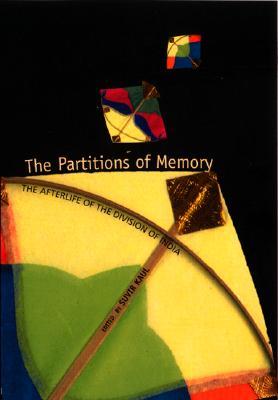
The Partitions of Memory: The Afterlife of the Division of India – edited by Suvir Kaul

Echoes of the traumatic events surrounding the Partition of India in 1947 can be heard to this day in the daily life of the subcontinent, each time India and Pakistan play a cricket match or when their political leaders speak of “unfinished business.” Sikhs who lived through the pogrom following the assassination of Indira Gandhi recall Partition, as do, most recently, Muslim communities targeted by mobs in Gujarat.

The eight essays in The Partitions of Memory suggest ways in which the tangled skein of Partition might be unraveled. The contributors range over issues as diverse as literary reactions to Partition; the relief and rehabilitation measures provided to refugees; children’s understanding of Partition; the power of “national” monuments to evoke a historical past; the power of letters to evoke more immediately poignant pasts; and the Dalit claim, at the prospect of Partition, to a separate political identity. The book demonstrates how fundamental the material and symbolic histories of Partition are to much that has happened in South Asia since 1947.

Contributors:
Mukulika Banerjee, Urvashi Butalia, Joya Chatterji, Priyamvada Gopal, Suvir Kaul, Nita Kumar, Sunil Kumar, Richard Murphy, and Ramnarayan S. Rawat.

In My Hands Today…

Die with Zero: Getting All You Can from Your Money and Your Life – Bill Perkins

Imagine if by the time you died, you did everything you were told to. You worked hard, saved your money, and looked forward to financial freedom when you retired.

The only thing you wasted along the way was…your life.

Die with Zero presents a startling new and provocative philosophy as well as practical guide on how to get the most out of your money—and out of your life. It’s intended for those who place lifelong memorable experiences far ahead of simply making and accumulating money for one’s so-called Golden Years.

In short, Bill Perkins wants to rescue you from over-saving and under-living. Regardless of your age, Die with Zero will teach you Perkins’ plan for optimizing your life, stage by stage, so you’re fully engaged and enjoying what you’ve worked and saved for.

You’ll discover how to maximize your lifetime memorable moments with “experience bucketing,” how to convert your earnings into priceless memories by following your “net worth curve,” and find out how to navigate whether to invest in, or delay, a meaningful adventure based on your “spend curve” and “personal interest rate.”

Using his own life experiences as well as the inspiring stories and cautionary tales of others—and drawing on eye-opening insights about time, money, and happiness from psychological science and behavioral finance —Perkins makes a timely, convincing, and contrarian case for living large.

In My Hands Today…

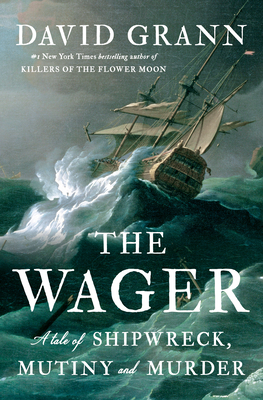
The Wager: A Tale of Shipwreck, Mutiny and Murder – David Grann

On January 28, 1742, a ramshackle vessel of patched-together wood and cloth washed up on the coast of Brazil. Inside were thirty emaciated men, barely alive, and they had an extraordinary tale to tell. They were survivors of His Majesty’s Ship the Wager, a British vessel that had left England in 1740 on a secret mission during an imperial war with Spain. While the Wager had been chasing a Spanish treasure-filled galleon known as “the prize of all the oceans,” it had wrecked on a desolate island off the coast of Patagonia. The men, after being marooned for months and facing starvation, built the flimsy craft and sailed for more than a hundred days, traversing nearly 3,000 miles of storm-wracked seas. They were greeted as heroes.

But then … six months later, another, even more decrepit craft landed on the coast of Chile. This boat contained just three castaways, and they told a very different story. The thirty sailors who landed in Brazil were not heroes – they were mutineers. The first group responded with countercharges of their own, of a tyrannical and murderous senior officer and his henchmen. It became clear that while stranded on the island the crew had fallen into anarchy, with warring factions fighting for dominion over the barren wilderness. As accusations of treachery and murder flew, the Admiralty convened a court martial to determine who was telling the truth. The stakes were life-and-death–for whomever the court found guilty could hang.