World Wildlife Day

Humans share our planet with other species who coexist with us. The term wildlife traditionally refers to undomesticated animal species but has come to include all organisms that grow or live wild in an area without being introduced by humans. Wildlife can be found in all ecosystems – deserts, forests, rainforests, plains, grasslands, and other areas, including the most developed urban areas, all have distinct forms of wildlife. While the term in popular culture usually refers to animals that are untouched by human factors, most scientists agree that much wildlife is affected by human activities with many wild animals, even the dangerous ones, have value to human beings which may be economic, educational, or emotional. Humans have historically tended to separate civilization from wildlife in many ways, including the legal, social, and moral senses. Global wildlife populations have decreased by 68% since 1970 as a result of human activity, particularly overconsumption, population growth and intensive farming, according to a 2020 World Wildlife Fund’s Living Planet Report and the Zoological Society of London’s Living Planet Index measure, which is further evidence that humans have unleashed a sixth mass extinction event. According to CITES, it has been estimated that annually the international wildlife trade amounts to billions of dollars and it affects hundreds of millions of animal and plant specimens.

According to data from the International Union for Conservation of Nature (IUCN) Red List of Threatened Species, over 8,400 species of wild fauna and flora are critically endangered, while close to 30,000 more are understood to be endangered or vulnerable. In 2019, the Intergovernmental Science-Policy Platform on Biodiversity and Ecosystem Services‘ Global Assessment Report on Biodiversity and Ecosystem Services found that a quarter of species on Earth already face the threat of extinction and that global ecosystems had declined by an average of nearly half, relative to their earliest estimated states. Continued loss of species, habitats and ecosystems also threaten all life on Earth, including us. People everywhere rely on wildlife and biodiversity-based resources to meet all our needs, from food to fuel, medicines, housing, and clothing. Millions of people also rely on nature as the source of their livelihoods and economic opportunities.

Between 200 and 350 million people live within or adjacent to forested areas around the world, relying on the various ecosystem services provided by forest and forest species for their livelihoods and to cover their most basic needs, including food, shelter, energy and medicines. Roughly 28% of the world’s land surface is currently managed by indigenous peoples, including some of the most ecologically intact forests on the planet. These spaces are not only central to their economic and personal well-being but also their cultural identities.
On 20 December 2013, at its 68th session, the United Nations General Assembly (UNGA) proclaimed 3 March – the day of signature of the Convention on International Trade in Endangered Species of Wild Fauna and Flora (CITES) in 1973 – as UN World Wildlife Day to celebrate and raise awareness of the world’s wild animals and plants. The UNGA resolution also designated the CITES Secretariat as the facilitator for the global observance of this special day for wildlife on the UN calendar. World Wildlife Day has now become the most important global annual event dedicated to wildlife. This day was proposed by Thailand to celebrate and raise awareness of the world’s wild fauna and flora and member countries reaffirmed the intrinsic value of wildlife and its various contributions, including ecological, genetic, social, economic, scientific, educational, cultural, recreational and aesthetic, to sustainable development and human well-being.

World Wildlife Day will celebrate forest-based livelihoods and seek to promote forest and forest wildlife management practices that accommodate both human well-being and the long-term conservation of forests and promote the value of traditional practices that contribute to establishing a more sustainable relationship with these crucial natural systems. The animals and plants that live in the wild have an intrinsic value and contribute to the ecological, genetic, social, economic, scientific, educational, cultural, recreational and aesthetic aspects of human well-being and to sustainable development.

The planet’s forests are home to some 80 per cent of all terrestrial wild species. They help regulate the climate and support the livelihoods of hundreds of millions of people and some 90 per cent of the world’s poorest people are dependent in some way on forest resources, particularly the indigenous communities that live in or near forests.

Some 28 per cent of the world’s land is managed by indigenous communities, including some of the most intact forests on the planet which provide livelihoods and cultural identity. The unsustainable exploitation of forests harms these communities and contributes to biodiversity loss and climate disruption. Every year, the world loses 4.7 million hectares of forests, an area larger than Denmark and the major cause is unsustainable agriculture as well as global timber trafficking, which accounts for up to 90 per cent of tropical deforestation in some countries and also attracts the world’s biggest organised crime groups. The illegal trade in wild animal species is another threat, increasing the risks of zoonotic diseases, such as Ebola and COVID-19.

World Wildlife Day has a different theme every year and in 2022 will be celebrated under the theme “Safeguarding key species for ecosystem restoration” with the celebrations seeking to draw attention to the conservation status of some of the most critically endangered species of wild fauna and flora, and to drive discussions towards imagining and implementing solutions to conserve them. The day will therefore drive the debate towards the imperative need to reverse the fate of the most critically endangered species, to support the restoration of their habitats and ecosystems and to promote their sustainable use by humanity.
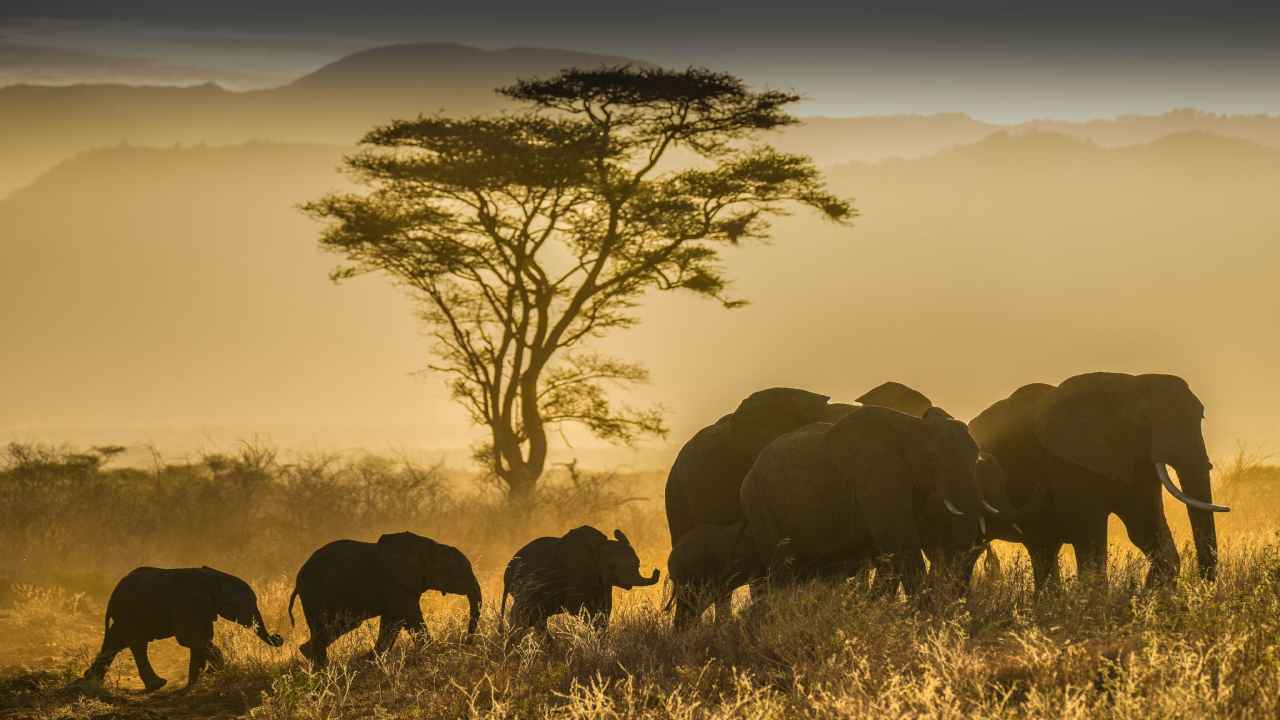
World Wildlife Day is an opportunity to celebrate the many beautiful and varied forms of wild fauna and flora and to raise awareness of the multitude of benefits that their conservation provides to people. At the same time, the Day reminds us of the urgent need to step up the fight against wildlife crime and human-induced reduction of species, which have wide-ranging economic, environmental and social impacts. Given these various negative effects, Sustainable Development Goal 15 focuses on halting biodiversity loss.

Forests, forests species and the livelihoods that depend on them currently find themselves at the crossroads of the multiple planetary crises we currently face, from climate change to biodiversity loss and the health, social and economic impacts of the COVID-19 pandemic.

So on this day, pledge to protect the forests and the flora and fauna which live in them. We deserve to leave this planet a better place than when we started using it.

Benford’s Law

Numbers are all around us and with numbers come number patterns. And when we research number patterns, we come across something very interesting. Also known as the Newcomb–Benford law, the law of anomalous numbers or the first-digit law, Benford’s Law is a statistical statement about the occurrence of digits in lists of data and is an observation that in many real-life sets of numerical data, the leading digit is likely to be small.

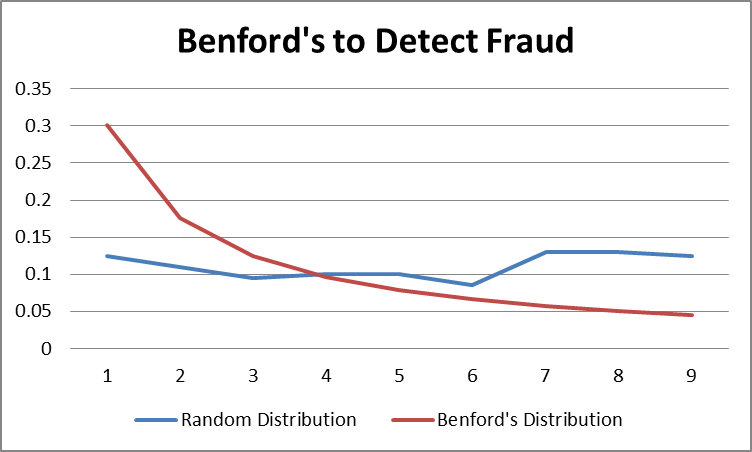
According to the law, in sets that obey the law, the number 1 appears as the leading significant digit about 30% of the time, while 9 appears as the leading significant digit less than 5% of the time. If the digits were distributed uniformly, they would each occur about 11.1 % of the time. Benford’s Law also makes predictions about the distribution of second digits, third digits, digit combinations, and so on. The law is named after physicist Frank Benford, who stated it in 1938 in a paper titled “The Law of Anomalous Numbers”, although it had been previously stated by Simon Newcomb in 1881 and is similar in concept, though not identical in distribution, to the Zipf’s law. So according to Benford’s Law, the finding that the first digits or numerals to be exact of the numbers found in series of records of the most varied sources do not display a uniform distribution, but rather are arranged in such a way that the digit “1” is the most frequent, followed by “2”, “3”, and so in a successively decreasing manner down to “9”

The discovery of Benford’s law goes back to 1881 when the Canadian-American astronomer Simon Newcomb noticed that in logarithm tables the earlier pages that started with 1 were much more worn than the other pages. Newcomb’s published result is the first known instance of this observation and includes distribution on the second digit, as well. Newcomb proposed a law that the probability of a single number N being the first digit of a number was equal to log(N + 1) − log(N). The phenomenon was again noted in 1938 by the physicist Frank Benford, who tested it on data from 20 different domains and was credited for it. Benford’s data set included the surface areas of 335 rivers, the sizes of 3259 US populations, 104 physical constants, 1800 molecular weights, 5000 entries from a mathematical handbook, 308 numbers contained in an issue of Reader’s Digest, the street addresses of the first 342 persons listed in American Men of Science and 418 death rates. The total number of observations used in the paper was 20,229.

It has been shown that this result applies to a wide variety of data sets, including electricity bills, street addresses, stock prices, house prices, population numbers, death rates, lengths of rivers, and physical and mathematical constants. Like other general principles about natural data – for example, the fact that many data sets are well approximated by a normal distribution — some illustrative examples and explanations cover many of the cases where Benford’s law applies, though there are many other cases where Benford’s law applies that resist a simple explanation. It tends to be most accurate when values are distributed across multiple orders of magnitude, especially if the process of generating the numbers is described by a power-law, which is common in nature.

Benford’s law tends to apply most accurately to data that span several orders of magnitude. As a rule of thumb, the more orders of magnitude that the data evenly covers, the more accurately Benford’s law applies. For instance, one can expect that Benford’s law would apply to a list of numbers representing the populations of UK settlements. But if a settlement is defined as a village with a population between 300 and 999, then Benford’s law will not apply.

In general, it has been seen a series of numerical records follows Benford’s Law when they
represents magnitudes of events or events, such as populations of cities, flows of water in rivers or sizes of celestial bodies; do not have pre-established minimum or maximum limits; are not made up of numbers used as identifiers, such as identity or social security numbers, bank accounts, telephone numbers; and have a mean which is less than the median, and the data is not concentrated around the mean

This law can be utilised to detect patterns or the lack thereof in naturally occurring datasets. This can lead to important applications in data science such as catching anomalies or fraud detection. It’s expected that a large set of numbers will follow the law, so accountants, auditors, economists and tax professionals have a benchmark what the normal levels of any particular number in a set are.

In the latter half of the 1990s, accountant Mark Nigrini found that Benford’s law can be an effective red-flag test for fabricated tax returns; True tax data usually follows Benford’s law, whereas made-up returns do not. Ponzi schemes can be detected using the law. Unrealistic returns, such as those purported by the Maddoff scam, fall far from the expected Benford probability distribution.

In 1972, Hal Varian suggested that the law could be used to detect possible fraud in lists of socio-economic data submitted in support of public planning decisions. Based on the plausible assumption that people who fabricate figures tend to distribute their digits fairly uniformly, a simple comparison of first-digit frequency distribution from the data with the expected distribution according to Benford’s law ought to show up any anomalous results. In the United States, evidence-based on Benford’s law has been admitted in criminal cases at the federal, state, and local levels.

Walter Mebane, a political scientist and statistician at the University of Michigan, was the first to apply the second-digit Benford’s law-test (2BL-test) in election forensics. Such analyses are considered a simple, though not foolproof, method of identifying irregularities in election results and helping to detect electoral fraud. Benford’s law has been used as evidence of fraud in the 2009 Iranian elections. An analysis by Mebane found that the second digits in vote counts for President Mahmoud Ahmadinejad, the winner of the election, tended to differ significantly from the expectations of Benford’s Law and that the ballot boxes with very few invalid ballots had a greater influence on the results, suggesting widespread ballot stuffing. Another study used bootstrap simulations to find that the candidate Mehdi Karroubi received almost twice as many vote counts beginning with the digit 7 as would be expected according to Benford’s law, while analysis from Columbia University concluded that the probability that a fair election would produce both too few non-adjacent digits and the suspicious deviations in last-digit frequencies as found in the 2009 Iranian presidential election is less than 0.5%. Benford’s Law has also been applied for forensic auditing and fraud detection on data from the 2003 California gubernatorial election, the 2000 and 2004 United States presidential elections, and the 2009 German federal election.

Benford’s law has also been misapplied to claim election fraud. When applying the law to Joe Biden’s election returns for Chicago, Milwaukee, and other localities in the 2020 United States presidential election, the distribution of the first digit did not follow Benford’s law. The misapplication was a result of looking at data that was tightly bound in range, which violates the assumption inherent in Benford’s law that the range of the data is large.

Macroeconomic data the Greek government reported to the European Union before entering the eurozone was shown to be probably fraudulent using Benford’s law, albeit years after the country joined the EU. In genome data, the number of open reading frames and their relationship to genome size differs between eukaryotes and prokaryotes with the former showing a log-linear relationship and the latter a linear relationship. Benford’s law has been used to test this observation with an excellent fit to the data in both cases. The law has also been used successfully in scientific fraud detection. A test of regression coefficients in published papers showed agreement with Benford’s law. As a comparison group subjects were asked to fabricate statistical estimates. The fabricated results conformed to Benford’s law on first digits but failed to obey Benford’s law on second digits.

So if you want to test Benford’s Law yourself, it’s very simple. Just pick up a random book or magazine and list or sort the numbers. You will find about 30% of the numbers collected from any issue will start with the number 1. Let me know in the comments section if the law fit in your experiment. 

Valentine’s Day

Today is Valentine’s Day which worldwide is celebrated as the day of love. Also called Saint Valentine’s Day or the Feast of Saint Valentine, Valentine’s Day is celebrated annually on February 14 and originated as a Christian feast day honouring one or two early Christian martyrs named Saint Valentine and, through later folk traditions, has become a significant cultural, religious, and commercial celebration of romance and love in many regions of the world.

There are several martyrdom stories associated with the various Valentines connected to February 14, including an account of the imprisonment of Saint Valentine of Rome for ministering to Christians persecuted under the Roman Empire in the third century. According to an early tradition, Saint Valentine restored sight to the blind daughter of his jailer and numerous later additions to the legend have better related it to the theme of love. An 18th-century embellishment to the legend claims he wrote the jailer’s daughter a letter signed “Your Valentine” as a farewell before his execution while another addition posits that Saint Valentine performed weddings for Christian soldiers who were forbidden to marry.

The Feast of Saint Valentine was established by Pope Gelasius I in 496 AD to be celebrated on February 14 in honour of Saint Valentine of Rome, who died on that date in 269 AD. The day became associated with romantic love in the 14th and 15th centuries when notions of courtly love flourished, apparently by association with the lovebirds of early spring. In 18th century England, it grew into an occasion in which couples expressed their love for each other by presenting flowers, offering confectionery, and sending greeting cards, known as valentines. By the 1900s printed cards began to replace written letters due to improvements in printing technology. Ready-made cards were an easy way for people to express their emotions in a time when direct expression of one’s feelings was discouraged. Cheaper postage rates also contributed to an increase in the popularity of sending Valentine’s Day greetings. The Valentine’s Day symbols that are used today include the heart-shaped outline, doves, and the figure of the winged Cupid. In Italy, Saint Valentine’s Keys are given to lovers as a romantic symbol and an invitation to unlock the giver’s heart, as well as to children to ward off epilepsy, also known as Saint Valentine’s Malady. Americans probably began exchanging hand-made valentines in the early 1700s. Today, according to the Greeting Card Association, an estimated 145 million Valentine’s Day cards are sent each year, making Valentine’s Day the second largest card-sending holiday of the year, after Christmas.

An official feast day in the Anglican Communion and the Lutheran Church, the day is not a public holiday anywhere. Many parts of the Eastern Orthodox Church also celebrate Saint Valentine’s Day on July 6 in honour of the Roman presbyter Saint Valentine, and on July 30 in honour of Hieromartyr Valentine, the Bishop of Interamna in modern-day Terni, Italy.

While the European folk traditions connected with Saint Valentine and St. Valentine’s Day have become marginalised by the modern Anglo-American customs connecting the day with romantic love, some remaining associations connect the saint with the advent of spring. While the custom of sending cards, flowers, chocolates and other gifts originated in the UK, Valentine’s Day remains connected with various regional customs in England. In Norfolk, a character called Jack Valentine knocks on the rear door of houses leaving sweets and presents for children with many children scared of this mystical person. In Slovenia, Saint Valentine or Zdravko was one of the saints of spring, the saint of good health and the patron of beekeepers and pilgrims as the belief is that plants and flowers start to grow on this day and has been celebrated as the day when the first work in the vineyards and the fields commences. The day is also said to mark the beginning of spring.

The oldest known valentine still in existence today was a poem written in 1415 by Charles, Duke of Orleans, to his wife while he was imprisoned in the Tower of London following his capture at the Battle of Agincourt. (The greeting is now part of the manuscript collection of the British Library in London, England.) Several years later, it is believed that King Henry V hired a writer named John Lydgate to compose a valentine note to Catherine of Valois.

Cupid is often portrayed on Valentine’s Day cards as a naked cherub launching arrows of love at unsuspecting lovers. But the Roman God Cupid has his roots in Greek mythology as the Greek god of love, Eros. Accounts of his birth vary; some say he is the son of Nyx and Erebus; others, of Aphrodite and Ares; still others suggest he is the son of Iris and Zephyrus or even Aphrodite and Zeus, who would have been both his father and grandfather. According to the Greek Archaic poets, Eros was a handsome immortal who played with the emotions of Gods and men, using golden arrows to incite love and leaden ones to sow aversion. It wasn’t until the Hellenistic period that he began to be portrayed as the mischievous, chubby child he’d become on Valentine’s Day cards.

Giving red roses may be an obvious romantic gesture today on Valentine’s Day, but it wasn’t until the late 17th century that giving flowers became a popular custom. The practice can be traced back to when King Charles II of Sweden learned the language of flowers which pairs different flowers with specific meanings on a trip to Persia and subsequently introduced the tradition to Europe. The act of giving flowers then became a popular trend during the Victorian Era, including on Valentine’s Day, with red roses symbolising deep love.

So here’s wishing everyone a very Happy Valentine’s Day. Remember, where there is love, there is life!

A VUCA World and how it impacts us

The past few years have shown us in no uncertain words how volatile our world is. Every week brings new changes and most of us are unable to make any plans because we don’t know what next week will bring us.

This is encapsulated very well in the acronym VUCA which stands for Volatile, Uncertain, Complex and Ambiguous which stands for what our world is today. First used in 1987, the acronym draws on the leadership theories of Warren Bennis and Burt Nanus, to describe or to reflect on the volatility, uncertainty, complexity and ambiguity of general conditions and situations. The U.S. Army War College introduced the concept of VUCA to describe the more volatile, uncertain, complex and ambiguous multilateral world perceived as resulting from the end of the Cold War and more frequent use and discussion of the term VUCA began from 2002. It has subsequently taken root in emerging ideas in strategic leadership that apply in a wide range of organizations, from for-profit corporations to education.

The deeper meaning of each element of VUCA serves to enhance the strategic significance of the VUCA foresight and insight as well as the behaviour of groups and individuals in organisations. It discusses systemic failures and behavioural failures, which are characteristic of organisational failure.

V stands for Volatility which is the nature and dynamics of change, and the nature and speed of change forces and change catalysts. It refers to the speed of change in an industry, market or the world in general. It is associated with fluctuations in demand, turbulence and short time to markets and it is well-documented in the literature on industry dynamism. The more volatile the world is, the more and faster things change.

U is Uncertainty or the lack of predictability, the prospects for surprise, and the sense of awareness and understanding of issues and events. Uncertainty refers to the extent to which we can confidently predict the future. Part of the uncertainty is perceived and associated with people’s inability to understand what is going on. Uncertainty, though, is also a more objective characteristic of an environment. Truly uncertain environments are those that don’t allow any prediction, also not on a statistical basis. The more uncertain the world is, the harder it is to predict.

C means Complexity which is the multiplex of forces, the confounding of issues, no cause-and-effect chain and confusion that surrounds organisations. It refers to the number of factors that we need to take into account, their variety and the relationships between them. The more factors, the greater their variety and the more they are interconnected, the more complex an environment is. Under high complexity, it is impossible to fully analyse the environment and come to rational conclusions. The more complex the world is, the harder it is to analyse.

And lastly, A stands for Ambiguity which encompasses the haziness of reality, the potential for misreads, and the mixed meanings of conditions and the cause-and-effect confusion. These elements present the context in which organizations view their current and future state, present boundaries for planning and policy management and come together in ways that either confound decisions or sharpen the capacity to look, plan and move ahead. It points to a lack of clarity about how to interpret something. A situation is ambiguous, for example, when information is incomplete, contradicting or too inaccurate to draw clear conclusions. More generally it refers to fuzziness and vagueness in ideas and terminology. The more ambiguous the world is, the harder it is to interpret.

The particular meaning and relevance of VUCA often relate to how people view the conditions under which they make decisions, plan forward, manage risks, foster change and solve problems. In general, the premises of VUCA tend to shape an organisation’s capacity to anticipate the issues that shape, understand the consequences of issues and actions, appreciate the interdependence of variables, prepare for alternative realities and challenges and interpret and address relevant opportunities. For most organisations, VUCA is a practical code for awareness and readiness.

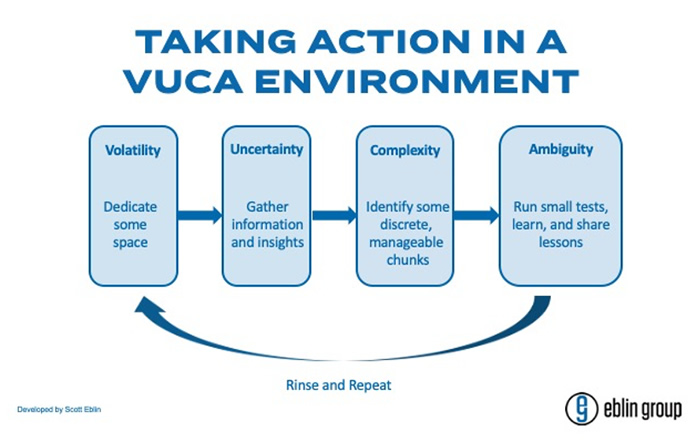
So how can we try and navigate a VUCA World? Though it may seem inescapable in certain situations and industries, one can use it to advantage. The key to managing is to break VUCA down into its parts and to identify volatile, uncertain, complex, or ambiguous situations. Each type of situation has its causes and resolutions, so one should aim to deal with one at a time.

  • Counter volatility with vision. Accept and embrace change as a constant and don’t resist it.
  • Create a strong, compelling statement of objectives and values, and develop a clear, shared vision of the future. Have flexible goals which can be amended quickly.
  • Meet uncertainty with understanding which can help understand and develop new ways of thinking and acting in response to VUCA’s elements.
  • Make investing in, analysing and interpreting business and competitive intelligence a priority, so that one doesn’t fall behind. Stay up to date with industry news, and listen carefully to find out what others want.
  • Review and evaluate performance. Consider what one did well, what came as a surprise, and what one could do differently next time.
  • Simulate and experiment with situations, so that one can explore how they might play out, and how one might react to them in the future. Aim to anticipate possible future threats and devise likely responses. Gaming, scenario planning, crisis planning and role-playing are useful tools for generating foresight and preparing responses.
  • Communicate clearly because in complex situations, clearly expressed communication help to understand direction.
  • Develop and promote collaboration. VUCA situations are often too complicated for one person to handle, so strong teams that can work effectively in a fast-paced, unpredictable environment is essential.
  • Fight ambiguity with agility by promoting flexibility, adaptability and agility. Plan, but build in contingency time and be prepared to alter plans as events unfold.
  • Hire, develop and promote people who thrive in VUCA environments as these people are likely to be collaborative, comfortable with ambiguity and change, and have complex thinking skills.
  • Encourage people to think and work outside of their usual functional areas, to increase their knowledge and experience. Job rotation and cross-training can be excellent ways to improve agility.
  • Lead teams, but don’t dictate to or control them, instead develop collaborative environments and work hard to build a consensus. Encourage debate, dissent and participation from everyone.
  • Embrace an ideas culture. Reward team members who demonstrate vision, understanding, clarity, and agility.

When one is affected by VUCA, one has a choice. Either one allows VUCA to manage, overload and overwhelm them, or they accept and manage it so that they can mitigate its effects. When one decides to accept VUCA, they choose to make themselves and others less vulnerable and empower everyone to deal with uncontrollable, unpredictable forces.

World Wetlands Day

Today is the World Wetlands Day. Dating back to 1971, World Wetlands Day is an environmentally-related celebration that reaffirms the protection and love for wetlands, which are the small environments of plant life and organisms found within water bodies that bring about ecological health in abundance to not only water bodies but environments as a whole. First celebrated in 1997, World Wetlands Day serves to recognise the influence and positive production that Wetlands have had on the world and in terms brings communities together for the benefit of Mother Nature. This day also raises global awareness because wetlands play a significant role in people and on the planet. The day was formally acknowledged by the United Nations on 30 August 2021as World Wetlands Day. 2 February each year is World Wetlands Day to raise global awareness about the vital role of wetlands for people and our planet. This day also marks the date of the adoption of the Convention on Wetlands on 2 February 1971, in the Iranian city of Ramsar on the shores of the Caspian Sea.

A patch of land that develops pools of water after a rainstorm would not necessarily be considered a wetland, even though the land is wet. Wetlands have unique characteristics: they are generally distinguished from other water bodies or landforms based on their water level and on the types of plants that live within them. Specifically, wetlands are characterised as having a water table that stands at or near the land surface for a long enough period each year to support aquatic plants. A wetland is a distinct ecosystem that is flooded by water, either permanently or seasonally. Flooding results in oxygen-free or anoxic processes prevailing, especially in the soils. Wetlands are considered among the most biologically diverse of all ecosystems, serving as home to a wide range of unique plant and animal species and occur naturally on every continent, except for Antarctica. The water in wetlands is either freshwater, brackish or salt water and the main wetland types are classified based on the dominant plants and/or the source of the water. Wetlands contribute several functions that benefit people and are called ecosystem services and include water purification, groundwater replenishment, stabilization of shorelines and storm protection, water storage and flood control, processing of carbon including carbon fixation, decomposition and sequestration, other nutrients and pollutants, and support of plants and animals. Wetlands also place a role in climate change mitigation and adaptation. The world’s largest wetlands include the Amazon River basin, the West Siberian Plain, the Pantanal in South America, and the Sundarbans in the Ganges-Brahmaputra delta. According to the UN Millennium Ecosystem Assessment, wetlands are more affected by environmental degradation than any other ecosystem on Earth.

Over time, human construction has led to various ecological problems affecting wetlands. Overpopulation and construction have led to a decrease in environmental conservation and total has brought issues to these lands. Many wetlands are being lost and ecologists claim that humans should recognise this dilemma before the loss of a natural filter and conserver of the world.

The theme for the 2022 World Wetlands Day is Wetlands Action for People & Nature and today the Convention on Wetlands and its Contracting Parties will launch the next World Wetlands Day campaign to scale wetlands conservation actions for people and planetary health.