Sacred Stones, Spaces, and Stories: Ashtavinayaka Part 3

On the serene banks of the Bhima River, atop a gentle hillock shrouded in babul trees, stands the Siddhivinayak Temple at Siddhatek, a site revered as one of the eight sacred Ashtavinayak shrines of Maharashtra. This temple, with its unique right-trunked Ganesha and deep roots in myth and history, is a powerful spiritual destination, drawing pilgrims seeking blessings, accomplishment or siddhi, and the removal of obstacles. As the only Ashtavinayak temple where Ganesha’s trunk turns to the right, Siddhatek holds a special place in the hearts of devotees.

Siddhatek is a small village in the Ahmednagar district, about 100 km from Pune. The temple sits on a hillock, surrounded by the lush greenery of babul trees, with the Bhima River flowing nearby, creating an atmosphere of tranquillity and spiritual elevation. The pilgrimage to Siddhatek is not merely a physical journey but a symbolic ascent, both literal and metaphorical, toward divine accomplishment.

According to tradition, the original temple at Siddhatek was built by Lord Vishnu himself. Over the centuries, the temple fell into ruin and was lost to memory. The site’s sanctity was revived when a local cowherd, guided by a divine vision, discovered the ancient idol of Siddhivinayak and began worshipping it. News of the miraculous idol spread, and the shrine regained its prominence as a centre of devotion.

The current temple was constructed in the late 18th century under the patronage of Rajmata Ahilyabai Holkar, the philosopher-queen of Indore, who is celebrated for her contributions to Hindu temple architecture across India. Further enhancements were made during the Peshwa era, notably by Sardar Haripant Phadke, who built the Nagarkhana, or drum chamber, and a paved pathway to the temple’s main entrance. The outer sabha-mandapa, or assembly hall, originally built by Mairal, a landlord from Baroda, was rebuilt in 1970 after being demolished in 1939. Today, the temple is managed by the Chinchwad Devasthan Trust, which also oversees the Morgaon and Theur Ashtavinayak temples.

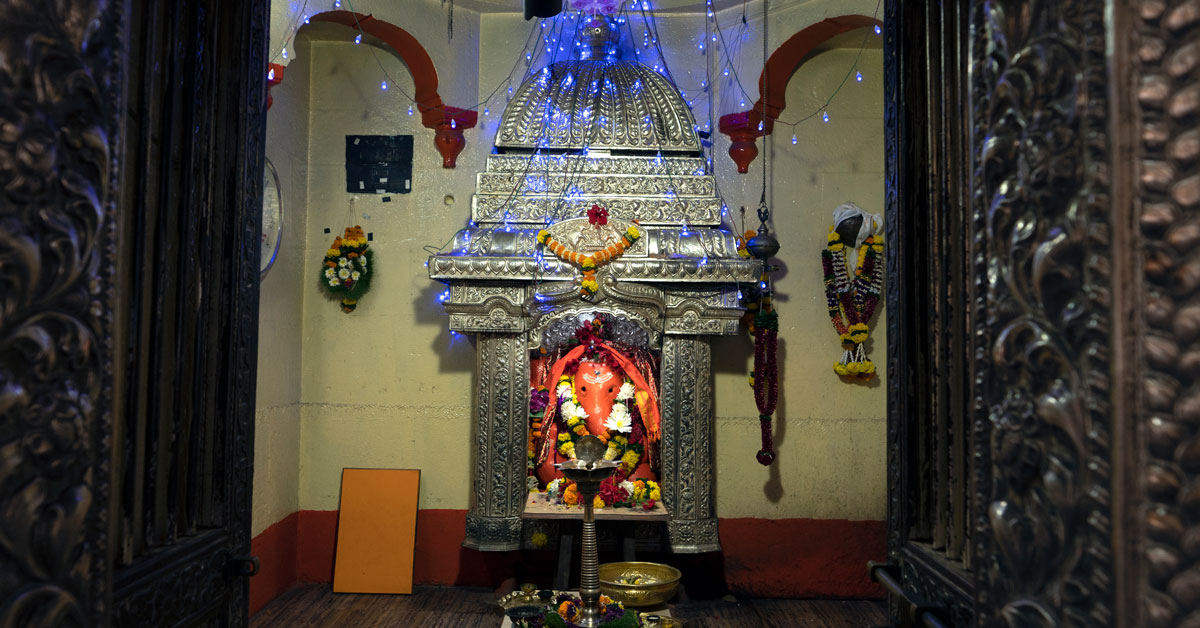
The Siddhivinayak Temple is constructed primarily from black stone, giving it an austere yet elegant appearance. The temple faces north, a direction considered auspicious, and features a sanctum, the garbhagriha, with a dome-shaped stone ceiling. The sanctum is relatively modest in size, measuring 15 feet in height and 10 feet in width.

The central focus of the temple is the swayambhu, or self-manifested idol of Ganesha, known here as Siddhivinayak. Unlike most other Ganesha idols, which have their trunks turned to the left, the Siddhatek idol’s trunk turns to the right, a feature regarded as highly potent and difficult to appease. The idol is encased in brass and is depicted in a cross-legged posture, flanked by his consort Siddhi, symbolising spiritual accomplishment.

The entrance to the sanctum is guarded by brass statues of Jaya and Vijaya, the celestial gatekeepers of Vishnu’s abode. The sanctum also houses a Shiva-panchayatana, a grouping that includes Shiva, Ganesha, Vishnu, the Goddess, and Surya, the Sun God, reflecting the temple’s inclusive spiritual philosophy. The Nagarkhana, or the drum chamber, built by Sardar Haripant Phadke, is used during major festivals and rituals.

The most celebrated legend associated with Siddhatek is rooted in the ancient Mudgala Purana and other sacred texts. At the dawn of creation, the god Vishnu lay in deep yogic slumber or yoganidra, while Brahma, the creator, emerged from a lotus growing from Vishnu’s navel. As Brahma began the work of creation, two demons, Madhu and Kaitabha, arose from the dirt in Vishnu’s ear and began to wreak havoc, threatening the cosmic order.

Vishnu awoke and engaged the demons in battle, but despite his might, he could not defeat them. Seeking guidance, he approached Shiva, who revealed that Vishnu had neglected to invoke Ganesha, the remover of obstacles, before commencing his task. Realising his error, Vishnu travelled to Siddhatek and performed intense penance, chanting the mantra “Om Sri Ganeshaya Namah” for over a hundred years.

Moved by Vishnu’s devotion, Ganesha appeared and granted him siddhi, divine powers, and success. Armed with these blessings, Vishnu returned to the battlefield and, through a clever ruse, tricked the demons into granting him a boon, which he used to destroy them. Thus, the site where Vishnu attained siddhi became known as Siddhatek, and the form of Ganesha worshipped here is called Siddhivinayak, the bestower of accomplishment and supernatural powers. Siddhatek is also believed to be the place where other great souls, Maharshi Vyas, Bhrushundi, the Ganapatya saint Morya Gosavi, and his son Narayan Maharaj, attained siddhi through intense devotion and penance.

The Siddhivinayak Temple at Siddhatek is renowned for its rigorous and elaborate daily worship schedule. The day begins with the Kakad aarti, the early morning prayer, typically around 5 – 5:30 am. Shree Darshan is the early morning darshan, or viewing of the deity, from 5:30 am to noon. Naivedhya, or the offering of food to the deity, takes place around 12:05–12:30 pm. The afternoon Shree Darshan takes place between 12:30 and 7 pm. The evening Dhup Aarti is from 7 to 7:10 pm, while the evening aarti is from 7:30 to 8 pm. The night Shree Darshan is from 8 to 9:50 pm, while the final aarti before bedtime, the Shejaarti, happens at 9:50 pm, after which the temple is closed until the next morning. During the Maha Abhishekha, the grand ritual bathing, which occurs from 7:30 am to 1:00 pm, devotees are not permitted in the main temple area, and offerings of flowers and fruits are restricted.

A distinctive ritual at Siddhatek is the practice of performing 21 pradakshinas, or circumambulations, around the temple. This tradition is rooted in the story of Sardar Haripant Phadke, who, after losing his post as commander-in-chief, prayed to Siddhivinayak for 21 days, performing 21 circumambulations each day. His devotion was rewarded, and he regained his position, a testament to the temple’s reputation as a “jagrut kshetra”, a site of living, active divine power. Devotees continue this practice, believing that sincere performance of 21 pradakshinas can fulfil heartfelt wishes and bring about spiritual accomplishment.

Ganesh Chaturthi, celebrated in August or September, is the most prominent festival at Siddhatek. The temple is adorned with elaborate decorations, and the air is filled with devotional hymns and the rhythmic beat of traditional drums. Thousands of devotees gather to participate in the festivities, which include special rituals, processions, and communal prayers.

Ganesh Jayanti, marking the birth anniversary of Lord Ganesha, is celebrated in the Hindu month of Magha, about January or February. The highlight of the festival is a three-day “palkhi” or a palanquin procession, during which the idol of Ganesha is carried through the village, accompanied by devotional singing and cultural performances. Special rituals and celebrations also occur on Vijayadashami or Dussehra and Somavati Amavasya, a new moon that falls on a Monday, further enhancing the temple’s vibrant spiritual life.

Siddhatek is traditionally the second temple visited in the Ashtavinayak pilgrimage circuit, following Morgaon. However, due to travel convenience, some pilgrims visit it third, after Morgaon and Theur. Regardless of the sequence, Siddhatek is regarded as a crucial stop, as the right-trunked Ganesha is believed to be especially powerful in granting siddhi and removing obstacles. The temple is not just a site of individual devotion, but also a centre of community and cultural life.

The Siddhivinayak Temple at Siddhatek, with its unique right-trunked deity, ancient legends of divine accomplishment, and vibrant ritual, makes it a cornerstone of the Ashtavinayak pilgrimage.

World Diabetes Day

World Diabetes Day (WDD), observed annually on November 14, is the primary global awareness campaign focusing on diabetes mellitus. Launched in 1991 by the International Diabetes Federation (IDF) and the World Health Organization (WHO), this day was established in response to the alarming rise in diabetes cases worldwide. The date was chosen to honour the birthday of Sir Frederick Banting, who, along with Charles Best, co-discovered insulin in 1922. Over the years, WDD has grown into a global movement, with over 230 IDF Member Associations in more than 160 countries and territories participating in various activities, including diabetes screening programs, media campaigns, and sports events.

The inception of World Diabetes Day was driven by the need to address the rapid increase in diabetes cases globally. In 2006, the United Nations General Assembly adopted a resolution recognizing diabetes as a chronic, debilitating, and costly disease, and designated November 14 as World Diabetes Day. This resolution marked a significant step in elevating diabetes to the status of a global public health issue, emphasizing the need for international cooperation in addressing the disease.

In today’s world, diabetes is a critical public health issue that affects millions of people globally. According to the IDF, diabetes-related healthcare expenditure reached $966 billion in 2021, highlighting the economic burden of the disease. World Diabetes Day serves as a platform to raise awareness about diabetes, promote education, and advocate for better access to care and treatment. Each year, the campaign focuses on a specific theme related to diabetes, addressing issues such as diabetes and human rights, diabetes and lifestyle, and diabetes in vulnerable populations.

The theme for World Diabetes Day 2024–2026 is “Diabetes and Well-being,” focusing on physical, societal, and mental well-being. This theme underscores the holistic approach needed to manage diabetes, recognising that the disease affects not only physical health but also emotional and social well-being.

Diabetes is a chronic disease when the body cannot properly regulate blood glucose levels. There are several types of diabetes, each with its own characteristics and management strategies.

Type 1 Diabetes: Type 1 diabetes is an autoimmune condition in which the body’s immune system attacks and destroys the insulin-producing cells in the pancreas. It is usually diagnosed in children and young adults, although it can occur at any age. People with type 1 diabetes require lifelong insulin therapy to manage their blood glucose levels.

Type 2 Diabetes: Type 2 diabetes is the most common form of diabetes, accounting for 90–95% of all cases. It occurs when the body becomes resistant to insulin or when the pancreas cannot produce enough insulin. Risk factors for type 2 diabetes include obesity, physical inactivity, and a family history of the disease. Unlike type 1 diabetes, type 2 diabetes can often be prevented or delayed through lifestyle changes such as healthy eating, regular exercise, and weight management.

Gestational Diabetes: Gestational diabetes develops during pregnancy and usually resolves after childbirth. However, women who have had gestational diabetes are at increased risk of developing type 2 diabetes later in life. Managing blood glucose levels during pregnancy is crucial to prevent complications for both the mother and the baby.

Prediabetes: Prediabetes is a condition where blood glucose levels are higher than normal but not high enough to be classified as diabetes. People with prediabetes are at increased risk of developing type 2 diabetes, as well as heart disease and stroke. However, prediabetes can often be reversed through lifestyle changes such as weight loss, healthy eating, and increased physical activity.

Preventing Diabetes

Preventing diabetes, particularly type 2 diabetes, involves adopting a healthy lifestyle. Here are some key strategies:

  • Healthy eating: Focus on a diet rich in whole grains, fruits, vegetables, and lean proteins. Avoid sugary beverages and limit the intake of refined carbohydrates.
  • Regular exercise: Aim for at least 30 minutes of moderate-intensity exercise, such as brisk walking, five days a week. Physical activity helps improve insulin sensitivity and manage weight.
  • Weight management: Maintaining a healthy weight is crucial in preventing type 2 diabetes. Even a modest weight loss of 5–7% can significantly reduce the risk.
  • Quit smoking: Smoking increases the risk of insulin resistance and type 2 diabetes. Quitting smoking can reduce this risk and improve overall health.
  • Monitor blood sugar levels: Regular monitoring of blood glucose levels can help identify prediabetes early, allowing for timely intervention.

Impact of Diabetes 

Diabetes has far-reaching consequences, affecting not only the individual but also their family and society as a whole.

Physical and emotional toll: Living with diabetes requires constant management, including monitoring blood glucose levels, taking medications, and making lifestyle adjustments. Over time, high blood glucose levels can lead to serious complications such as heart disease, kidney failure, vision loss, and nerve damage[8]. The emotional burden of diabetes can also be significant, with many individuals experiencing stress, anxiety, and depression.

Economic impact: The economic impact of diabetes is substantial, both for individuals and healthcare systems. The cost of diabetes care, including medications, regular check-ups, and management of complications, can place a significant financial burden on families. In some low-income and middle-income countries, the cost of insulin and blood glucose monitoring alone can consume half of a family’s income. On a broader scale, diabetes-related healthcare expenditure places a heavy strain on national healthcare systems, diverting resources from other critical areas.

Family dynamics: Diabetes can also affect family dynamics, particularly when a family member is diagnosed with the disease. Family members often take on caregiving roles, which can lead to emotional stress and financial strain. In some cases, parents of children with type 1 diabetes may need to reduce their working hours or change their jobs to accommodate the demands of diabetes management.

World Diabetes Day serves as a reminder of the urgent need to address the global diabetes epidemic. By raising awareness, promoting education, and advocating for better access to care, we can work towards reducing the burden of diabetes on individuals, families, and society. The theme highlights the importance of a holistic approach to diabetes management, addressing not only physical health but also emotional and social well-being. Preventing diabetes requires a collective effort, involving individuals, families, healthcare providers, and policymakers. By adopting healthy lifestyles, supporting those living with diabetes, and investing in diabetes research and care, we can make significant strides in combating this global health challenge. As we observe World Diabetes Day, let us commit to taking action to improve the lives of those affected by diabetes and to prevent future generations from facing this debilitating disease.

Adulting 101: How to Build a Professional Wardrobe on a Budget

As young adults enter the workforce, one of the first challenges they often face is creating a professional wardrobe that aligns with workplace expectations and fosters confidence, all without breaking the bank. Whether you’re starting your first job, attending interviews, or aiming to present yourself more professionally, the key is striking the right balance between quality and affordability.

Your wardrobe is a reflection of your professionalism, confidence, and readiness for the workplace. Your appearance creates the first impression in interviews, meetings, and daily workplace interactions. A polished and professional wardrobe signals competence and attention to detail. Dressing professionally can enhance your self-esteem, making you feel more confident and capable in professional settings. Many organisations have dress codes, whether formal, business casual, or creative casual. A professional wardrobe helps you align with the workplace environment. Your wardrobe is an investment in your career and personal brand. The way you present yourself can impact how colleagues and supervisors perceive your abilities.

Before building your wardrobe, it’s important to understand your workplace dress code. Formal business attire includes suits, dress shirts, ties, and polished shoes. Typically required in industries like law, finance, or corporate roles. Business casual is a mix of dressy and casual items like button-down shirts, chinos, skirts, blouses, and loafers. Common in tech, marketing, and education sectors. Creative casual attire allows for greater individuality and creative expression. Think neat jeans, casual blazers, dresses, and stylish shoes. Often found in creative industries like design, media, or startups. Some workplaces, like healthcare and hospitality, may require uniforms, reducing the need for extensive personal wardrobe building. Knowing your employer’s dress code ensures your purchases align with expectations while saving you from buying unnecessary items.

A professional wardrobe doesn’t need to be extensive. Start with versatile staples that can be mixed and matched to create multiple outfits.

For women, with tops, staples include button-down shirts in classic white or pastel colours for formal wear, blouses that are feminine and polished options suitable for business casual as well, and neutral sweaters, which are great for layering in colder months. Good options for bottoms can include tailored trousers, which can be paired with blouses or button-downs for a professional look; pencil or midi skirts, which are stylish yet workplace-appropriate options; and dark jeans for creative, casual workplaces. Shift dresses or wrap dresses are comfortable, versatile, and professional. If your climate calls for outerwear, a structured blazer instantly elevates any outfit, while cardigans are softer alternatives for layering. Coming to shoes, flats or loafers are comfortable and polished choices for daily wear while neutral heels with 2-3 inch heels give a professional touch.

For men, dress shirts in white, blue, and pale-coloured shirts work with any suit, and polo shirts are perfect for business casual days. Sweaters in neutral options are good for layering over shirts in colder months. For bottoms, tailored pants in black, navy, or grey are perfect, while chinos are versatile, casual, yet professional. Dark jeans are suitable for creative workplaces. For outerwear, blazers are a must-have for formal and business casual settings, while bomber jackets or cardigans are casual alternatives for layering. On to shoes, Oxford or Derby shoes are perfect for formal business attire, while loafers are great for business casual.

A capsule wardrobe is a collection of essential clothing items that are versatile and timeless. It reduces clutter, makes outfit planning simpler, and helps save money. To build a capsule wardrobe, choose neutral colours and focus on black, navy, gray, beige, and white, as they pair easily with other items. Select multi-functional pieces and prioritise items that can transition from formal to casual settings. Stick to high-quality basics and invest in durable clothing items that withstand wear and tear.

Shop smart. Building a professional wardrobe on a budget requires strategic shopping. Before heading to the store, take inventory of your current wardrobe. Identify items that can be repurposed for workplace outfits. Shop at thrift stores, as thrift stores often carry high-quality professional clothing at significantly reduced prices. Look for timeless pieces like blazers, dress shirts, and trousers. Take advantage of sales and watch for seasonal sales, such as end-of-season or Black Friday, to purchase high-quality items at discounted rates. Buy second-hand online from platforms like Poshmark, Depop, or eBay that offer gently used professional clothing at affordable prices. Invest in quality for key items and spend more on staples like a blazer or dress shoes, as these items are worn frequently and need to last longer. Save money on less frequently used items like accessories. Seek affordable brands and explore budget-friendly brands that offer professional attire.

Maximise your wardrobe by mixing and matching items to create multiple outfits. As an example, for women, pair a pencil skirt with a blouse for formal meetings. Then swap the skirt for tailored trousers and layer a cardigan for business casual. For men, pair navy dress pants with a white shirt and blazer for a presentation. Remove the blazer and add a sweater for a more informal look.

Maintain your wardrobe, as proper care ensures your wardrobe lasts longer. Launder carefully and follow washing instructions to avoid damage or shrinkage. Use delicate cycles for dress shirts or blouses. Invest in repairs. Fix loose buttons, replace worn soles, or tailor items that don’t fit perfectly. Rotate clothing and avoid wearing the same items repeatedly. Rotating clothing prevents excessive wear.

Some additional tips for budget-friendly wardrobe building.

  • Focus on fit: Ill-fitting clothes can ruin a professional look. Invest in tailoring for a polished appearance.
  • Keep it minimal: Stick to essentials rather than purchasing trendy items that will quickly go out of style.
  • Build slowly: There’s no need to buy everything at once. Gradually build your wardrobe by adding new pieces as needed.
  • Accessorise wisely: Accessories like ties, watches, scarves, or necklaces can elevate outfits without significant expense.
  • Swap with friends: Organise clothing swaps with friends or colleagues to refresh your wardrobe without spending money.

Common mistakes to avoid

  • Overbuying: Buying too many items can lead to clutter and waste. Focus on versatile staples.
  • Ignoring quality: Cheap items can wear out quickly. Invest in durable fabrics for frequently worn garments.
  • Prioritising trends over timeless pieces: Trending styles may not align with professional expectations. Stick to classic designs.
  • Forget comfort: Professional clothing should be comfortable, especially for long workdays. Avoid tight or overly restrictive items.

Building a professional wardrobe on a budget is entirely achievable with thoughtful planning and strategic decision-making. By focusing on essentials, shopping smart, and maintaining your clothing properly, you can create a polished and versatile wardrobe that aligns with workplace expectations while saving money.

Remember that your wardrobe is an investment in your personal and professional growth. It reflects your confidence, competence, and commitment to presenting your best self. With these tips, you’ll be able to navigate your career with style and assurance while staying financially savvy.

Sacred Stones, Spaces, and Stories: Ashtavinayaka Part 2

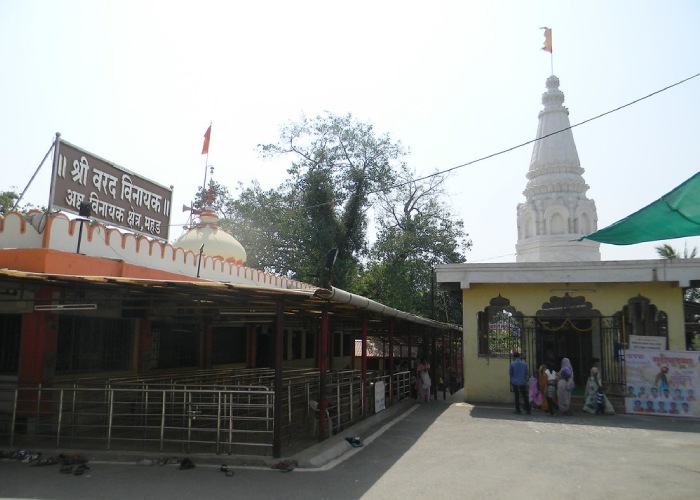
Also known as the Shri Moreshwar Temple, the Shri Mayureshwar Mandir, situated in the tranquil village of Morgaon, approximately 65 km from the Pune district, marks the starting and ending point of the Ashtavinayak circuit.

Morgaon is the foremost centre of worship of the Ganapatya sect, which considers Ganesha as the Supreme Being. A Hindu legend relates the temple to the killing of the demon Sindhura by Ganesha. The exact date of the temple’s construction is unknown, although the Ganapatya saint Moraya Gosavi is known to have been associated with it. The temple flourished due to the patronage of the Peshwa rulers and descendants of Moraya Gosavi.

The village of Morgaon derives its name from the Marathi word for peacock, ‘mor,’ a nod to the region’s once-abundant population of these majestic birds. The temple itself is situated on the banks of the sacred Karha River, and the village is said to be laid out in the shape of a peacock, deepening the connection between the land and its presiding deity, Lord Ganesha in his Mayureshwar, or peacock-riding, form.

The origins of Shri Mayureshwar Mandir trace back to the Bahmani period, with construction believed to have occurred between the 14th and 17th centuries. The temple’s architecture is distinctive, featuring a high stone boundary wall and four minarets at each corner, giving it the appearance of a mosque from a distance, a strategic design choice to protect it during times of political upheaval. The temple flourished under the patronage of the Peshwa rulers, who considered Ganesha their family deity, and the spiritual influence of the Ganapatya saint Moraya Gosavi, who is closely associated with the temple’s history and legacy.

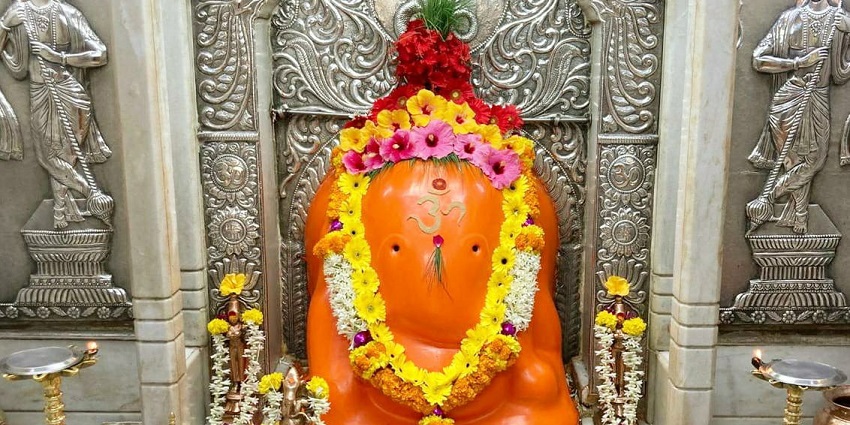
The Shri Moreshwar Temple is a striking blend of Hindu and Islamic architectural influences. There are our entrance gates, with each gate facing a cardinal direction and adorned with an image of Ganesha, representing his manifestations in the four Yugas or ages. The four minarets and 50-foot-tall stone walls were built to safeguard the temple from invaders. Unusually, a large statue of Nandi, Shiva’s sacred bull, stands before the temple entrance, a rare sight in Ganesha temples, explained by a local legend that the Nandi statue was left there after the vehicle transporting it broke down. The sabha-mandapa or assembly hall houses 23 different idols of Ganesha, each depicting a unique form, including the eight avatars described in the Mudgala Purana. The courtyard contains two sacred trees, Shami and Bilva, associated with penance and spiritual significance. Two lamp towers or Deepmalas and a six-foot-tall mouse, Ganesha’s vahana or mount, are prominent features in the courtyard. The sanctum sanctorum, the garbhagriha, enshrines the swayambhu or self-manifested idol Lord of Ganesha as Mayureshwar, depicted with four arms, three eyes, and a trunk turned to the left, seated on a peacock and flanked by his consorts, Siddhi and Buddhi.

The most celebrated legend associated with the temple is the tale of Ganesha’s incarnation as Mayureshwar to vanquish the demon Sindhu. According to the Ganesha Purana, Sindhu was born to Chakrapani and Ugra, and by the grace of the Sun-god, was granted a bowl of amrita, the elixir of immortality. To safeguard it, Sindhu swallowed the bowl, becoming invincible and unleashing terror across the three worlds. The gods, unable to withstand his tyranny, prayed to Ganesha, who incarnated as Mayureshwar, a six-armed, white-complexioned deity riding a peacock. In a fierce battle, Ganesha defeated Sindhu’s army, slew his general Kamalasura, and ultimately cut open Sindhu’s body to empty the amrita bowl, thus killing the demon and restoring cosmic order. After this victory, Ganesha gifted his peacock mount to his brother Kartikeya, cementing his epithet as Mayureshwar or Moreshwar, aka the “Lord of the Peacock.”

Another legend recounts how the creator-god Brahma, preserver-god Vishnu, dissolver-god Shiva, the Divine Mother Devi, and the Sun-god Surya meditated at Morgaon to understand their creator and purpose. Ganesha manifested before them as an Omkara flame, revealing his supremacy and blessing them with divine knowledge.

A further myth tells of Brahma’s penance to cleanse himself of the sin of desiring his daughter, Sarasvati. The sacred Turiya Tirtha river appeared, and Brahma carried its water in his pot to worship Ganesha at Morgaon. When he stumbled and spilt the water, it became the Karha River, which continues to flow by the temple today.

The Ganapatya saint Moraya Gosavi is deeply connected to the temple’s lore. He was a devout worshipper who travelled monthly from Chinchwad to Morgaon on foot to offer prayers. On one occasion, arriving after the temple had closed, the locks miraculously fell away, allowing him to worship Ganesha. His devotion inspired the construction of the Mangalmurti temple at Chinchwad and elevated the status of the Moreshwar temple as a premier centre of Ganapatya worship.

The temple’s daily worship schedule is meticulously observed, offering devotees multiple opportunities to participate in sacred rituals. The ritual bathing and purification of the deity, the Prakshal Puja, is conducted between 5 and 6 am, while the Shodashopachar Puja, the traditional sixteen-step ceremonial worship, happens between 7 am and 12 noon. The five-step worship, the Panchopachar Puja, takes place at 8 pm, while the Samudaik Evening Aarti, which is a communal ritual of lighting the lamp,p happens at 7:30 p,m and the nighttime aarti, the Shej Aarti, is done at 10 pm before the temple’s doors are shut for the day.

Devotees traditionally first worship Nagna Bhairava, then Mayureshwar, and finally Sakshi Vinayaka, who is believed to be the witness to prayers offered at the temple. The people of Morgaon collectively offer food or a thali lunch to visitors during Magh Shuddh Panchami, reflecting the temple’s role as a hub of community and hospitality.

The temple becomes the focal point of grand celebrations during Ganesh Chaturthi, the Bhadrapada Shukla Chaturthi, and Ganesh Jayanti or Magha Shukla Chaturthi. Devotees flock to Morgaon, and a procession arrives from the Mangalmurti temple in Chinchwad, carrying the palkhi or palanquin of Ganesha. Festivities continue for more than a month, culminating on Ashvin Shukla Dashami, with fairs, processions, and communal feasting. The temple also hosts celebrations on Vijayadashami, Shukla Chaturthi, Krishna Chaturthi, and Somavati Amavasya, the new moon coinciding with a Monday.

The main idol is believed to be swayambhu or self-manifested and is said to have been consecrated twice by Brahma, once before and once after being destroyed by the demon Sindhu. Each of the four gates represents a cardinal direction and a life goal: Dharma or righteousness, Artha or wealth, Kama or desire, and Moksha or liberation. The idol is covered with layers of saffron-colored vermillion, which naturally peels off every century, revealing the original image, a phenomenon regarded as miraculous by devotees. The sabha-mandapa houses 23 different forms of Ganesha, including the eight avatars from the Mudgala Purana, making it a living gallery of Ganesha iconography. The presence of the Shami and Bilva trees in the courtyard is tied to legends of penance and spiritual awakening. The juxtaposition of Nandi and the mouse at the temple entrance is unique, blending Shaiva and Ganapatya symbolism.

The Ashtavinayak Yatra, a pilgrimage to eight Ganesha temples around Pune, is considered incomplete unless the devotee both begins and ends the journey at Shri Mayureshwar Mandir. This cyclical pilgrimage reflects the Hindu understanding of spiritual journeys as both linear and circular, with every ending marking a new beginning.

Shri Mayureshwar Mandir in Morgaon is more than a temple; it is a living testament to the enduring power of faith, myth, and community. Its legends, rituals, and architecture encapsulate the essence of Maharashtra’s spiritual heritage, inviting devotees and seekers to embark on a journey that is as much about inner transformation as it is about external pilgrimage.

Abbott FreeStyle Libre Review

“Awareness is the first step toward balance.”

When you live with diabetes, you quickly learn that no two days are ever quite the same. Some mornings feel steady; others are unpredictable. For years, I managed this dance with the help of finger-prick tests: tiny, fleeting snapshots of my glucose that left me guessing about everything in between.

I had heard about the Freestyle Libre and to be honest, I resisted it for a while because while I hated the needle pricks, I also didn’t want a needle poked into my skin for two weeks. But during my trip to Europe, I decided that I will take the plunge and decided to give the sensor a try to see if it made any difference to my glucose levels and if it changed the way I understand my body.

The Freestyle Libre is a continuous glucose monitor (CGM) developed by Abbott. About the size of a two-dollar coin, it’s worn on the back of your upper arm and stays in place for up to 14 days. Instead of pricking your fingers multiple times a day, you simply scan the sensor using the LibreLink app on your phone (or a reader device). Each scan instantly shows your glucose reading, a trend arrow, and a graph of your recent levels. Behind the scenes, the sensor quietly measures glucose in the interstitial fluid, the fluid between your cells, capturing readings every few minutes, day and night. When you upload your data to LibreView, the accompanying analysis platform, you see beautifully detailed charts of your glucose patterns: your highs, lows, daily rhythms, and how often you stay within your target range. It’s like turning your health data into a living, breathing story.

Before the Libre, my glucose management felt like reading a book with half its pages missing. I knew how things started and ended, but not what happened in between. With the sensor, I could finally see the full narrative of how my body responded to meals, exercise, stress, and sleep. I started noticing gentle morning rises, calm mid-afternoons, and occasional evening peaks. These weren’t “bad numbers”, they were clues.

For those in Singapore, Abbott has an Experience Centre where you can try the sensor for SGD 10. I signed up and went down to their Experience Centre at Raffles Place. I was the only one that session, so I got a one-on-one session with the lady doing the session. She gave me a sensor, showed me how to put it on and also ran a few videos on the sensor. You can also purchase sensors there at a discount and they had a scheme that if you purchase 3 sensors within three months, you get a free sensor. It’s an excellent way to see how the device feels, how the app works, and what kind of data you’ll receive before committing to regular use.For anyone who’s ever felt unsure about CGMs, it’s a low-cost, no-pressure way to experience the technology firsthand, and to understand how empowering it can be.

I had already decided to go the subscription route, so didn’t buy from the experience centre. I subscribe to two sensors every four weeks and according to their website, if you pay for five months, the sixth month is frew. You can also opt to receive two sensors every eight weeks. The plan allows you to pause or cancel if your needs change, giving flexibility alongside the convenience.

On to my experience with the sensor. I began experimenting: adding a handful of nuts to breakfast, taking short walks after dinner, and noticing how hydration and rest made a difference. The feedback was almost immediate. A smoother curve on the graph often mirrored a calmer, steadier day.

One of the most powerful things about using a CGM is how it connects daily choices to visible outcomes. For instance, I learned that foods I assumed were harmless sometimes caused unexpected spikes, or that meals rich in fibre and protein kept my glucose beautifully stable, and stress and lack of sleep could nudge levels up even on perfect food days. Instead of guessing, I was finally learning. The Libre didn’t judge; it simply showed patterns, and with each pattern came understanding.

Every so often, I noticed dips, usually in the early mornings or after long gaps between meals. They weren’t severe, but they were informative. The data reminded me to plan better, to carry small snacks when I’m on the go, and to listen to my body’s subtle cues before they became loud alarms. Over time, I became attuned to these rhythms. The more I observed, the more intuitive the whole process felt, like tuning in to my body’s quiet language. There’s something deeply empowering about turning invisible fluctuations into visible information. Instead of worrying about what might be happening, I could see it, and respond thoughtfully. The emotional shift was subtle but profound: I stopped thinking in terms of “good” or “bad” readings. I began thinking in terms of patterns, habits, and adjustments. That shift, from judgment to curiosity, is what changed everything. I wasn’t trying to control my body; I was learning to work with it.

From a practical perspective, the Freestyle Libre fits seamlessly into daily life. Application is quick and nearly painless, a gentle click on the back of the arm, and it’s done. The sensor stays on through showers, workouts, and sleep; after a while, you barely notice it. To scan, just hold your phone near the sensor for a second. No lancets, no fuss. The LibreLink and LibreView apps are beautifully designed. The graphs are clear, colourful, and easy to understand even for someone who isn’t data-minded.

But the sensor sometimes falls out, sometimes even as early as less than a week of usage. But Abbott Singapore has been very good about replacing faulty sensors. You just have to call them or let them know through their website, and they will send you a replacement sensor. The only caveat is that you have to send them the faulty sensor. This is not only for them to check the sensor but also to avoid people misusing this facility and scamming them.

I didn’t expect this little patch to become a mindfulness tool, but it did. Each curve on the graph became a reminder to slow down, breathe, and be kinder to myself. Instead of frustration, I found fascination. Watching my glucose stabilise after a calm morning walk or a wholesome meal gave me a quiet sense of accomplishment.

After more than three months of using the Freestyle Libre, I can confidently say this: it’s more than a monitor; it’s a mirror, one that reflects the connection between how you live and how your body responds. It doesn’t replace intuition; it deepens it. And it turns the daily task of managing diabetes into something gentler, more insightful, and even, in its own quiet way, beautiful. The Freestyle Libre gave me not just numbers but understanding. And with understanding comes peace.

Will I continue using it in the long term? Probably yes. As of now, I can afford the price of about SGD 200 per month, but if that price point becomes expensive, I may consider using two sensors over eight weeks.

If you’re considering using it, you’ll learn more about your body in a few weeks than in years of occasional testing. It’s discreet, painless, and surprisingly easy to use. The data may surprise you, but it will empower you.