Travel Bucket List: Malaysia Part 33 – Penang Part 2

George Town
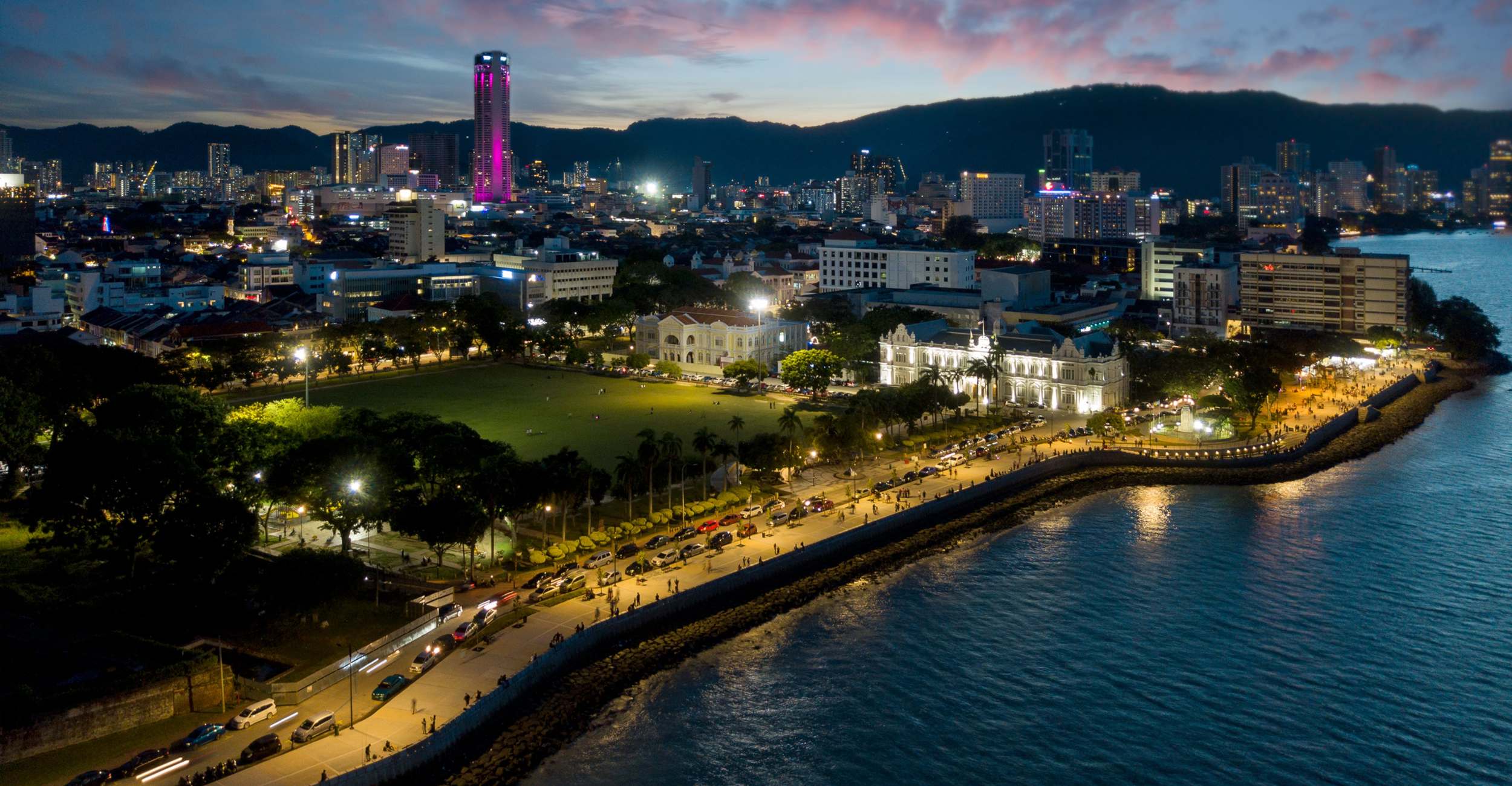
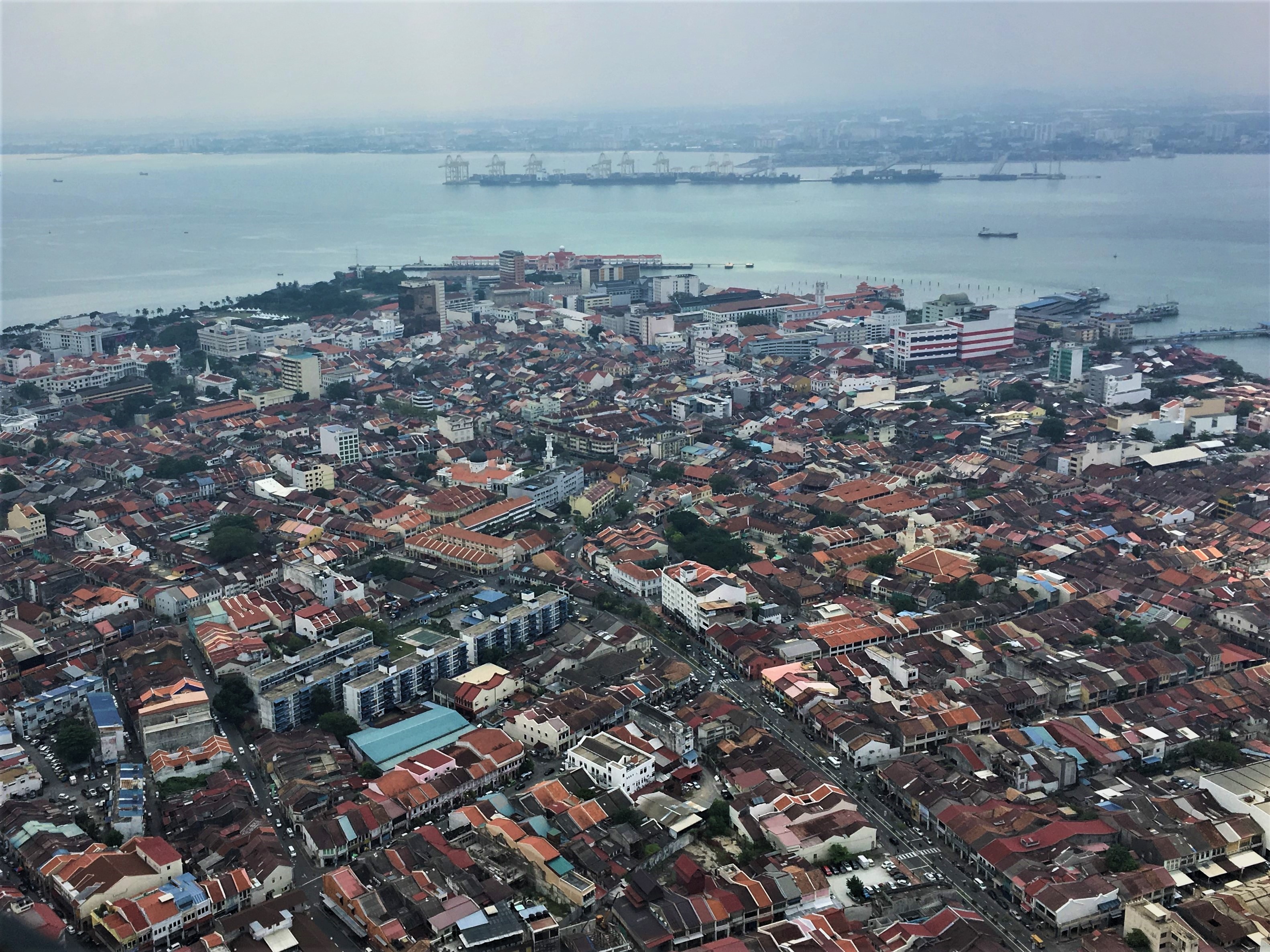
Penang’s capital, George Town is the core city of the George Town Conurbation, Malaysia’s second-largest metropolitan area with a population of 2.84 million. The city proper covers an area of 306 sq. km and was home to a population of 794,313 as of 2020.

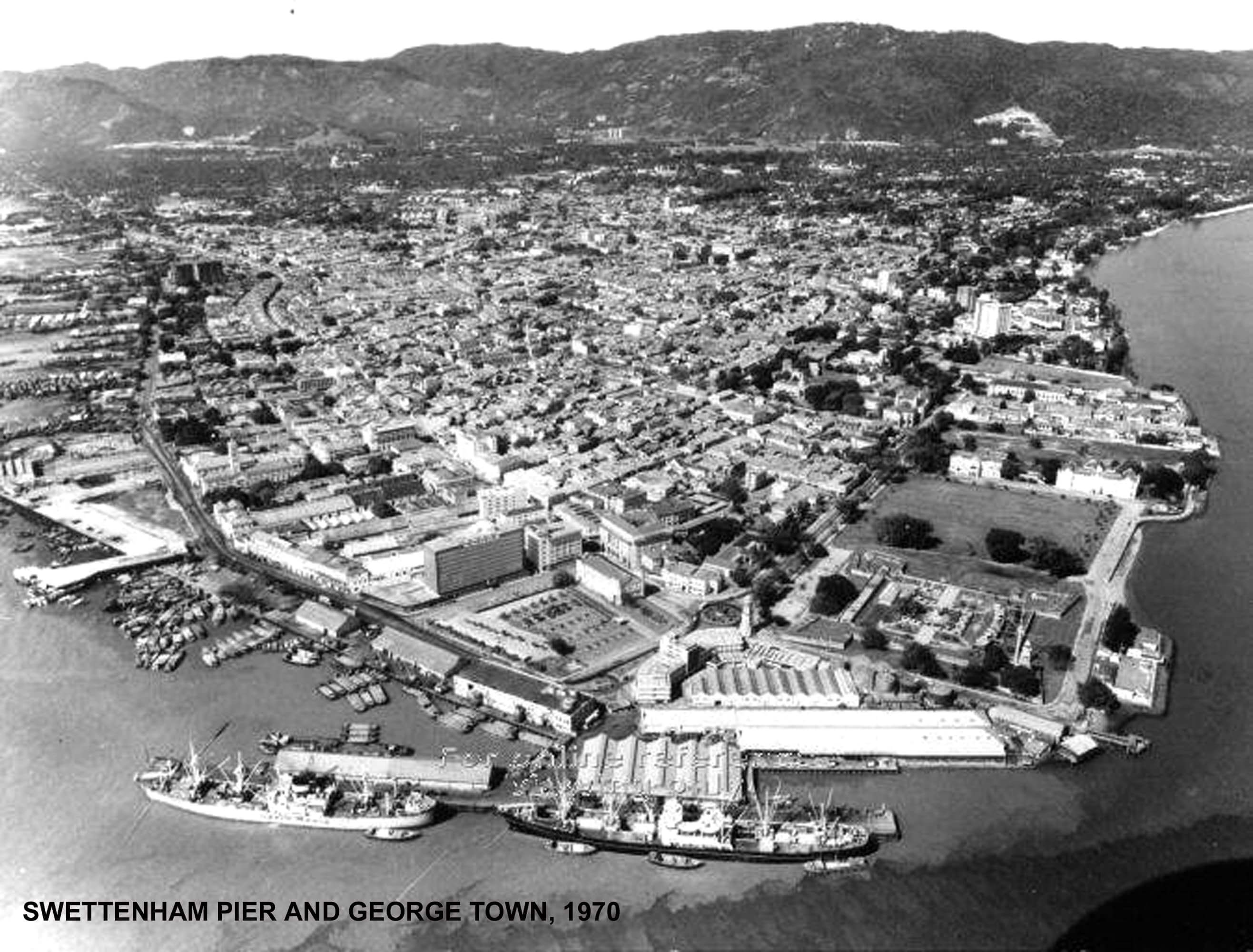
Initially established as an entrepôt by Francis Light in 1786, George Town now serves as the economic hub for northern Malaysia and contributes nearly 8% of the country’s disposable income, second only to Kuala Lumpur. George Town remains the financial centre of northern Malaysia, while the Bayan Lepas Free Industrial Zone, a high-tech manufacturing hub in the city’s south, has become the nucleus of Malaysia’s electronics industry. It is also the primary medical tourism hub in the country. In recent years, Swettenham Pier has emerged as the busiest port of call in Malaysia for cruise shipping.

George Town was the first British settlement in Southeast Asia and its proximity to maritime routes along the Strait of Malacca attracted an influx of immigrants from various parts of Asia in the early 19th century. Following rapid growth in its early years, it became the capital of the Straits Settlements in 1826, only to lose its administrative status to Singapore in 1832. The Straits Settlements became a British crown colony in 1867. George Town was subjugated by the Empire of Japan in December 1941, before being retaken by the British at the end of World War II. Shortly before Malaya attained independence from Britain in 1957, George Town was declared a city by Queen Elizabeth II, making it the first city in the country’s modern history. In 1974, the Malaysian federal government revoked George Town’s city status, a position that would not be altered until 2015, when its jurisdiction was reinstated and expanded to cover the entirety of Penang Island and the surrounding islets.
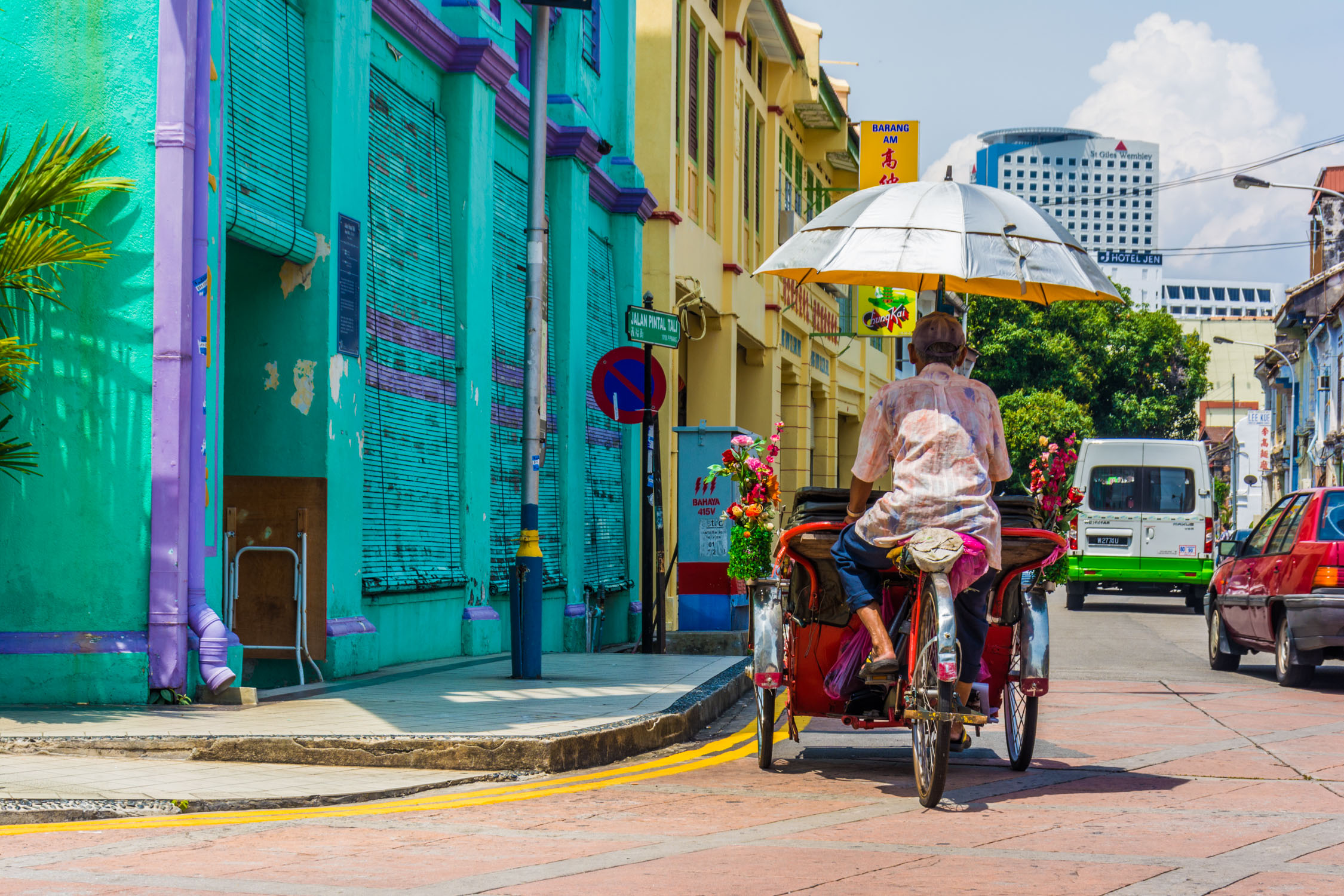
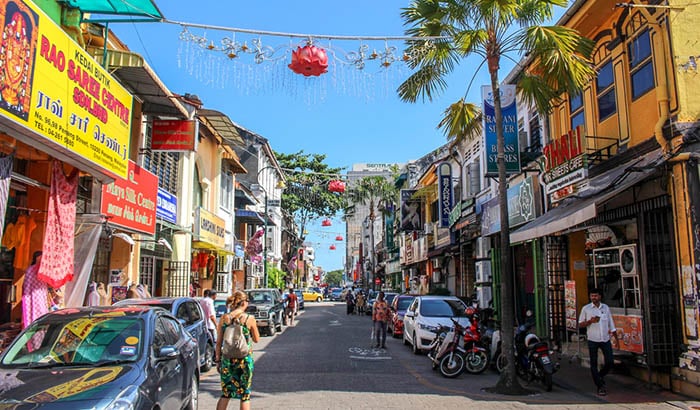
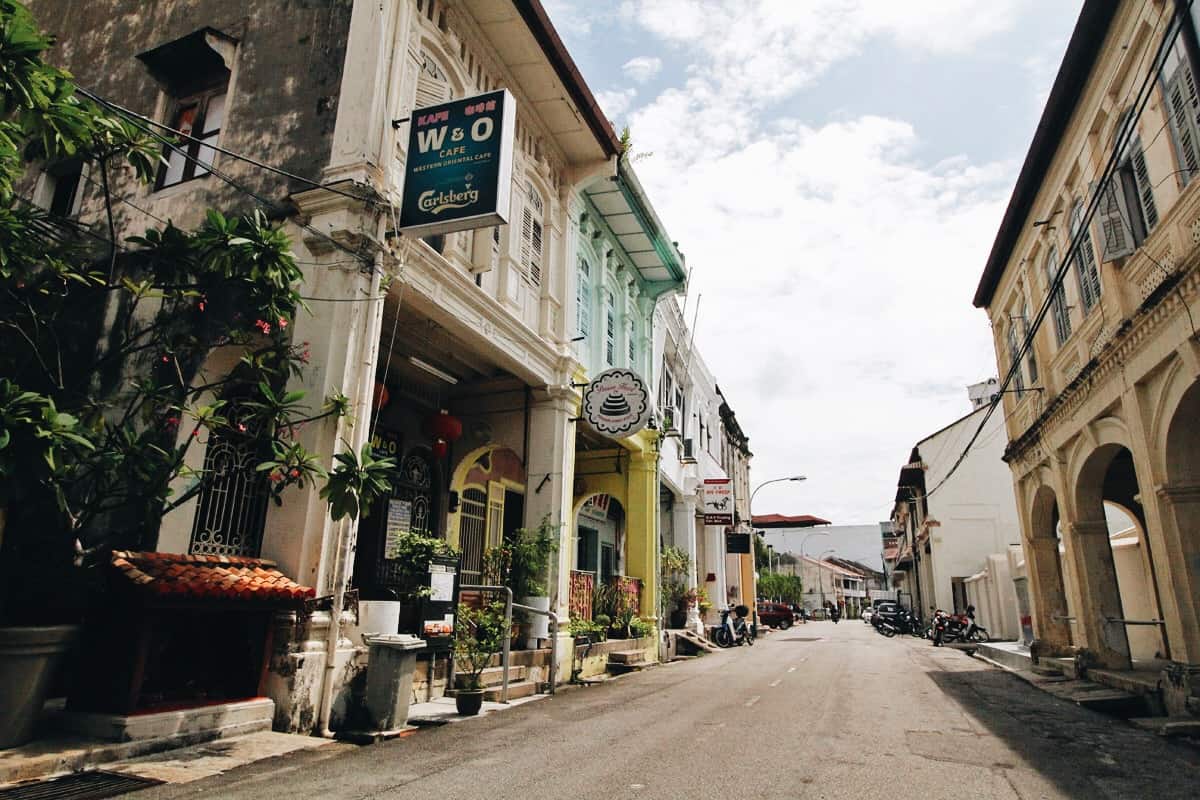
The city is renowned for its unique architectural styles, which have been shaped by centuries of intermingling of various ethnicities and religions. It has also gained a reputation as modern Malaysia’s gastronomical capital for its distinct and ubiquitous street cuisine. The preservation of these cultures contributed to the city centre’s designation as a UNESCO World Heritage Site in 2008.

George Town was named in honour of King George III, the ruler of Great Britain and Ireland between 1760 and 1820. Before the arrival of the British, the area had been known as Tanjung Penaga, due to the abundance of penaga laut or Calophyllum inophyllum trees found at the cape or tanjung of the city. It is often mistakenly spelt as Georgetown, which was never the city’s official name. This misspelling may be due to confusion with other places worldwide that share the same name. In common parlance, the city of George Town is also erroneously called Penang, which is the name of the entire state that includes mainland Seberang Perai.

In 1771, Francis Light, a former Royal Navy captain, was instructed by the British East India Company or EIC to establish trade relations in the Malay Peninsula. He arrived in Kedah, a Siamese vassal state facing threats from the Bugis of Selangor. Kedah’s ruler Sultan Muhammad Jiwa Zainal Adilin II offered Light Penang Island in exchange for British military protection. Light noted the strategic potential of the island as a convenient magazine for trade that could enable the British to check Dutch and French territorial ambitions in Southeast Asia, and tried unsuccessfully to persuade his superiors to accept the Sultan’s offer. It was only in 1786 when Light was finally authorised to negotiate the British acquisition of Penang Island. After the cession was finalised with Sultan Abdullah Mukarram Shah of Kedah, Light and his entourage landed on the island on 17 July that year. They took formal possession of the island in the name of King George III of England on 11 August and Penang Island was renamed Prince of Wales Island after the heir to the British throne and the new settlement of George Town – the first of British colonial possessions in Southeast Asia – was established in honour of King George III.

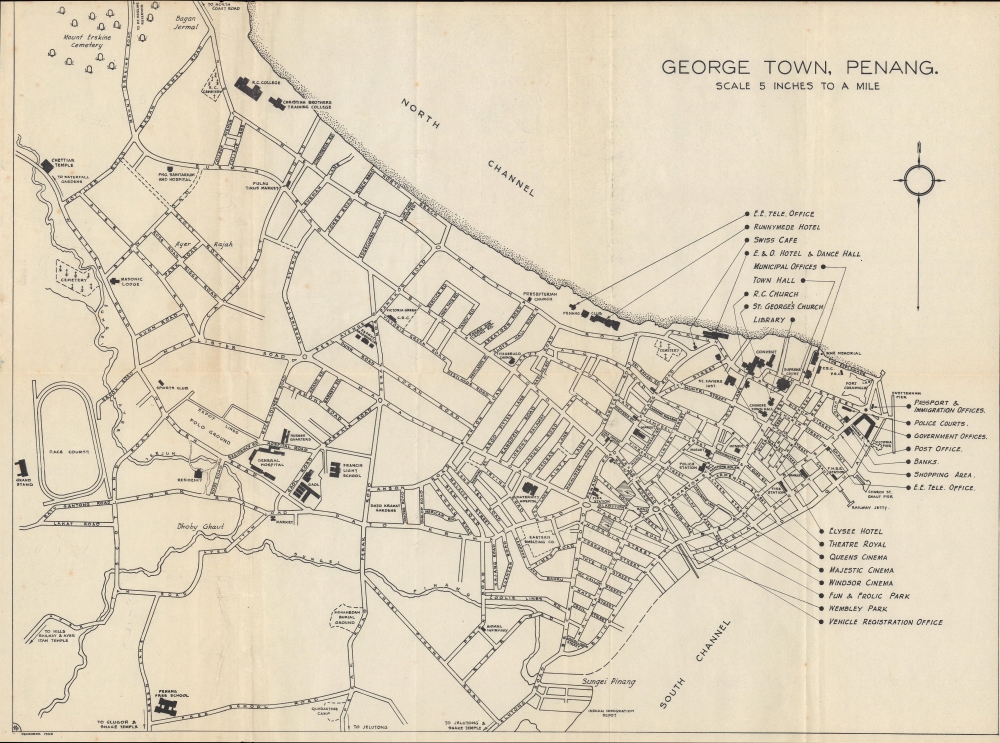
When Light first landed on the cape, it was densely covered in jungle. After the area was cleared, Light instructed the construction of Fort Cornwallis, the first structure in the newly established settlement. Having cleared the jungles at the cape, Light set out to build the first streets of George Town—Light, Beach, Chulia and Pitt streets—that were arranged in a grid-like pattern. As he intended, the new settlement grew rapidly as a free port and a centre of spice production, taking maritime trade from Dutch posts in the region. The spice trade allowed the EIC to cover the administrative costs of Penang. The threat of French invasion amid the Napoleonic Wars forced the British to enlarge and reinforce Fort Cornwallis as the garrison for the settlement.

George Town’s development as the prime British entrepôt along the Malacca Straits led to the establishment of a local government and a Supreme Court in the settlement by 1808, marking the birth of Malaysia’s modern judiciary. In 1826, George Town was made the capital of the Straits Settlements, which was also composed of Singapore and Malacca. However, the capital was then shifted to Singapore in 1832, as the latter had outperformed George Town as the region’s preeminent harbour.

Despite playing second fiddle to Singapore, George Town continued to play a crucial role as a British entrepôt. Following the opening of the Suez Canal and a tin mining boom in the Malay Peninsula, the Port of Penang became a leading exporter of tin. By the end of the 19th century, George Town had become the foremost financial centre of British Malaya, attracting international banks to its shores. Throughout the century, George Town’s population grew rapidly in tandem with the settlement’s economic prosperity. An influx of immigrants from all over Asia quadrupled its population within a mere four decades. A cosmopolitan population emerged, comprising Chinese, Malay, Indian, Peranakan, Eurasian, Thai and other ethnicities. The population growth also created social problems, such as inadequate health facilities and rampant crime, with the latter culminating in the Penang Riots of 1867.
George Town came under direct British rule when the Straits Settlements became a British crown colony in 1867. Law enforcement was beefed up and the secret societies that had previously plagued George Town were gradually outlawed. More investments were also made in the settlement’s health care and public transportation. With improved access to education, a greater level of participation in municipal affairs by its Asian residents and substantial press freedom, George Town was perceived as being more intellectually receptive than Singapore. The settlement became a magnet for English authors, Asian intellectuals and revolutionaries, including Rudyard Kipling, Somerset Maugham and Sun Yat-sen. However, political turmoil in Qing China and the influx of Chinese migrants into the settlement continued to pose security concerns among the British authorities. Sun, in particular, chose George Town as the headquarters for revolutionary activities by the Tongmenghui in Southeast Asia that eventually launched the Wuchang Uprising, a precursor to the Xinhai Revolution that ushered in the beginning of Republican China.

George Town emerged from World War I relatively unscathed, except for the Battle of Penang where the Imperial German Navy cruiser SMS Emden sank two Allied warships off the settlement. This was the only naval battle that took place in Malayan territory during the war. World War II, on the other hand, caused unprecedented social and political turmoil in George Town. In mid-December 1941, the settlement was subjected to severe Japanese aerial bombardment, forcing inhabitants to flee George Town and take refuge in the jungles. While Penang Island had been designated a fortress before the outbreak of fighting, the British high command led by Lieutenant-General Arthur Percival decided to abandon the island and secretly evacuate George Town’s European population, leaving the settlement’s Asian residents at the mercy of the impending Japanese onslaught. Historians have since contended that the moral collapse of British rule in Southeast Asia came not at Singapore, but at Penang.

The Imperial Japanese Army or IJA seized George Town on 19 December without encountering any resistance. During the Japanese occupation, George Town was only lightly garrisoned by the IJA, while the Imperial Japanese Navy converted Swettenham Pier into a major submarine base for the Axis powers. Japanese military police notoriously imposed orders to massacre Chinese civilians under the Sook Ching policy; the victims were buried in mass graves all over the island, such as at Rifle Range, Bukit Dumbar and Batu Ferringhi. Poverty and wanton Japanese brutality towards the local population also forced women into sexual slavery.

Between 1944 and 1945, Allied bombers based in India targeted naval and administrative buildings in George Town, damaging and destroying several colonial buildings in the process. The Penang Strait was mined to constrict Japanese shipping. Following Japan’s surrender, on 3 September 1945, British Royal Marines launched Operation Jurist to retake George Town, making it the first settlement in Malaya to be liberated from the Japanese.
After a period of military administration, the British dissolved the Straits Settlements in 1946 and merged the Crown Colony of Penang into the Malayan Union, which was then replaced with the Federation of Malaya in 1948. At first, the impending annexation of the British colony of Penang into the vast Malay heartland proved unpopular among Penangites. Partly due to concerns that George Town’s free port status would be at risk in the event of Penang’s absorption into Malaya’s customs union, the Penang Secessionist Committee was founded in 1948 and attempted to avert Penang’s merger with Malaya. The secessionist movement was ultimately met with British disapproval. To assuage the concerns raised by the secessionists, the British government guaranteed George Town’s free port status and promised greater decentralisation. Meanwhile, municipal elections were reintroduced in 1951, further diminishing the secessionists’ commitment to their cause. Nine councillors were to be elected from George Town’s three electoral wards, while the British High Commissioner held the power to appoint six more. By 1956, George Town became Malaya’s first fully-elected municipality and in the following year, it was granted city status by Queen Elizabeth II. This made George Town the first city within the Malayan Federation, and by extension, Malaysia.

During the early years of Malaya’s independence, George Town retained its free port status, which had been guaranteed by the British. The George Town City Council enjoyed full financial autonomy and by 1965, it was the wealthiest local government in Malaysia, with an annual revenue almost double that of the Penang state government. This financial strength allowed the Labour-led city government to implement progressive policies, and to take control of George Town’s infrastructure and public transportation. These included the maintenance of its public bus service, as well as the construction of public housing schemes and the Ayer Itam Dam. However, longstanding political differences between the George Town City Council and the Alliance-controlled state government led to allegations of maladministration against the city government. In response, Chief Minister Wong Pow Nee took over the powers of the George Town City Council in 1966. Local government elections nationwide were also suspended in the aftermath of the Indonesia–Malaysia confrontation, never to be reinstated.

The period of relative prosperity vis-à-vis the rest of Malaysia came to an end in 1969 when the Malaysian federal government eventually rescinded George Town’s free port status. This sparked massive unemployment, brain drain and urban decay within the city. The federal government also began channelling resources towards the development of Kuala Lumpur and Port Klang, setting the stage for George Town’s protracted decline. To revive Penang’s fortunes, newly-elected Chief Minister Lim Chong Eu launched the Komtar project in 1974 and spearheaded the establishment of the Bayan Lepas Free Industrial Zone or Bayan Lepas FIZ, which, at the time, was outside the city’s periphery. Although these were successful in transforming Penang into a tertiary-based economy, they also led to the decentralisation of the urban population as residents gravitated towards newer suburban townships closer to the Bayan Lepas FIZ. The destruction of hundreds of shophouses and whole streets for the construction of Komtar further exacerbated the hollowing out of George Town.
In 1974, the George Town City Council and the Penang Island Rural District Council were merged to form the Penang Island Municipal Council, which led to a prolonged debate over George Town’s city status. George Town had benefitted from a real estate boom towards the end of the 20th century, but in 2001, the Rent Control Act was repealed, worsening the depopulation of the city’s historical core and leaving colonial-era buildings in disrepair. The city faced additional challenges like incoherent urban planning, poor traffic management and brain drain, lacking the expertise to regulate urban development and arrest its decline. In response, George Town’s civil societies banded together and galvanised public support for the conservation of historic buildings and to restore the city to its former glory. Widespread resentment over the city’s decline also resulted in the then-opposition Pakatan Rakyat bloc, now Pakatan Harapan, wresting power in Penang from the incumbent Barisan Nasional (BN) administration in the 2008 state election.

Efforts to preserve the city’s heritage paid off when in 2008, a portion of George Town was inscribed as a UNESCO World Heritage Site. The newly-elected state government took a more inclusive approach to heritage conservation and sustainable urban development, while concurrently pursuing economic diversification. The city has since witnessed an economic rejuvenation, boosted by an influx of foreign investors and the private sector. Whilst George Town had been declared a city by Queen Elizabeth II in 1957, the city’s jurisdiction was expanded by the Malaysian federal government to encompass the entirety of Penang Island and the surrounding islets in 2015.

The jurisdiction of George Town covers an area of approximately 306 sq km, encompassing the entirety of Penang Island and nine surrounding islets. Over the centuries, the built-up area of George Town has expanded in three directions – along the island’s northern coast, south down the eastern shoreline and towards Penang Hill to the west. The suburb of Balik Pulau is located on the western plains of the island. The surrounding islets within George Town’s jurisdiction are Jerejak, Andaman, Udini, Tikus, Lovers’, Betong, Betong Kecil, Kendi and Rimau Islands.
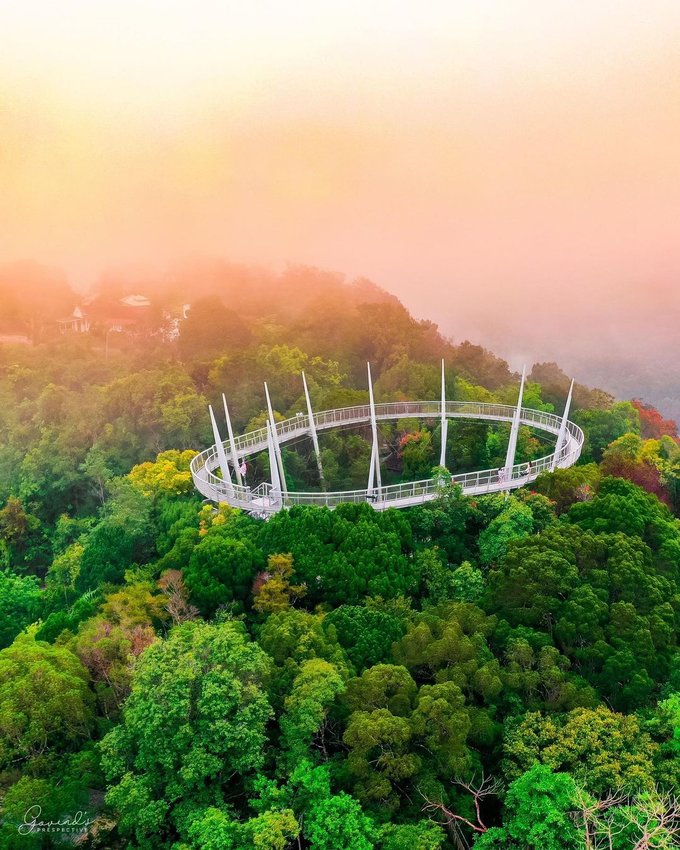
Penang Hill, with a height of 833 m is the highest point in Penang, serving as a water catchment area and a green lung for George Town. In 2021, the 124.81 sq km Penang Hill Biosphere Reserve was inscribed as a UNESCO Biosphere Reserve in recognition of the area’s biodiversity. This zone includes the Penang Botanic Gardens and the 25.62 sq km Penang National Park at the northwestern tip of Penang Island, touted as the smallest national park in the world.

Like most island cities, land scarcity is a pressing issue in George Town. Land reclamation projects have been extensively undertaken to provide valuable land in high-demand areas. As of 2015, George Town expanded by 9.5 sq km due to land reclamation that altered much of the city’s eastern shoreline. In 2023, a massive reclamation project commenced off Batu Maung to build the 9.2 sq km Silicon Island, envisioned as a new hub for high-tech manufacturing and commerce. Following years of reclamation, the coastline at Gurney Drive is being transformed into Gurney Bay, earmarked as a new iconic waterfront destination for Penang. Reclamation works to create the nearby mixed-use precinct of Andaman Island are also ongoing.

The Pinang Peranakan Mansion, also known as the Baba and Nonya House or the Blue House, is a two-storey treasure trove of historical antiques and artefacts, making it one of the most unique museums in Malaysia. The iconic green-hued mansion is dedicated to Penang’s Peranakan heritage. The mansion is unique and carefully preserved, where one can see how the old Chinese houses were decorated as well as the customs and traditions they followed. This 19th-century house displays Peranakan relics, antiques, and collections, with a Scottish-European interior.

The Pinang Peranakan Mansion is heavily influenced by both Chinese and European architecture. Upon entering, one sees the wooden panels and open courtyards, which are famous in the Chinese style, which are intermingled with staircases made of material imported specially from Scotland or Victorian centrepieces and figurines that give it its European touch. One can also visit the temple at the side of the house that honours the life and work of Kapitan Cina Chung Keng Kwee, the former owner of the Penang Peranakan Mansion. The Blue Mansion is open daily from 9:30 am to 5 pm with free guided tours available at 11:30 am and 3:30 pm. Entry is free for children under 12 while adults need to pay RM 20 per person.
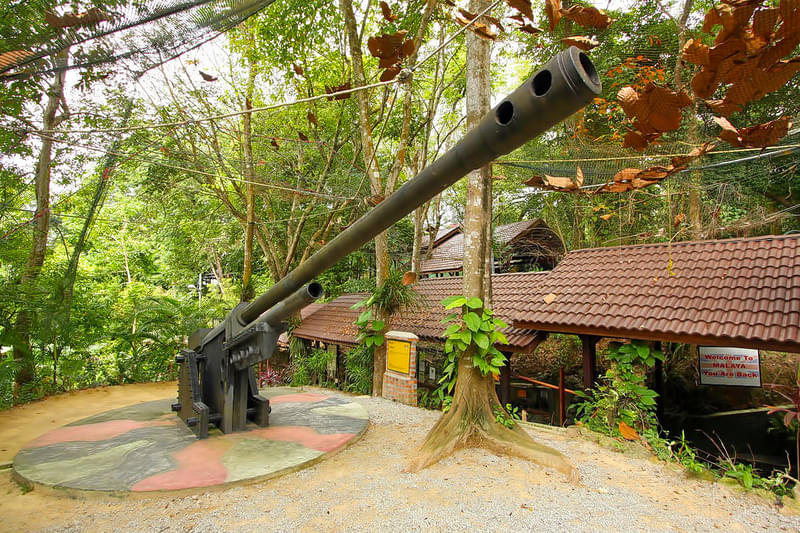
The Penang War Museum is a former British military fortress that once served as the site for the legendary Battle of Penang against the Japanese army. Situated in Bukit Batu Maung on Penang’s southern coast, it now serves as a museum, gaining fame as Southeast Asia’s largest war museum. It is also dubbed one of Asia’s most haunted sites. This is due to its dark history as a torture house and prison. Many people have claimed to have witnessed paranormal sightings and ghostly apparitions. However, there are varying accounts to this claim. This privately run museum has a lot to explore, including underground tunnels and several historical artefacts like cannons. Although in disuse, most of the structures at the war museum are intact for visitors to wander and explore. There are many underground tunnels, ammunition bunkers, cookhouses and underground offices. Interestingly, some of these tunnels are also linked to the sea. Visitors can check out the barracks where the British, Malay and Indian soldiers used to live and, through old photographs, get an idea of the kind of life the prisoners and the soldiers led there. Also, there are many artefacts on display, including an old bicycle and cannons. Lots of information boards and signs have also been put up.

The Penang War Museum has the defunct former British bastion, built in the 1930s as a defence structure against the sea invasion by the Imperial Japanese Army. However, the unexpected happened and instead, the Japanese launched an aerial attack. The British and Commonwealth troops had no choice but to evacuate the fortress. Thus, it came under the Imperial Japanese Army and was then used as an army base and prison. The Japanese used to interrogate, torture and behead the prisoners here which led to many ghostly stories being linked to it. When the war ended in 1945, the fort fell into disuse. The museum is open daily between 9 am and 7 pm while night tours are conducted between 8 and 10 pm. Reservation is required for night tours and should be booked before 6 pm. Entry fees are RM 30 for adults while children aged between 5 and 12 need to pay RM 15. For optional tours including tunnel tour, canon firing bay, observation tower and tunnel view, additional charges apply ranging from RM 5 to RM 15.
Travel Bucket List: Malaysia Part 32 – Penang Part 1

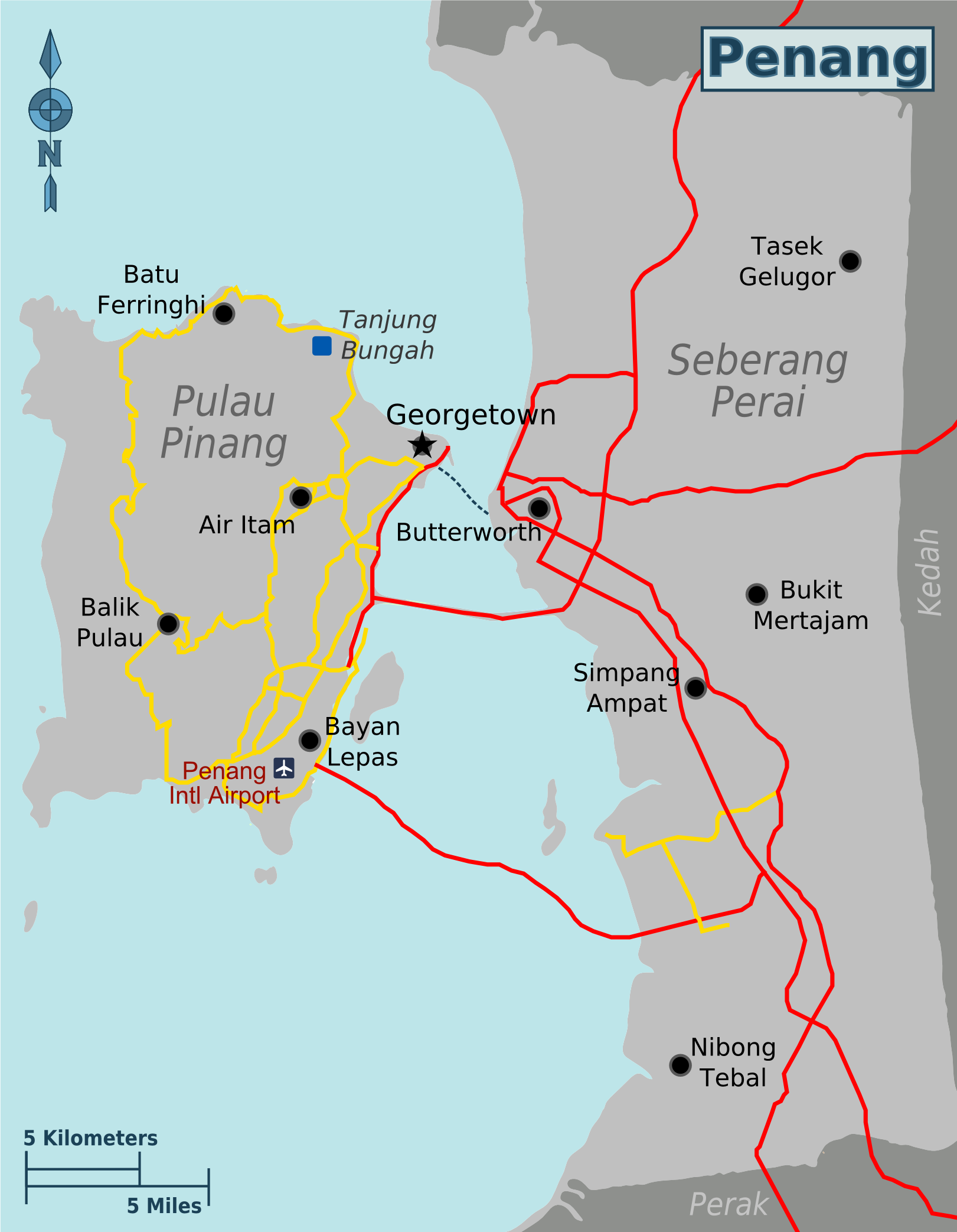
Located on the northwest coast of Peninsular Malaysia, by the Malacca Strait, the state of Penang is divided into two parts: Penang Island, where the capital city, George Town, is located, and Seberang Perai on the Malay Peninsula. These two halves are physically connected by the Penang Bridge and the Second Penang Bridge. The state shares borders with Kedah to the north and east, and Perak to the south. Penang is the second-smallest state in Malaysia by size after Perlis, located on the northwestern coastline of Peninsular Malaysia. The Seberang Peraihinterland across the Malacca Strait on the Malay Peninsula shares land borders with Kedah to the north and east and Perak to the south. Penang Island is surrounded by several islets, both natural and man-made. Some of these islets include Jerejak, Betong, Kendi, Rimau and the Andaman Islands. The capital city of George Town encompasses the entirety of Penang Island and a few surrounding islets. On the other hand, the city of Seberang Perai covers the whole mainland half of Penang.

Penang is one of Malaysia’s most densely populated and urbanised states, with Seberang Perai being Malaysia’s third-largest city by population. The state is culturally diverse, with a population that includes Chinese, Malays, Indians, Eurasians, Siamese and expatriates.

Penang’s economy shifted from entrepot trade to electronics manufacturing and the tertiary sector in the late 20th century. Today, it is one of the country’s most developed economic powerhouses, with the second-highest GDP per capita among Malaysian states and the third-highest Human Development Index after Kuala Lumpur and Selangor. Penang is also Malaysia’s leading exporter, with nearly RM 451 billion in exports in 2022, primarily through the Penang International Airport, the nation’s third busiest airport.

The name Penang comes from the modern Malay name Pulau Pinang, which means areca nut island. The State of Penang is also colloquially referred to as the Pearl of the Orient, the Island of Pearls or Pulau Mutiara.

Established by Francis Light in 1786, Penang became part of the Straits Settlements, a British crown colony also comprising Malacca and Singapore. During World War II, Japan occupied Penang, but the British regained control in 1945. Penang was later merged with the Federation of Malaya, which, upon independence, became Malaysia in 1957.
Over the course of history, Penang Island has been known by different names by seafarers from various regions. The locals named it Pulo Ka Satu, meaning The First Island, as it was the largest island on the maritime route between Lingga and Kedah. The Siamese, who were the overlords of Kedah, called it Ko Mak. Maritime explorers also took note of the island’s abundance of areca nut. During the 15th century, Admiral Zheng He of Ming China referred to the island as Bīngláng Yǔ or areca nut island in his navigational charts. In the description of Malacca, Portuguese cartographer Manuel Godinho de Erédia named it Pulo Pinaom.

Artifacts found in Seberang Perai indicate that Penang was inhabited by nomadic Melanesians around 5,000 to 6,000 years ago during the Neolithic era. The Cherok Tok Kun megalith, uncovered at Bukit Mertajam in 1845, features Pali inscriptions that suggest the Hindu-Buddhist Bujang Valley civilisation, which was based in present-day Kedah, had established its authority over certain parts of Seberang Perai by the 6th century. The entirety of Penang later formed part of Kedah, which came under Siamese suzerainty by the late 18th century.

Penang’s modern history began in 1786, when Francis Light, a representative of the British East India Company (EIC), obtained Penang Island from Sultan Abdullah Mukarram Shah of Kedah in exchange for military aid. Light had been sent to the Malay Peninsula by the EIC to build trade relations in the region, where he saw the strategic potential of Penang Island as a convenient magazine for trade that could enable the British to check Dutch and French territorial ambitions in Southeast Asia. After negotiating an agreement with the Sultan, Light and his entourage landed on Penang Island on 17 July that year and took formal possession of the island in the name of King George III of England on 11 August. The island was renamed Prince of Wales Island after the heir to the British throne and the new settlement of George Town was established in honour of King George III. Unbeknownst to Sultan Abdullah, Light had acted without the authority or the consent of his superiors in India. When Light reneged on his promise of military protection, the Sultan launched an attempt to recapture the Prince of Wales Island in 1791. However, the attempt was defeated by EIC forces and the Sultan sued for peace. An annual payment of 6000 Spanish dollars was agreed in exchange for British sovereignty over the island.

In 1800, Lieutenant-Governor George Leith secured a strip of hinterland across the Penang Strait, which was subsequently named Province Wellesley, and is known as Seberang Perai today. The new treaty for the acquisition of Province Wellesley superseded Light’s earlier agreement and gave the British permanent sovereignty over both Prince of Wales Island and the newly ceded mainland territory. The annual payment to the Sultan of Kedah was increased to 10,000 Spanish dollars. The British authorities and its successor, the Malaysian federal government, maintained the sum of annual payments to Kedah until 2018 when the federal government increased the amount by RM10 million yearly.

George Town grew rapidly as a free port and a centre of spice production, taking maritime trade from Dutch posts in the region. In 1805, Penang became a separate presidency of British India, sharing a similar status with Bombay and Madras. By 1808, a local government for George Town was in place, whilst the establishment of the Supreme Court of Penang marked the birth of Malaysia’s modern judiciary. In 1826, Penang, Singapore and Malacca were incorporated into the Straits Settlements, with George Town as the capital. However, Singapore soon supplanted George Town as Southeast Asia’s premier entrepôt. In 1832, Singapore replaced George Town as the capital of the Straits Settlements.

The Port of Penang still retained its importance as a vital British entrepôt. Towards the end of the 19th century, George Town became a major tin exporter and Malaya’s primary financial centre. Penang’s prosperity attracted a cosmopolitan population and led to the development of until then rural areas such as Butterworth and Bukit Mertajam. The population growth also created social problems, such as inadequate sanitation and health facilities, as well as rampant crime, with the latter culminating in the Penang Riots of 1867. In the same year, the Straits Settlements became a British crown colony, leading to improved law enforcement, and investments in health care and public transportation in Penang under direct British rule. Owing to enhanced access to education, active participation of residents in municipal affairs and substantial press freedom, George Town was perceived as being more intellectually receptive than Singapore. Penang emerged from World War I relatively unscathed, apart from the Battle of Penang that saw the Imperial German Navy cruiser SMS Emden sinking two Allied warships off George Town.

On the other hand, World War II led to unparalleled social and political upheaval. Although Penang Island had been designated as a fortress, Penang fell without struggle to the Imperial Japanese Army on 19 December 1941, after suffering devastating aerial attacks. The British covertly evacuated Penang’s European populace; historians have since contended that “the moral collapse of British rule in Southeast Asia came not at Singapore, but at Penang”.

Penang Island was subsequently renamed Tojo-to after Prime Minister Hideki Tojo. The Japanese occupiers notoriously massacred Chinese residents under the Sook Ching policy and forced women into sexual slavery. The Port of Penang was put to use as a major submarine base by the Axis Powers. Between 1944 and 1945, Allied bombers from India targeted naval and administrative buildings in George Town, damaging and destroying several colonial buildings in the process. The Penang Strait was mined to restrict Japanese shipping. After Japan’s surrender, the British marines launched Operation Jurist on 3 September 1945 to retake Penang Island, making George Town the first settlement in Malaya to be liberated from the Japanese.

Penang was placed under British military administration until 1946, after which the Straits Settlements were abolished. The British sought to consolidate the various political entities in British Malaya under a single polity known as the Malayan Union. Consequently, the Crown Colony of Penang was merged into the Malayan Union and its successor, the Federation of Malaya. Initially, the impending annexation of Penang into the vast Malay heartland proved unpopular among Penangites. The Penang Secessionist Committee was formed in 1948 due to economic and ethnic concerns, but their attempt to avert Penang’s merger with Malaya was unsuccessful due to British disapproval.

To allay concerns, the British government guaranteed George Town’s free port status and reintroduced municipal elections in 1951. George Town became the first fully-elected municipality in Malaya by 1956 and was granted city status by Queen Elizabeth II in the following year. This made George Town the first city within the Federation of Malaya, and by extension, Malaysia. George Town’s free port status was rescinded by the Malaysian federal government in 1969, leading to a loss of maritime trade, and causing massive unemployment and brain drain.

To revive the economy, the Bayan Lepas Free Industrial Zone was created. Regarded by many as the Silicon Valley of the East, the zone proved instrumental in reversing Penang’s economic slump and led to the state’s rapid economic growth until the late 1990s. During this time, the Penang Bridge, the first road link between Penang Island and the Malay Peninsula, was also built. Persistent brain drain, exacerbated by federal policies that favoured the development of Kuala Lumpur, meant that Penang was no longer at the forefront of the country’s economy by the 2000s. This, coupled with the deteriorating state of affairs in general led to simmering discontent within Penang’s society. In response, George Town’s non-governmental organisations and the national press galvanised public support and formed partnerships to restore the city to its former glory. The widespread resentment also resulted in the then-opposition Pakatan Rakyat bloc (now Pakatan Harapan) wresting power from the incumbent Barisan Nasional (BN) administration in the 2008 state election. Meanwhile, efforts to conserve George Town’s heritage architecture paid off when in 2008, the city’s historical core was inscribed as a UNESCO World Heritage Site.

The 2004 Indian Ocean tsunami hit the western and northern coasts of Penang Island, claiming 52 lives, out of 68 in Malaysia.

Penang Island is irregularly shaped, with a hilly and mostly forested interior. The island’s coastal plains are narrow, with the most extensive plain located at the northeastern cape. George Town, which started as a small settlement at the northeastern tip of the island, has expanded over the centuries to encompass the entire island, although the marshy western coast remains relatively underdeveloped. The highest point within Penang is Penang Hill, which stands at a height of 833 m at the centre of the island. Seberang Perai, on the other hand, has a mostly flat topography, save for a few hills such as at Bukit Mertajam. Due to land scarcity, land reclamation projects have been undertaken in high-demand areas. In 2023, a massive reclamation project commenced off George Town’s southern coast to build the 920 ha Silicon Island, envisioned as a new hub for high-tech manufacturing and commerce. Following years of reclamation works, the shoreline off Gurney Drive is also being transformed into Gurney Bay, intended as a new iconic waterfront destination for Penang.

Travel Bucket List: Malaysia Part 30 – Terengganu Part 2

Colloquially known as KT, Kuala Terengganu is the administrative, economic, and royal capital of the state. It is also the only royal capital among the nine royal states of the country to bear its state’s name. Kuala Terengganu is located about 440 km northeast of Kuala Lumpur on the East Coast of Peninsular Malaysia. The city is situated at the estuary of the Terengganu River, facing the South China Sea. Kuala Terengganu was awarded city status as well as the title Bandaraya Warisan Pesisir Air or Waterfront Heritage City on 1 January 2008.

Kuala Terengganu continued to be Terengganu’s capital when it was still a vassal state of Siam and during the early years of the British colonisation of Malaya. Terengganu fell under the administration of Britain through the Bangkok Treaty of 1909 and was forced to accept a resident British advisor. Terengganu, along with four other states were grouped under the term of Unfederated Malay States. The British maintained its rule on Terengganu until the Japanese occupation in World War II. On 18 October 1943, Terengganu was annexed by Thailand as part of an agreement with the Japanese and after the war, the British regained control of Terengganu.

Kuala Terengganu was a major fishing port and one of the important trading ports in Malaya. The chief export commodities were coffee, gambier, gold, ivory, pepper, and tin. They were mainly traded for rice, tobacco, cotton goods and opium.

Kuala Terengganu’s economy is mostly made up of small-scale manufacturing industries such as traditional textile making, local food industries, arts and craft factories, and agriculture, with most of them centred around residential areas or villages. As the principal gateway for tourists to the state, tourism remains one of the economic sources for Kuala Terengganu.

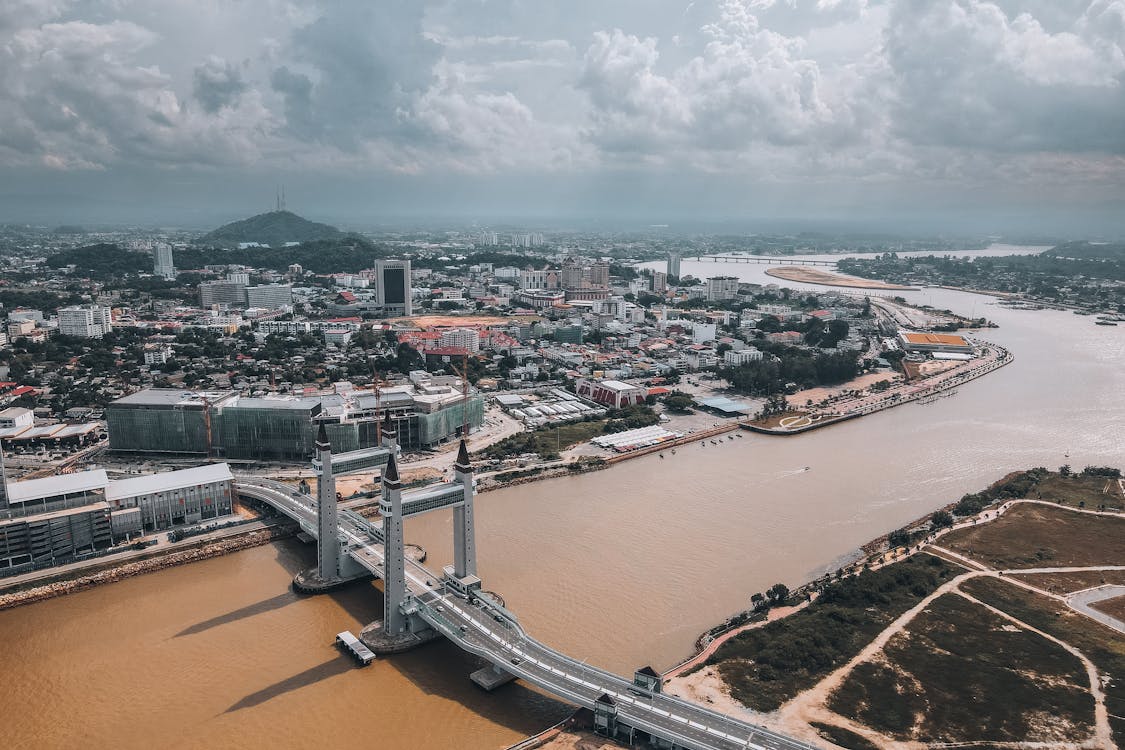
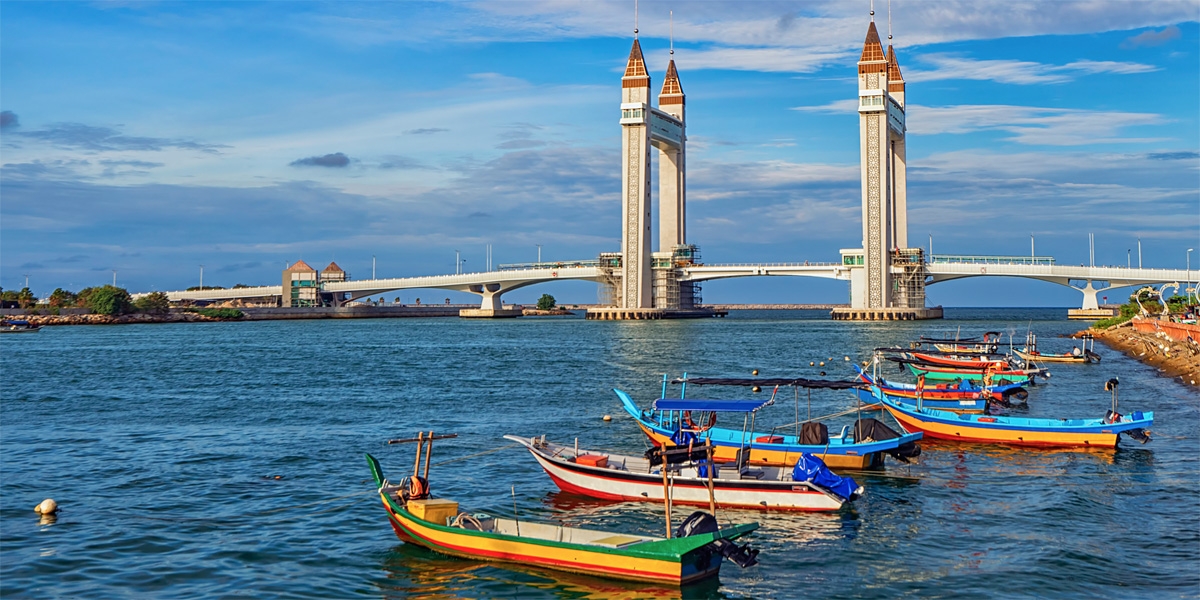
The Terengganu River is a beautiful river that originates from Lake Kenyir in Hulu Terengganu and flows through Kuala Terengganu, leading up to the South China Sea. This beautiful river has several bridges namely the Sultan Mahmud Bridge, the Manir Bridge, the Pulau Sekati Bridge, and the Kuala Terengganu Drawbridge. Several cruises also operate at the site which provides an enjoyable experience to visitors. A boat ride in this beautiful river will enable one to witness traditional fishing boats, traditional silt houses, as well as wonderful wildlife creatures.

A small hill known as Bukit Puteri can be found close to Pasar Payang. The hill is located near the banks of the Terengganu River and because of its strategic location, it was used as a fortification by the sultans of the state. Old artefacts, a graveyard, and monuments can be found on top of the hill. During the Islamic holy month of Ramadan, a century-old brass bell known as genta will be rung to signify that it is time for iftar or the end of the fasting on that day.

Pulau Duyong is a river island located at the Terengganu River estuary known for its traditional boat-making activities. Pulau Duyong also contains a historical monument known as Kota Lama Duyong or Duyong Old Fort, which is a traditional Malay house built with local and European elements. Rumah Warisan Haji Su or Haji Su Heritage House, a complex of two traditional Malay houses located in mukim Losong, is another historical and cultural attraction of the city.

The Chinatown of Kuala Terengganu is the centre of the Peranakan Chinese in the city. One of the main tourist attractions of Kuala Terengganu, this settlement consists of two rows of shophouses from the prewar era, with some of them dating back to the 1700s. Most of the houses are 2 stories high, mainly made of bricks or concrete, with wooden flooring for the second storey. Some have kept the intricate wood carving windows, huge, heavy wooden front doors, and old plaques. The centuries-old buildings now consist of sundry shops, local coffee shops, offices, souvenir shops, restaurants, kopitiam, and other services. It is home to two Chinese temples, Ho Ann Kiong and Tien Hou Kong, which were built in 1801 and 1896. The Hoi Ann Temple houses a statue of Mazu, the Goddess of the Sea. Another landmark is the 19th-century Low Tiey water well, erected in 1875, which still supplies clean water to Chinatown’s residents. The recent attractions in Kampung China are its back alleys, many of which are transformed into thematic lanes containing various information, decorations, and murals. Turtle Alley is a beautiful back alley that portrays a lot of information about turtles, with turtle-themed walls and floor mosaics. Another thematic lane, the Tuake Wee Seng Hee Cultural Lane, is old-styled with a colonial-era telephone booth and a classic red cast iron post box, which is still used today. The walls of the lane are filled with a collection of old signs from shops in Chinatown and Han Dynasty-era poems. This is one of the most popular photography spots in Chinatown. Chinatown is popular for the various local delicacies such as roti paong, durian cake, Pulut Dipa and the white keropok lekor, which is made out of wolf herring or ikan parang.

The architecture in Chinatown shows influences of traditional Southern Chinese architecture along with neoclassical or Art Deco. The shophouses have distinguishing façades. While the older buildings have bland designs, the neoclassical buildings have a more ornate architecture. The shophouses were not made singularly, but rather connected with other shophouses to form a long structure, separated by numerous back alleys. They are mostly two-story buildings. Families using the shophouses for commercial purposes dedicate the ground floor to business and trade and live on the top floor. One of the most significant and common details of all these buildings is the covered passageway in front of the buildings, known as kaki lima or the five-foot way.

Bazaar Warisan contains vendors selling traditional fabrics such as batik and songket. The double-storeyed Pasar Besar Kedai Payang or Central Market, more commonly known as Pasar Payang is the main market of the city and houses different kinds of goods. One of Terengganu’s famous attractions, the market is located in the heart of Kuala Terengganu on the banks of the Terengganu River. The market building comprises two floors and can accommodate up to 1,000 traders. There is a great variety of products on display at the market, including those that depict the heritage of the stage and are thus sold in keeping with the Terengganu culture. The stalls on the ground floor sell wet goods as well as some delicious traditional cakes, in addition to selling grocery items. On the first floor, one will find shops selling copper products, songket fabrics, clothes, brocade, batik, and brassware, as well as a variety of bronze art items and accessories.

Malaysia’s first floating mosque, the Tengku Tengah Zaharah Mosque, is located near the banks of Kuala Ibai Lagoon, just 4 km from Kuala Terengganu. The 25-year-old mosque was built by the late Sultan of Terengganu in memory of his mother. Built in a Moorish architectural style, the mosque is made of shimmering white marble, along with Bomanite paving and mosaic work, and looks even more attractive during the night. While the main prayer hall is downstairs and allows only males to enter, the hall on the upper level allows females. Winning the Aga Khan Award for exceptional architecture in 1994, Tengku Tengah can accommodate 2000 attendees in its 5 acres of circumference. The pristine white 125-foot-tall minaret of the mosque against the peeping South China Sea on one side makes the Tengku Tengah Zaharah Mosque a major attraction. Non-Muslims are not permitted to enter during prayer hours.

Nestled in the Islamic Heritage Park, the Crystal Mosque is a unique and popular attraction. Constructed between 2006 and 2008, the mosque encompasses several modern architectural elements. The crystal mosque boasts four minarets that appear to radiate a golden hue during the daytime. The exterior is made up of glass, crystal, and steel, and the interiors are adorned with ginormous crystal chandeliers. The corridor is decorated with magnificent latticework, and the gorgeous yellow mihrab has calligraphy engraved on it. The mosque can accommodate up to 1500 people at any point in time. The mosque is open between 6 am and 11 pm.

The Abidin Mosque is the old state royal mosque whose history dates back to 1793. It was built by Sultan Zainal Abidin II and is also referred to as the Big Mosque or the White Mosque. Abidin Mosque boasts nine domes and intricately decorated latticed windows. The gigantic structure can accommodate up to 2500 people at any time. The old Royal Mausoleum is also situated nearby.

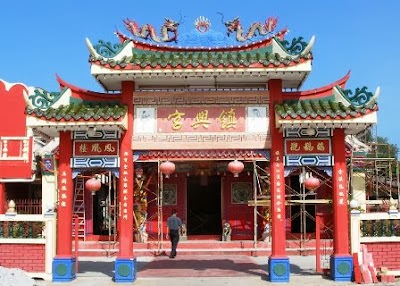
Ho Ann Kiong is the oldest Chinese temple in Chinatown, Kuala Terengganu. This beautiful temple is adorned with red and golden architectural elements and marvellous stone carvings. One can also admire the gigantic wishing tree that can be found behind the temple premises. The history of this temple dates back to 1801, when it was built by the early Hokkien community. Unfortunately, this temple was destroyed by fire in 2010 and fully restored in 2012. UNESCO has assigned heritage value to the temple.

The Terengganu State Museum is one of the largest museum complexes in Malaysia and Southeast Asia, with an area of 75,000 sq m. The architecture is based on the traditional Terengganu Malay house known as rumah tele. It has eight different galleries across four buildings and other open-air exhibits such as the Petronas Gallery, the Maritime Gallery, the Islam Gallery, exhibits of traditional Terengganuese houses, and many others. The museum is also the home of the Terengganu Inscription Stone, the oldest artefact with Jawi writing in the country. This museum is adorned with concrete stilts, landscaped gardens, ponds, and beautiful roofs. Some of the other attractions of the museum include the rumah tele gifted by King Mongkut of Thailand, the Batu Bersurat inscription stone, traditional weapons, Islamic artistic elements, and traditional real houses. The museum is open from 9 a.m. to 5 p.m. on Saturdays and Thursdays, from 9 a.m. to 12 noon and then from 3 p.m. to 5 p.m. on Fridays. Entry fees for Malaysians are RM 5 for adults, RM 2 for children and RM 1 for students in uniform. For foreigners, it is RM 15 for adults and RM 10 for children.

The Batu Bersurat, Batu Bersurat Terengganu or the inscribed stone of Terengganu can be found in the Terengganu State Museum. This stone provides one of the oldest pieces of evidence of Jawi writing, which is the Arabic alphabet used in Malaysia. The stone was found near the Teluk Gedong waterfront and was listed as a United Nations Memory of the World.

To date, the stone’s replica can be found in Kampung Buluh, Kuala Berang and Ladang Roundabout in Kuala Terengganu. Its inscriptions prove that Islam was the state religion. The stone rises to a height of about 89 cm and weighs about 214.8 kg. The Batu Bersurat bears 3 facades and its four sides bear inscriptions in opposite directions. While the inscriptions talk about the spread of Islamic culture, they also provide insight into the lives of Malaysian people during the 10th and 11th centuries. A proclamation by the ruler of Terengganu can also be found in the Batu Bersurat. In this proclamation, the ruler urges his subjects to uphold Islam and he also states the 10 basic Sharia laws. A symbol of the Dutch East India Company is also carved on the stone. Information about regional trade is also inscribed on it. Further, it also bears the depiction of a tiger that appears to be stealing a child. The Batu Bersurat stone was found in Terengganu, Malaysia. It was founded by the locals during a flash flood and taken to a mosque, where it was used as a platform for ablutions. Here, it was discovered by Syed Hussin, who took the stone to the Sultan of Terengganu to obtain more information about it.

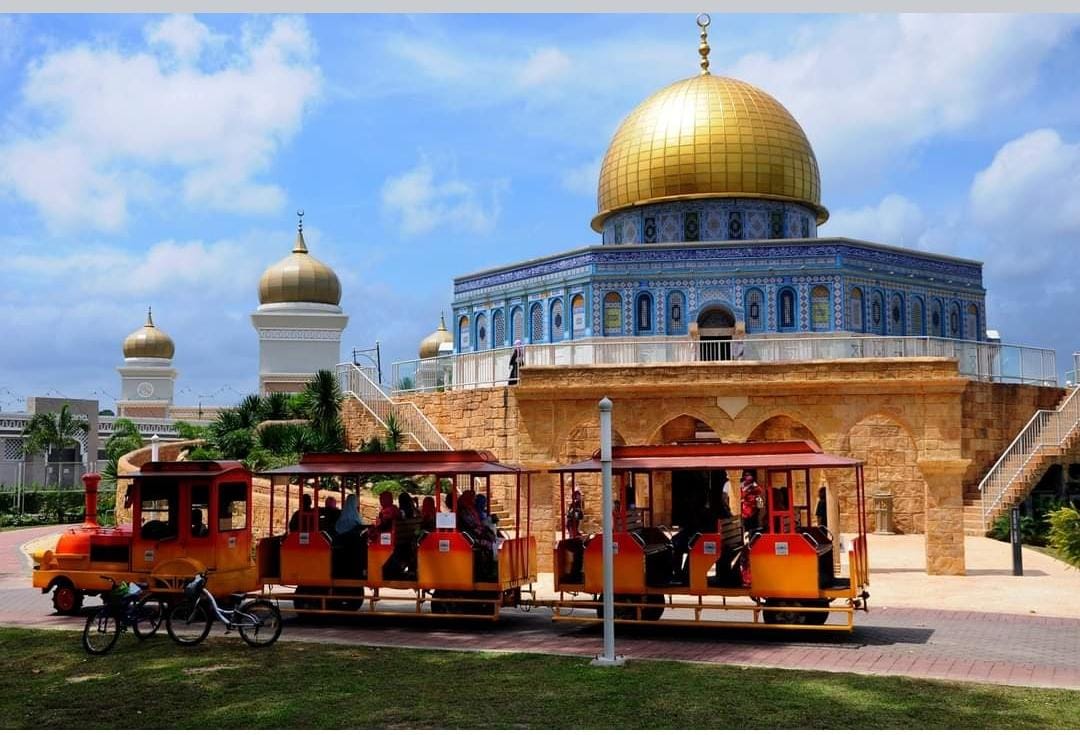
Taman Tamadun Islam or the Islamic Heritage Park, was opened in 2008 and is located on Wan Man Island. The star attraction is the congregation of various Islamic historical monuments from around the world. There are several offers and packages of attractions bundled together that enable visitors to get the maximum value for their money. There is a river cruise that operates from 10 am to 6 pm on Mondays, Wednesdays and Thursdays, and from 9 am to 6 pm on Fridays, Saturdays, Sundays and selected holidays. Monument Park and the Taman Tamadun Islam River Cruise remain closed on Tuesdays except for school and selected public holidays. The Friday prayer break timing is from 11:30 am to 2:30 pm. Entry fees are RM 20 for adults and RM !5 for children between seven and twelve. For Monument Park, the entry fees are RM 24.10 for adults and RM 17.80 for children between 7 and 12. The public park is open to all, free of charge. There are 22 replicas of world-famous mosques, architectural structures and monuments of Islamic influence and importance, like India’s Taj Mahal, Saudi Arabia’s Masjidil Haram and Egypt’s Alabaster Mosque, to name a few. It is also lit up in the evening with a splendid light show.

Travel Bucket List: Malaysia Part 29 – Terengganu Part 1

Located in eastern Peninsular Malaysia, Terengganu is bordered in the northwest by Kelantan, in the southwest by Pahang, and in the east by the South China Sea. Several outlying islands, including the Perhentians, Kapas and Redang, are also part of the state. The state is also known by its Arabic honorific, Darul Iman or Abode of Faith. Terengganu is geographically divided into sparsely populated and mountainous inland known as the Terengganu Highlands and largely flat coastal plains, in which most of the state’s people are concentrated. The state is known for having the longest coastline in west Malaysia and many of the most popular islands in Malaysia are located in the state of Terengganu.

The coastal city of Kuala Terengganu, which stands at the mouth of the broad Terengganu River, is both the state and royal capital as well as the largest city in Terengganu. Other major cities and towns include Jerteh, Kuala Dungun, Chukai, Kuala Berang, Marang, and Permaisuri. Terengganu is Malaysia’s 7th-largest state by area and 10th-largest in population. Terengganu, along with Kelantan, Perlis and the Federal Territory of Putrajaya, is one of the most homogeneous states and territories in the country, of which 95% of the population are ethnic Malay-Muslims with their distinct language, dialect, culture, history, and tradition.

In Malay, kuala can mean river mouth, estuary, or confluence. Thus, Kuala Terengganu is roughly translated as the confluence or estuary of Terengganu, referring to the broad expanse of the Terengganu River estuary, which empties into the South China Sea. There are several theories regarding the name Terengganu. One theory attributes the name’s origin to terang ganu, Malay for bright rainbow. Another story, considered to be the most popular version, is said to have been originally narrated by the ninth Sultan of Terengganu, Baginda Omar. It tells of a party of hunters from Pahang roving and hunting in what is now southern Terengganu. One of the hunters spotted a big animal fang lying on the ground. A fellow party member asked to which animal the fang belonged. The hunter, not knowing which animal, simply answered taring anu, Malay for fang of something. The party later returned to Pahang with a rich hoard of game, fur, and sandalwood, which impressed their neighbours. They asked the hunters where they sourced their riches, to which they replied, from the land of Taring Anu, which later evolved into Terengganu. Terengganu was called Trangkanu by the Siamese when it was under their influence. Terengganuans usually pronounce Terengganu as Tranung or Ganu, with the G often being emphasized.

The traditional Chinese name for Terengganu has been Dīngjiānú, which is a direct transcription of the Malay name. However, in recent years, the Chinese community in Terengganu has raised objections to the name, citing that the characters used loosely translate to giving birth to a child who will become a slave. They successfully petitioned the regulatory commission for the Chinese language in Malaysia to change the Chinese name for the state to Dēngjiālóu, which can be loosely translated to aspiring or stepping up to a higher level, in September 2004. The new name was in unofficial use by the state’s Chinese community for at least 30 years before its official adoption.

Human activities may have already existed in Terengganu as early as 16,000 years ago, during the Paleolithic age, as evidenced by the discovery of a skeleton in Gua Bewah, Hulu Terengganu, in 2009. The skeleton, which is called Bewah Man, has been analysed as 5,000 years older than skeletons found in Perak, making it the oldest known modern human skeleton in the country.

Terengganu’s location by the South China Sea ensured that it had been on trade routes since ancient times. Based on Ptolemy’s 2nd-century map called Golden Chersonese, the areas of what would be known as Terengganu today were historically called Perimula and Kole Polis. The earliest written reports on the area that mentioned the name Terengganu were by Chinese merchants and seafarers in the early 6th century A.D. During the early Hindu-Buddhist period, Terengganu was known as Tan-Tan, which is based on what is now Kuala Telemong. It was a small ancient polity that came under the influence of Langkasuka, a powerful kingdom based either in Kedah or Patani in the 1st century AD. In the 7th century, the dynasty of Langkasuka that once ruled over Terengganu was replaced by a new kingdom called Srivijaya, under whom Terengganu traded extensively with other kingdoms in the Malay Peninsula, Borneo and Sumatra, Champa, the Khmer Empire, the Majapahit Empire and especially the Chinese.

The present Sultanate of Terengganu was established in 1708. The first Sultan of Terengganu, Sultan Zainal Abidin I, established his court near Kuala Berang, then moved his court a few more times until he settled near Bukit Keledang, Kuala Terengganu. During the early 18th century, Kuala Terengganu was still a small town. It was described as having about one thousand houses that were scattered around the town. The Chinese were already present in Kuala Terengganu at that time. Half of the population were Chinese, and they were engaged in agriculture and trading. After the death of Sultan Daud in 1831, a brief civil war erupted between two claimants to the throne, namely Tengku Mansur and Tengku Omar. Tengku Omar was based at Bukit Puteri, while Tengku Mansur was based at Balik Bukit. Tengku Omar was defeated by Tengku Mansur, and he fled from Terengganu. Tengku Mansur became the next Sultan as Sultan Mansur II. His son, Sultan Muhammad, succeeded him as the next Sultan after his death in 1837. However, in 1839, Tengku Omar returned to Terengganu with his entourage to reclaim the throne. He defeated Sultan Muhammad and forced Sultan Muhammad to flee. Tengku Omar reoccupied his fort at Bukit Puteri and was throned as the next Sultan, Sultan Omar.

Terengganu was the first Malay state to receive Islam, as attested to by the Terengganu Inscription Stone with Arabic inscriptions found in Kuala Berang. The inscribed date, which is incomplete due to damage, can be read as various dates from 702 to 789 AH (1303 to 1387 CE). Terengganu became a vassal state of Malacca but retained considerable autonomy with the emergence of the Johor Sultanate.

Terengganu emerged as an independent sultanate in 1724. The first sultan was Tun Zainal Abidin, the younger brother of a former sultan of Johor, and Johor strongly influenced Terengganu politics through the 18th century. In the 19th century, Terengganu became a vassal state of the Thai Rattanakosin Kingdom and sent tribute every year called bunga mas. Terengganu prospered and was largely left alone by the authorities in Bangkok, unlike in neighbouring Patani and Kelantan. The period also witnessed the existence of a Terengganuan vassal, Besut Darul Iman.

The terms of the Anglo-Siamese Treaty of 1909 saw power over Terengganu transferred from Siam to Great Britain. A British advisor was appointed to the sultan in 1919, and Terengganu became one of the Unfederated Malay States. The move was highly unpopular locally, and in 1928, the British used military force to suppress a popular uprising.

During World War II, Japan occupied Terengganu and transferred sovereignty over the state back to Siam, which had been renamed Thailand in 1939, along with Kelantan, Kedah, and Perlis. After the defeat of Japan, British control over these Malay states was reestablished. Terengganu became a member of the Federation of Malaya in 1948, then a state of a sovereign Malaya in 1957, which became Malaysia in 1963. Following decades of rule by the Barisan Nasional coalition, the Pan-Malaysian Islamic Party (PAS) came to power in 1999, making Terengganu the second state in Malaysia to be ruled by the Islamist party, the first being neighbouring Kelantan.

Terengganu used to be Malaysia’s poorest state until oil and gas were discovered off its coastline in the 1980s, and the state’s main industry now is petroleum and gas. Tourism and fishing are also major industries and agriculture also remains important. Terengganu was traditionally famous for boatbuilding, with highly decorated, carved wooden boats called bangau to be found in the harbour of every village and town. The state did not receive many Indian or Chinese migrants, and therefore Malay cultural influences predominate. Traditional pursuits such as kite-flying contests, top-spinning contests, and traditional arts and crafts such as batik and songket are still very much alive.

Terengganu, along with Kelantan, is known as the cradle of the Malay civilization in Peninsular Malaysia. There are various traditional dances in the state, such as the Ulek Mayang, Rodat, Saba, Balai, and Nur Sakti; some even predate the arrival of Islam in the region. Terengganu is also one of few states to adopt the gamelan as part of their traditional theatre, after Riau and Pahang; the Terengganu gamelan has developed a distinct identity from the Sundanese and Javanese gamelan. The gamelan was originally brought to Pahang and later to Terengganu and was played only during royal occasions. Today, the gamelan is part of the state’s cultural heritage.

Travel Bucket List: Malaysia Part 28 – Kelantan Part 2

Continuing our exploration of Kelantan

The architecture of the Sultan Ismail Petra Silver Jubilee Mosque is unique because it combines Chinese and Islamic architecture and resembles the 1,000-year-old Niujie Mosque in Beijing. Construction on the mosque started on September 12, 2005, and the mosque was inaugurated in August 2009 and boasts an area of 3.7 acres and can accommodate 1,000 worshipers at one time. The mosque’s interiors are a fascinating mixture of Chinese, Islamic, Indian, and Uzbek styles of architecture and elements. It has a towering minaret where one can see the names of all 25 Prophets inscribed on tiles. The mosque is open to people of all faiths except during prayer time.

The Muhammadi Mosque was built as a tribute to the late Sultan Muhammad IV’s contribution and service to the state. Masjid Al-Ismaili is a significant and beautiful mosque. It is said that this mosque was a gift to Sultan Ismail Petra from his son, Sultan Muhammad Ⅴ. That’s why it is a great testimony to father-son bonding. The mosque has five minarets and a five-step staircase leading to the entrance, and the number five symbolizes the five pillars of Islam. At the same time, it has six domes, symbolizing six pillars of faith. The mosque is open to people of all faiths during non-prayer times.

The Wat Photivihan Sleeping Buddha is one of the 25 temples found in Tumpat and one of the most popular in the country. Also called the Phothivihan Buddhist Temple or Wat Yamu, the temple was established in 1973 by Abbot Phra Krurasapia Chakorn and attracts thousands of Thai pilgrims every year. The temple houses a 40-metre statue of the sleeping Buddha, considered the largest and longest in the state since its construction in 1975. Upon its completion in 1979, the statue was recognised as one of the two reclining Buddha statues in Malaysia and also the largest in Southeast Asia, until it was surpassed by the 66-metre statue in Chaukhtatgyi Buddha Temple in Myanmar. Devotees of this temple are mainly ethnic Thais since the temple itself is a typical Thai Buddhist temple of Theravada Buddhism. There is also a Chinese Pavilion, a Tibetan-style hall featuring a statue of the Bodhisattva Avalokitesvara with 18 arms and Phra Phrom, the four-faced goddess. The compound also includes accommodation for monks and visitors. There is plenty of free parking and entrance to the temple is free. Any donations from visitors are always welcome.

Wat Machimmaram Temple is an amazing Thai Buddhist temple located in Tumpat with a 30-meter-high sitting Buddhist statue. The temple’s architecture is a mixture of Chinese and Thai styles, with guardian deity statues in Chinese style. There is a turtle pool and many food and drink stalls. Wat Maisuwankiri, near the village of Kampung Bukit Tanah, boasts a floating temple and a richly decorated dragon boat surrounded by a murky moat. At Wat Pikulthong, on the apex of a mound of earth, this gold mosaic standing Buddha shimmers under a tropical sun. Wat Kok Seraya features a golden stupa and a statue of a standing female Buddha.

The Seng Choon Kiong, also known as Mazu Temple, is an approximately 300-year-old temple in Kampung Tok’kong and is a site of pilgrimage for worshippers of Mazu in Malaysia. The Water and Moon Temple is a must-visit because it has a history spanning more than 500 years. The temple’s statues are nearly 600 years old. It is locally believed that the temple grants the wishes of the needy. Zi Xia Dong, or Princess Cave, is a Chinese cave temple that is located just opposite the Water and Moon Temple. To reach the temple, one must cross the metal bridge, a pebbled path, and a rubber plantation before climbing up a 20-meter-high staircase to reach the peak of the limestone hill. Inside the cave is a giant figure of the Goddess of Mercy, which is worshipped. There are many stories about this cave. One story is that there was a princess who was ferrying a ship through this land with her father and other crew members. When the ship arrived here, the Princess fell in love with the Pulai settlement, and she was reluctant to go back with her father. So to escape from her father, she hid in the cave and gradually became the guardian of the hill.

The town of Gua Musang is famous for its limestone hills and caves. The name Gua Musang means Cave of the Fox. One can explore numerous caves here, including Gua Musang, Princess Cave, Gua Batu Hijau, Bombed Cave, and many more. One should take enough precautions while climbing and exploring these caves, as some of them are filled with insects and bats. Gua Ikan is one of the most commonly visited caves in Kelantan. It is very famous because the cave’s rock formation resembles a fish shape, which is why it earned the name Fish Cave. Due to the complexity of the cave’s geology, it is recommended to hire a guide from the nearby Gunung Stong State Park. The cave is made of limestone and hosts animals like bats, whip scorpions, spiders, and lots of mosquitos. The caves are open between 8 am and 5 pm daily. Close to Dabong, this cave features a limestone grotto carved out by a flowing river that can rise rapidly and dangerously after rain. Usually, however, it is a pleasant, if slightly overused, picnic spot.

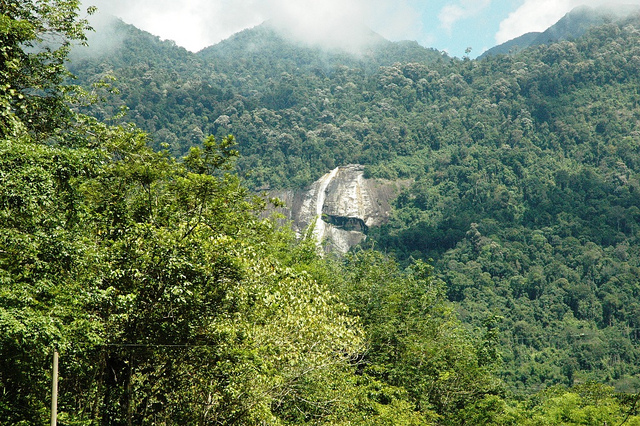
Gunung Stong State Park is home to one of the highest waterfalls in Malaysia, the seven-tiered Jelawang Waterfall. Named for the 1422 m-high Gunung Stong mountain, this 219.5 sq km park, only 15km from Dabong, features beautiful stepped waterfalls and offers amazing hiking, swimming and trekking. It is believed to be home to elephants, tigers and tapirs. The beauty of Jelawang Waterfall can be seen from a distance as one travels towards the park entrance. From the park, you can hire a guide to lead you, or you can hike yourself, following the trails given.

Located in the Gua Musang Region near Kelantan’s borders with Pahang and Terengganu, Taman Negara is located in the Hantu Hill and Lebir Reserve forests. Also known as Kuala Koh National Park, because it is located across three states, visitors sometimes get confused about which state the national park is located in. In truth, the park is located in the district of Gua Musang in Kelantan State. The park is mostly tropical rainforest and is home to Malaysia’s highest mountain, Mount Tahan. There are a vast number of exotic birds, animals, insects, and even reptiles and amphibians. The park is open from 9 a.m. to 5:30 p.m. on Mondays and Saturdays and from 9:30 a.m. to 5:30 p.m. on Sundays. Taman Tasik Gua Musang is a relaxing and beautiful lake garden where one can enjoy walking, jogging, and exercising.

Named after Prophet Muhammad’s entrepreneurial wife, Siti Khadijah Market is a fitting name for a market mostly run by women. The market was originally established as Buluh Kubu Market in 1985 and opened to the public by Sultan Ismail Petra. The market was then renamed Kelantan Menteri Besar Nik Abdul Aziz Nik Mat in 1997. The market is housed in a four-story building and features an octagonal shape. Fresh goodies, ready-to-eat foods, local snacks and drinks can be found in the market. The bottom floor is dedicated to wet items such as fish, vegetables, chicken and so on. Level 1 is allocated to dry food items such as serundeng. They additionally sell traditional Kelantan cakes, chicken, spiked fish, rice noodles, glazed rice, nasi dagang, laksam and somtam. The second and third floors are for non-food items.

Also known as Balai Getam Guri, the Handicraft Village and Craft Museum houses many fine examples of Kelantanese craftsmanship such as traditional embroidery, songket weaving, batik printing, silver work and wood carving. Kampung Kraftangan is a handicraft market, a touristy affair opposite Istana Batu, with a one-room museum with displays of woodcarving, batik-making and other crafts.

The pale-yellow Istana Batu building, constructed in 1939, was the crown prince’s palace until it was donated to the state. Now a museum, the richly furnished rooms give a surprisingly intimate insight into royal life, with family photos and personal belongings scattered among the fine china, chintzy sofas and the late sultan’s collection of hats.

The Bank Kerapu War Museum was the Japanese headquarters during their occupation during WWII. Before that, this building was the first trading bank in Kelantan. This museum displays more than 1000 exhibits relating to war such as Japanese tools that were used during the occupation. It is open from 8:30 am to 4:45 pm daily except Fridays.

Next to the tourist information centre, the Muzium Negeri Kelantan is the official state museum. The exhibits on Kelantan’s history and culture are interesting, but the accompanying signage can be poor. Muzium Islam occupies an old villa once known as Serambi Mekah or Verandah to Mecca, a reference to its days as Kelantan’s first school of Islamic instruction. Nowadays, it displays a small collection of photographs and artefacts relating to the history of Islam in the state.

Istana Jahar, Kota Bharu’s best museum, focuses on Kelantanese rituals and crafts. It’s housed in a beautiful chocolate-brown building that dates back to 1887 and is easily one of the most attractive traditional buildings in the city. The collection here includes detailed descriptions of batik weaving, the elaborate ceremonies of coming-of-age circumcision, wedding nights and funerary rights. It is known as Jahar because of a tree that grew on the palace grounds. The museum is open from 8:30 am to 4:45 pm on all days except Fridays. For locals, adults need to pay RM 2 and children pay RM 1, while foreign adults will pay RM 4 and children will pay RM 2.

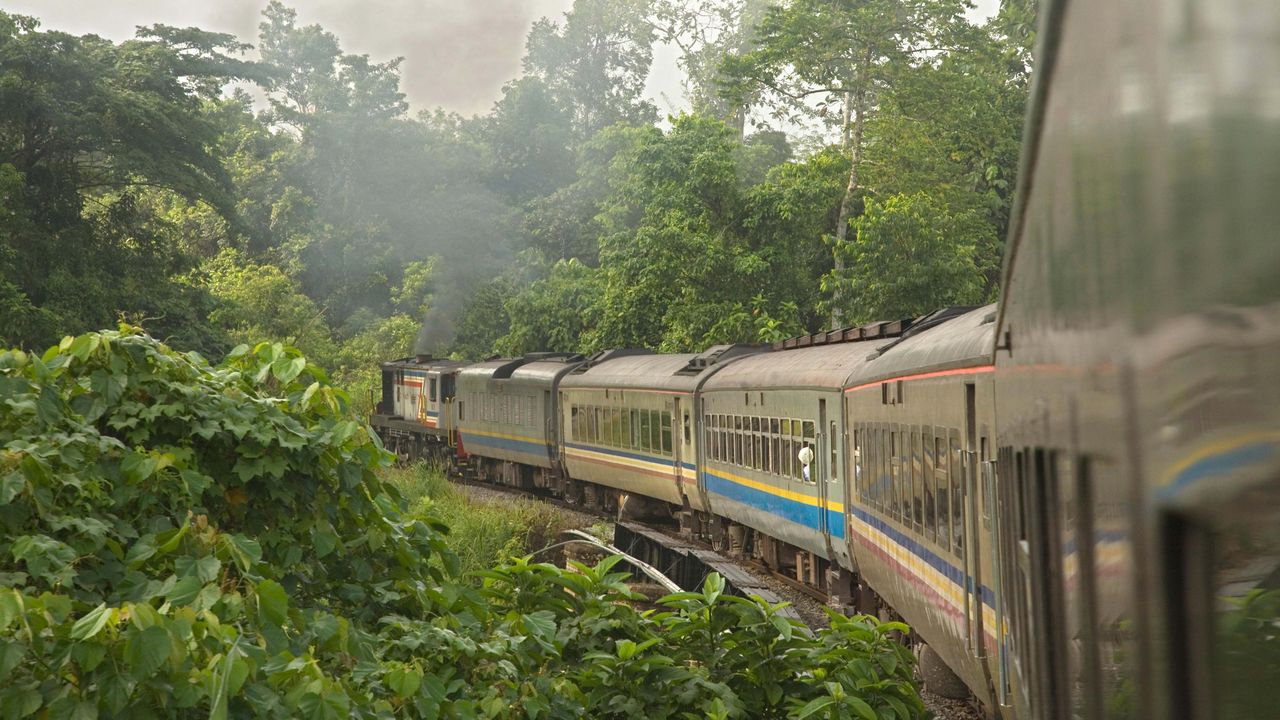
The Jungle Railway is a must-see attraction of Kota Bharu. The railway runs along the east coast and through the centre of Malaysia and passes through Kelantan, where it stops at the city of Tumpat. It is described as one of the world’s most picturesque journeys. Throughout the journey, one can get to see the luxurious green jungle with the best scenery of the journey once it heads north. While travelling from Kuala Lipis to Kuala Krai, one can see huge rivers and limestone hills around the town of Gua Musang. And that, according to tourists, holds the best scenery of the entire journey. To travel from Tumpat to Kuala Lumpur, a first-class ticket will cost between RM 101 and RM 130 and a second-class ticket will be about RM 31 per person.

This is all that I could find about the state of Kelantan. I believe that this state is very underrated and has a lot of potential for tourism. Let’s see when I can make it here. Keep watching this space for the next state we will be exploring, the state of Terengganu.