Festivals of India: Tamil New Year

Tomorrow is the first day of year on the Tamil calendar and is set in sync with the solar cycle of the lunisolar Hindu calendar, as the first day of the Tamil month Chithirai. It therefore falls on or about 14 April every year on the Gregorian calendar. The same day is observed by Hindus elsewhere as the traditional new year, but is known by other names such as Vishu in Kerala, and Vaisakhi or Baisakhi in central and northern India. The Tamil calendar follows a 60-year cycle which is also very ancient and is observed by most traditional calendars of India and China. According to popular belief it is related to 5 revolutions of Jupiter around the Sun, and also to 60-year orbit of Nakshatras or stars as mentioned in Surya Siddhanta. The 2020 Tamil New Year is called Saarvari.

The day is observed as a family time and before this day, households clean up the house, prepare a tray with fruits, flowers and auspicious items, light up the family Puja altar and visit their local temples. People wear new clothes and children go to elders to pay their respects and seek their blessings, then the family sits down to a vegetarian feast.

The Tamil New Year follows the spring equinox and generally falls on 14 April of the Gregorian year. The day celebrates the first day of the traditional Tamil calendar and is a public holiday in both Tamil Nadu and Sri Lanka. The same date is observed as the traditional new year by many Hindus in Assam, West Bengal, Kerala, Manipur, Tripura, Bihar, Odisha, Punjab, Uttar Pradesh, Uttarakhand, Himachal Pradesh, Haryana, Rajasthan as well as by Hindus in Nepal and Bangladesh. Several Buddhist communities in Myanmar, Cambodia, Laos, Thailand, and Sinhalese in Sri Lanka also celebrate the same day as their new year, likely an influence of the shared culture between South and Southeast Asia in the 1st millennium. The day is celebrated as Vishu in Kerala, Vaisakhi or Baisakhi in central and north India, Pohela Sankranti in Odisha, Pohela Boishakh in West Bengal, and Bangladesh, Rongali Bihu in Assam, Bikram Samwat or Vaishak Ek in Nepal, Aluth Avuruthu in Sri Lanka as the Sinhalese New Year, Songkran in Thailand, Pi Mai in Laos, Choul Chhnam Khmer in Cambodia and Thingyan in Myanmar

There are several references in early Tamil literature to the April new year. Nakkirar, the Sangam period author of the Neṭunalvāṭai, wrote that the sun travels from Mesha/Chitterai through 11 successive signs of the zodiac. Kūdalūr Kizhaar refers to Mesha Raasi/Chitterai as the commencement of the year in the Puṟanāṉūṟu. The Tolkaapiyam is the oldest surviving Tamil grammar that divides the year into six seasons where Chitterai marks the start of the Ilavenil season or summer. The Silappadikaaram mentions the 12 Raasis or zodiac signs starting with Mesha/Chitterai or roughly Aries as per the western zodiac. The Manimekalai alludes to the Hindu solar calendar as we know it today. Adiyarkunalaar, an early medieval commentator or Urai-asiriyar mentions the twelve months of the Tamil calendar with particular reference to Chitterai. There were subsequent inscriptional references in Pagan, Burma dated to the 11th century and in Sukhothai, Thailand dated to the 14th century to South Indian, often Vaishnavite, courtiers who were tasked with defining the traditional calendar that began in mid-April

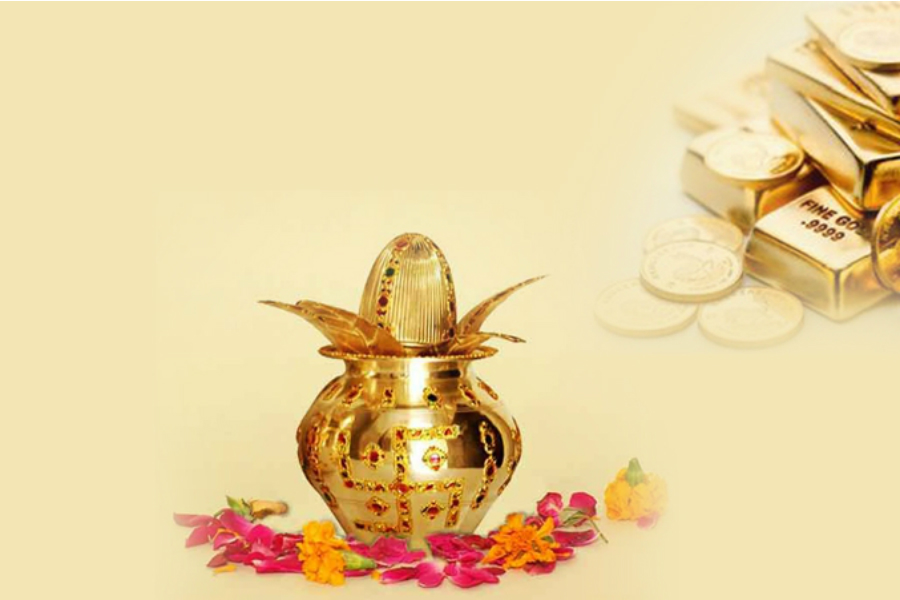
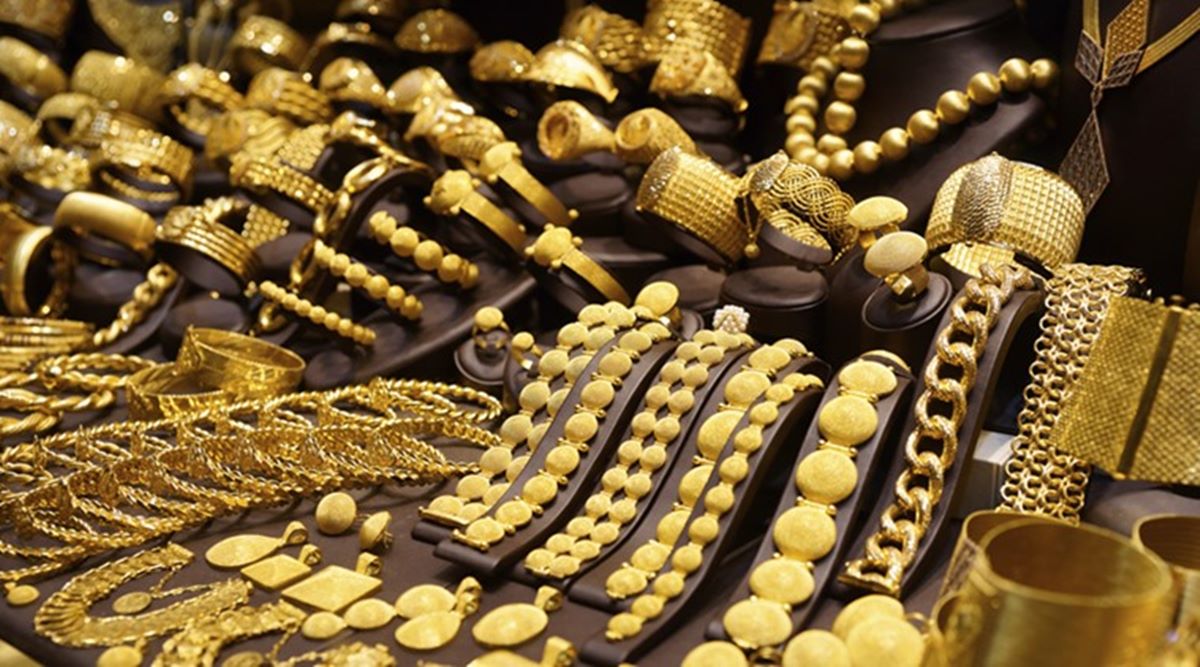
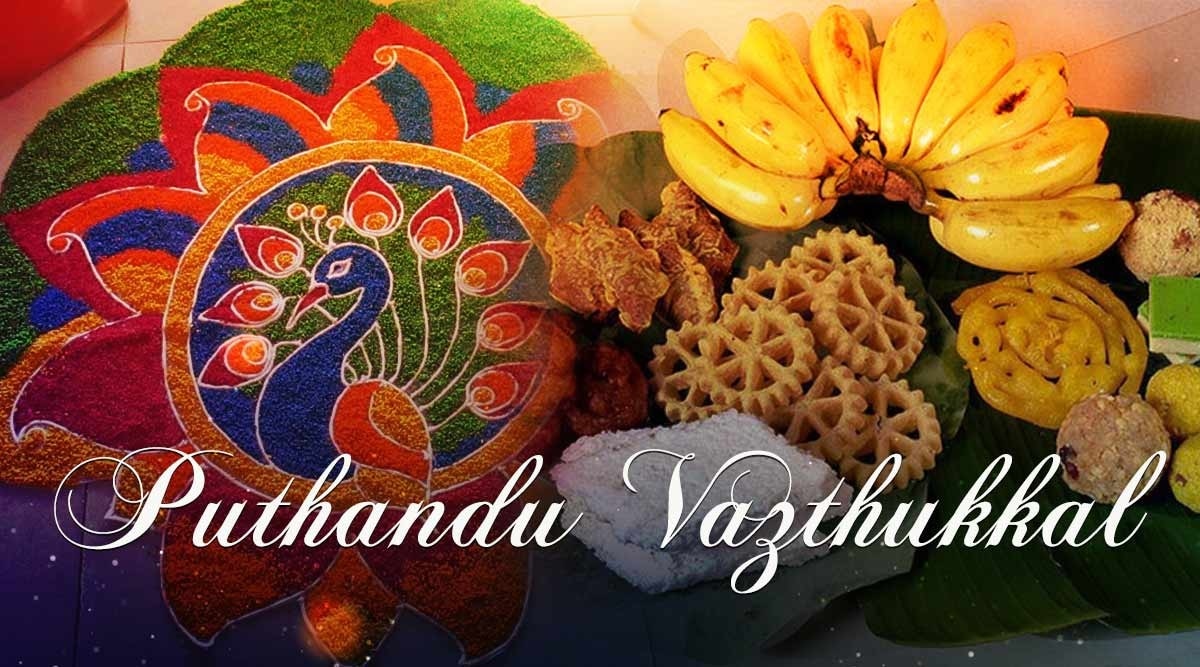
On the eve of the New Year or Puthandu, a tray arranged with three fruits (mango, banana and jack fruit), betel leaves and arecanut, gold/silver jewellery, coins/money, flowers and a mirror. This is similar to the Vishu new year festival ceremonial tray in Kerala. According to the Tamil tradition, this festive tray is auspicious as the first sight upon waking on the new year day. Home entrances are decorated elaborately with colored rice powder designs called kolams.

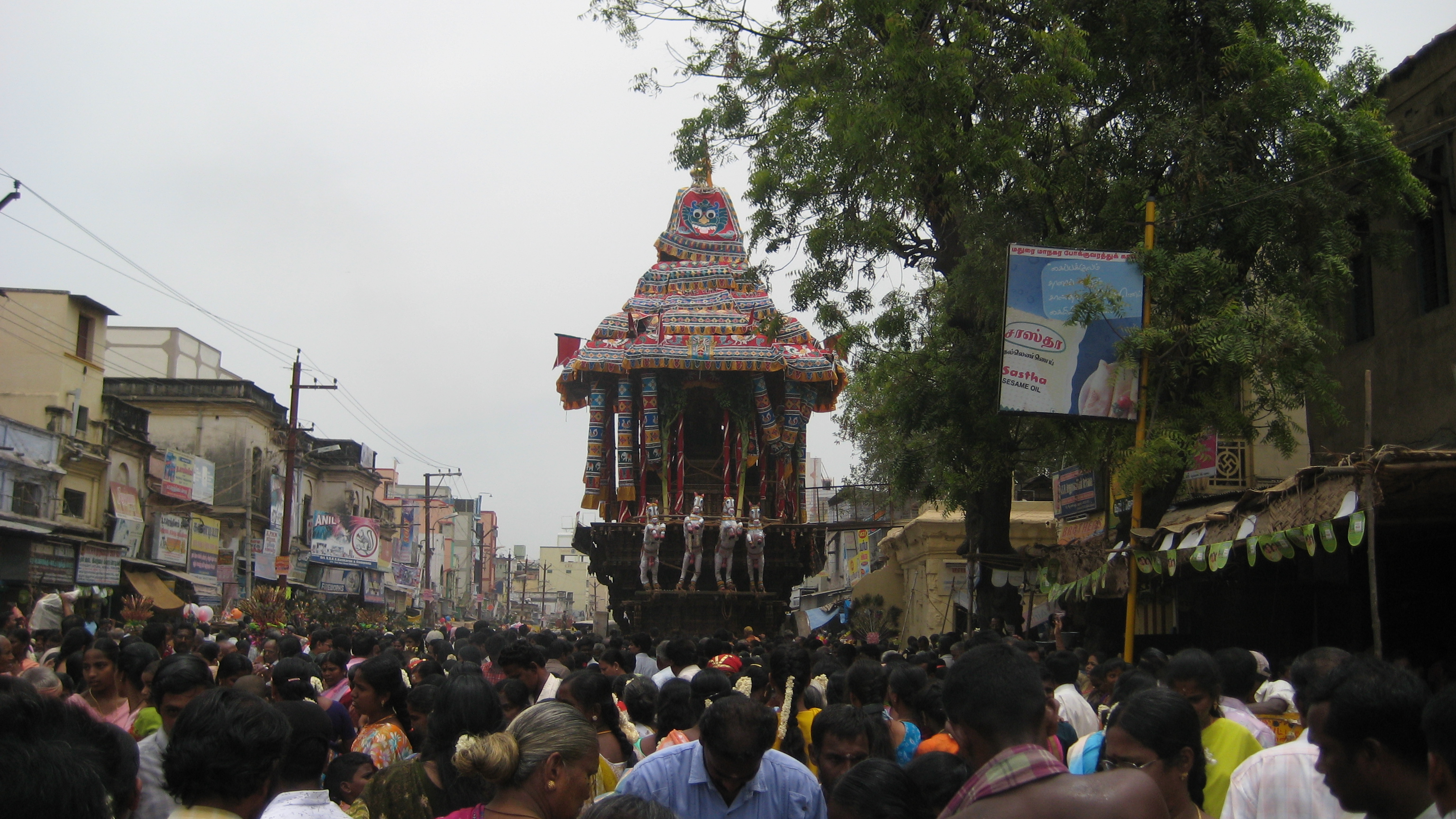
In the temple city of Madurai, the Chitterai Thiruvizha is celebrated in the Meenakshi Temple. A huge exhibition is held, called Chitterai Porutkaatchi. On the day of the Tamil New Year, a big Car Festival is held at Tiruvidaimarudur near Kumbakonam. Festivals are also held at Tiruchirapalli, Kanchipuram and other places.

In Sri Lanka, the Tamils observe the traditional new year in April with the first financial transaction known as the Kai-vishesham. In this transaction children go to elders to pay their respect, and elders give their blessings and gift pocket money to the children in return. The event is also observed with the ‘arpudu’ or the first ploughing of the ground to prepare for the new agricultural cycle. The game of ‘por-thenkai’ or coconut wars between youth is played in villages through the Tamil north and east of the island while cart races are also held. The festive Puthandu season in April is a time for family visits and the renewal of filial bonds. It also coincides with the Sinhalese new year season and so is a time of joy and celebration throughout the island.

During the festive lunch that day, families eat dishes which are a combination of all flavours – sweet, sour, bitter and pungent. This is usually in the form of a mango pachadi or salad since mangoes would have started to come into season by this time. These traditional recipes combining different flavours are a symbolic reminder that one must expect all flavors of experiences in the coming new year, that no event or episode is wholly sweet or bitter, experiences are transitory and ephemeral, and to make the most from them.

In our temple in Matunga, we also have the head priests of the temple reach the annual Panchangam or calendar or alamanc for the coming year. The priest will also interpret any interesting configurations of the stars and planets and let know know which nakshatras or stars and rashis or zodiac signs would likely to be affected or blessed in the coming year. This is only a very general and cursory reading, but is something my parents look forward to each year. This year, with the country under lockdown, they will not be partaking in this activity.

To everyone celebrating their new year these days, here’s wishing you a very Happy New Year and may the coming year put to rest all the calamities of the old year and bring you and your families happiness and prosperity!

Festivals of India: Hanuman Jayanti

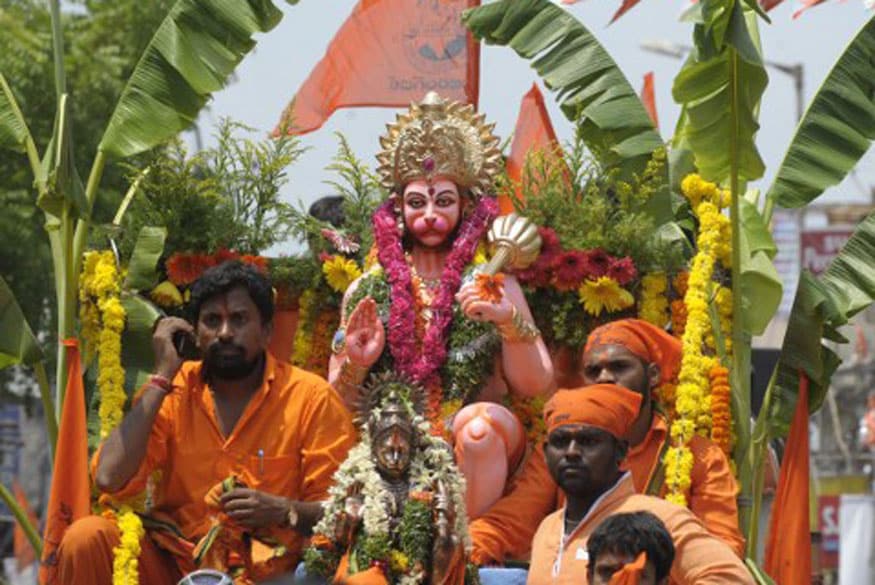
Celebrating the birth of India’s ancient superhero, Hanuman Jayanti is celebrated on different days in different parts of India. In most states of India, the festival is observed either in Chaitra, usually on the day of Chaitra Pournimaa or in Vaishakha, while in a few states like Kerala and Tamil Nadu, it is celebrated in the month Dhanu, also called Margazhi in Tamil. The date of Hanuman Jayanti varies from year to year and across India, various states and communities celebrate it in different times of the year. Communities in South India usually celebrate this festival during the Margazhi month of Moola Nakshathram as that month is believed to be when Hanuman was born. Telangana and Andhra Pradesh, however, celebrate Hanuman Jayanti from Chaitra Purnima to the tenth day of Krishna Paksha in the month of Vaishaka. Maharashtra places the holiday on the full moon day during the month of Chaitra.This year, the festival is celebrated today, the 8th of April, across India, Nepal, Sri Lanka and across the world where his devotees reside.

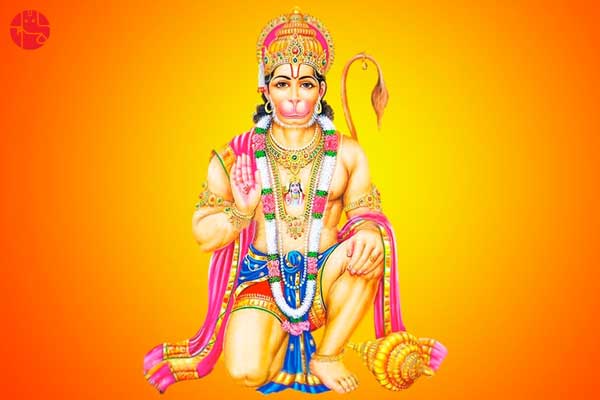
Also known as Sankatmochan, Dukhbhanjan, Maruti Nandan or Pawanputra, Lord Hanuman is an ardent devotee of Lord Sri Rama and is widely known for his unflinching devotion to Sri Rama. He is said to be able to assume any form at will, wield the mace or gada as well as many other celestial weapons, lift and move mountains, dart through the air, seize the clouds and equally rival Garuda in the swiftness of flight. Hanuman is seen as a symbol of strength and energy and also someone to turn to when a devotee is in difficulty.

Source

On Hanuman Jayati, devotees of Lord Hanuman celebrate him and seek his protection and blessings. They flock to temples to worship him and present religious offerings. In return, The devotees receive Prasad or the holy offering by the temple priests as sweets, flowers, coconuts, tilak, sacred ash and holy water. People also celebrate him on this day by reciting various devotional hyms and prayers like the Hanuman Chalisa and reading holy scriptures like the Ramayana and Mahabharata. Lord Hanuman is said to be the epitome of belief, trust and devotion. On this day, devotees pray to imbibe these qualities in their lives and lead a principled life.

Source

Lord Hanuman was born on the Anjaneri mountain. His mother Anjana was an apsara who was born on earth due to a curse. She was redeemed from this curse on giving birth to a son. The Valmiki Ramayana states that his father Kesari was the son of Brihaspati, he was the King of a place named Sumeru. Anjana performed intense prayers lasting 12 long years to Shiva to get a child. Pleased with their devotion, Shiva granted them the son they sought. Hanuman, in another interpretation, is the incarnation or reflection of Shiva himself.

Hanuman is often called the son of the deity Vayu or the Wind God; several different traditions account for the Vayu’s role in Hanuman’s birth. One story mentioned in Eknath’s Bhavartha Ramayana from the 16th century which states that when Anjana was worshiping Shiva, the King Dasharatha of Ayodhya was also performing the ritual of Putrakama yagna in order to have children. As a result, he received some sacred pudding or payasam to be shared by his three wives, leading to the births of Rama, Lakshmana, Bharata, and Shatrughna. By divine ordinance, a kite snatched a fragment of that pudding and dropped it while flying over the forest where Anjana was engaged in worship. Vayu, the Hindu deity of the wind, delivered the falling pudding to the outstretched hands of Anjana, who consumed it. Hanuman was born to her as a result. Another tradition says that Anjana and her husband Kesari prayed Shiva for a child. By Shiva’s direction, Vayu transferred his male energy to Anjana’s womb. Accordingly, Hanuman is identified as the son of the Vayu

Another story of Hanuman’s origins is derived from the Vishnu Purana and Naradeya Purana. Narada, infatuated with a princess, went to his lord Vishnu, to make him look like Vishnu, so that the princess would garland him at swayamvara or the husband-choosing ceremony. He asked for ‘Hari Mukh’ (Hari is another name of Vishnu, and mukh means face). Vishnu instead bestowed him with the face of a vanara. Unaware of this, Narada went to the princess, who burst into laughter at the sight of his ape-like face before all the king’s court. Narada, unable to bear the humiliation, cursed Vishnu, that Vishnu would one day be dependent upon a vanara. Vishnu replied that what he had done was for Narada’s own good, as he would have undermined his own powers if he were to enter matrimony. Vishnu also noted that Hari has the dual Sanskrit meaning of vanara. Upon hearing this, Narada repented for cursing Vishnu. But Vishnu told him not to repent as the curse would act as a boon, for it would lead to the birth of Hanuman, an avatar of Shiva, without whose help Rama (Vishnu’s avatar) could not kill Ravana.

Lord Hanuman is best known for his role in the epic poem and sacred text the Ramayana, which tells the story of the divine Prince Rama. Rama was sent into exile unjustly by his stepmother, Kaikeyi. While in exile, Rama’s wife, Sita, is abducted by the demon Ravana. Much of the epic poem is devoted to Rama’s determined quest to rescue Sita from Ravana. Rama successfully recovers Sita and kills Ravana with the help of the vanara or his monkey army. Rama and Sita return to the kingdom of Ayodhya and usher in a golden age of humanity. Rama, the titular character of the Ramayana, is identified as an incarnation, or avatara, of the god Vishnu.

Source

Hanuman plays a central role in the Ramayana, and his stories are nearly always tied to those of Prince Rama, also called Lord Ram. Even before Hanuman’s birth, it was predicted that he would be a devotee of Lord Ram. After he was born, Hanuman was a trouble maker who, among other feats of mischief, tried to grab the sun from the sky. In response, powerful sages cursed Hanuman and made him forget his magic powers. Hanuman became a loyal servant to Rama and a commander of Rama’s legions of monkeys. The memory of his powers was restored to Hanuman by Jambavan, the king of the bears, and as a result, Hanuman made a giant leap across the strait that lies between India and Sri Lanka, called the Palk Strait today, to steal the medicinal herbs necessary to heal the wounded in Rama’s army. When Hanuman struggled to identify the herbs, he picked up the entire mountain and brought that back to India. Before Hanuman left Sri Lanka, his tail was set on fire. Hanuman, however, used this fire to burn Sri Lanka to the ground.

Hanuman is held up as the embodiment of loyalty and devotion and these admirable traits are recognized year round at temples dedicated to Hanuman and given special attention during Hanuman Jayanti. During Hanuman Jayanti, Hindus take an early morning holy bath and either attend temples dedicated to Hanuman or perform puja at home if they have their own shrine dedicated to Hanuman. The Hanuman Chalisa is read in order to conquer evil spirits and provide mental peace to those reading and listening. People apply red powder to their foreheads in an echo of how Hanuman covered his whole body in sindoor to ensure Rama’s immortality. There is an interesting legend to why Hanuman covered his body with Sindoor. As per the legend, when Lord Hanuman found Sri Sita applying sindhūr to her forehead, He questioned her and she replied that doing so would ensure a long life for her husband, Lord Sri Rama. Lord Hanuman then proceeded to smear his entire body with sindhūr, thus ensuring Lord Sri Rama’s immortality.

Hanuman is also celebrated as a symbol of devotion, strength, magical powers and energy and also as the 11th Rudra avatara of the great god Shiva. Many devotees pray to Hanuman to be blessed with bravery, intelligence and loyalty like that which Hanuman displayed.

Hanuman is a popular god among Hindus, and his temples are often filled with monkeys who know that humans cannot harm them so long as they are on temple grounds. Hindus, however, are not the only ones who recognize Hanuman. Hanuman also appears in Buddhism, Sikhism and Jainism as well as in Indian pop culture.

Hanuman has been honored for millennia, and that fact has not changed in the modern age. Thousands still flock to his temples and wear sindoor in recognition of his devotion to Rama. Hanuman himself would likely be pleased with this. There is, after all, something perfect about the determined loyalty of Hindus to the god who was known for his faithfulness.

Here’s the divine voice of the late singer M.S. Subbalakshmi reciting the Hanuman Chalisa to end this blog post!

Festivals of India: Gudi Padwa

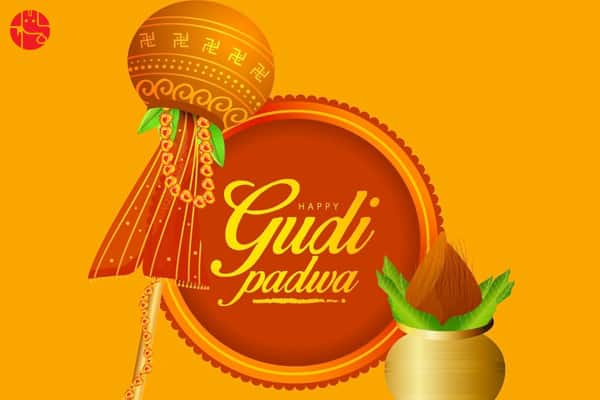
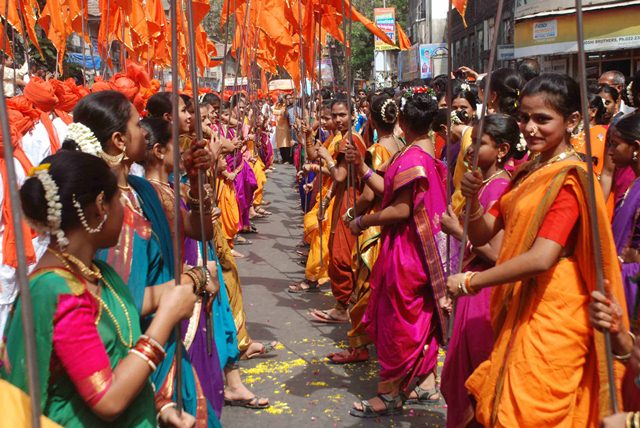
Spring is in the air and this means that various Indian communities will start celebrating their new year. The first is usually Gudi Padwa, a spring-time festival that marks the traditional new year for Marathi and Konkani Hindus. It is celebrated in and near Maharashtra and Goa on the first day of the Chaitra month to mark the beginning of the New year according to the lunisolar Hindu calendar. The word Padwa comes from the Sanskrit word Pratipada, which refers to the first day of a lunar fortnight. The festival is observed with colorful floor decorations or rangoli, a special Gudi flag which is garlanded with flowers, mango and neem leaves and topped with an upturned silver or copper vessel, street processions, dancing and festive foods.

Gudi Padwa marks end of one harvest season and beginning of a new one for farmers and so is also celebrated as a harvest festival in the region. On this day the position of the Sun is above the point of intersection of the equator, which according to the Hindu calendar marks the commencement of the Spring Season.

In India, this day which is the first day of the bright phase of the moon is called Gudi Padwa in Marathi, Ugadi in Telugu, and Yugadi in Kannada. The Sindhi community celebrates this day as Cheti Chand as the new year and observed as the emergence day of Lord Jhulelaal. Prayers are offered to Lord Jhulelaal and the festival is celebrated by making delicacies. However, this is not the universal new year for all Hindus. For some, such as those in and near Gujarat, the new year festivities coincide with the five day Diwali festival. For many others, the new year falls on Vaisakhi between 13 and 15 April, according to the solar cycle part of the Hindu lunisolar calendar, and this is by far the most popular not only among Hindus of the Indian subcontinent but also among Buddhists and Hindus in many parts of southeast Asia.

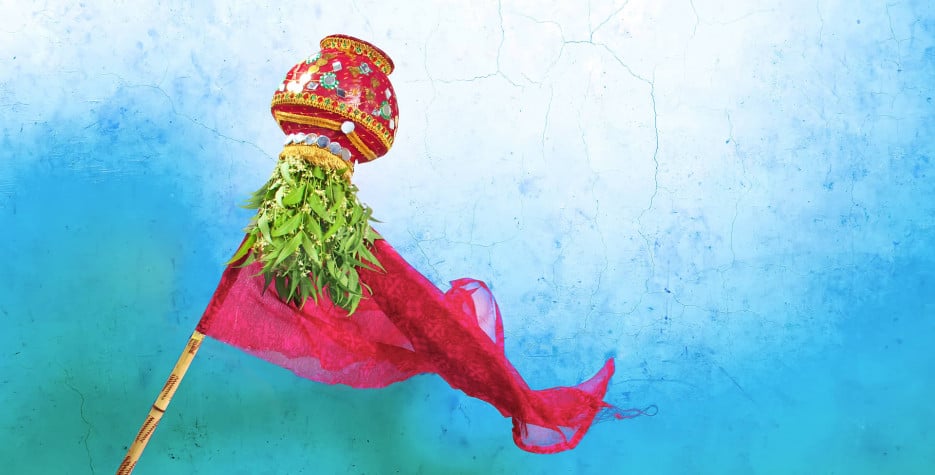
It’s really fascinating on the day of Gudi Padwa to see many Gudis arrangements in the windows and doors of Maharashtrian and Konkani households. The Gudi is a bright colorful silk scarf-like cloth tied to the top of a long bamboo pole. On the top of the pole, one or more boughs of neem leaves and mango leaves are attached along with a garland of flowers. This arrangement is capped with a silver, bronze or copper pot called handi or kalash in Marathi signifying victory or achievement. The whole arrangement is hoisted outside each household, typically to the right and is visible to everybody. Villages or neighborhoods also come together and host a community Gudi Kavad, which they carry together to the local Shiva temple. Some temples are located on the top of hills, and groups work together to help reach the kavad to the top.

There are many historical legends and beliefs associated with this festival. One of these comes from the Brahma Purana which states that Lord Brahma recreated the world after a raging deluge in which all time had stopped and all the people of the world, destroyed. On Gudi Padva, time restarted and from this day on, the era of truth and justice, known as Satyug began. Therefore, Lord Brahma is worshipped on this day and the Gudi symbolises the Brahmadhvaj.

Another popular legend about the origin of this festival revolves around the return of Lord Rama to Ayodhya along with his wife Sita and his brother Laxman from exile. The ‘Brahmadhvaj’ is hoisted in memory of the coronation of Lord Rama. The Gudi is hoisted at the entrance of the household in commemoration of the Gudi that was hoisted in Ayodhya as a victory flag. It is also believed that Lord Rama was victorious over King Bali on this day, marking this occasion.

For the people of Mahrashtra, there is an added significance to this festival. It is believed that Chhattrapati Shivaji Maharaj, celebrated leader of the Maratha clan, led the troops to victory and attained freedom for the kingdom from the dominion of the Mughals in that area. The Gudi then is a symbol of victory and prosperity.

It also symbolizes the victory of King Shalivahana and was hoisted by his people when he returned to Paithan (near current day Aurangabad).

The Gudi is believed to ward off evil, invite prosperity and good luck into the house. Many businessmen inaugurate their ventures on this day as it is considered an auspicious day.

On this day, courtyards in village houses will be swept clean and plastered with fresh cow-dung. Even in urban areas, even if they don’t do it everyday, on this day people take the time out to do some spring cleaning and women work on intricate rangoli designs on their doorsteps, the vibrant colours mirroring the burst of colour associated with spring. Everyone dresses up in new clothes and it is a time for family gatherings. Traditionally, families prepare a special dish that mixes various flavors, particularly the bitter leaves of the neem tree and sweet jaggery. Additional ingredients include sour tamarind and astringent dhane seeds. Most communities prepare something similar which is a reminder of life’s sweet and bitter experiences, as well as a belief that the neem-based mixture has health benefits.

Here’s wishing all those celebrating Gudi Padwa, Ugadi, Cheti Chand and Yugadi a very happy new year and to enjoy your celebrations and the yummy food that follows!

Festivals of India: Holi

Literally the most colourful of all festivals and the one I am personally not a big fan of, the festival of Holi hearlds the arrival of spring, the end of winter, the blossoming of love, and for many, a festive day to meet others, play and laugh, forget and forgive, and repair broken relationships. The festival also celebrates the beginning of a good spring harvest season. This year, the Holi festivities, which is usually celebrated for a night plus the next day, started yesterday night and today India and especially northern India will be awash in colours.

The first evening is known as Holika Dahan (burning of demon holika) or Chhoti Holi (aka small Holi) and the following day as Holi or Rangwali Holi (aka colourful Holi). This festival is an ancient Hindu religious festival which has become popular with non-Hindus as well in many parts of South Asia, as well as people of other communities outside Asia.

Holi celebrations start on the night before Holi with a Holika Dahan where people gather, perform religious rituals in front of the bonfire, and pray that their internal evil be destroyed the way Holika, the sister of the demon king Hiranyakashipu, was killed in the fire. The next morning is celebrated as Rangwali Holi – a free-for-all festival of colours, where people smear each other with colours and drench each other. Water guns and water-filled balloons are also used to play and colour each other. Anyone and everyone is fair game, friend or stranger, rich or poor, man or woman, children, and elders. The frolic and fight with colours occurs in the open streets, open parks, outside temples and buildings. Groups carry drums and other musical instruments, go from place to place, sing and dance. People visit family, friends and foes to throw coloured powders on each other, laugh and gossip, then share Holi delicacies, food and drinks. Some customary drinks include bhang (made from cannabis), which is intoxicating. In the evening, after sobering up, people dress up and visit friends and family.

There is a symbolic legend to explain why Holi is celebrated as a festival of triumph of good over evil in the honour of Hindu god Vishnu and his follower Prahlada. King Hiranyakashipu, according to a legend found in chapter 7 of Bhagavata Purana, was the king of demonic Asuras, and had earned a boon that gave him five special powers: he could be killed by neither a human being nor an animal, neither indoors nor outdoors, neither at day nor at night, neither by astra (projectile weapons) nor by any shastra (handheld weapons), and neither on land nor in water or air. Hiranyakashipu grew arrogant, thought he was God, and demanded that everyone worship only him. However, Hiranyakashipu’s own son, Prahlada, however, disagreed and was and remained devoted to Lord Vishnu. This infuriated Hiranyakashipu who subjected Prahlada to cruel punishments, none of which affected the boy or his resolve to do what he thought was right. Finally, Holika, Prahlada’s evil aunt, tricked him into sitting on a pyre with her. Holika was wearing a cloak that made her immune to injury from fire, while Prahlada was not. As the fire roared, the cloak flew from Holika and encased Prahlada, who survived while Holika burned. Vishnu, the god who appears as an avatar to restore Dharma in Hindu beliefs, took the form of Narasimha – half human and half lion (which is neither a human nor an animal), at dusk (when it was neither day nor night), took Hiranyakashyapu at a doorstep (which was neither indoors nor outdoors), placed him on his lap (which was neither land, water nor air), and then eviscerated and killed the king with his lion claws (which were neither a handheld weapon nor a launched weapon). The Holika bonfire and Holi signifies the celebration of the symbolic victory of good over evil, of Prahlada over Hiranyakashipu, and of the fire that burned Holika.

In the Braj region of India (Mathura and Agra in the current state of Uttar Pradesh), where the Lord Krishna grew up, the festival is celebrated until Rang Panchmi (which happens around 5-6 days after Holi) in commemoration of the divine love of Radha for Krishna. The festivities officially usher in spring, with Holi celebrated as a festival of love. There is a symbolic myth behind commemorating Krishna as well. As a baby, Krishna developed his characteristic dark skin colour because the she-demon Putana poisoned him with her breast milk. In his youth, Krishna despaired whether the fair-skinned Radha would like him because of his dark skin colour. His mother, tired of his desperation, asks him to approach Radha and ask her to colour his face in any colour she wanted. This she did, and Radha and Krishna became a couple. Ever since, the playful colouring of Radha and Krishna’s face has been commemorated as Holi.

The festival of Holi is celebrated at a time when people are pretty much tired of the gloomy winters and thus have a tendency to feel sleepy and lazy. It’s natural for the body to experience some sluginess due to the changes in temperature. To counteract this, people sing loudly or even speak loudly. Their movements are brisk and their music is loud. All of this helps to rejuvenate the system of the human body. Also, colours when sprayed on the body have a great impact on it. Biologists believe the liquid dye or Abeer penetrates the body and enters into the pores. It has the effect of strengthening the ions in the body and adds health and beauty to it. Of course this is only true for natural colours and not the synthetic colours used today. Another scientific reason for celebrating Holi relates to the tradition of Holika Dahan. The mutation period of winter and spring, induces the growth of bacteria in the atmosphere as well as in the body. When Holika is burnt, temperature rises very high at the bonfire. So when people perform Parikrima (the circumambulation or going around the bonfire) around the fire, the heat from the fire kills the bacteria in the body thus, cleansing it. In the south where winters are not as severe, Holi is rarely celebrated or celebrated in a different way. The day after the burning of Holika people put ash or Vibhuti on their forehead and they would mix sandalwood paste with the young leaves and flowers of the mango tree and consume it to promote good health. Some also believe that play with colours help to promote good health as colours are said to have great impact on our body and our health. Doctors believe that for a healthy body, colours too have an important place besides the other vital elements. Deficiency of a particular colour in our body causes ailment, which can be cured only after supplementing the body with that particular colour.

Traditionally Holi used to be played with colours found in nature. Traditional colours, called ‘Gulal’ are known to have medicinal properties since they were usually made of neem, kumkum, turmeric, bilva and other medicinal herbs. The flowers of the palash or flame of the forest trees provide the bright red and orange colours. Powdered fragrant red sandalwood, dried hibiscus flowers, madder tree, radish, and pomegranate are alternate sources and shades of red. Mixing lime with turmeric powder creates an alternate source of orange powder, as does boiling saffron in water. Henna and the dried leaves of gulmohur tree offer a source of green colour. In some areas, the leaves of spring crops and herbs have been used as a source of green pigment. Turmeric powder is the typical source of yellow colour. Sometimes this is mixed with gram or other flour to get the right shade. Bael fruit, amaltas, species of chrysanthemums, and species of marigold are alternate sources of yellow. Indigo plant, Indian berries, species of grapes, blue hibiscus, and jacaranda flowers are traditional sources of blue colour while beetroot is the traditional source of magenta and purple colour. Often these are directly boiled in water to prepare coloured water. Dried tea leaves offer a source of brown coloured water. Certain clays are alternate source of brown while some types of grapes, gooseberry and charcoal offer gray to black colours.

These days however, natural powders are becoming rare and chemically produced industrial dyes have been used to take their place in almost all of urban India. Due to the commercial availability of attractive pigments, slowly the natural colours are replaced by synthetic colours. These colours which more often than not contain questionable chemicals cause mild to severe symptoms of skin irritation and inflammation. Lack of control over the quality and content of these colours is a problem, as they are frequently sold by vendors who do not know their source. I remember friends coming to school, college and work in varying hues, some of which are not found anywhere in nature. Another gripe I have with the synthetic colours is the very weird smell that comes from them which really puts me off. And then let’s talk about the water bombs that contain a mixture of water and these colours which people throw from their homes, balconies and rooftops during this time period. I remember growing up, I used to hate getting out of the house during this time and in Mumbai, this period would typically be examination time, which meant actually getting out more to tuition classes and study sessions. We used to rarely walk alone, preferring to go out in groups so we can look all around us, especially when walking by medium to high rise buildings and preferring to walk in the middle of the road, even if that was not the safest place to walk. So you can see why in the beginning of this post, I said this is not a festival I particularly enjoy.

Happy Holi folks!

Festivals of India: Thaipusam

Last Saturday, Tamils all over the world celebrated the festival of Thaipusam. This festival is celebrated on the full moon in the Tamil month of Thai which starts in in mid-January, usually coinciding with Pushya star, known as Poosam in Tamil. It is mainly observed in countries where there is a significant presence of Tamil community. It is quite a big celebration

It is a national holiday in countries like Malaysia, Sri Lanka and Mauritius. In certain states of Malaysia and in the nations of Sri Lanka and Mauritius it is a government and a bank holiday.In Singapore, it was previously a national holiday but was removed from the official list of national holidays.

The word Thaipusam is a combination of the name of the month, Thai, and the name of a star, Pusam. This particular star is at its highest point during the festival. The festival commemorates the occasion when Parvati gave Murugan a Vel “spear” so he could vanquish the evil demon Soorapadman. It is commonly believed that Thaipusam marks Murugan’s birthday.

This festival was, according to one tradition, said to have been supposedly created during one of the battles between the Asuras (or to be more specific Soorapadman) and the Devas. At one point, the latter were defeated several times by the former. The Devas were unable to resist the onslaught of the Asura forces. In despair, they approached Shiva and entreated to give them an able leader under whose heroic leadership they might obtain victory over the Asuras. They surrendered themselves completely and prayed to Shiva. Shiva granted their request by creating the mighty warrior, Skanda, out of his own power or Achintya Shakti. He at once assumed leadership of the celestial forces, inspired them and defeated the Asura forces and to recognise that day the people created the festival, Thaipusam.

According to Skanda Puranam, the legend of Murugan, and Thirupugal which are divine verses on Murugan, adhere to Shaivam principles. Murugan is the embodiment of Shiva’s light and wisdom and devotees pray to him to overcome the obstacles they face, as He is the divine vanquisher of evil. The motive of Thaipusam festival is to pray to God to receive his grace so that bad traits are destroyed.

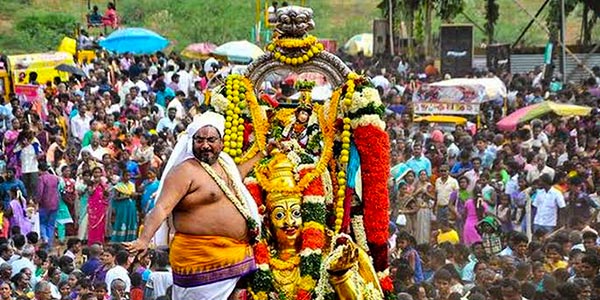
The Kavadi Attam (“kavadi dance”) is a ceremonial act of devotional sacrifice through dance, food offerings, and bodily self-mortification. It is often performed by devotees during the festival of Thaipusam in honor of Murugan. The kavadi is a heavy semicircular, decorated canopy or shrine supported by a wooden rod that the pilgrim carries on their shoulders to the temple and attached to the devotee with shrap skewers. They symbolize the burdens carried. The largest of the burdens, known as the vel kavadi, requires the person carrying it to be pierced by 108 small spears or vels! Other worshipers carry pots of milk, fruit, or grains as offerings to Lord Murgan, symbolising abundance and fertility.

The worshipers who pierce their tongues, cheeks, and faces with sharp objects hardly bleed and report feeling very little pain! Many claim that their wounds heal nearly immediately and don’t produce scars. Before being pierced, devotees are worked into a trance-like state with chanting and drums. Once entranced, the crowd helps to take care of them as they are led through the procession. Tongues are often pierced and pinned through the cheeks as a symbolic gesture of the volunteer giving up the gift of speech.

The devotee makes the pilgrimage (the nadai payanam) with bare feet, dressed in bright orange and yellow — Lord Murugan’s favorite colors — while they chant and walk to the temple. bearing food offerings on the kavadi. Depending on the location of the temple, this walk to the temple can take more than a week. The temple of Murugan in Palani is a popular destination, as it is one among the arupadai veedu (“six houses” – the sites sacred to Murugan). The Palani Murugan temple also has a reputation as a place of healing. Bogar (an ancient siddhar and devotee of Murugan) made the statue of Murugan in Palani, with the mixture of several sidhha medicines.

Devotees prepare for the celebration by keeping their body always clean, doing regular prayers, following a vegetarian diet and fasting before the Thaipusam. Kavadi-bearers have to perform elaborate ceremonies at the time of assuming the kavadi and at the time of offering it to Murugan. The kavadi-bearer observes celibacy and consumes only certain types of foods known as satvik food, once a day, while continuously thinking of God. On the day of the festival, devotees shave their heads and undertake a pilgrimage along a set route, while engaging in various acts of devotion, notably carrying the various types of kavadi. The devotees believe that worshiping lord Murugan every year in this way makes them physically and mentally healthy, and helps clear them of karmic debts they may have incurred. It is believed that only when the mind is free of material worth and the body free from physical pleasures can a devotee undertake the sacred task without feeling any pain.

At its simplest, the pilgrimage may entail walking the route carrying a pot of milk, but mortification of the flesh by piercing the skin, tongue or cheeks with vel skewers is also common. In addition, some pierce their tongues or cheeks, all the way through, with a small spear. similar practice is performed by the Nagarathar community in Pazhani, India. This is known as the Nagarathar Kavadi.