In My Hands Today…

The Vendor of Sweets – R.K. Narayan

A widower of Gandhian principles, Jagan harbours affection for his son Mali. Yet even Jagan’s patience begins to fray when Mali descends on the city of Malgudi full of modern notions.

In his early days Jagan loses his wife Ambika because of his belief in nature cures. He had never spent much time with his wife, something that causes discontent in his son Mali. Mali has got his passport and tickets ready without even informing Jagan about his plans.Mali, without his father’s permission discontinues his education, and goes to America to get training to write a book. But, the old man accepts even this diversion with good heart and treasures every letter received from Mali and proudly exhibits it to anyone who cares to listen. A few years later, he comes back very Westernized and brings along a half-American, half-Korean girl, Grace. Jagan assumes that they are married, though Mali never told him this in a straightforward way, which causes great disappointment to Jagan. Jagan however develops an affection for Grace and feels Mali is not giving her the attention she deserves.

Soon Mali expresses a desire to start a machine factory with some partners from America. He asks his father to invest in this factory. Jagan is unwilling, which causes friction between Jagan and Mali. Troubled by the turmoil, Jagan decides to retire from active working. As this is happening, Mali is caught by the police for drunkenness and deserts his wife. Jagan then asks his cousin to make sure that Mali stays in prison for some time, so that he can learn his mistakes. Jagan also gives some amount of money to the cousin so that he can buy a plane ticket to Grace so she can go back to her hometown.

In My Hands Today…

The Rug Merchant – Meg Mullins

At the heart of Meg Mullins’ debut novel is one of the most touchingly believable characters in recent fiction, a gentle soul in the body of an Iranian exile in New York. Ushman Khan sells exquisite hand-woven rugs to a wealthy clientele that he treats with perfect rectitude. He is lonely, and his loneliness becomes unbearable when he learns that his wife in Iran is leaving him. But when a young woman named Stella comes into his store, what ensues is a love story that is all the more moving because its protagonists understand tragedy. The Rug Merchant will sweep readers away with its inspiring, character-rich tale about shaking free from disappointment and finding connection and acceptance in whatever form they appear.

In My Hands Today…

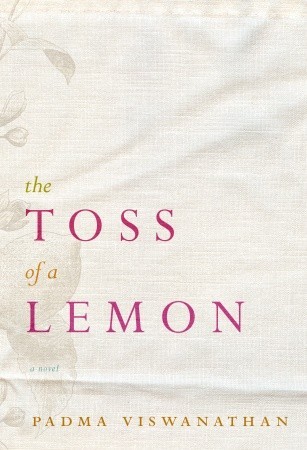
The Toss of a Lemon – Padma Viswanathan

In south India in 1896, ten-year old Sivakami is about to embark on a new life. Hanumarathnam, a village healer with some renown as an astrologer, has approached her parents with a marriage proposal. In keeping with custom, he provides his prospective in-laws with his horoscope. The problem is that his includes a prediction, albeit a weak one, that he will die in his tenth year of marriage.

Despite the ominous horoscope, Sivakami’s parents hesitate only briefly, won over by the young man and his family’s reputation as good, upstanding Brahmins. Once married, Sivikami and Hanumarathnam grow to love one another and the bride, now in her teens, settles into a happy life. But the predictions of Hanumarathnam’s horoscope are never far from her new husband’s mind. When their first child is born, as a strategy for accurately determining his child’s astrological charts, Hanumarathnam insists the midwife toss a lemon from the window of the birthing room the moment his child appears. All is well with their first child, a daughter, Thangam, whose birth has a positive influence on her father’s astrological future. But this influence is fleeting: when a son, Vairum, is born, his horoscope confirms that his father will die within three years.

Resigned to his fate, Hanumarathnam sets himself to the unpleasant task of readying his household for his imminent death. Knowing the hardships and social restrictions Sivakami will face as a Brahmin widow, he hires and trains a servant boy called Muchami to help Sivakami manage the household and properties until Vairum is of age.

When Sivakami is eighteen, Hanumarathnam dies as predicted. Relentless in her adherence to the traditions that define her Brahmin caste, she shaves her head and dons the white sari of the widow. With some reluctance, she moves to her family home to raise her children under the protection of her brothers, but then realizes that they are not acting in the best interests of her children. With her daughter already married to an unreliable husband of her brothers’ choosing, and Vairum’s future also at risk, Sivakami leaves her brothers and returns to her marital home to raise her family.

With the freedom to make decisions for her son’s future, Sivakami defies tradition and chooses to give him a secular education. While her choice ensures that Vairum fulfills his promise, it also sets Sivakami on a collision course with him. Vairum, fatherless in childhood, childless as an adult, rejects the caste identity that is his mother’s mainstay, twisting their fates in fascinating and unbearable ways.

In My Hands Today…

Water – Bapsi Sidhwa and Deepa Mehta

Set in 1938, against the backdrop of Gandhi’s rise to power, Water follows the life of eight-year-old Chuyia, abandoned at a widow’s ashram after the death of her elderly husband. There, she must live in penitence until her death. Unwilling to accept her fate, she becomes a catalyst for change in the widows’s lives. When her friend Kalyani, a beautiful widow-prostitute, falls in love with a young, upper-class Gandhian idealist, the forbidden affair boldly defies Hindu tradition and threatens to undermine the ashram’s delicate balance of power. This riveting look at the lives of widows in colonial India is ultimately a haunting and lyrical story of love, faith, and redemption.

In My Hands Today…

A Good Indian Wife – Anne Cherian

Handsome anesthesiologist Neel prides himself on his decisiveness, both in and out of the operating room. So when he agrees to return to India to visit his ailing grand­father, he is sure he’ll be able to resist his family’s pleas that he marry a “good” Indian girl. With a girlfriend and a promising career back in San Francisco, the last thing Neel needs is an arranged marriage.

Leila is a thirty-year-old teacher in Neel’s family’s village who has watched too many prospective husbands come and go to think her newest suitor will be any different. She is well past prime marrying age; her family has no money for a dowry; and then there’s the matter of an old friendship with a Muslim boy named Janni.

Neel and Leila struggle to reconcile their own desires with the expectations of others in this riveting story of two people, two countries, and two ways of life that may be more compatible than they seem.