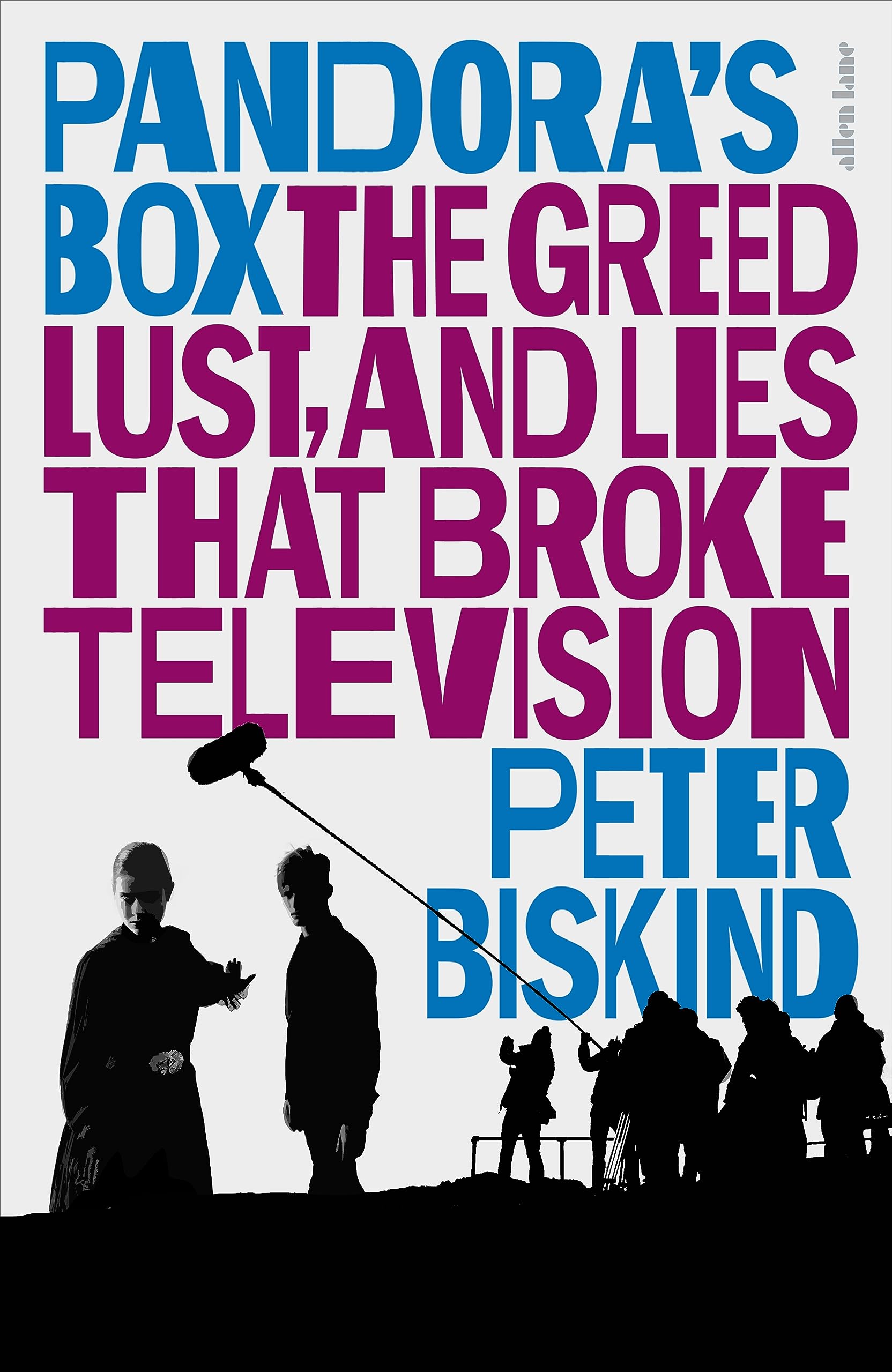
Pandora’s Box: The Greed, Lust, and Lies that Broke Television – Peter Biskind
We are now lucky enough to be living through the era of so-called Peak TV, in which television, in its various formats, has seized the entertainment mantle from movies and dominates our leisure time. How and why this happened is the subject of this book.
Instead of focusing on one service, like HBO, Pandora’s Box asks, “What did HBO do besides give us The Sopranos?” The answer: It gave us a revolution. Biskind bites off a big chunk of entertainment history, following HBO from its birth to maturity, moving on to the basic cablers like FX and AMC, and ending with the streamers and their wars, pitting Netflix against Amazon Prime Video, Max, and the killer pluses—Disney, Apple TV, and Paramount.
Since the creative and business sides of TV are thoroughly entwined, Biskind examines both, and the interplay between them. Through frank and shockingly intimate interviews with creators and executives, Pandora’s Box investigates the dynamic interplay of commerce and art through the lens the game-changing shows they aired—not only old warhorses like The Sopranos, but recent shows like The White Lotus, Succession, and Yellow- (both -stone and -jackets)—as windows into the byzantine practices of the players as they use money and guile to destroy their competitors. With its long view and short takes—riveting snapshots of behind-the-scenes mischief—Pandora’s Box is the only book you’ll need to read to understand what’s on your small screen and how it got there.
Last week during the September school holidays, finally GG and I caught Crazy Rich Asians. I had read the book a few years back when it first released and was actually looking forward to the movie when it was announced.
The film was super hyped here in Singapore and probably rightly so since the movie is set in this city-state and would bring tremendous world attention, especially the tourism dollars here.
The movie, to me especially, didn’t live up to the book. But then, that’s me and there’s rarely any movie which lives up to the movie in my head, so I’ll let that ride. The film is an unabashed and cinematic depiction of Singapore and the Singapore Tourism Board should be happy with the outcome of the dollars they have spent on this movie. The movie is a celebration of Singapore and even though I am sure not all scenes shown as Singapore has actually been shot here, it was fun to see familiar landmarks on the big screen and try to decipher where a particular scene could have been shot.
Crazy Rich Asians follows Rachel Chu (Constance Wu), a Chinese American economics professor at NYU who’s been dating fellow professor Nick Young (Henry Golding) for over a year. For their spring break, Nick invites Rachel to visit his home of Singapore, where he’s returning for his best friend Colin’s (Chris Pang) wedding. Rachel decides to join him, meaning it will be the first time she’s met his family, including his mother Eleanor (Michelle Yeoh). Plus, it gives Rachel the chance to visit her college best friend, Peik Lin (Awkwafina), who also lives in Singapore. However, when Rachel and Nick are upgraded to first class on their flight, she quickly realizes her long-term boyfriend hasn’t been completely upfront about his family – particularly how wealthy they are – and it takes her by surprise.
Once they arrive in Singapore, Rachel is quickly accepted by Colin’s fiancée Araminta (Sonoya Mizuno), and she’s invited to the bachelorette party, while Colin and Nick must suffer through a bachelor party thrown by their former classmate Bernard Tai (Jimmy O. Yang). However, Rachel’s approached by Nick’s ex-girlfriend Amanda (Jing Lusi) and feels less than welcome. Things only get worse when Nick introduces Rachel to Eleanor, who decidedly doesn’t think Rachel is good enough for her son. With the help of Peik Lin – and some allies in Nick’s family, Nick’s cousin Astrid (Gemma Chan) and second cousin Oliver (Nico Santos) – Rachel must decide if she wants to fight for Nick, or escape from the extravagant world of Singapore’s rich and famous in favour of her relatively quiet life in New York City.
The film is fun, light and frothy and I loved Rachel’s character. She is a smart, well read and an independent woman who is not afraid to call out Nick when he is wrong. Another strong woman on the show was Astrid played by Gemma Chan. I loved her in the book and though her character was not as well fleshed out as I would have liked it, I am looking forward to her story in more detail when the sequel comes out.
Someone watching this movie may think Singapore is filled with Chinese millionaires and billionaires as almost everyone in the film is Chinese and a millionaire. You would be hard pressed to find other races in the film (Singapore is a multi-cultural and multi-racial society), not even in scenes which show them socialising (except for the one where Rachel befriends the Malay princess Intan).
All in all, this is a fun film and for those who don’t know Singapore, this is a good starting point. Singapore is shot very well and I am sure the STB will use parts of the film as marketing campaigns moving forward.
My verdict: Do go and see the film, you won’t regret it!
Based on a real-life female spy immortalised in Harinder Sikka’s spy thriller, Calling Sehmat, Raazi was a real treat to watch.
Set in the months before the India-Pakistan war of 1971 and the liberation of Bangladesh, this film is all about Sehmat (Alia Bhat), a young 20-year-old Kashmiri Delhi University student. She comes from a family who believes in the adage, ‘country before self’ and whose father Hidayat Khan (Ranjit Kapoor), is a double agent for the Indian intelligence community whose close friend is Brigadier Syed (Shishir Sharma) from the Pakistan Armed Forces to whom he feeds carefully curated information.
Since Hidayat has been diagnosed with cancer, he decides to send his untrained daughter into the enemy camp in an audacious plan, get her married to Syed’s son Iqbal (Vicky Kaushal) and plant her into the home of the enemy to glean information and pass it to the Indian intelligence. The film is then all about how Sehmat tries to win over her in-laws and how she gathers information from their home and from that of the homes of their friends and colleagues and how she is almost caught every time.
She is never suspected by anyone, except an old family retainer, Abdul (Arif Zakaria) who came over from India at Partition and one day is caught by him. She then kills him by crushing him under a vehicle, her first murder in this operation. Her brother-in-law (Ashwath Bhatt) then starts suspecting her because the retainer tries to use her name when he is found and hospitalised, and she then kills him too.
The Pakistani intelligence then suspects that someone from the Syed household is leaking secrets and when Sehmat fears that she will get caught, she hides all her spying equipment in Abdul’s room. When the cache is found out, Iqbal realises it’s his wife and not Abdul who is the real spy. Sehmat also realises that Iqbal knows her secret and she flees from the home using the grandson of a senior officer as a shield and when Iqbal confronts her with the authorities, the Indian spymaster and her handler, Khalid Mir (Jaideep Alhawat) decide to eliminate both of them, only to realise that Sehmat had tricked everyone and she was safe. She returns back to India only to find out that she is pregnant. She refuses to abort the child and moves away from everything. It is shown that the child is now an officer in the Indian Armed Forces.
I found the casting absolutely spot on! The actors portraying the Pakistani characters seemed so authentic that it seemed to me I was watching a Hum TV drama (a Pakistani television channel).
With every movie that I see, Alia Bhat impresses me even more. I feel she has come a long way since her debut and her fresh-faced innocence as Sehmat is wonderful. She owns the movie and you find yourself rooting for her at every turn (even though you kind of know she will triumph in the end, this being a Bollywood film). The film also stars Alia’s mum Soni Razdan and when you see the two of them in the same shot, you realise how much Alia resembles her mum.
Jaideep Alhawat as Khalid Mir, the Indian spymaster and Sehmat’s handler was very impressive as the cold-blooded, ruthless spy for whom it is country before everything else. Vicky Kaushal as Iqbal was fantastic and the chemistry between him and Alia was superb!
The music in the film was evocative of the seventies and was fairly unobtrusive, never really becoming a focus of attention, but blended beautifully in the background. I loved both the rendering of Ae Watan.
Meghna Gulzar really deserves each and every award that she is sure to get when the awards season starts.
My verdict – please do go and watch the film, it’s worth it!
Padmaavat, the renamed version of Sanjay Leela Bhansali’s Padmavati was one of the most anticipated movies in recent times. You don’t have to be an Indian to know this as there have been reports across various media about how the Rajput Karni Sena was stalling the release of the film. Having finally watched the film, I actually failed to figure out what the hullabaloo was all about. In fact, they should be thankful to SLB for the positive spin he gave the whole community as the film seemed to be a pean of homage to this community. Instead of going to his set and slapping him, they should be applauding and felicitating him! On to the movie…
As is all Bhansali films, this film’s visuals were lush and beautiful and the beauty of Rajasthan was very well captured here. The contrast between the rugged desert beauty of Rajasthan and lush tropical Sri Lanka where Deepika’s character Princess Padmavati is from is very vivid. I ogled over the gorgeous clothes and jewellery that the main characters wore, but there were times when it looked like an extended clothes/jewellery commercial, especially scenes when the director focused on them for long periods of time.
Ranveer Singh excelled in his role as the villainous Alauddin Khilji, the ruler of Delhi, who lusts after Rani Padmavati, whom he has never seen actually, but heard about her beauty and so wants to possess her. Singh plays the role with his usual flamboyance, but there were times when watching the movie, I felt that I’ve seen this role before. He seems to do the pretty same larger than life role in almost every film and is probably already getting typecast. It does help that, from what I’ve seen and read so far, he has a similar personality in real life too! I’d love to see him a completely different role just to showcase his acting ability.
Deepika Padukone as the Sri Lankan immigrant Rani Padmavati was beautiful, graceful and poised. I feel she has grown in her acting and was pretty restrained throughout the movie. She really came on her own in the second half of the movie, when she goes to rescue her husband who was imprisoned by deceit by Khilji and also shows what a strategist she is when she gets revenge on the brahmin who was behind all the angst in her life by putting his death as a precondition to her even leaving her palace.
Shahid Kapoor as Maharawal Ratan Singh, the king of Chittor who goes to Singhal to purchase pearls which his first wife wanted and falls in love with the Singhal princess Padmavati and brings her back to his palace was regal and unflappable. He brims with Rajput pride and there are umpteen instances of dialogues from his mouth which talk about what an honourable Rajput should do and what are the qualities of a Rajput. He is shown to be everything that is good in a person, but the character felt very one dimensional. I mean, is there really anyone in the world who is so good and who does not have any flaws? Seemed to me that the director in his effort to showcase the differences between Ratan Singh and Khilji, made one saccharine sweet and the other a hated warmonger!
Other characters who caught my eye were Mehrunissa and Malik Khafur. Mehrunissa, Khiji’s wife and cousin, who fell in love with him and then was traumatised on her wedding day when she learnt about his infidelity is portrayed very understatedly by Aditi Rao Hydari. I wish there was more screen time for this character who tried, in her way to undermine Khiji’s atrocities especially when it came to Padmavati. Malik Khafur, Khilji’s ruthless eunuch general, played by Jim Sarb was another fine performance. The scenes between Khilji and Malik Khafur had lots of homophobic tones in their interactions.
I did find that there was not so much chemistry between Ratan Singh and Padmavati, which was a bit of a disappointment as in previous Bhansali films, the leads had intense chemistry which added to the film. Also, music which in previous films have always been wonderful didn’t really pull me in this time. Except for the controversial Ghoomar song, none of the other songs really stayed with me after I exited the theatre.
Another thing I really have to point out. This movie is set in the thirteenth century where women’s right’s were pretty non-existent, especially in patriarchy fuelled societies like the Rajputs. So in that sense, the director is not wrong in infusing the movie with a lot of patriarchy driven dialogues which had me cringing in my seat. The worst was towards the end of the movie, the night before Ratan Singh’s duel with Khilji (which Khilji won because Malik cheated and killed Singh with arrows on his back), Padmavati and Singh have some tender moments and during that, she asks her husband permission to kill herself and perform Jauhar should the need arise. The reason she gives is that she needs her husband’s permission to even die, which, in this day and age sounds weird to me.
The last scene, the controversial (I’ve used this word a lot in this post) Jauhar scene is quite over the top, showing hundreds of women, all dressed in bridal red, with the camera lovingly focussing on young girls and a pregnant woman, all walking towards a humongous funeral pyre led by Padmavati to escape the clutches of the evil enemies, whose main aim in the attack was getting Padmavati. I sat, cringing at this, because I don’t believe a woman’s existance ends when her man’s existance ends. But this is a film and the director’s vision, so I let it go. I also let it go because this was probably how men in ancient India kept their women firmly downtrodden.
As I walked out of the theatre, I thanked God, I was not born in that era!
On Sunday, GG and I caught the live-action remake of Disney’s Beauty and the Beast. This film is rated PG in Singapore which meant she could not see it with her friends. But honestly, I really didn’t the big deal about it being PG as the theatre was filled with young children and their parents, many much younger than GG!
Emma Watson was aptly cast as the bookish, but brave Belle while the actor who played the Beast, Dan Stevens only showed his true self at the very end, was scary initially as the beast and one who got our sympathy as the movie moved along. Luke Evan’s Gaston was also spot on as the slightly slimy and pretentious character he was.
The film is pretty true to the animated version and those who’ve seen it will follow the movie. I loved the songs and GG hummed along with the soundtrack. The film is longer than the typical Hollywood movie with a running time of 129 minutes. It also gives a bit of the backstory about why the Beast behaved the way he did in the beginning (when he gets cursed) as well as a bit of Belle’s background, especially about her dead mother. These scenes, which are experienced by Belle with the Beast show us and Belle his soft side and are probably instrumental in getting her to fall in love with him.
As to the other cast, my favourite of the household help was Lumiere, Beast’s butler who turned into a candlestick voiced and enacted by Ewan McGregor. The interplay between him and the majordomo turned clock Cogsworth played by Ian McKellen was lovely to watch as was the romance between Lumiere and Plumette, the housemaid played by Gugu Mbatha-Raw who had been turned into a feather duster. I also loved how Mrs Potts (Emma Thompson) and Chip (Nathan Mack) were interpreted, and would have loved to have more scenes between the two. Another interesting character was Gaston’s sidekick LeFou who was played quite flamboyantly by Josh Gad. He was an out and out closet case, corrupt and utterly devoted to Gaston, but who in the finale changes sides and moves to the side of the good.
I also liked that throughout the film, there was a lot of racial diversity, but I’d image that in the 16th century France where the film is set, especially in the small village of Villeneuve where Belle lives and the nearby castle of the Beast, you would not expect to see this kind of racial diversity.
On to the elephant in the room, the overtly gay scene which everyone was talking about. Because of this scene and perhaps one more somewhere in the middle of the film, Malaysia has postponed the release of this film indefinitely. Both the scenes were, according to me, not worth the hype it generated. Agreed that this is a children’s film, but the violence where the Beast fends off the wolves and also when the villagers come to kill the beast and ransack the castle would probably be more frightening to children than these scenes. These were literally blink and miss scenes and I seriously doubt any child in the theatre (and there were plenty the day we saw the film) would have even realised what was happening in that fraction of a second.
So there you have it, a film which is surely worth the ticket price (plus the popcorn you will inevitably buy). Please do go and see it if you haven’t yet. If you have, I’d love to hear what you thought of it.
Here are some trailers from the film for those who haven’t seen it yet.

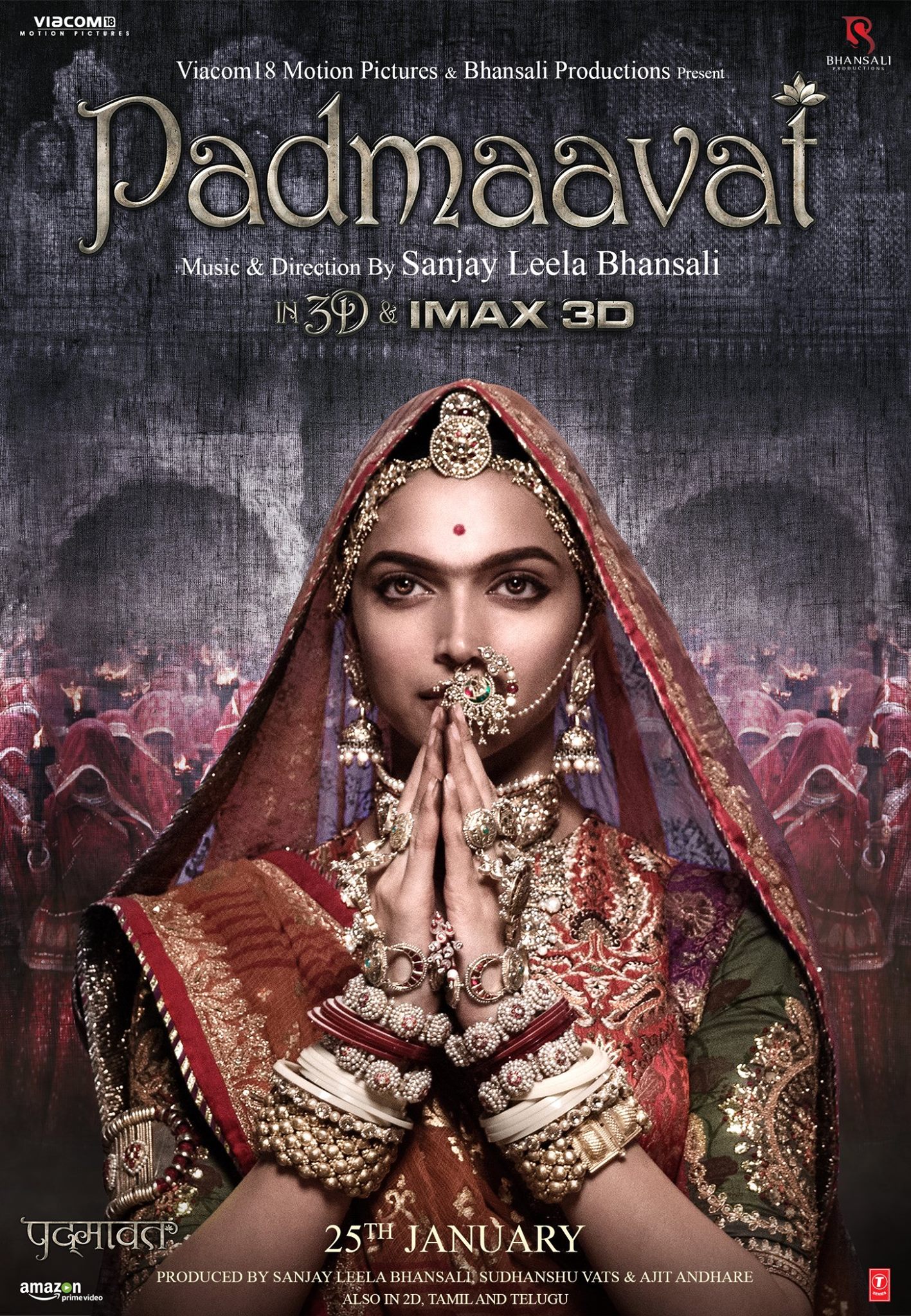 Padmaavat, the renamed version of Sanjay Leela Bhansali’s Padmavati was one of the most anticipated movies in recent times. You don’t have to be an Indian to know this as there have been reports across various media about how the Rajput Karni Sena was stalling the release of the film. Having finally watched the film, I actually failed to figure out what the hullabaloo was all about. In fact, they should be thankful to SLB for the positive spin he gave the whole community as the film seemed to be a pean of homage to this community. Instead of going to his set and slapping him, they should be applauding and felicitating him! On to the movie…
 Memories and Such
