In My Hands Today…

The Taste of Empire: How Britain’s Quest for Food Shaped the Modern World – Lizzie Collingham

In The Taste of Empire, acclaimed historian Lizzie Collingham tells the story of how the British Empire’s quest for food shaped the modern world.

Told through twenty meals over the course of 450 years, from the Far East to the New World, Collingham explains how Africans taught Americans how to grow rice, how the East India Company turned opium into tea, and how Americans became the best-fed people in the world.

In The Taste of Empire, Collingham masterfully shows that only by examining the history of Great Britain’s global food system, from sixteenth-century Newfoundland fisheries to our present-day eating habits, can we fully understand our capitalist economy and its role in making our modern diets.

In My Hands Today…

Kitchen Confidential: Adventures in the Culinary Underbelly – Anthony Bourdain

A deliciously funny, delectably shocking banquet of wild-but-true tales of life in the culinary trade from Chef Anthony Bourdain, laying out his more than a quarter-century of drugs, sex, and haute cuisine.

New York Chef Tony Bourdain gives away secrets of the trade in his wickedly funny, inspiring memoir/expose. Kitchen Confidential reveals what Bourdain calls “twenty-five years of sex, drugs, bad behavior and haute cuisine.”

Recipes: Mor Chaar

This recipe is from my memories. My mother used to go to the market and do her rounds of the temple in Matunga about thrice a week from time I can remember. It has stopped now because of COVID, and had reduced to about twice a week a couple of years back, but this used to be the routine all through my growing up years. On those days, she would have to come back home and then make dinner for us. Some days, when time was short, she used to rustle this dish up to go with rice and any leftover stir fry vegetable. An extremely quick recipe, this can be made in less than 10 minutes start to finish. My mother used to add tomatoes to it, which, because of the quick cooking time would be slightly raw and which I hated at that time. So I would make sure I avoided getting any tomatoes in my plate. My sister, on the other hand, loved the tomatoes, so to us, it was a win-win situation. My version does not have any tomatoes, but you can add them if you want. This can also be a version of Kadhi, albeit one without any thickening agent like coconut or chickpea flour.

This dish is prepared across Tamil households and made when you need to make something very quickly. It can also be drunk as a cooling yoghurt based dish when it is hot outside as it will cool the body down. I served this with a carrot thogayal and a vegetable stir-fry for lunch with brown rice.

Mor Chaar

Ingredients:

  • 1 cup yoghurt, thinned to about 2 cups and beaten well
  • Salt to taste
  • 1 tsp oil
  • 1 tsp mustard seeds
  • ¼ tsp fenugreek seeds
  • ¼ tsp asafoetida
  • 5-6 curry leaves
  • ¼ tsp turmeric powder
  • 2-3 dried red chillies
  • Finely chopped coriander leaves to garnish

Method:

  • Whisk the yoghurt to thin it, add salt to taste and keep aside.
  • Heat the oil in a pan and when the oil warms, add the mustard seeds
  • When the mustard seeds pop, add the fenugreek seeds, dried red chillies, asafoetida and curry leaves and let the curry leaves crackle.
  • Add the turmeric powder and stir for a couple of seconds.
  • Now reduce the flame of the gas and pour in the whisked yoghurt, continuously stirring so the yoghurt does not curdle.
  • Keep stirring and whisking the buttermilk and on a low to medium flame, let this come to a nice rolling boil.
  • Boil for a few minutes and switch off. Garnish with coriander leaves and serve hot with rice and a vegetable.

Recipes: Indian Style Vegetable Soup

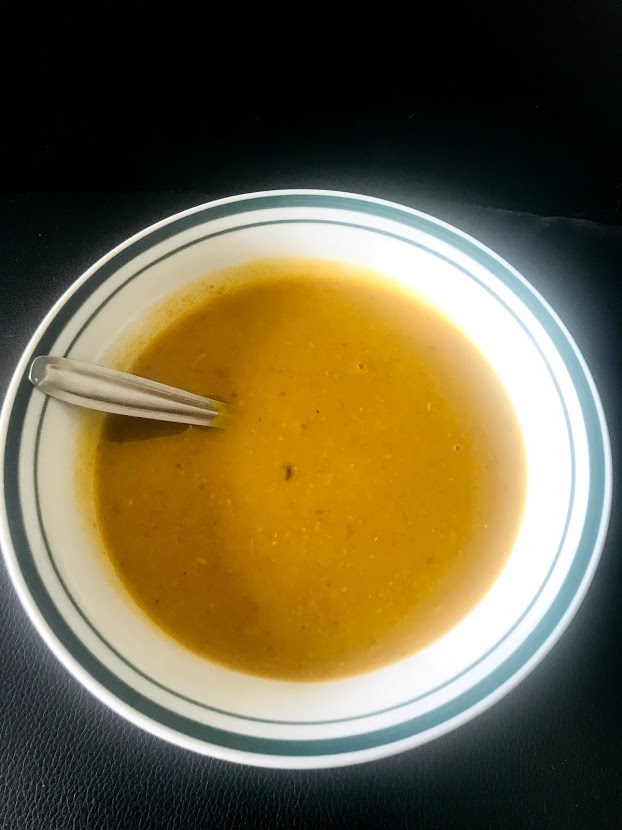
Back in the days when I was a teen and in my early twenties, I used to diet and soups was a huge part of that diet, especially for dinner. And the soup I am sharing today is inspired by those soups that my mother used to make for me. It is quite easy to make and is pretty much a one pot meal which is cooked in the pressure cooker.

The colour of the soup will be dependent on the vegetables used and mine turned a bit greenish because of the green vegetables I used.

Indian Style Vegetable Soup

Ingredients:

  • 2 cups chopped vegetables (you can use any combination you like, this time I used potatoes, sweet potatoes, carrots, cauliflower, broccoli and frozen green peas)
  • 2 medium sized onions, roughly chopped
  • 1 bulb of garlic, peeled
  • 1 inch piece of ginger, peeled
  • 1 small bunch of coriander leaves, roughly chopped
  • 2-3 dried red chillies
  • 1 tsp cumin seeds
  • 1 tsp fennel seeds
  • 4-5 cloves
  • 4-5 cardamom pods
  • 1 inch piece of cinnamon
  • 1 bay leaf
  • 1 tsp coriander seeds
  • ¼ tsp turmeric powder
  • Pepper powder to taste
  • Salt to taste
  • 1 tsp oil

Method:

  • Chop the vegetables and keep aside
  • Roughly chop the onions and the garlic and ginger and keep aside
  • Heat oil in the pressure cooker and when the oil warms up, add the cumin seeds first and when the seeds start spluttering, add the fennel seeds and then the cloves, cardamom and cinnamon and give it a good stir.
  • Next add the garlic and ginger and stir it for a while till the garlic starts to brown.
  • Then add the turmeric powder, stir a bit and then add the vegetables and the coriander leaves. Stir a bit, add the bay leaf and add just enough water that the vegetables don’t stick to the bottom of the pressure cooker.
  • Let the pressure build up and cook for about 4-5 whistles. Switch off the flame, let the pressure ease and the vegetables cool.
  • If you are cooking on the stovetop, then cover and cook until the vegetables are completely cooked and starting to fall apart. Switch off the gas and let it cool.
  • When the vegetables are cooled enough, transfer to a blender and in batches blend it as fine or as chunky as you like.
  • When it’s blended to your liking, transfer it back to the pan, add enough water to bring it to the consistency you want and let it come to a nice rolling boil. Season with salt and pepper.
  • When it has been boiling for about 10 minutes in a low medium flame, switch off the flame and have hot with some croutons.

Notes:

  • The coriander leaves add a green colour to the soup and can be omitted if this is a vegetable you don’t like.
  • Tomatoes are also a wonderful addition to the soup. If adding tomatoes, make an x cross at the stem of the tomatoes and put it whole on top of the vegetables while cooking. Once the vegetables are cooked, remove the tomato with a slotted spoon and it can be easily peeled. Then blend it along with the other vegetables.

In My Hands Today…

Eat a Peach – David Chang and Gabe Ulla

In 2004, David Chang opened a noodle restaurant named Momofuku in Manhattan’s East Village, not expecting the business to survive its first year. In 2018, he was the owner and chef of his own restaurant empire, with 15 locations from New York to Australia, the star of his own hit Netflix show and podcast, was named one of the most influential people of the 21st century and had a following of over 1.2 million. In this inspiring, honest and heartfelt memoir, Chang shares the extraordinary story of his culinary coming-of-age.

Growing up in Virginia, the son of Korean immigrant parents, Chang struggled with feelings of abandonment, isolation and loneliness throughout his childhood. After failing to find a job after graduating, he convinced his father to loan him money to open a restaurant. Momofuku’s unpretentious air and great-tasting simple staples – ramen bowls and pork buns – earned it rave reviews, culinary awards and before long, Chang had a cult following.

Momofuku’s popularity continued to grow with Chang opening new locations across the U.S. and beyond. In 2009, his Ko restaurant received two Michelin stars and Chang went on to open Milk Bar, Momofuku’s bakery. By 2012, he had become a restaurant mogul with the opening of the Momofuku building in Toronto, encompassing three restaurants and a bar.

Chang’s love of food and cooking remained a constant in his life, despite the adversities he had to overcome. Over the course of his career, the chef struggled with suicidal thoughts, depression and anxiety. He shied away from praise and begged not to be given awards. In Eat a Peach, Chang opens up about his feelings of paranoia, self-confidence and pulls back the curtain on his struggles, failures and learned lessons. Deeply personal, honest and humble, Chang’s story is one of passion and tenacity, against the odds.