In My Hands Today…

Savarkar: Echoes from a Forgotten Past, 1883–1924 – Vikram Sampath
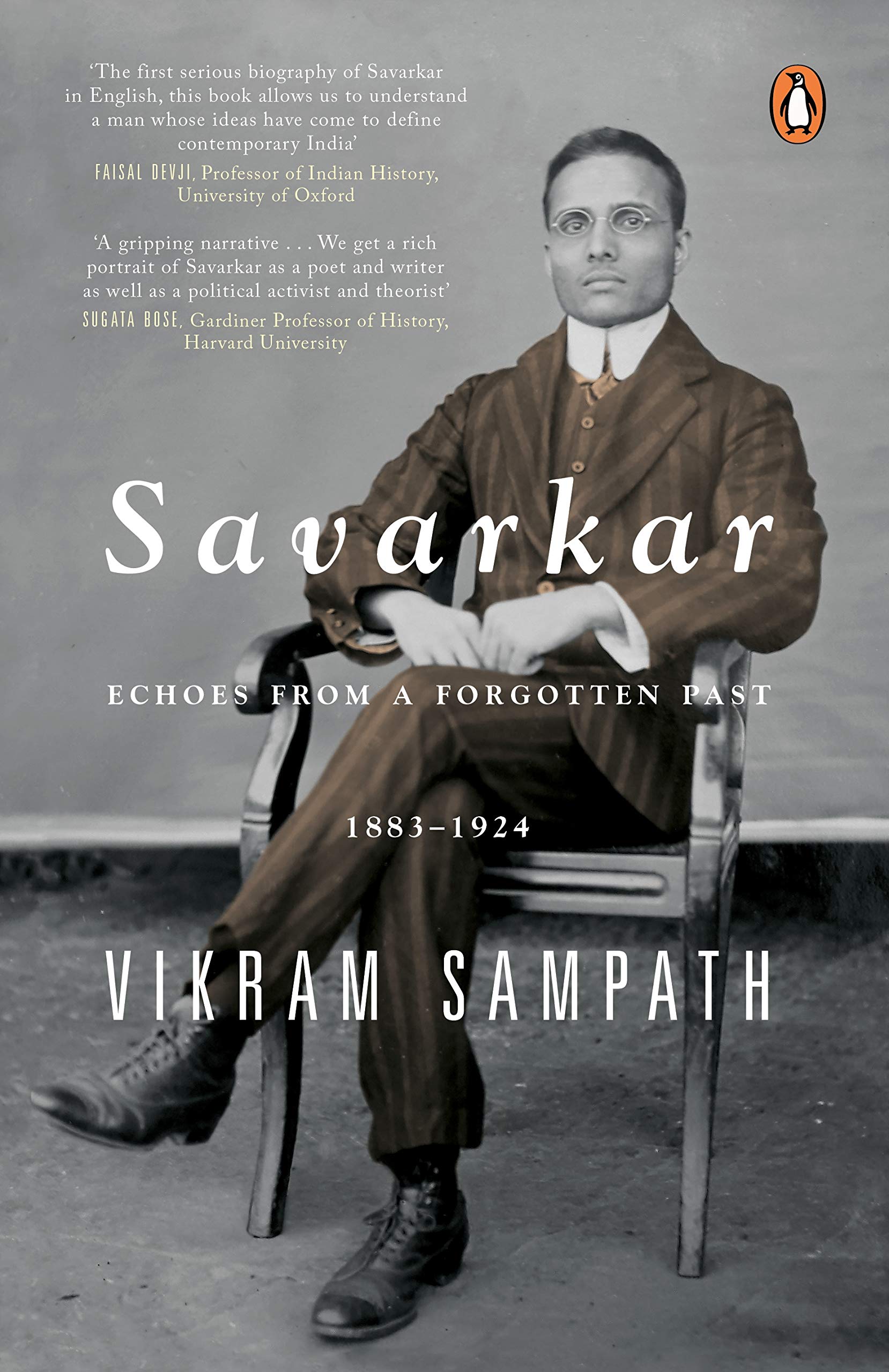
As the intellectual fountainhead of the ideology of Hindutva, which is in political ascendancy in India today, Vinayak Damodar Savarkar is undoubtedly one of the most contentious political thinkers and leaders of the twentieth century. Accounts of his eventful and stormy life have oscillated from eulogizing hagiographies to disparaging demonization. The truth, as always, lies somewhere in between and has unfortunately never been brought to light. Savarkar and his ideology stood as one of the strongest and most virulent opponents of Gandhi, his pacifist philosophy and the Indian National Congress.

An alleged atheist and a staunch rationalist who opposed orthodox Hindu beliefs, encouraged inter-caste marriage and dining, and dismissed cow worship as mere superstition, Savarkar was, arguably, the most vocal political voice for the Hindu community through the entire course of India’s freedom struggle. From the heady days of revolution and generating international support for the cause of India’s freedom as a law student in London, Savarkar found himself arrested, unfairly tried for sedition, transported and incarcerated at the Cellular Jail, in the Andamans, for over a decade, where he underwent unimaginable torture.

From being an optimistic advocate of Hindu-Muslim unity in his treatise on the 1857 War of Independence, what was it that transformed him in the Cellular Jail to a proponent of ‘Hindutva’, which viewed Muslims with suspicion?

Drawing from a vast range of original archival documents across India and abroad, this biography in two parts-the first focusing on the years leading up to his incarceration and eventual release from the Kalapani-puts Savarkar, his life and philosophy in a new perspective and looks at the man with all his achievements and failings.


In My Hands Today…

Flowers of Fire: The Inside Story of South Korea’s Feminist Movement and What It Means for Women’s Rights Worldwide – Hawon Jung

Since the beginning of the #MeToo movement, tens of thousands of people in South Korea have taken to the street, and many more brave individuals took a stand, to end a decades-long abortion ban and bring down powerful men accused of sexual misconduct—including a popular presidential contender. South Korean feminists know that the revolution has been a long time coming, between battles against its own patriarchal society as well as challenging stereotypes of docile Asian women in the Western imagination.

Now, author Hawon Jung will show the rest of the world that these women are no delicate flowers—they are trailblazing flames. Flowers of Fire takes the reader into the trenches of this fight for equality, following along as South Korean activists march on the streets, navigate public and private spaces where spycam porn crimes are rampant, and share tips and tricks with each other as they learn how to protect themselves from harassment and how to push authorities to act.

Jung, the former Seoul correspondent for the AFP, draws on her on-the-ground reporting and interviews with many women who became activists and leaders, from the elite prosecutor who ignited the country’s #MeToo movement to the young women who led the war against non-consensual photography. Their stories, though long overlooked in the West, mirror realities that women across the world are all too familiar with: threats of defamation lawsuits to silence victims of assault, tech-based sexual abuse, and criminal justice systems where victims’ voices are often met with suspicion and abusers’ downfalls are met with sympathy. These are the issues at the heart of their #MeToo movement, and South Korean women have fought against them vigorously—and with extraordinary success. In Flowers of Fire, Jung illuminates the strength and tenacity of these women, too often sidelined in global conversations about feminism and gender equality.

In My Hands Today…

Everything Is Predictable: How Bayesian Statistics Explain Our World – Tom Chivers

At its simplest, Bayes’s theorem describes the probability of an event, based on prior knowledge of conditions that might be related to the event. But in Everything Is Predictable, Tom Chivers lays out how it affects every aspect of our lives. He explains why highly accurate screening tests can lead to false positives and how a failure to account for it in court has put innocent people in jail. A cornerstone of rational thought, many argue that Bayes’s theorem is a description of almost everything.

But who was the man who lent his name to this theorem? How did an 18th-century Presbyterian minister and amateur mathematician uncover a theorem that would affect fields as diverse as medicine, law, and artificial intelligence?

Fusing biography, razor-sharp science writing, and intellectual history, Everything Is Predictable is an entertaining tour of Bayes’s theorem and its impact on modern life, showing how a single compelling idea can have far reaching consequences.

In My Hands Today…

Dinosaurs at the Dinner Party: How an Eccentric Group of Victorians Discovered Prehistoric Creatures and Accidentally Upended the World – Edward Dolnick

In the early 1800s the world was a safe and cozy place. But then a twelve-year-old farm boy in Massachusetts stumbled upon a row of fossilized three-toed footprints the size of dinner plates—the first dinosaur tracks ever found. Soon, in England, Victorians unearthed enormous bones—bones that reached as high as a man’s head.

Outside of myths and fairy tales, no one had imagined that creatures like three-toed giants once lumbered across the land. And if anyone conjured up such a scene, they would never imagine that all those animals could have vanished hundreds of millions years ago. The thought of sudden, arbitrary disappearance from life was unnerving and forced the Victorians to rethink everything they knew about the world. Celebrated storyteller and historian Edward Dolnick leads readers through a compelling true adventure as the paleontologists of the first half of the 19th century puzzled their way through the fossil record to create the story of dinosaurs we know today.

In My Hands Today…

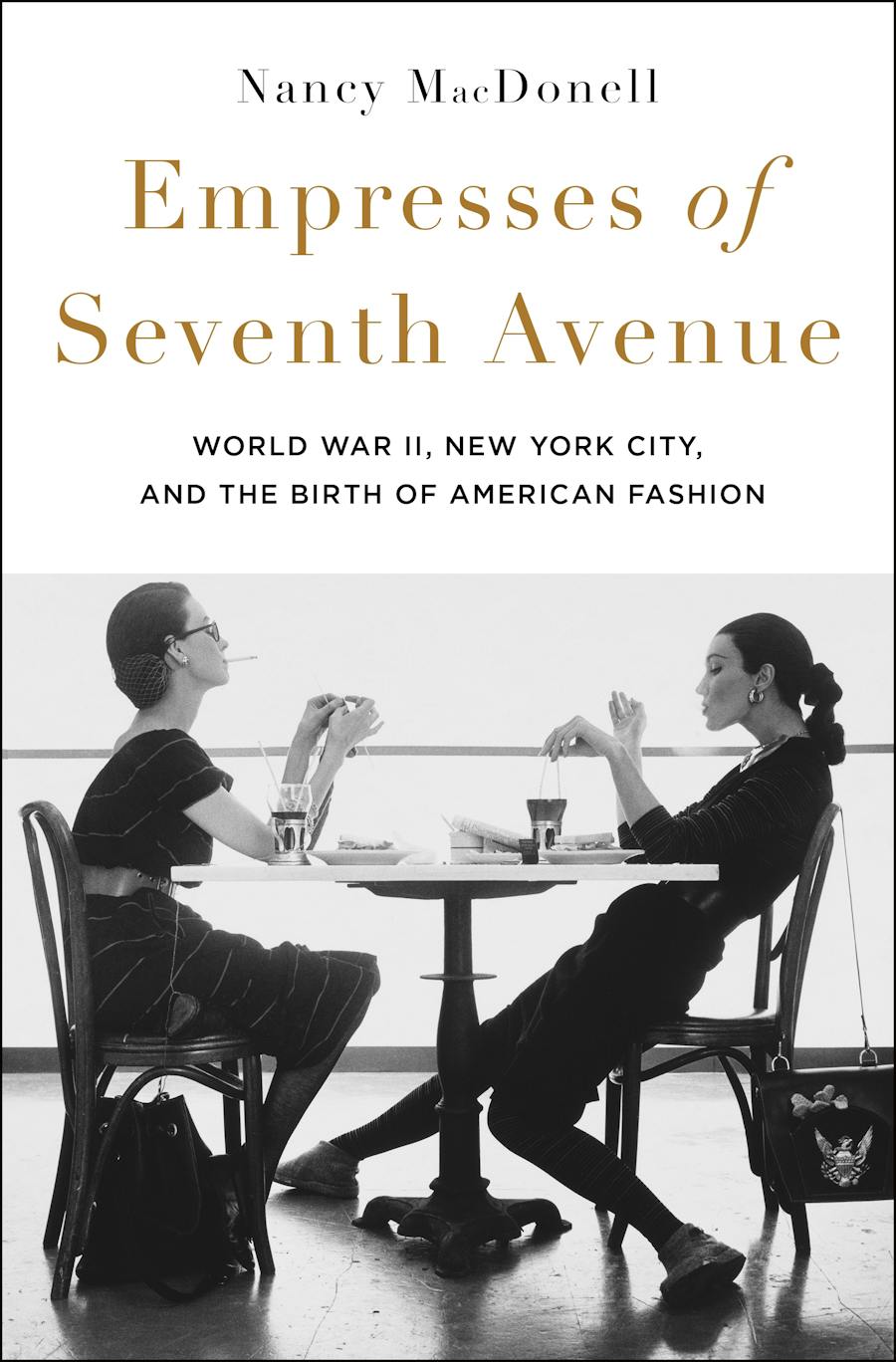
Empresses of Seventh Avenue: World War II, New York City, and the Birth of American Fashion – Nancy MacDonell

Calvin Klein. Ralph Lauren. Donna Karan. Halston. Marc Jacobs. Tom Ford. Michael Kors. Tory Burch. Today, American designers are some of the biggest names in fashion, yet before World War II, they almost always worked anonymously. The industry, then centered on Seventh Avenue in Manhattan, had always looked overseas for “inspiration”—a polite phrase for what was often blatant copying—because style, as all the world knew, came from Paris.

But when the Nazis invaded France in 1940, the capital of fashion was cut off from the rest of the world. The story of the chaos and tragedy that followed has been told many times—but how it directly affected American fashion is largely unknown.

Defying the naysayers, New York-based designers, retailers, editors, and photographers met the moment, turning out clothes that were perfectly suited to the American way of life: sophisticated, modern, comfortable, and affordable. By the end of the war, “the American Look” had been firmly established as a fresh, easy elegance that combined function with style. But none of it would have happened without the influence and ingenuity of a small group of women who have largely been lost to history.

Empresses of Seventh Avenue will tell the story of how these extraordinary women put American fashion on the world stage and created the template for modern style—and how the nearly $500 billion American fashion industry, the largest in the world, could not have accrued its power and wealth without their farsightedness and determination.