

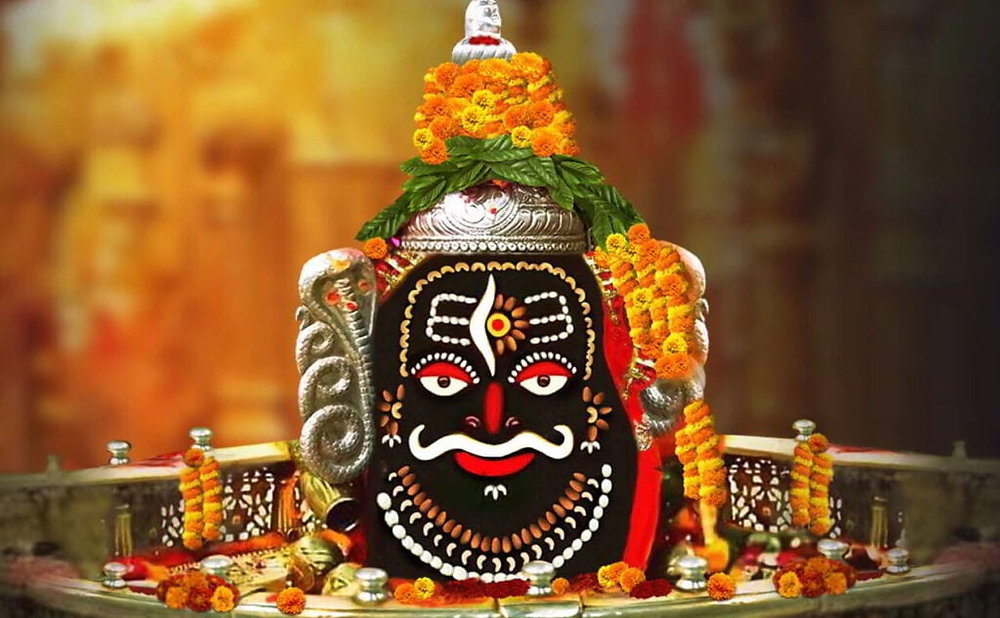
In the ancient city of Ujjain, perched on the banks of the holy Shipra River in Madhya Pradesh, stands the majestic Mahakaleshwar Temple, a storied sanctuary of Lord Shiva, honoured as one of the twelve Jyotirlingas in India. Mahakaleshwar, meaning “The Lord of Time and Death,” is unique for its south-facing linga or dakshinamukhi, a rare feature symbolising Shiva’s might over death itself. Throughout centuries, the temple has drawn kings, saints, poets, and millions of devotees, serving both as a spiritual epicentre and a monument to resilience amid cycles of destruction and renewal. In Ujjain, the cosmic rhythms of time and faith converge, making Mahakaleshwar a beacon in the Jyotirlinga pilgrimage and the soul of the city’s religious life.
The legends of Mahakaleshwar are at once magnificent and profound, revealing why the temple is revered as the guardian of time. One prominent tale is the Legend of King Chandrasena and Shrikhand: King Chandrasena of Ujjain, a devout Shiva worshipper, safeguarded the city while performing deep meditation. A simple farm boy, Shrikhand, inspired by the king’s devotion, discovered a buried Shiva lingam and began worshiping it. As the city faced invasion by enemies, Shiva appeared in his fearsome Mahakala form, answering the prayers of his devotees, vanquishing the oppressors, and promising to protect Ujjain henceforth. This miraculous event led to the formal enshrinement of the Mahakaleshwar Jyotirlinga, considered “Swayambhu” or self-manifested, offering devotees solace from fear and assurance of Shiva’s eternal guardianship.
Another powerful legend recounts the wrath of Lord Shiva during the cosmic Tandava dance at the death of his beloved Sati, after her father Daksha insulted him. Shiva’s dance of destruction in Ujjain led him to manifest here as Mahakaleshwar, “the mightier than time,” eternally transcending the cycles of birth and death. The temple also honours Kalabhairava, Shiva’s fierce aspect, as the guardian deity of Ujjain. According to lore, those who worship Kalabhairava here are protected, further cementing Mahakaleshwar’s reputation as a place to overcome fear and hardship.
Ujjain itself is ranked among the “Saptapuris”, the seven holy cities offering moksha or liberation from rebirth, making Mahakaleshwar a crucial gateway in Hindu eschatology. With roots stretching back over two millennia, Mahakaleshwar Temple is a living chronicle of Ujjain’s history.
Archaeological records and ancient coins suggest that the original temple may have been constructed during the rule of Prajapati Brahma, with concrete evidence pointing to the reign of the Paramara dynasty as a formative period. Multiple dynasties: Guptas, Mauryas, Paramaras, Mughals, Marathas, and Scindias, have presided over Ujjain, each leaving their mark on the temple and city.
The invasions over centuries were brutal: The temple was repeatedly razed by foreign aggressors. Prominent among these was the destruction during the 13th century by Iltutmish, Sultan of Delhi. Nevertheless, local rulers like Udayaditya and Naravarman spearheaded reconstructions, reinstating Mahakaleshwar as Ujjain’s spiritual heart.
A hallmark of Mahakaleshwar’s history is its Bhasma Aarti tradition—the offering of sacred ash to Shiva, rooted in tantric lore and embraced by successive generations. The continuously burning dhuni or sacred fire in the temple is believed to have blazed for centuries. Ujjain also hosts the grand Kumbh Mela every twelve years, fusing Mahakaleshwar’s ritual power with vast communal gatherings. Through cycles of devastation and revival, the temple has stood as a metaphor for time’s flow and the endurance of faith.
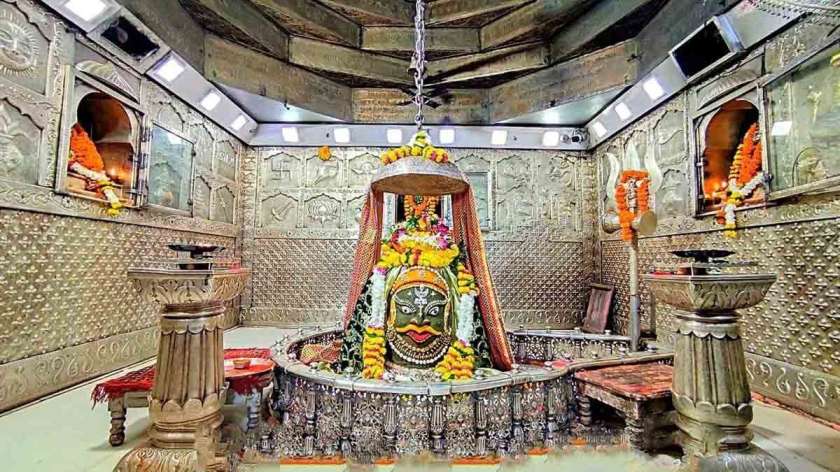
Mahakaleshwar’s architecture is an elegant fusion of Bhumija, Chalukya, and Maratha styles, shaped by the eras and rulers who rebuilt it. The sprawling five-level temple complex is centred on the sanctum sanctorum, the garbhagriha, housing the self-manifested lingam deeply embedded in the earth. Its south-facing orientation sets it apart, signifying Shiva’s power over death and time, a feature central to spiritual and ritual practices.
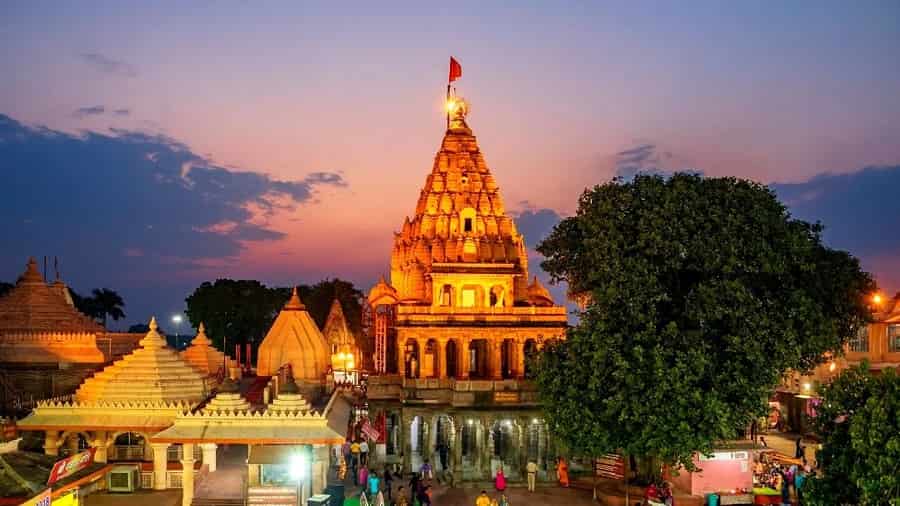
The temple towers, shikharas, are adorned with detailed carvings of mythological themes, while wide pillared halls or mandapas invite mass gatherings. Constructed of massive stone blocks and ornate marbles, the temple’s design blends durability with artistry. Within the precincts are shrines dedicated to Parvati, Ganesh, Kartikeya, and Nandi; exquisite reliefs cover walls and pillars depicting Shiva, his vahanas or vehicles, and attendant deities. A distinctive feature is the Kalabhairava sanctuary, reinforcing the temple’s role as a protectorial space. The eternal dhuni is both a literal and symbolic heart of the temple, its smoke infusing the daily bhasma aarti and connecting worshippers with cosmic cycles. The multi-storeyed structure allows for distinct ritual layers, each with its own atmospheric ambiance and spiritual significance.
Mahakaleshwar is famed for its intense, immersive rituals. The most celebrated daily rite, performed at 4 am is the Bhasma Aarti. Priests douse the lingam with bhasma or ashes from the sacred funeral pyres, anoint and dress the deity, then awaken Lord Shiva with chanting, music, and offerings. Only men can witness the actual bhasma application, a tradition echoing the tantric emphasis on transformation through ash and fire. Daily pujas are a cycle of morning, afternoon, and evening prayers, including abhisheka which is the ritual bathing with water, milk, honey, aarti with lamps and conch shells, and the distribution of prasad or blessed food. Mahashivaratri draws throngs from across India for all-night vigils, fasting, and processions. The temple marks other local and national festivals with grandeur. As offerings to Kalabhairava, devotees present liquor, a rare permitted custom signifying liberation from taboo, fear, and the mundane. Local families and temple societies maintain centuries-old traditions, with inclusive efforts ensuring all strata of society participate in ritual cycles. The rituals here are elemental: fusing body, mind, and spirit in cycles reflecting the movement of time and the inevitability of death and renewal.
A visit to Mahakaleshwar is a transformative pilgrimage, set in the vibrant and historic city of Ujjain. Ujjain is accessible by rail and road, with the nearest airport at Indore about 55 km. Pilgrims arrive from across India and the world, often as part of Jyotirlinga circuits or during festivities like Kumbh Mela. Ujjain is known for its welcoming Dharmashalas or pilgrim hostels, bustling markets, and street-side eateries serving traditional cuisine. The city’s ancient lanes, ghats, and ritual spaces evoke the spiritual heritage of the region. Situated on the banks of the Shipra, Mahakaleshwar’s setting connects water, life, and cosmic cycles. Ujjain itself is considered a point of cosmic calibration, India’s ancient prime meridian, from which astronomical calculations are made. Pilgrims recount mystical dreams, moments of deep peace, and miraculous recoveries. The very stones of Mahakaleshwar seem to pulse with time’s rhythm, whispering stories from millennia past. The experience is one of immersion: in ritual, history, and spiritual community, leaving participants profoundly changed.
Mahakaleshwar Temple, beyond its religious role, has indelibly shaped literature, art, music, and identity in Ujjain and beyond. The temple and city feature in countless Sanskrit and Hindi works, from Kalidasa’s “Meghadoot” to medieval bhakti poetry and modern narratives. The myth of Shiva as Mahakala has inspired tales of divine power and cosmic cycles. Shiva-centered ragas and devotional songs echo in temple halls and city festivals, providing inspiration for classical and folk artists. Painted scrolls, sculptures, and murals throughout Madhya Pradesh reference Mahakaleshwar, his fiery dance, and the city’s sacred landscapes. For Ujjain’s inhabitants, Mahakaleshwar’s festival calendar structures civic life; local customs, crafts, and economies revolve around the temple. The city’s reputation as a “divine timekeeper” arises from the temple’s mythic and astronomical associations. Pilgrimage narratives and experiences are widely shared in contemporary literature and digital media, further expanding Mahakaleshwar’s cultural reach.
Today, the Mahakaleshwar Temple embodies both ancient resilience and adaptive modernity. Governed by the Mahakaleshwar Mandir Trust, the temple organises daily rituals, festivals, and infrastructural development. Ujjain has emerged as a major pilgrimage hub and a heritage destination. Infrastructure improvements have increased accessibility while retaining the temple’s historic ambience. Recent decades have seen extensive conservation: restoring sculptures, reinforcing the foundations, and managing the temple’s cultural landscape. Mahakaleshwar attracts a diverse, transnational array of pilgrims—youth, families, scholars, spiritual seekers—reflecting the broad appeal of Shiva and the enduring relevance of Jyotirlinga worship. Mahakaleshwar’s presence in popular media, documentaries, and digital platforms continues to widen its spiritual resonance in India and worldwide.
Mahakaleshwar Temple in Ujjain stands as the eternal keeper of time, a place where mythology, history, ritual, and humanity converge. As the only south-facing Jyotirlinga, it underscores Shiva’s power over mortality and time, offering liberation, protection, and renewal to all who seek it. In the labyrinthine lanes of Ujjain and the echoing halls of Mahakaleshwar, the cosmic cycles unfold, inviting generations of pilgrims into a dance with the divine. Through destruction and restoration, legend and lived experience, Mahakaleshwar continues to guard the passage of time, remaining a pillar of India’s spiritual heritage and a guiding light in the Jyotirlinga circuit.
 Memories and Such