In My Hands Today…

The People’s Hospital: Hope and Peril in American Medicine – Ricardo Nuila

Where does one go without health insurance, when turned away by hospitals, clinics, and doctors? In The People’s Hospital, physician Ricardo Nuila’s stunning debut, we follow the lives of five uninsured Houstonians as their struggle for survival leads them to a hospital where insurance comes second to genuine care.

First, we meet Stephen, the restaurant franchise manager who signed up for his company’s lowest priced plan, only to find himself facing insurmountable costs after a cancer diagnosis. Then Christian—a young college student and retail worker who can’t seem to get an accurate diagnosis, let alone treatment, for his debilitating knee pain. Geronimo, thirty-six years old, has liver failure, but his meager disability check disqualifies him for Medicaid—and puts a life-saving transplant just out of reach. Roxana, who’s lived in the community without a visa for more than two decades, suffers from complications related to her cancer treatment. And finally, there’s Ebonie, a young mother whose high-risk pregnancy endangers her life. Whether due to immigration status, income, or the vagaries of state Medicaid law, all five are denied access to care. For all five, this exclusion could prove life-threatening.

Each patient eventually lands at Ben Taub, the county hospital where Dr. Nuila has worked for over a decade. Nuila delves with empathy into the experiences of his patients, braiding their dramas into a singular narrative that contradicts the established idea that the only way to receive good healthcare is with good insurance. As readers follow the movingly rendered twists and turns in each patient’s story, it’s impossible to deny that our system is broken—and that Ben Taub’s innovative model, which emphasizes people over payments, could help light the path forward.

In My Hands Today…

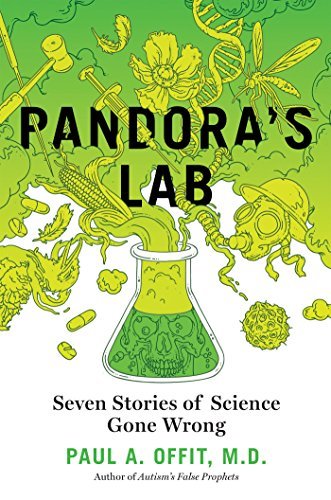
Pandora’s Lab: Seven Stories of Science Gone Wrong – Paul A. Offit


What happens when ideas presented as science lead us in the wrong direction?

History is filled with brilliant ideas that gave rise to disaster, and this book explores the most fascinating—and significant—missteps: from opium’s heyday as the pain reliever of choice to recognition of opioids as a major cause of death in the U.S.; from the rise of trans fats as the golden ingredient for tastier, cheaper food to the heart disease epidemic that followed; and from the cries to ban DDT for the sake of the environment to an epidemic-level rise in world malaria.

These are today’s sins of science—as deplorable as mistaken past ideas about advocating racial purity or using lobotomies as a cure for mental illness. These unwitting errors add up to seven lessons both cautionary and profound, narrated by renowned author and speaker Paul A. Offit. Offit uses these lessons to investigate how we can separate good science from bad, using some of today’s most controversial creations—e-cigarettes, GMOs, drug treatments for ADHD—as case studies. For every “Aha!” moment that should have been an “Oh no,” this book is an engrossing account of how science has been misused disastrously—and how we can learn to use its power for good.

In My Hands Today…

All in Her Head: The Truth and Lies Early Medicine Taught Us About Women’s Bodies and Why It Matters Today – Elizabeth Comen

For as long as medicine has been a practice, women’s bodies have been treated like objects to be practiced on: examined and ignored, idealized and sexualized, shamed, subjugated, mutilated, and dismissed. The history of women’s healthcare is a story in which women themselves have too often been voiceless—a narrative instead written from the perspective of men who styled themselves as authorities on the female of the species, yet uninformed by women’s own voices, thoughts, fears, pain and experiences. The result is a cultural and societal legacy that continues to shape the (mis)treatment and care of women.

While the modern age has seen significant advancements in the medical field, the notion that female bodies are flawed inversions of the male ideal lingers on—as do the pervasive societal stigmas and lingering ignorance that shape women’s health and relationships with their own bodies.

Memorial Sloan Kettering oncologist and medical historian Dr. Elizabeth Comen peels back the curtain on the collective medical history of women to reintroduce us to our whole bodies—how they work, the actual doctors and patients whose perspectives and experiences laid the foundation for today’s medical thought, and the many oversights that still remain unaddressed. With a physician’s knowledge and empathy, Dr. Comen follows the road map of the eleven organ systems to share unique and untold stories, drawing upon medical texts and journals, interviews with expert physicians, as well as her own experience treating thousands of women.

Empowering women to better understand ourselves and advocate for care that prioritizes healthy and joyful lives—for us and generations to come—All in Her Head is written with humor, wisdom, and deep scientific and cultural insight. Eye-opening, sometimes enraging, yet always captivating, this shared memoir of women’s medical history is an essential contribution to a holistic understanding and much-needed reclaiming of women’s history and bodies.

In My Hands Today…

Lady Doctors: The Untold Stories of India’s First Women in Medicine – Kavitha Rao

At a time when medicine is a highly sought-after career for Indian women, it is hard to imagine what it was like for the pioneers. The story of how firmly they were bound in fetters of family, caste, and society and how fiercely they fought to escape needs to be told. In Lady Doctors, Kavitha Rao unearths the extraordinary stories of six women from the 1860s to the 1930s who defied the idea that they were unfit for medicine by virtue of their gender.

From Anandibai Joshi, who broke caste rules by crossing an ocean, to Rukhmabai Raut, who escaped a child marriage, divorced her husband, and studied to be a doctor; from Kadambini Ganguly, who took care of eight children while she worked, to child widow Haimabati Sen, who overcame poverty and hardship—these women had a profound and lasting impact. And in their forgotten lives lie many lessons for modern women.

In truth, the compelling stories of these radical women have been erased from our textbooks and memories because histories have mostly been written by men, about men. In an immensely readable narrative and with impeccable research, Lady Doctors rectifies this omission.

In My Hands Today…

Rough Sleepers – Tracy Kidder

When Jim O’Connell graduated from Harvard Medical School and was nearing the end of his residency at Massachusetts General Hospital, the chief of medicine made a proposal: Would he defer a prestigious fellowship and spend a year helping to create an organization to bring health care to homeless citizens?

Jim took the job because he felt he couldn’t refuse. But that year turned into his life’s calling. Tracy Kidder spent five years following Dr. O’Connell and his colleagues as they served their thousands of homeless patients.

In this book, we travel with O’Connell as he navigates the city, offering medical care, socks, soup, empathy, humor, and friendship to some of the city’s most vulnerable citizens. He emphasizes a style of medicine in which patients come first, joined with their providers in what he calls “a system of friends.”