In My Hands Today…

The Rebel Romanov: Julie of Saxe-Coburg, the Empress Russia Never Had – Helen Rappaport

In 1795, Catherine the Great of Russia was in search of a bride for her grandson Constantine, who stood third in line to her throne. In an eerie echo of her own story, Catherine selected an innocent young German princess, Julie of Saxe-Coburg, aunt of the future Queen Victoria. Though Julie had everything a young bride could wish for, she was alone in a court dominated by an aging empress and riven with rivalries, plotting, and gossip―not to mention her brute of a husband, who was tender one moment and violent the next. She longed to leave Russia and her disastrous marriage, but her family in Germany refused to allow her to do so.

Desperate for love, Julie allegedly sought consolation in the arms of others. Finally, Tsar Alexander granted her permission to leave in 1801, even though her husband was now heir to the throne. Rootless in Europe, Julie gave birth to two―possibly three―illegitimate children, all of whom she was forced to give up for adoption. Despite entreaties from Constantine to return and provide an heir, she refused, eventually finding love with her own married physician.

At a time when many royal brides meekly submitted to disastrous marriages, Julie proved to be a woman ahead of her time, sacrificing her reputation and a life of luxury in exchange for the freedom to live as she wished. The Rebel Romanov is the inspiring tale of a bold woman who, until now, has been ignored by history.

In My Hands Today…

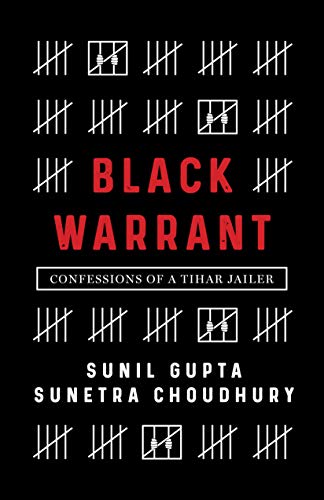
Black Warrant: Confessions of a Tihar Jailer – Sunil Gupta

What is life like inside Asia’s largest prison?

What happens when a man is hanged, but his pulse refuses to give up even after two hours?

Did Nirbhaya’s rapist, Ram Singh, commit suicide or was he murdered?

For the first time we have a riveting account from an insider who has spent close to four decades as an officer at Tihar Jail during some of the most turbulent times in Indian political history.

For the first time he breaks his silence about all he’s seen – from the first man he met in Tihar, Charles Sobhraj, to the controversies surrounding former CBI head, Alok Verma.

Responsible for carrying out ‘Black Warrants’, Gupta witnessed 14 hangings, the most recent and his last, being that of Afzal Guru. Joining him is award-winning journalist Sunetra Choudhury whose recent book Behind Bars is a bestseller and took her deep inside the maze of prisons. Read this book for the most intimate and raw account of India’s judicial and criminal justice system.

In My Hands Today…

The Tatas: How a Family Built a Business and a Nation – Girish Kuber

The Tatas is the story of one of India’s leading business families.

It starts in the nineteenth century with Nusserwanji Tata – a middle-class Parsi priest from the village of Navsari in Gujarat, and widely regarded as the Father of Indian Industry – and ends with Ratan Tata – chairman of the Tata Group until 2012.

But it is more than just a history of the industrial house; it is an inspiring account of India in the making. It chronicles how each generation of the family invested not only in the expansion of its own business interests but also in nation building.

For instance, few know that the first hydel project in the world was conceived and built by the Tatas in India. Nor that some radical labour concepts such as eight-hour work shifts were born in India, at the Tata mill in Nagpur.

The National Centre for the Performing Arts, the Tata Cancer Research Centre, the Tata Institute of Fundamental Research – the list about the Tatas’ contribution to India is a long one. A bestseller in Marathi when it was first published in 2015, this is the only book that tells the complete Tata story over two hundred years.

In My Hands Today…

The Woman Who Wasn’t There: The True Story of an Incredible Deception – Robin Gaby Fisher, Angelo J. Guglielmo Jr.

The astounding story of Tania Head, whose heartrending account of surviving the World Trade Center attacks made her a celebrity—until it all turned out to be an elaborate hoax.

It was a tale of loss and recovery, of courage and sorrow, of horror and inspiration. Tania Head’s astonishing account of her experience on September 11, 2001—from crawling through the carnage and chaos to escaping the seventy-eighth-floor sky lobby of the burning south tower to losing her fiancé in the collapsed north tower—transformed her into one of the great victims and heroes of that tragic day.

Tania selflessly took on the responsibility of giving a voice and a direction to the burgeoning World Trade Center Survivors’ Network, helping save the “Survivor Stairway” and leading tours at Ground Zero, including taking then-governor Pataki, Mayor Bloomberg, and former mayor Giuliani on the inaugural tour of the WTC site. She even used her own assets to fund charitable events to help survivors heal. But there was something very wrong with Tania’s story—a terrible secret that would break the hearts and challenge the faith of all those she claimed to champion.

Told with the unique insider perspective and authority of Angelo J. Guglielmo, Jr., a filmmaker shooting a documentary on the efforts of the Survivors’ Network, and previously one of Tania’s closest friends, The Woman Who Wasn’t There is the story of one of the most audacious and bewildering quests for acclaim in recent memory—one that poses fascinating questions about the essence of morality and the human need for connection at any cost.

In My Hands Today…

Airplane Mode: An Irreverent History of Travel – Shahnaz Habib

A playful personal and cultural history of travel from a postcolonial, person-of-color perspective, Airplane Mode asks: what does it mean to be a joyous traveler when we live in the ruins of colonialism, capitalism and climate change?

For Shahnaz Habib, an Indian Muslim woman, travel has always been a complicated pleasure. Yet, journeys at home and abroad have profoundly shaped her life. In this inquiring and surprising debut, Habib traces a history of travel from pilgrimages to empires to safaris, taking on colonialist modes of thinking about travel and asking who gets to travel and who gets to write about it.

Threaded through the book are inviting and playful analyses of obvious and not-so-obvious travel artifacts: passports, carousels, bougainvilleas, guidebooks, expressways, the idea of wanderlust. Together, they tell a subversive history of travel as a Euro-American mode of consumerism—but as any traveler knows, travel is more than that. As an immigrant whose loved ones live across continents, Habib takes a deeply curious and joyful look at a troubled and beloved activity.