In My Hands Today…

Doppelganger: A Trip into the Mirror World – Naomi Klein
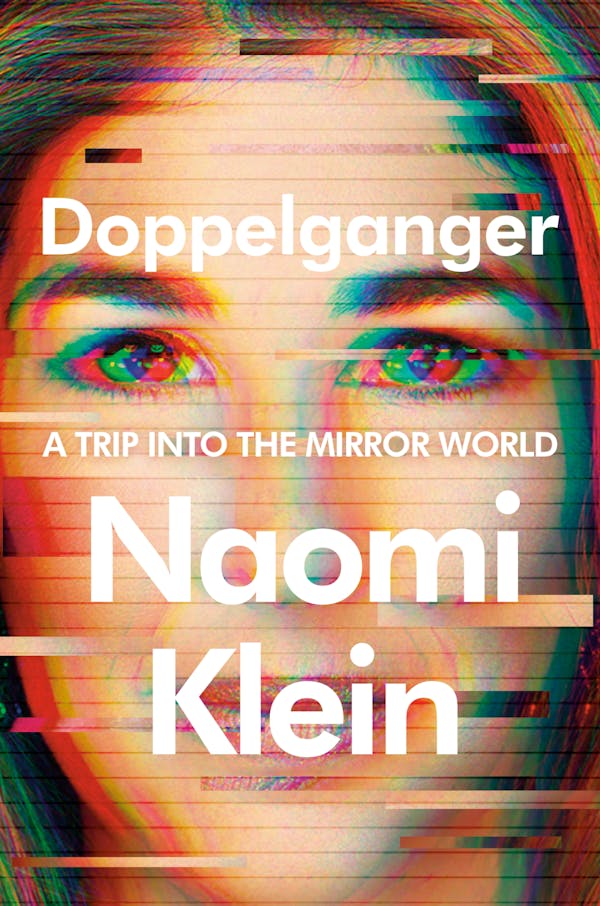
What if you woke up one morning and found you’d acquired another self―a double who was almost you and yet not you at all? What if that double shared many of your preoccupations but, in a twisted, upside-down way, furthered the very causes you’d devoted your life to fighting against?

Not long ago, the celebrated activist and public intellectual Naomi Klein had just such an experience―she was confronted with a doppelganger whose views she found abhorrent but whose name and public persona were sufficiently similar to her own that many people got confused about who was who. Destabilized, she lost her bearings, until she began to understand the experience as one manifestation of a strangeness many of us have come to know but struggle to define: AI-generated text is blurring the line between genuine and spurious communication; New Age wellness entrepreneurs turned anti-vaxxers are scrambling familiar political allegiances of left and right; and liberal democracies are teetering on the edge of absurdist authoritarianism, even as the oceans rise. Under such conditions, reality itself seems to have become unmoored. Is there a cure for our moment of collective vertigo?

Naomi Klein is one of our most trenchant and influential social critics, an essential analyst of what branding, austerity, and climate profiteering have done to our societies and souls. Here she turns her gaze inward to our psychic landscapes, and outward to the possibilities for building hope amid intersecting economic, medical, and political crises. With the assistance of Sigmund Freud, Jordan Peele, Alfred Hitchcock, and bell hooks, among other accomplices, Klein uses wry humor and a keen sense of the ridiculous to face the strange doubles that haunt us―and that have come to feel as intimate and proximate as a warped reflection in the mirror.

Combining comic memoir with chilling reportage and cobweb-clearing analysis, Klein seeks to smash that mirror and chart a path beyond despair. Doppelganger What do we neglect as we polish and perfect our digital reflections? Is it possible to dispose of our doubles and overcome the pathologies of a culture of multiplication? Can we create a politics of collective care and undertake a true reckoning with historical crimes? The result is a revelatory treatment of the way many of us think and feel now―and an intellectual adventure story for our times.

In My Hands Today…

The People’s Hospital: Hope and Peril in American Medicine – Ricardo Nuila

Where does one go without health insurance, when turned away by hospitals, clinics, and doctors? In The People’s Hospital, physician Ricardo Nuila’s stunning debut, we follow the lives of five uninsured Houstonians as their struggle for survival leads them to a hospital where insurance comes second to genuine care.

First, we meet Stephen, the restaurant franchise manager who signed up for his company’s lowest priced plan, only to find himself facing insurmountable costs after a cancer diagnosis. Then Christian—a young college student and retail worker who can’t seem to get an accurate diagnosis, let alone treatment, for his debilitating knee pain. Geronimo, thirty-six years old, has liver failure, but his meager disability check disqualifies him for Medicaid—and puts a life-saving transplant just out of reach. Roxana, who’s lived in the community without a visa for more than two decades, suffers from complications related to her cancer treatment. And finally, there’s Ebonie, a young mother whose high-risk pregnancy endangers her life. Whether due to immigration status, income, or the vagaries of state Medicaid law, all five are denied access to care. For all five, this exclusion could prove life-threatening.

Each patient eventually lands at Ben Taub, the county hospital where Dr. Nuila has worked for over a decade. Nuila delves with empathy into the experiences of his patients, braiding their dramas into a singular narrative that contradicts the established idea that the only way to receive good healthcare is with good insurance. As readers follow the movingly rendered twists and turns in each patient’s story, it’s impossible to deny that our system is broken—and that Ben Taub’s innovative model, which emphasizes people over payments, could help light the path forward.

In My Hands Today…

The Third Pole: Mystery, Obsession, and Death on Mount Everest – Mark Synnott

Shivering, exhausted, gasping for oxygen, beyond doubt . . .

A hundred-year mystery lured veteran climber Mark Synnott into an unlikely expedition up Mount Everest during the spring 2019 season that came to be known as “the Year Everest Broke.” What he found was a gripping human story of impassioned characters from around the globe and a mountain that will consume your soul—and your life—if you let it.

The mystery? On June 8, 1924, George Mallory and Sandy Irvine set out to stand on the roof of the world, where no one had stood before. They were last seen eight hundred feet shy of Everest’s summit, still “going strong” for the top. Could they have succeeded decades before Sir Edmund Hillary and Tenzing Norgay? Irvine is believed to have carried a Kodak camera with him to record their attempt, but it, along with his body, has never been found. Did the frozen film in that camera have a photograph of Mallory and Irvine on the summit before they disappeared into the clouds, never to be seen again? Kodak says the film might still be viable. . . .

Mark Synnott made his own ascent up the infamous North Face along with his friend Renan Ozturk, a filmmaker using drones higher than any had previously flown. Readers witness first-hand how Synnott’s quest led him from oxygen-deprivation training to archives and museums in England, to Kathmandu, the Tibetan high plateau, and up the North Face into a massive storm. The infamous traffic jams of climbers at the very summit immediately resulted in tragic deaths. Sherpas revolted. Chinese officials turned on Synnott’s team. An Indian woman miraculously crawled her way to frostbitten survival. Synnott himself went off the safety rope—one slip and no one would have been able to save him—committed to solving the mystery.

Eleven climbers died on Everest that season, all of them mesmerized by an irresistible magic. The Third Pole is a rapidly accelerating ride to the limitless joy and horror of human obsession.

In My Hands Today…

How to Say Babylon – Safiya Sinclair

Throughout her childhood, Safiya Sinclair’s father, a volatile reggae musician and militant adherent to a strict sect of Rastafari, became obsessed with her purity, in particular, with the threat of what Rastas call Babylon, the immoral and corrupting influences of the Western world outside their home. He worried that womanhood would make Safiya and her sisters morally weak and impure, and believed a woman’s highest virtue was her obedience.

In an effort to keep Babylon outside the gate, he forbade almost everything. In place of pants, the women in her family were made to wear long skirts and dresses to cover their arms and legs, head wraps to cover their hair, no make-up, no jewelry, no opinions, no friends. Safiya’s mother, while loyal to her father, nonetheless gave Safiya and her siblings the gift of books, including poetry, to which Safiya latched on for dear life. And as Safiya watched her mother struggle voicelessly for years under housework and the rigidity of her father’s beliefs, she increasingly used her education as a sharp tool with which to find her voice and break free. Inevitably, with her rebellion come clashes with her father, whose rage and paranoia explodes in increasing violence. As Safiya’s voice grows, lyrically and poetically, a collision course is set between them.

In My Hands Today…

Border: A Journey to the Edge of Europe – Kapka Kassabova

In this extraordinary work of narrative reportage, Kapka Kassabova returns to Bulgaria, from where she emigrated as a girl twenty-five years previously, to explore the border it shares with Turkey and Greece. When she was a child, the border zone was rumored to be an easier crossing point into the West than the Berlin Wall, and it swarmed with soldiers and spies. On holidays in the “Red Riviera” on the Black Sea, she remembers playing on the beach only miles from a bristling electrified fence whose barbs pointed inward toward the enemy: the citizens of the totalitarian regime.

Kassabova discovers a place that has been shaped by successive forces of history: the Soviet and Ottoman empires, and, older still, myth and legend. Her exquisite portraits of fire walkers, smugglers, treasure hunters, botanists, and border guards populate the book. There are also the ragged men and women who have walked across Turkey from Syria and Iraq. But there seem to be nonhuman forces at work here too: This densely forested landscape is rich with curative springs and Thracian tombs, and the tug of the ancient world, of circular time and animism, is never far off.

Border is a scintillating, immersive travel narrative that is also a shadow history of the Cold War, a sideways look at the migration crisis troubling Europe, and a deep, witchy descent into interior and exterior geographies.