In My Hands Today…

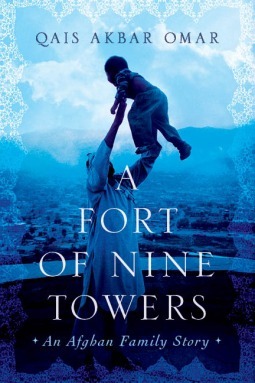
A Fort of Nine Towers: An Afghan Family Story – Qais Akbar Omar

Qais Akbar Omar was born in Kabul in a time of relative peace. Until he was 7, he lived with his father, a high school physics teacher, and mother, a bank manager, in the spacious, garden-filled compound his grandfather had built. Noisy with the laughter of his cousins (with whom they lived in the typical Afghan style), fragrant with the scent of roses and apple blossoms, and rich in shady, tucked-away spots where Qais and his grandfather sat and read, home was the idyllic centre of their quiet, comfortable life.

But in the wake of the Russian withdrawal and the bloody civil conflict that erupted, his family was forced to flee and take refuge in the legendary Fort of Nine Towers, a centuries-old palace in the hills on the far side of Kabul. On a perilous trip home, Omar and his father were kidnapped, narrowly escaping, and the family fled again, his parents leading their 6 children on a remarkable, sometimes wondrous journey. Hiding inside the famous giant Bamiyan Buddhas sculpture, and among Kurchi herders, Omar cobbles together an education, learning the beautiful art of carpet-weaving from a deaf mute girl, which will become the family’s means of support. Against a backdrop of uncertainty, violence and absurdity, young Qais Omar weaves together a story–and a self–that is complex, colourful, and profound.

In My Hands Today…

Son of Singapore – Tan Kok Seng, Austin Coates (Co-translator)

A publishing sensation in the 1970s and 1980s, Son of Singapore traces the extraordinary upbringing of an Everyman. As a Teochew farm boy coming of age during the Japanese Occupation, Tan Kok Seng enters the “university of the world” at only 15, becoming a coolie at the Orchard Road market. On his rounds to the homes of the “Red Hairs”, he befriends a group of Chinese dialect-speaking Caucasians who inspire him to improve himself beyond his humble roots. Set against Singapore’s push towards self-governance, Tan’s engaging autobiography reflects the pioneering spirit of the times.

Written in deceptively simple prose, notable for its English transliteration of Teochew adages, Son of Singapore sensitively captures fast-disappearing places, people and everyday ways of living.

In My Hands Today…

Unlost: A journey of self-discovery and the healing power of the wild outdoors – Gail Muller

Gail Muller was told she’d be in a wheelchair by the age of forty. At forty-one she set out to hike one of the world’s toughest treks, The Appalachian Trail – a 2,200-mile journey that would help her reclaim her life and heal her mind and body. An inspiring, moving and uplifting memoir for fans of Cheryl Strayed’s Wild and Elizabeth Gilbert’s Eat, Pray, Love.

As Gail took her first steps through the wilderness of the USA, she had no idea what lay ahead of her, but she knew she felt burnout from city life, lost and broken – ready to heal a mind and body that she had battled with for so long.

From the resilience-building mountain climbs, painful injuries and harsh reality of braving the raw elements, to the unexpected friendships forged with other hikers and the kindness of strangers offering food and shelter – with every step, Gail started to let go of a past dominated by chronic pain and reconnected with herself in a way she’d never been able to before.

A love letter to the healing power of the wild outdoors and an incredible testament to the strength of the human spirit, Gail’s story is for anyone who has ever felt stuck in a rut, lost or scared. She shows us that even in our darkest times, it’s possible to find our inner grit, face our fears and feel hopeful.

In My Hands Today…

Bewildered – Laura Waters

What would move you to ditch your life and take off into the wild for five months? For Laura Waters, it took the implosion of a toxic relationship and a crippling bout of anxiety. Armed with maps, a compass and her life in a bag on her back, she set out to walk the untamed landscapes of the Te Araroa trail in New Zealand, 3000 kilometres of raw, wild, mountainous trail winding from the top of the North Island to the frosty tip of the South Island. But when her walking partner dropped out on the second day, she was faced with a choice: abandon the journey, or face her fears and continue on alone? She chose to walk on.

For five months, Laura battled not only treacherous terrain and elements, but also the demons of self-doubt and anxiety. As the kilometres fell behind her, nature did its work, stripping away her identity and guiding her towards a new way of being. At the end of Te Araroa, it was the hard-earned insights into the power of nature, emotional wellbeing and fulfilling relationships – with others as well as with herself – that were Laura’s greatest accomplishments. She emerged ‘rewilded’, and it transformed her life.

In My Hands Today…

Alone Time: Four Seasons, Four Cities, and the Pleasures of Solitude – Stephanie Rosenbloom

In our increasingly frantic daily lives, many people are genuinely fearful of the prospect of solitude, but time alone can be both rich and restorative, especially when travelling.

Through on-the-ground reporting and recounting the experiences of artists, writers, and innovators who cherished solitude, Stephanie Rosenbloom considers how being alone as a traveller–and even in one’s own city–is conducive to becoming acutely aware of the sensual details of the world–patterns, textures, colours, tastes, sounds–in ways that are difficult to do in the company of others.

Alone Time is divided into four parts, each set in a different city, in a different season, in a single year. The destinations–Paris, Istanbul, Florence, New York–are all pedestrian-friendly, allowing travellers to slow down and appreciate casual pleasures instead of hurtling through museums and posting photos to Instagram.

Each section spotlights a different theme associated with the joys and benefits of time alone and how it can enable people to enrich their lives–facilitating creativity, learning, self-reliance, as well as the ability to experiment and change. Rosenbloom incorporates insights from psychologists and sociologists who have studied solitude and happiness and explores such topics as dining alone, learning to savour, discovering interests and passions, and finding or creating silent spaces. Her engaging and elegant prose makes Alone Time as warmly intimate an account as the details of a trip shared by a beloved friend–and will have its many readers eager to set off on their own solo adventures.