

Modern India Observed is an ongoing series exploring how contemporary India gathers, celebrates, consumes, worships, and rests. Through places, events, and everyday rituals, it looks at the subtle shifts shaping public life, not to judge them, but to understand what they reveal.
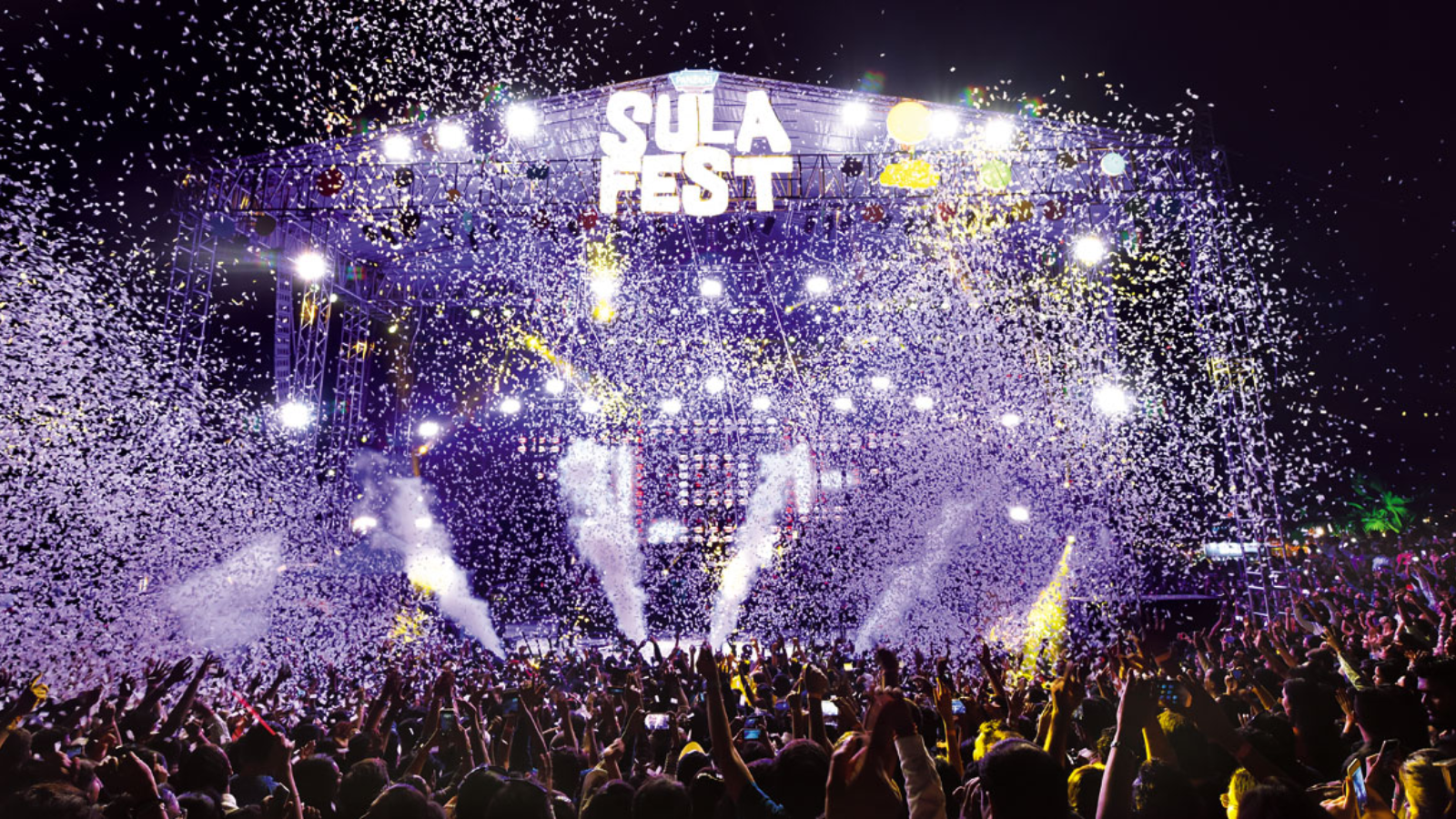
In late January this year, as the light thinned over Nashik’s vineyard hills, a crowd settled onto grass with paper plates, plastic cups, and wine glasses balanced carefully between them. Music drifted outward from the amphitheatre stage. Some people moved closer as the tempo rose. Others stayed where they were, content to listen from a distance.
This was SulaFest 2026: two days of live music at Sula Vineyards, now a familiar entry in India’s leisure calendar. By August, the volume has faded, and the social media posts have long been archived. What remains more interesting than the line-up is the question beneath it: what does a vineyard music festival in Nashik reveal about how modern India gathers?
It is easy to dismiss festivals as entertainment. It is harder and more interesting to read them as cultural text. Because SulaFest is not only about artists or alcohol. It is about a particular version of Indian leisure that has grown steadily more visible over the last decade.

The Vineyard as Social Space
A vineyard is not a neutral setting. Unlike an indoor arena or a city concert hall, it carries a horizon. Rows of vines stretch outward, reminding you that this is agricultural land before it is an event space. The air feels less compressed. The sky remains part of the experience.
At SulaFest 2026, the setting shaped behaviour. People arrived early, not only to secure a spot but also to linger. Groups spread themselves out across the grass. Conversations flowed in daylight before attention shifted fully to the stage. Even as evening deepened and the crowd thickened, it remained possible to stand slightly to the side and observe rather than immerse completely.
For those who are not instinctively drawn to crowds, that flexibility matters. One can participate without surrendering entirely to density. Arrive early. Listen while the light is still generous. Leave before exhaustion sets in. The festival accommodates this rhythm.
The programming, as in previous years, moved gradually from relaxed afternoon performances into more high-energy night acts. As dusk settled during the 2026 edition, the energy shift was tangible. Daylight conversations gave way to collective attention. Beats carried farther across the open air than they would indoors. Indie choruses found easy sing-along momentum. Electronic sets tightened the crowd’s movement into something almost tidal. Even those at the periphery felt the pull. The vineyard softened the edges, but the sound still gathered people inward.
Wine: Craft, Aspiration, and Respectability
Alcohol has never been foreign to India. What has changed is the tone around certain kinds of drinking. Over the past decade, wine has moved into mainstream visibility with a distinct cultural positioning. It is frequently framed as refined, lighter, more civilised. For many middle-class Indians, especially women, wine offers a socially smoother way to drink in public spaces. It carries less stigma than harder spirits. It feels less confrontational. It photographs well.
There is aspiration in that. Social media has amplified it. A glass of wine against a vineyard sunset has become shorthand for cultivated leisure. Yet beneath the imagery lies agriculture.
Sula Vineyards, founded in 1999, has played a central role in positioning Nashik as India’s most recognised wine region. The Indian wine story is rooted in soil, weather patterns, experimentation, and patience. Wine is a craft long before it becomes a lifestyle. At SulaFest 2026, both layers were visible. Some attendees treated wine as a celebration. Others approached it more slowly, tasting and comparing. Many simply held a glass while listening to music. It helps not to romanticise it. Wine at a vineyard festival need not be glamorous. It can be agriculture meeting leisure. That grounding keeps the experience honest. Live and let live applies here. Pleasure does not require performance.
The Quiet Shift in Public Leisure
Public leisure in India has evolved noticeably in recent years. Urban women, in particular, inhabit social spaces with greater ease than they once did. Music festivals, vineyard weekends, and group travel are no longer narrowly coded environments. Wine plays into that shift. It provides a register of drinking that is perceived as socially smoother. Whether that perception is entirely accurate is less important than its effect. It broadens participation.
At SulaFest 2026, the crowd reflected this incremental change. Groups of women travelled together comfortably. Mixed circles moved through the space without self-consciousness. The festival felt mainstream rather than fringe. This is not a revolution. It is recalibration. And recalibration is often how culture changes.

Devotion and Indulgence on the Same Map
To understand SulaFest fully, one must widen the lens beyond the amphitheatre. Nashik is also home to Trimbakeshwar Temple, one of the twelve jyotirlingas, located roughly 28 kilometres from the city. Pilgrims queue there with seriousness that has nothing to do with lifestyle branding or curated leisure. And yet both experiences exist within the same short drive.
One can attend a vineyard music festival one evening and stand in a temple queue the next morning. India does not require these moments to cancel each other out. Leisure and devotion coexist geographically without anxiety. This coexistence may be the most telling aspect of SulaFest’s location.
For visitors, the contrast shapes the weekend meaningfully. A day of music and open sky can be followed by an early morning visit to Trimbakeshwar or a quieter walk along the Godavari ghats. The body slows. The mood shifts. The senses recalibrate. Neither invalidates the other. SulaFest is not an isolated bubble. It is situated within a layered cultural landscape.

The Practical Reality
Romantic accounts of festivals often skip logistics. They should not. SulaFest runs long hours and is an adult event. It demands stamina. Hydration matters. Planning transport matters. Comfortable shoes matter. Arriving early is wiser than arriving late. Leaving before peak density is sensible, not unsporting. The difference between a satisfying weekend and a draining one rarely lies in the music alone. It lies in the small decisions around it. As Indian festivals become more organised and mainstream, attendees have grown more intentional. The 2026 edition felt less like chaotic novelty and more like structured leisure. That maturity is telling.

Energy Changes, Joy Does Not
There is a thread of nostalgia running through any festival, though it may not always be obvious. Not exactly nostalgia for youth, but for collective energy. Energy changes as we age. Crowds feel denser. Noise feels louder. Bodies tire sooner. But joy, communal, rhythmic, shared joy, persists.
Sitting slightly to the side at SulaFest, watching the crowd move as the sun dipped behind the vines, one could feel that continuity. Friends leaned into one another. Strangers swayed in the same direction. The music rose and fell. Nothing dramatic occurred. Yet something steady held.
What SulaFest ultimately reflects is not excess but adjustment. A country recalibrating how it relaxes. Wine is treated as a craft rather than a taboo. Women inhabiting public leisure without apology. Music held in open air instead of behind closed doors. Devotion and indulgence share geography without argument.
None of this is theatrical. That is precisely the point. SulaFest is not a pilgrimage. It is not a spiritual retreat. It is not rebellion. It is a well-produced weekend that quietly mirrors a modern India learning to hold multiple identities at once. It does not need to be annual devotion. But it is worth doing at least once.
This essay is part of the Modern India Observed series

