In My Hands Today…

Waiting to Be Arrested at Night: A Uyghur Poet’s Memoir of China’s Genocide – Tahir Hamut Izgil, translated by Joshua L Freeman

One by one, Tahir Hamut Izgil’s friends disappeared. The Chinese government’s brutal persecution of the Uyghur people had continued for years, but in 2017 it assumed a terrifying new scale. The Uyghurs, a predominantly Muslim minority group in western China, were experiencing an echo of the worst horrors of the twentieth century, amplified by China’s establishment of an all-seeing high-tech surveillance state. Over a million people have vanished into China’s internment camps for Muslim minorities.

Tahir, a prominent poet and intellectual, had been no stranger to persecution. After he attempted to travel abroad in 1996, police tortured him until he confessed to fabricated charges and sent him to a re-education through labor camp. But even having endured three years in the camp, he could never have predicted the Chinese government’s radical solution to the Uyghur question two decades later. Was the first sign when Tahir was interrogated for hours after a phone call with a fellow poet in the Netherlands? Or when his old friend was sentenced to life in prison simply for calling for Uyghurs’ legal rights to be enforced? Perhaps it was when the police seized Uyghurs’ radios and installed jamming equipment to cut them off from the outside world.

Once Tahir noticed that the park near his home was nearly empty because so many neighbors had been arrested, he knew the police would be coming for him any day. One night, after Tahir’s daughters were asleep, he placed by his door a sturdy pair of shoes, a sweater, and a coat so that he could stay warm if the police came for him in the middle of the night. It was clear to Tahir and his wife that fleeing the country was the family’s only hope.

Waiting to Be Arrested at Night is the story of the political, social, and cultural destruction of Tahir Hamut Izgil’s homeland. Among leading Uyghur intellectuals and writers, he is the only one known to have escaped China since the mass internments began. His book is a call for the world to awaken to the unfolding catastrophe, and a tribute to his friends and fellow Uyghurs whose voices have been silenced.
In My Hands Today…

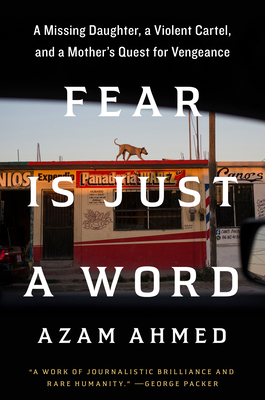
Fear Is Just a Word: A Missing Daughter, a Violent Cartel, and a Mother’s Quest for Vengeance – Azam Ahmed

Fear Is Just a Word begins on an international bridge between Mexico and the United States, as fifty-six-year-old Miriam Rodríguez stalks one of the men she believes was involved in the murder of her daughter Karen. He is her target number eleven, a member of the drug cartel that has terrorized and controlled what was once Miriam’s quiet hometown of San Fernando, Mexico, almost one hundred miles from the U.S. border. Having dyed her hair red as a disguise, Miriam watches, waits, and then orchestrates the arrest of this man, exacting her own version of justice.

Woven into this deeply researched, moving account is the story of how cartels built their power in Mexico, escalated the use of violence, and kidnapped and murdered tens of thousands. Karen was just one of the many people who disappeared, and Miriam, a brilliant, strategic, and fearless woman, begged for help from the authorities and paid ransom money she could not afford in hopes of saving her daughter. When that failed, she decided that “fear is just a word,” and began a crusade to track down Karen’s killers and to help other victimized families in their search for justice.

What do people do when their country and the peaceful town where they have grown up become unrecognizable, suddenly places of violence and fear? Azam Ahmed takes us into the grieving of a country and a family to tell the mesmerizing story of a brave and brilliant woman determined to find out what happened to her daughter, and to see that the criminals who murdered her were punished. Fear Is Just a Word is an unforgettable and moving portrait of a woman, a town, and a country, and of what can happen when violent forces leave people to seek justice on their own.

In My Hands Today…

Anansi’s Gold: The Man Who Looted the West, Outfoxed Washington, and Swindled the World – Yepoka Yeebo

When Ghana won its independence from Britain in 1957, it instantly became a target for home-grown opportunists and rapacious Western interests determined to snatch any assets that colonialism hadn’t already stripped. A CIA-funded military junta ousted the new nation’s inspiring president, Kwame Nkrumah, then falsely accused him of hiding the country’s gold overseas.

Into this big lie stepped one of history’s most charismatic scammers, a con man to rival the trickster god Anansi. Born into poverty in Ghana and trained in the United States, John Ackah Blay-Miezah declared himself custodian of an alleged Nkrumah trust fund worth billions. You, too, could claim a piece–if only you would “invest” in Blay-Miezah’s fictitious efforts to release the equally fictitious fund. Over the 1970s and ‘80s, he and his accomplices―including Ghanaian state officials and Nixon’s former attorney general–scammed hundreds of millions of dollars out of thousands of believers. Blay-Miezah lived in luxury, deceiving Philadelphia lawyers, London financiers, and Seoul businessmen alike, all while eluding his FBI pursuers. American prosecutors called his scam “one of the most fascinating–and lucrative–in modern history.”

In Anansi’s Gold , Yepoka Yeebo chases Blay-Miezah’s ever-wilder trail and discovers, at long last, what really happened to Ghana’s missing wealth. She unfolds a riveting account of Cold War entanglements, international finance, and postcolonial betrayal, revealing how what we call “history” writes itself into being, one lie at a time.

In My Hands Today…

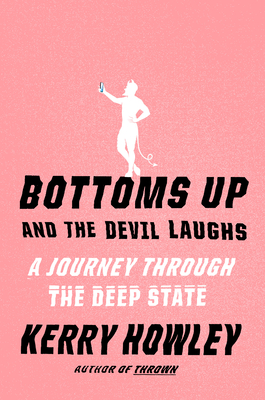
Bottoms Up and the Devil Laughs: A Journey Through the Deep State – Kerry Howley

Who are you? You are data about data. You are a map of connections–a culmination of everything you have ever posted, searched, emailed, liked, and followed. In this groundbreaking work of narrative nonfiction, Kerry Howley investigates the curious implications of living in the age of the indelible. Bottoms Up and the Devil Laughs tells the true story of intelligence specialist Reality Winner, a lone young woman who stuffs a state secret under her skirt and trusts the wrong people to help. After printing five pages of dangerous information she was never supposed to see, Winner finds herself at the mercy of forces more invasive than she could have possibly imagined.

Following Winner’s unlikely journey from rural Texas to a federal courtroom, Howley maps a hidden world, drawing in John Walker Lindh, Lady Gaga, Edward Snowden, a rescue dog named Outlaw Babyface Nelson, and a mother who will do whatever it takes to get her daughter out of jail. Howley’s subjects face a challenge new to history: they are imprisoned by their past selves, trapped for as long as the Internet endures. A soap opera set in the deep state, Bottoms Up and the Devil Laughs is a free fall into a world where everything is recorded and nothing is sacred, from a singular writer unafraid to ask essential questions about the strangeness of modern life.

In My Hands Today…

Some People Need Killing: A Memoir of Murder in My Country – Patricia Evangelista

My job is to go to places where people die. I pack my bags, talk to the survivors, write my stories, then go home to wait for the next catastrophe. I don’t wait very long.”

Journalist Patricia Evangelista came of age in the aftermath of a street revolution that forged a new future for the Philippines. Three decades later, in the face of mounting inequality, the nation discovered the fragility of its democratic institutions under the regime of strongman Rodrigo Duterte.

Some People Need Killing is Evangelista’s meticulously reported and deeply human chronicle of the Philippines’ drug war. For six years, Evangelista chronicled the killings carried out by police and vigilantes in the name of Duterte’s war on drugs—a war that has led to the slaughter of thousands—immersing herself in the world of killers and survivors and capturing the atmosphere of fear created when an elected president decides that some lives are worth less than others.

The book takes its title from a vigilante whose words seemed to reflect the psychological accommodation that most of the country had “I’m really not a bad guy,” he said. “I’m not all bad. Some people need killing.”