In My Hands Today…

Material World: The Six Raw Materials That Shape Modern Civilization – Ed Conway & Edmund Conway

Sand, salt, iron, copper, oil, and lithium. These fundamental materials have created empires, razed civilizations, and fed our ingenuity and greed for thousands of years. Without them, our modern world would not exist, and the battle to control them will determine our future.

The fiber-optic cables that weave the World Wide Web, the copper veins of our electric grids, the silicon chips and lithium batteries that power our phones and though it can feel like we now live in a weightless world of information—what Ed Conway calls “the ethereal world”—our twenty-first-century lives are still very much rooted in the material.

In fact, we dug more stuff out of the earth in 2017 than in all of human history before 1950. For every ton of fossil fuels, we extract six tons of other materials, from sand to stone to wood to metal. And in Material World, Conway embarks on an epic journey across continents, cultures, and epochs to reveal the underpinnings of modern life on Earth—traveling from the sweltering depths of the deepest mine in Europe to spotless silicon chip factories in Taiwan to the eerie green pools where lithium originates.

Material World is a celebration of the humans and the human networks, the miraculous processes and the little-known companies, that combine to turn raw materials into things of wonder. This is the story of human civilization from an entirely new the ground up.

In My Hands Today…

The Coming Wave: Technology, Power, and the Twenty-first Century’s Greatest Dilemma – Mustafa Suleyman and Primary Contributor Michael Bhaskar

We are approaching a critical threshold in the history of our species. Everything is about to change.

Soon you will live surrounded by AIs. They will organise your life, operate your business, and run core government services. You will live in a world of DNA printers and quantum computers, engineered pathogens and autonomous weapons, robot assistants and abundant energy.

None of us are prepared.

As co-founder of the pioneering AI company DeepMind, part of Google, Mustafa Suleyman has been at the centre of this revolution. The coming decade, he argues, will be defined by this wave of powerful, fast-proliferating new technologies.

In The Coming Wave , Suleyman shows how these forces will create immense prosperity but also threaten the nation-state, the foundation of global order. As our fragile governments sleepwalk into disaster, we face an existential unprecedented harms on one side, the threat of overbearing surveillance on the other.

Can we forge a narrow path between catastrophe and dystopia?

This groundbreaking book from the ultimate AI insider establishes “the containment problem”—the task of maintaining control over powerful technologies—as the essential challenge of our age.

In My Hands Today…

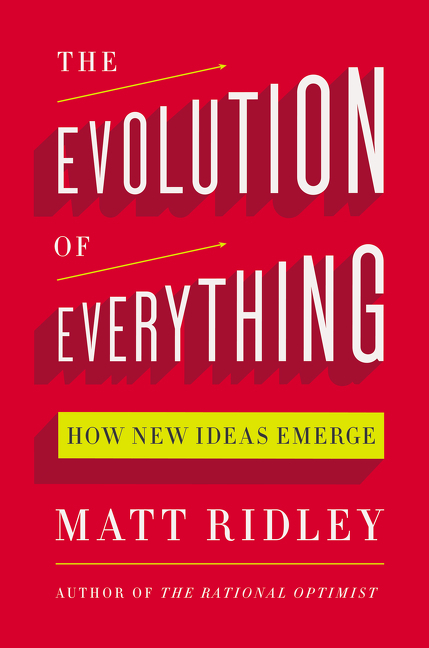
The Evolution of Everything: How New Ideas Emerge – Matt Ridley

The Evolution of Everything is about bottom-up order and its enemy, the top-down twitch—the endless fascination human beings have for design rather than evolution, for direction rather than emergence. Drawing on anecdotes from science, economics, history, politics, and philosophy, Matt Ridley’s wide-ranging, highly opinionated opus demolishes conventional assumptions that major scientific and social imperatives are dictated by those on high, whether in government, business, academia, or morality. On the contrary, our most important achievements develop from the bottom up. Patterns emerge, trends evolve. Just as skeins of geese form Vs in the sky without meaning to, and termites build mud cathedrals without architects, so brains take shape without brain-makers, learning can happen without teaching and morality changes without a plan.

Although we neglect, defy and ignore them, bottom-up trends shape the world. The growth of technology, the sanitation-driven health revolution, the quadrupling of farm yields so that more land can be released for nature—these were largely emergent phenomena, as were the Internet, the mobile phone revolution, and the rise of Asia. Ridley demolishes the arguments for design and effectively makes the case for evolution in the universe, morality, genes, the economy, culture, technology, the mind, personality, population, education, history, government, God, money, and the future.

In My Hands Today…

Remember: The Science of Memory and the Art of Forgetting – Lisa Genova

Have you ever felt a crushing wave of panic when you can’t for the life of you remember the name of that actor in the movie you saw last week, or you walk into a room only to forget why you went there in the first place? If you’re over forty, you’re probably not laughing. You might even be worried that these lapses in memory could be an early sign of Alzheimer’s or dementia. In reality, for the vast majority of us, these examples of forgetting are completely normal. Why? Because while memory is amazing, it is far from perfect. Our brains aren’t designed to remember every name we hear, plan we make, or day we experience. Just because your memory sometimes fails doesn’t mean it’s broken or succumbing to disease. Forgetting is actually part of being human.

In Remember, neuroscientist and acclaimed novelist Lisa Genova delves into how memories are made and how we retrieve them. You’ll learn whether forgotten memories are temporarily inaccessible or erased forever and why some memories are built to exist for only a few seconds (like a passcode) while others can last a lifetime (your wedding day). You’ll come to appreciate the clear distinction between normal forgetting (where you parked your car) and forgetting due to Alzheimer’s (that you own a car). And you’ll see how memory is profoundly impacted by meaning, emotion, sleep, stress, and context. Once you understand the language of memory and how it functions, its incredible strengths and maddening weaknesses, its natural vulnerabilities and potential superpowers, you can both vastly improve your ability to remember and feel less rattled when you inevitably forget. You can set educated expectations for your memory, and in doing so, create a better relationship with it. You don’t have to fear it anymore. And that can be life-changing.

In My Hands Today…

Power And Prediction: The Disruptive Economics of Artificial Intelligence – Ajay Agrawal, Joshua Gans and Avi Goldfarb

Banking and finance, pharmaceuticals, automotive, medical technology, retail. Artificial intelligence (AI) has made its way into many industries around the world. But the truth is, it has just begun its odyssey toward cheaper, better, and faster predictions to drive strategic business decisions–powering and accelerating business. When prediction is taken to the max, industries transform. The disruption that comes with such transformation is yet to be felt–but it is coming.

How do businesses prepare? In their bestselling first book, Prediction Machines, eminent economists Ajay Agrawal, Joshua Gans, and Avi Goldfarb explained the simple yet game-changing economics of AI. Now, in Power and Prediction, they go further to reveal AI as a prediction technology directly impacting decision-making and to teach businesses how to identify disruptive opportunities and threats resulting from AI. Their exhaustive study of new developments in artificial intelligence and the past history of how technologies have disrupted industries highlights the striking phase we are now in: after witnessing the power of this new technology and before its widespread adoption–what they call “the Between Times.” While there continue to be important opportunities for businesses, there are also threats of disruption. As prediction machines improve, old ways of doing things will be upended. Also, the process by which AI filters into the many systems involved in application is very uneven. That process will have winners and losers. How can businesses leverage, or protect, their positions?

Filled with illuminating insights, rich examples, and practical advice, Power and Prediction is the must-read guide for any business leader or policy maker on how to make the coming AI disruptions work for you rather than against you.