In My Hands Today…

Why I am a Hindu – Shashi Tharoor
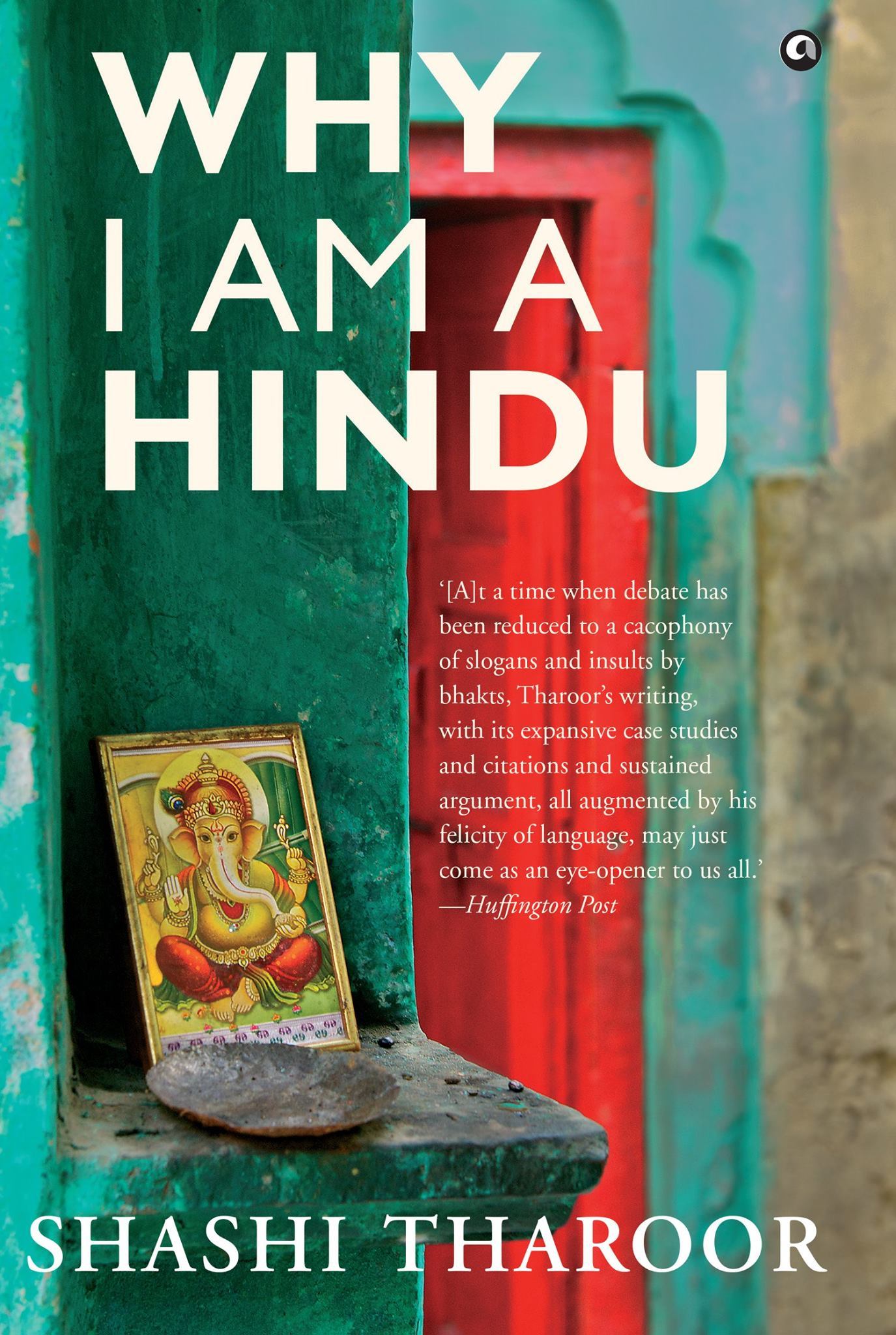
In Why I Am a Hindu, one of India’s finest public intellectuals gives us a profound book about one of the world’s oldest and greatest religions.

Starting with a close examination of his own belief in Hinduism, he ranges far and wide in his study of the faith. He talks about the Great Souls of Hinduism, Adi Shankara, Patanjali, Ramanuja, Swami Vivekananda, Ramakrishna Paramahamsa, and many others who made major contributions to the essence of Hinduism. He delves deep into Hinduism’s most important schools of thought (such as the Advaita Vedanta).

He explains, in easily accessible language, important aspects and concepts of Hindu philosophy like the Purusharthas and Bhakti, masterfully summarizes the lessons of the Gita and Vivekananda’s ecumenism, and explores with sympathy the ‘Hinduism of habit’ practised by ordinary believers.

He looks at the myriad manifestations of political Hinduism in the modern era, including violence committed in the name of the faith by right-wing organizations and their adherents. He analyzes Hindutva, explains its rise and dwells at length on the philosophy of Deen Dayal Upadhyaya, its most significant ideologue. He is unsparing in his criticism of extremist ‘bhakts’, and unequivocal in his belief that everything that makes India a great and distinctive culture and country will be imperiled if religious ‘fundamentalists’ are allowed to take the upper hand. However, he also makes the point that it is precisely because Hindus form the majority that India has survived as a plural, secular democracy.

A book that will be read and debated now and in the future, Why I Am a Hindu is a revelatory and original masterwork.

In My Hands Today…

Pax Indica: India and the World of the 21st Century – Shashi Tharoor

Indian diplomacy, a veteran told Shashi Tharoor many years ago, is like the love-making of an elephant: it is conducted at a very high level, accompanied by much bellowing, and the results are not known for two years.

In this lively, informative and insightful work, the award-winning author and parliamentarian brilliantly demonstrates how Indian diplomacy has become sprightlier since then and where it needs to focus in the world of the 21st century.

Explaining why foreign policy matters to an India focused on its own domestic transformation, Tharoor surveys Indias major international relationships in detail, evokes the countrys soft power and its global responsibilities, analyses the workings of the Ministry of External Affairs, Parliament and public opinion on the shaping of policy, and offers his thoughts on a contemporary new grand strategy for the nation, arguing that India must move beyond non-alignment to multi-alignment.

His book offers a clear-eyed vision of an India now ready to assume new global responsibility in the contemporary world. Pax Indica is another substantial achievement from one of the finest Indian authors of our times.

In My Hands Today…

An Era of Darkness: The British Empire in India – Shashi Tharoor

In 1930, the American historian and philosopher Will Durant wrote that Britain’s ‘conscious and deliberate bleeding of India… [was the] greatest crime in all history’. He was not the only one to denounce the rapacity and cruelty of British rule, and his assessment was not exaggerated. Almost thirty-five million Indians died because of acts of commission and omission by the British—in famines, epidemics, communal riots and wholesale slaughter like the reprisal killings after the 1857 War of Independence and the Amritsar massacre of 1919.

Besides the deaths of Indians, British rule impoverished India in a manner that beggars belief. When the East India Company took control of the country, in the chaos that ensued after the collapse of the Mughal empire, India’s share of world GDP was 23 per cent. When the British left it was just above 3 per cent.

The British empire in India began with the East India Company, incorporated in 1600, by royal charter of Her Majesty Queen Elizabeth I, to trade in silk, spices and other profitable Indian commodities. Within a century and a half, the Company had become a power to reckon with in India. In 1757, under the command of Robert Clive, Company forces defeated the ruling Nawab Siraj-ud-Daula of Bengal at Plassey, through a combination of superior artillery and even more superior chicanery. A few years later, the young and weakened Mughal emperor, Shah Alam II, was browbeaten into issuing an edict that replaced his own revenue officials with the Company’s representatives. Over the next several decades, the East India Company, backed by the British government, extended its control over most of India, ruling with a combination of extortion, double-dealing, and outright corruption backed by violence and superior force. This state of affairs continued until 1857, when large numbers of the Company’s Indian soldiers spearheaded the first major rebellion against colonial rule. After the rebels were defeated, the British Crown took over power and ruled the country ostensibly more benignly until 1947, when India won independence.

In this explosive book, bestselling author Shashi Tharoor reveals with acuity, impeccable research, and trademark wit, just how disastrous British rule was for India. Besides examining the many ways in which the colonizers exploited India, ranging from the drain of national resources to Britain, the destruction of the Indian textile, steel-making and shipping industries, and the negative transformation of agriculture, he demolishes the arguments of Western and Indian apologists for Empire on the supposed benefits of British rule, including democracy and political freedom, the rule of law, and the railways.

The few unarguable benefits—the English language, tea, and cricket—were never actually intended for the benefit of the colonized but introduced to serve the interests of the colonizers. Brilliantly narrated and passionately argued, An Era of Darkness will serve to correct many misconceptions about one of the most contested periods of Indian history.

In My Hands Today…

The Great Indian Novel – Shashi Tharoor

In this award-winning, internationally acclaimed novel, Tharoor has masterfully recast the 2,000 year-old epic, The Mahabharata, with fictional but highly recognizable events and characters from twentieth-century Indian politics. Chronicling the Indian struggle for freedom and independence from Great Britain, Tharoor directs his hilarious satire as much against Indian foibles as the bumbling of the British rulers.