

Somnath Temple, located in Prabhas Patan near Veraval on the western coast of Gujarat, India, is renowned as the first among the twelve sacred Jyotirlinga temples of Lord Shiva. Revered as Somnath, which means “Lord of the Moon,” the temple is intimately tied to ancient Hindu mythology and spiritual tradition. Positioned at the confluence of three rivers: Kapila, Hiran, and Saraswati, Somnath is not only a centre of profound religious significance but also a testimony to India’s enduring faith, resilience, and heritage. The temple serves as a radiant beacon for devotees seeking spiritual upliftment and a connection to the divine cosmic light that Shiva embodies.
The legends surrounding Somnath are as ancient as they are captivating, weaving together cosmic elements and divine intervention. The temple’s origins trace back mythologically to the Moon God, Soma or Chandra, who, according to legend, was cursed by his father-in-law, Daksha, for favouring his wife Rohini over his 27 other wives. This curse gradually dimmed Soma’s luminescence, threatening his celestial brilliance.
Desperate to redeem himself, Soma came to this sacred confluence, bathed in the Saraswati River, and prayed intensely to Lord Shiva for relief. Impressed by his devotion, Shiva lifted the curse, restoring Soma’s radiance, symbolising the waxing and waning moon cycles. In gratitude, the Moon God established the first temple of Lord Shiva here, dedicating it as Somnath, the protector of Soma’s lost lustre.
Another symbolic legend connects Somnath to the mythical Syamantaka jewel, associated with Lord Krishna, intertwining it with epic lore. The temple is also seen as a place where Lord Shiva manifests directly in the form of a Jyotirlinga, a column of radiant, unending light, representing the formless infinite. Devotees visit Somnath believing it to be a gateway to the divine and a powerful purifying force for the soul.
Somnath’s history is a tapestry of spiritual glory, cultural riches, repeated devastations, and resilient restoration. It is one of the earliest known Hindu pilgrimage sites, mentioned in sacred texts like the Skanda Purana and the Rigveda. Its sanctity as a Jyotirlinga dates back thousands of years.
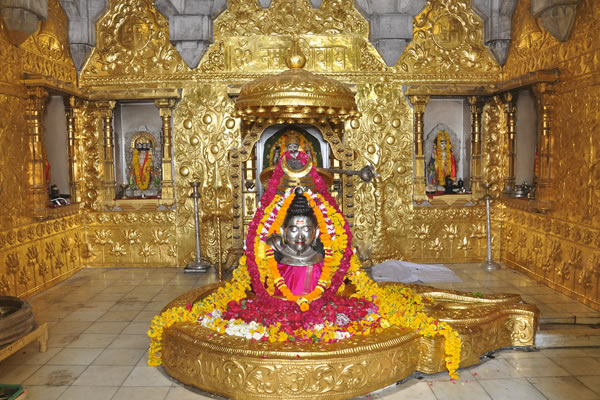
The temple site, originally called Prabhas, was visited by ancient kings, including the Gurjara-Pratihara Nagabhata II in the 9th century. The first major stone temple is believed to have been constructed or renovated by the Solanki ruler Bhima I in the 10th century. However, Somnath is no stranger to destruction. It was famously looted and demolished by Mahmud of Ghazni in 1025 AD, an event deeply etched in Indian history. Though he broke and took rich temple treasures, the temple’s sacred Jyotirlinga was said to have been protected or quickly restored by faithful custodians, and the site continued as a pilgrimage destination. Over the centuries, Somnath experienced multiple waves of destruction by invaders and periodic restorations by devout kings like the Chaulukya ruler Kumarapala in the 12th century.
In the medieval period, the temple was sacked again in 1299 by Alauddin Khalji’s forces. Yet, the resilience of Somnath is legendary, each destruction was met with reconstruction, underscoring the indomitable spirit of Hindu worshippers. The most momentous reconstruction in modern times was completed in 1951, spearheaded by Sardar Vallabhbhai Patel, India’s first Deputy Prime Minister, as a symbol of India’s unity and revival after independence.
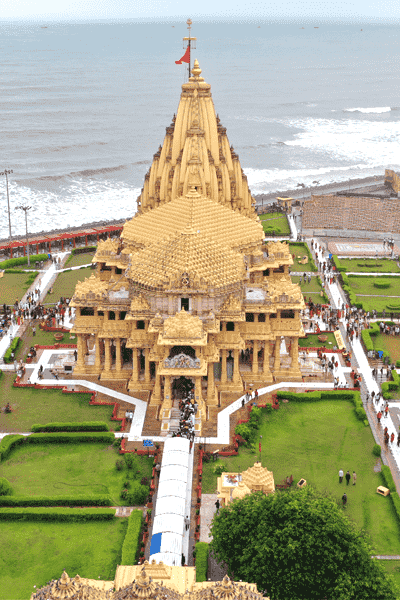
Today’s Somnath Temple blends tradition and grandeur in its architecture, reflecting the classic Chalukyan style infused with contemporary architectural revivalism. Positioned majestically on a rocky promontory overlooking the Arabian Sea, the temple’s striking silhouette is a blend of solid stonework and intricate carvings.
The temple complex is built predominantly of sandstone and marble, structured with multiple spires or shikharas that mimic the radiant cosmic pillar of light symbolised by the Jyotirlinga. Its massive walls and gateways bear sculpted depictions of Hindu deities, mythological tales, and floral motifs. The temple’s sanctum sanctorum houses the main Shiva lingam, enshrined beneath a large shikhara that draws the eyes heavenward. The temple layout adheres to traditional Hindu temple design principles, with an imposing mandapa or assembly hall leading to the garbhagriha or sanctum. The outer halls and corridors accommodate multitudes of pilgrims, emphasizing accessibility and communal worship.
The temple’s coastal location is architecturally significant, achieved by careful stone construction resistant to salt air corrosion and sea winds. The sound of the waves around the temple adds a dynamic aesthetic, enriching the spiritual atmosphere.
Beyond its spiritual and historical significance, Somnath Temple also houses a unique monument that reflects the advanced scientific and geographical knowledge of ancient India: the Baan Stambh or Arrow Pillar, which connects the temple’s sacredness with an extraordinary understanding of Earth’s geography. Dating back to approximately the 6th or 7th century CE, the pillar bears an inscription stating that if one were to draw a straight line due south from Somnath, there would be no landmass until reaching the South Pole or Antarctica. This claim: “there is no hindrance or no piece of land till the South Pole on this path”, has been confirmed by modern geographical knowledge and satellite imaging, making it a stunning testament to the advanced understanding of geography, astronomy, and Earth’s spherical nature held by ancient Indian scholars. This knowledge, inscribed centuries before the advent of modern navigation, points to a rich scientific heritage where spiritual sanctity and empirical observation coexisted. The pillar stands not only as a physical monument but as a symbol of India’s profound legacy in merging cosmic insight with earthly wisdom.

Somnath Temple’s ritual calendar is rich and vibrant, overseen by a dedicated group of priests who maintain continuous worship. Daily worship begins at dawn with the abhisheka, ceremonial bathing of the Shiva lingam with holy water, milk, honey, and bilva leaves, the sacred trifoliate leaves associated with Shiva. Devotees witness elaborate chants of the Vedas alongside the ringing of temple bells and burning of incense.
The temple celebrates all major Shiva festivals with grandeur, especially Mahashivaratri, attracting tens of thousands of devotees who vow fasting, night vigils, and special prayers to honor Shiva’s cosmic dance and benevolence. Other notable observances include Somvati Amavasya or New Moon days falling on Monday and Pradosham, days auspicious for Shiva worship.
Distinctive traditions include pilgrim offerings of coconuts, flowers, and silver bells, and the distributing of prasad or blessed food. Local communities participate actively in festival preparations, processions, and maintenance, highlighting the temple’s role as a shared spiritual and social space.
The journey to Somnath is as much a spiritual pilgrimage as a physical voyage. Located some 400 km from Ahmedabad, the temple is accessible by road, rail, and nearby airports at Diu and Rajkot. Pilgrims often combine visits with other nearby sacred sites in the Saurashtra region.
The town of Prabhas Patan around Somnath is known for its warm hospitality, with countless accommodations, eateries, and shops catering to pilgrims. The experience is enriched by the coastal ambience, sea breeze, and views of the Arabian Sea, making the temple visit soothing and contemplative. Many pilgrims recount tales of healing and peace upon arriving at the temple, reflecting its atmosphere of solemnity mingled with jubilant devotion. Local folklore includes stories of miraculous events, divine interventions, and blessings that have drawn believers for centuries.
Somnath Temple’s significance transcends religion; it has inspired literature, music, and art through ages. Praises of Somnath appear in Bhakti poetry, classical Sanskrit texts, and folk songs, celebrating Shiva’s power, the temple’s sanctity, and the heroic resilience of its custodians. The temple is a cultural symbol of Gujarat and India’s Hindu heritage, frequently invoked in nationalist narratives, especially post-independence, as an emblem of cultural integrity against adversity. Artistic depictions of Somnath adorn paintings, sculptures, and modern media, captivating visitors and devotees alike. The temple’s resilient history and spiritual aura continue to inspire performances, lectures, and pilgrim tales, contributing to the living cultural fabric of the region.
In the present day, Somnath Temple operates under the Shri Somnath Trust, which manages its maintenance, festivals, and visitor amenities. The temple is a major tourist and pilgrimage destination attracting millions annually, boosted by government initiatives to improve infrastructure and global awareness campaigns. Modern restoration efforts utilise advanced conservation techniques, blending heritage preservation with accessibility upgrades. The temple’s security and administration reflect contemporary needs while honoring traditional customs. Somnath’s festivals remain vibrant, incorporating large-scale events coupled with spiritual discourse, outreach, and cultural programs. Besides worship, the temple premises host charitable activities and community services.
The Somnath Temple stands as a luminous sentinel of India’s spiritual heritage: the first Jyotirlinga, a symbol of Shiva’s infinite light, lunar cycles, and divine resilience. Its history embodies the oscillation between destruction and spiritual revival, mirroring the eternal cycles Shiva governs. As the southern gateway of the Jyotirlinga pilgrimage circuit and a beacon for seekers of faith and renewal, Somnath not only enriches the religious landscape but also reflects the enduring cultural soul of India. Its sacred stones, rituals, and stories continue to draw pilgrims and culture lovers, ensuring that the eternal flame of Somnath shines brightly for generations to come.
 Memories and Such