
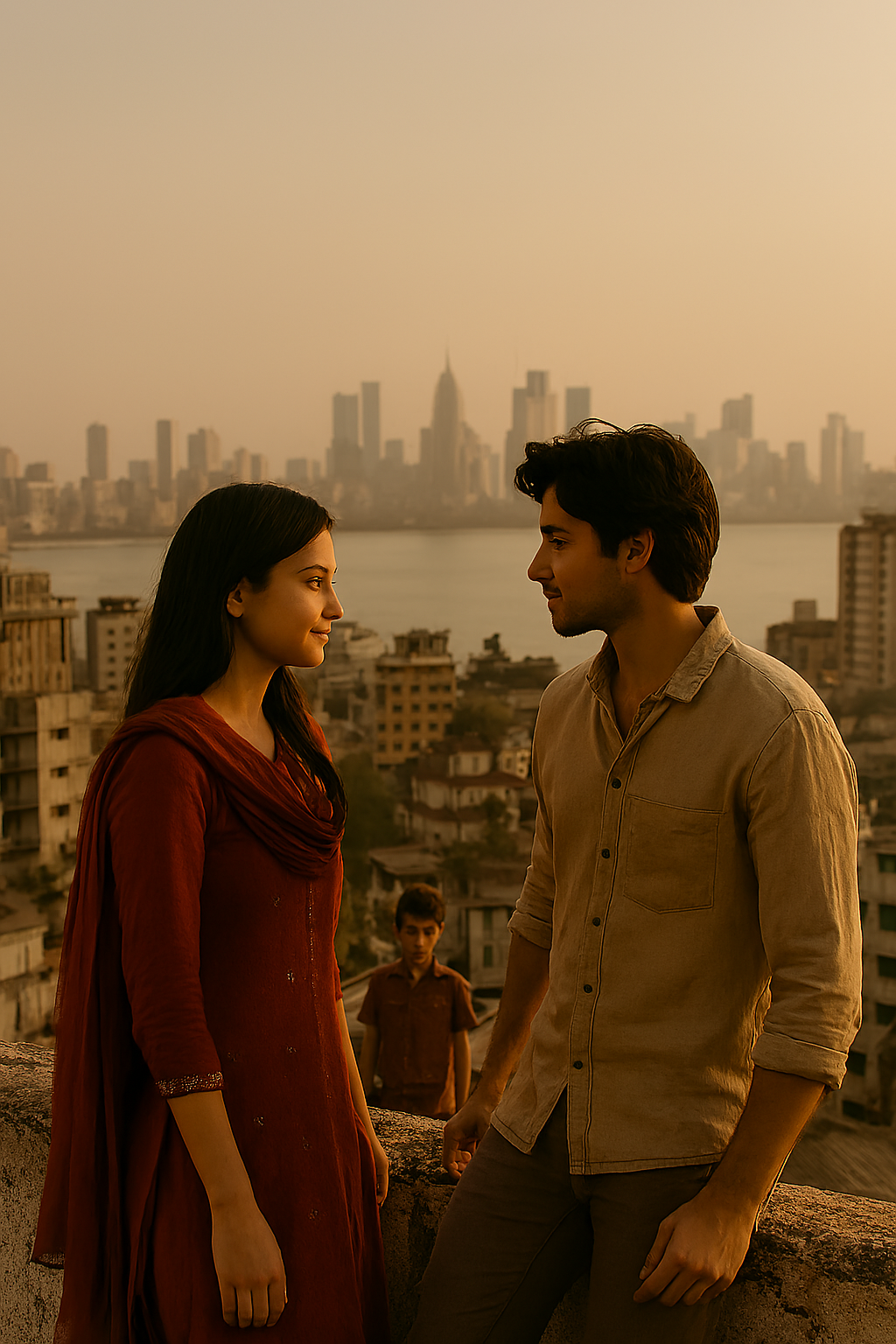
Part I – The Pune Beginning
The monsoon had washed Pune clean that July, leaving behind a city strung with dripping bougainvillaea and the faint smell of wet earth. Mira stood at the entrance of an NGO’s learning centre, clutching a folder of sketches for their new brochures. She was a freelance designer, hopping from project to project, but this assignment felt different. Here, the work was about teaching women to sell their products online, not about logos that popped.
“Are you here for the entrepreneurship class?” a man asked, stepping out of a rickshaw and shaking rain off his shoulders.
He wore a plain cotton shirt, sleeves rolled neatly, and dark trousers. There was nothing about him that shouted wealth or privilege, except perhaps the effortless confidence in his bearing.
“I’m here to design posters,” Mira replied, smiling.
“Then we’re colleagues,” he said, offering a hand. “Ari. I help with training.”
Later, she would remember that handshake: firm, warm, unhurried. As if he had all the time in the world.
Ari was unlike anyone she’d worked alongside. He wasn’t loud or self-important. He listened. He explained marketing terms to women who had never heard of a “customer base” with the same patience Mira used when teaching her nephew to read.
Sometimes, after class, they would grab cutting chai from the corner stall. Mira would complain about clients who wanted “more vibrancy” without knowing what they meant, and Ari would laugh, eyes creasing at the corners. He told her he was freelancing too; consulting for small ventures while taking time away from “family business pressures.”
She never asked further. She liked the man who turned up for chai in dusty loafers, not the ghost of whatever family weighed behind him.
By winter, friendship had melted into love. They rented a small flat near Deccan Gymkhana, its terrace peeling paint like sunburned skin. They bought second-hand chairs, quarreled over curtains, and celebrated victories as small as the landlord agreeing to fix the leaking tap.
On a Tuesday afternoon, in a registrar’s office that smelled faintly of ink and impatience, they married. Two friends signed as witnesses. Ari slid a simple silver band with two tiny leaves etched inside onto Mira’s finger. “Two lives, one stem,” he whispered, embarrassed by his own sentimentality.
Mira laughed and hugged him. It was not the wedding her mother would have wanted, nor the spectacle his background would have demanded, but it was enough.
For six months, they built a life out of late-night tea, morning rushes for the bus, and whispered promises on their small terrace. Mira never met his parents. Ari only said, “It’s complicated.” She didn’t press. Love, she thought, was proof enough.
Part II: The Accident
It happened on an ordinary evening in January. Ari had gone to meet a contact for a potential training programme. He texted her a quick *Back soon, want samosas?*
He never returned.
A lorry, swerving to avoid a motorbike, hit him at a junction. He was rushed to Sassoon General Hospital. His helmet saved his life, but a head injury left him unconscious.
When he woke the next day, the nurse asked gently, “Name?”
“Aarav Shah,” he murmured, surprising himself with the clarity.
Biometrics confirmed the match. Within hours, calls were made. By the next morning, the Shahs of Mumbai, industrialists with roots in textiles and wings in finance, had arrived. His father’s voice was steel; his mother’s eyes were damp with relief.
Aarav recognised them instantly. He remembered boarding school, Harvard lectures, and boardrooms in Nariman Point. But when the doctor asked, “Do you recall the last six months?” his brow furrowed. Blankness stretched before him like fog.
“No,” he whispered. “Only… fragments. Nothing clear.”
The Shahs didn’t correct him. They never mentioned Pune, never asked if he had a wife. To them, this was a second chance: their son had come back.
That night, while Mira waited with two cups of chai on their terrace, Aarav was driven down the expressway to Mumbai, to the world he had once tried to escape.
Part III: Mira Alone
The first days were madness. Mira called hospitals, police stations, and friends. She filed a missing person report: *Ari, no surname, about thirty, last seen near Camp.* The officer gave her a sympathetic smile. “People leave, madam. Maybe he went back to his family.”
Back to his family? What family? Ari had never said.
Weeks bled into months. Rent kept rising. Work was scarce. With a heavy heart, Mira packed their flat into boxes, slipped Ari’s ring onto a chain around her neck, and moved back with her parents in Nashik.
Eventually, she found steadier work, a job in a Mumbai agency that serviced big corporate clients. She told herself it was time to start over. Yet every night, when she unclasped her chain, she whispered into the dark: *Come back to me, Ari.*
Part IV: The Corporate Reunion
A year later, Mira sat in a glass-walled conference room in Lower Parel, nerves taut. Her agency was pitching for a massive account: Shah Group Industries. If they won, it would change everything for her career.
The door opened. Executives filed in. And then…
Her heart stopped.
Aarav Shah walked in, tall in a tailored suit, with a faint scar by his temple. He carried himself with polished authority, every inch the heir to billions.
Her Ari.
But his eyes slid past her with polite disinterest. He didn’t recognise her.
“Good morning,” he said, voice clipped. “Let’s begin.”
Mira forced herself to focus, though her hands trembled over the slides.
To her horror and secret relief, her agency won the account. She was assigned as an account manager. Which meant she would be working directly with Aarav Shah. The man who had once been her husband, now treating her like a stranger.
Part V: Working With a Stranger
The weeks that followed were agony.
In meetings, Aarav was courteous but detached. He praised her ideas when they were good, challenged them when they weren’t. To the rest of the team, it was professional respect. To Mira, it was a knife twisted daily.
Late nights in his office were the hardest. He would lean over her laptop, frown at a campaign line, and for a second, just a second, she would glimpse the man who teased her about fonts over chai. Then he would pull back, professional mask intact.
One evening, reviewing designs, she used a phrase she hadn’t spoken aloud in months: “Less glitter, more water.”
Aarav froze. His eyes flickered, unsettled. “Where did you pick that from?”
“It’s just something I say,” Mira lied quickly.
“Strange,” he murmured, shaking his head. “Feels… familiar.”
Over the next weeks, other moments surfaced. Her absent-minded humming of an old tune. The leaf motif she used in a draft campaign logo. The way she clasped her hands when thinking. Each time Aarav reacted, a flicker of recognition, quickly suppressed.
Mira, torn between hope and despair, kept silent. She couldn’t risk his scorn.
Part VI: Cracks in the Wall
The dam finally burst during a creative workshop. Mira presented a mock-up featuring a silver band with two etched leaves, repurposed as a campaign symbol for sustainability.
Aarav stared at it, blood draining from his face. He pressed his temple as if in pain. “This… I’ve seen this before.”
He left the room abruptly. Mira followed, heart pounding.
In the empty corridor, she said softly, “You have. You made it.”
He turned, eyes sharp. “What do you mean?”
She reached into her blouse, pulled out the chain, and held up the ring. “This is yours. You gave it to me when we married. In Pune. You called yourself Ari.”
The silence between them was deafening. Aarav’s gaze fixed on the ring, then on her face. Memories flooded: blurred but insistent. Rain. Chai. A small terrace. Laughter. A registrar’s stamp. Her voice whispering, *Two lives, one stem.*
His hand trembled. “Mira…”
Part VII: Truth and Confrontation
That night, Aarav confronted his parents. They sat in the sprawling Malabar Hill living room, city lights twinkling below.
“Why didn’t you tell me?” he demanded. “I was married. To Mira. I asked if there was anyone in Pune. You said no.”
His mother’s eyes glistened. “Beta, you nearly died. You remembered nothing. We thought it was a mistake, a phase…”
“A mistake?” His voice cracked. “The happiest months of my life, and you erased them?”
His father’s jaw hardened. “You are a Shah. You cannot throw away your future for—”
“For love?” Aarav shot back. “For choosing who I want to be?”
Silence fell. His mother wept quietly. His father’s face was unreadable. Aarav stood taller, voice steady. “I will not lose Mira again. She is my wife. And if the company wants me, it takes me on my terms.”
Part VIII: A Life Reclaimed
The weeks that followed were not easy. There were cold dinners, tense board meetings, and relatives whispering. But Aarav refused to back down. He carved out a new division in Shah Group, one focused on social ventures and sustainability, where his values and Mira’s creativity found a home.
Mira continued at her agency, though now she worked with him openly, no longer pretending to be a stranger. At first, colleagues gossiped, then grew used to the idea.
Slowly, even his parents softened. His mother began attending Mira’s NGO workshops, quietly proud. His father, grudgingly impressed by the profits of the new division, began to respect the marriage he had once dismissed.
Part IX: Happily Ever After
One evening, a year later, Aarav and Mira sat on the balcony of their Mumbai apartment, city lights flickering like restless fireflies. A kettle whistled in the kitchen. On the table between them lay the same ring, now firmly on her finger again.
“Do you remember everything now?” Mira asked softly.
“Not everything,” Aarav admitted. “Some days it’s foggy. But the feeling…” He reached for her hand. “The feeling never left. Even when I didn’t know your name.”
She smiled, tears glinting. “That’s enough.”
They sipped tea, the noise of Mumbai humming around them, and for a moment it felt like their Pune terrace, except higher, brighter, steadier.
Love had survived memory, class, and the weight of a dynasty. It had come back, not as glitter, but as water: steady, essential, unstoppable.
 Memories and Such