In My Hands Today…

Fear Is Just a Word: A Missing Daughter, a Violent Cartel, and a Mother’s Quest for Vengeance – Azam Ahmed
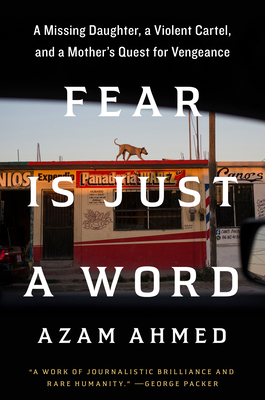
Fear Is Just a Word begins on an international bridge between Mexico and the United States, as fifty-six-year-old Miriam Rodríguez stalks one of the men she believes was involved in the murder of her daughter Karen. He is her target number eleven, a member of the drug cartel that has terrorized and controlled what was once Miriam’s quiet hometown of San Fernando, Mexico, almost one hundred miles from the U.S. border. Having dyed her hair red as a disguise, Miriam watches, waits, and then orchestrates the arrest of this man, exacting her own version of justice.

Woven into this deeply researched, moving account is the story of how cartels built their power in Mexico, escalated the use of violence, and kidnapped and murdered tens of thousands. Karen was just one of the many people who disappeared, and Miriam, a brilliant, strategic, and fearless woman, begged for help from the authorities and paid ransom money she could not afford in hopes of saving her daughter. When that failed, she decided that “fear is just a word,” and began a crusade to track down Karen’s killers and to help other victimized families in their search for justice.

What do people do when their country and the peaceful town where they have grown up become unrecognizable, suddenly places of violence and fear? Azam Ahmed takes us into the grieving of a country and a family to tell the mesmerizing story of a brave and brilliant woman determined to find out what happened to her daughter, and to see that the criminals who murdered her were punished. Fear Is Just a Word is an unforgettable and moving portrait of a woman, a town, and a country, and of what can happen when violent forces leave people to seek justice on their own.

In My Hands Today…

Anansi’s Gold: The Man Who Looted the West, Outfoxed Washington, and Swindled the World – Yepoka Yeebo

When Ghana won its independence from Britain in 1957, it instantly became a target for home-grown opportunists and rapacious Western interests determined to snatch any assets that colonialism hadn’t already stripped. A CIA-funded military junta ousted the new nation’s inspiring president, Kwame Nkrumah, then falsely accused him of hiding the country’s gold overseas.

Into this big lie stepped one of history’s most charismatic scammers, a con man to rival the trickster god Anansi. Born into poverty in Ghana and trained in the United States, John Ackah Blay-Miezah declared himself custodian of an alleged Nkrumah trust fund worth billions. You, too, could claim a piece–if only you would “invest” in Blay-Miezah’s fictitious efforts to release the equally fictitious fund. Over the 1970s and ‘80s, he and his accomplices―including Ghanaian state officials and Nixon’s former attorney general–scammed hundreds of millions of dollars out of thousands of believers. Blay-Miezah lived in luxury, deceiving Philadelphia lawyers, London financiers, and Seoul businessmen alike, all while eluding his FBI pursuers. American prosecutors called his scam “one of the most fascinating–and lucrative–in modern history.”

In Anansi’s Gold , Yepoka Yeebo chases Blay-Miezah’s ever-wilder trail and discovers, at long last, what really happened to Ghana’s missing wealth. She unfolds a riveting account of Cold War entanglements, international finance, and postcolonial betrayal, revealing how what we call “history” writes itself into being, one lie at a time.

In My Hands Today…

The Many Lives of Mama Love: A Memoir of Lying, Stealing, Writing, and Healing – Lara Love Hardin

No one expects the police to knock on the million-dollar, two-story home of the perfect cul-de-sac housewife. But soccer mom Lara Love Hardin has been hiding a shady secret: She is funding her heroin addiction by stealing her neighbors’ credit cards.

Lara is convicted of thirty-two felonies and becomes inmate S32179. She learns jail is a class system with a power structure somewhere between an adolescent sleepover party and Lord of the Flies. Furniture is made from tampon boxes, and Snickers bars are currency. But Lara quickly finds the rules and brings love and healing to her fellow inmates as she climbs the social ladder to become the “shot caller,” showing that jailhouse politics aren’t that different from the PTA meetings she used to attend.

When she’s released, she reinvents herself as a ghostwriter. Now, she’s legally co-opting other people’s identities and getting to meet Oprah, meditate with The Dalai Lama, and have dinner with Archbishop Desmond Tutu. But the shadow of her past follows her. Shame is a poison worse than heroin—there is no way to detox. She must learn to forgive herself and others, navigate life as a felon on probation, prove to herself that she is more good than bad, and much more.

In My Hands Today…

The Furies: Women, Vengeance, and Justice – Elizabeth Flock

In The Furies, Elizabeth Flock examines how three real-life women have used violence to fight back, and how views of women who defend their lives are often distorted by their depictions in media and pop culture. These three immersive narratives follow Brittany Smith, a young woman from Stevenson, Alabama, who killed a man she said raped her but was denied the protection of the Stand-Your-Ground law; Angoori Dahariya, leader of a gang in Uttar Pradesh, India, dedicated to avenging victims of domestic abuse; and Cicek Mustafa Zibo, a fighter in a thousands-strong all-female militia that battled ISIS in Syria. Each woman chose to use lethal force to gain power, safety, and freedom when the institutions meant to protect them—government, police, courts—utterly failed to do so. Each woman has been criticized for their actions by those who believe that violence is never the answer.

Through Flock’s propulsive prose and remarkable research on the ground—embedded with families, communities, and organizations in America, India, and Syria—The Furies examines, with exquisite nuance, whether the fight for women’s safety is fully possible without force. Do these women’s acts of vengeance help or hurt them, and ultimately, all women? Did they create lasting change in entrenched misogynistic and paternalistic systems? And ultimately, what would societies in which women have real power look like?

Across mythologies and throughout history, the stories of women’s lives frequently end with their bodies as sites of violence. But there are also celebrated tales of women, real and fictional, who have fought back. The novelistic accounts of these three women provoke questions about how to achieve true gender equality, and offer profound insights in the quest for answers.

In My Hands Today…

The Killer Across the Table: Unlocking the Secrets of Serial Killers and Predators with the FBI’s Original Mindhunter – John E. Douglas and Mark Olshaker

The FBI’s pioneer of criminal profiling, former special agent John Douglas, has studied and interviewed many of America’s most notorious killers—including Charles Manson, ”Son of Sam Killer” David Berkowitz and ”BTK Strangler” Dennis Rader—trained FBI agents and investigators around and the world, and helped educate the country about these deadly predators and how they operate, and has become a legend in popular culture, fictionalized in The Silence of the Lambs and the hit television shows Criminal Minds and Mindhunter.

Twenty years after his famous memoir, the man who literally wrote the book on FBI criminal profiling opens his case files once again. In this riveting work of true crime, he spotlights four of the most diabolical criminals he’s confronted, interviewed and learned from. Going deep into each man’s life and crimes, he outlines the factors that led them to murder and how he used his interrogation skills to expose their means, motives, and true evil. Like the hit Netflix show, The Killer Across the Table is centered around Douglas’ unique interrogation and profiling process. With his longtime collaborator Mark Olshaker, Douglas recounts the chilling encounters with these four killers as he experienced them—revealing for the first time his profile methods in detail.

Going step by step through his interviews, Douglas explains how he connects each killer’s crimes to the specific conversation, and contrasts these encounters with those of other deadly criminals to show what he learns from each one. In the process, he returns to other famous cases, killers and interviews that have shaped his career, describing how the knowledge he gained from those exchanges helped prepare him for these.